
Peak Oil is You

Donate Bitcoins ;-) or Paypal :-)


Page added on February 12, 2012

Three Major Journals Publish Articles on Limited World Oil Supply

In the past month, three major peer-reviewed journals have published articles relating to limited world oil supply:
- In Science, Technology is Turning U. S. Oil Around But Not the World’s, by Richard A. Kerr;
- In Nature, Climate Policy: Oil’s Tipping Point has Passed, by James Murray and David King; and
- In Energy, Oil Supply Limits and the Continuing Financial Crisis, by Gail Tverberg.
The fact that these articles have been published is significant, because articles in the mainstream press, such as Bloomberg’s recent article, Peak Oil Scare Fades as Shale Deepwater Wells Gush Crude, seem to suggest that our oil problems are past. While the US oil supply situation may be a little better, the world supply situation is still very bad, and oil prices are still very high around the world.
Furthermore, high oil prices tend to have a recessionary effect, and can lead to debt defaults. These issues are described in both the second and third articles above. Thus, there is a substantial chance that high oil prices are contributing to the debt default problem in Europe, and to forecast low world economic growth.
In this post, I briefly describe these articles.
In Science, Technology is Turning U. S. Oil Around But Not the World’s, by Richard A. Kerr
This article points out that even the optimistic estimates, such as BP’s recent Energy Outlook to 2030, see little growth in non-OPEC conventional oil production between now and 2030 (Figure 1).
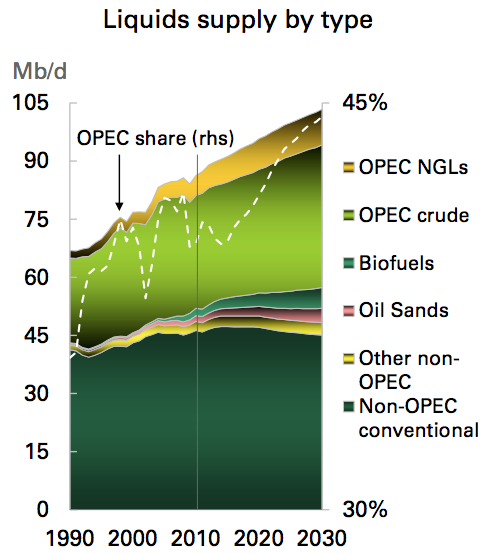 Figure 1. BP oil forecast to 2030, from BP Energy Outlook to 2030
We are thus dependent on growth in OPEC crude oil and in OPEC natural gas liquids, neither of which is assured, given political uncertainties in the Middle East. While technology advances are making possible some new US oil production, this growth is needed to offset declines in existing fields around the world. There is a great temptation by those using new technology to make forecasts using an “overabundance of optimism.” History shows that US oil production has mostly fallen since 1970 (Figure 2).
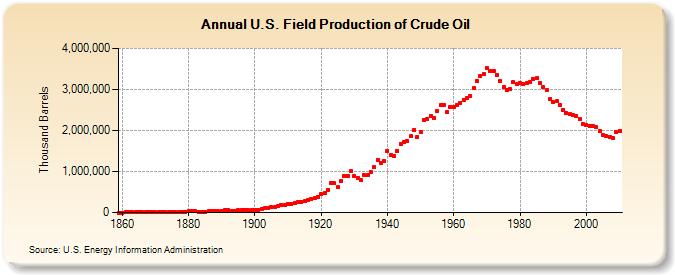 Figure 2. History of US production of crude oil, in figure created by EIA (similar to, but not the same as, figure shown Science article).
In Nature, Climate Policy: Oil’s Tipping Point has Passed, by James Murray and David King
According to the authors:
There is less fossil-fuel production available to us than many people believe. From 2005 onwards, conventional crude-oil production has not risen to match increasing demand. We argue that the oil market has tipped into a new state, similar to a phase transition in physics: production is now ‘inelastic’, unable to respond to rising demand, and this is leading to wild price swings. Other fossil-fuel resources don’t seem capable of making up the difference.
Such major spikes in fuel price can cause economic crises, and contributed to the one the world is recovering from now. The future economy is unlikely to be able to bear what oil prices have in store. Only by moving away from fossil fuels can we both ensure a more robust economic outlook and address the challenges of climate change. This will be a decades-long transformation that needs to start immediately.
The article talks about how high oil prices erode family budgets, and points out that it seems likely that it wasn’t just the ‘credit crunch’ that triggered the 2008 recession. The oil price crunch was also involved.
A call-out from the article summarizes a current problem:
The price of oil is likely to have been a contributor to the euro crisis in southern Europe.
In Energy, Oil Supply Limits and the Continuing Financial Crisis, by Gail Tverberg
This is an article I wrote in early 2011, that wasn’t officially published until January 2012. The article can temporarily be downloaded free, as the fifth item down on this list of articles from the January issue.
In this article, I explain why one would expect high oil prices to cause economic disruptions of many types. If consumers are spending more on high-priced oil (and high-priced food, because both costs tend to rise together), they will cut back on discretionary expenditures, such as going out to restaurants and taking vacations and buying new cars. Workers in affected industries will be laid off.
There will also be indirect impacts. People who have been laid off from work will tend to default on their loans, as will people who are living paycheck to paycheck and find that the cost of commuting has rising, and the cost of food has also risen. Holders of sub-prime mortgages will be disproportionately represented in the group of those with defaults, since they were among the least qualified loan applicants.
High oil prices can also be expect to affect housing prices. In part, this occurs because people who spend more on necessities (commuting and food) are less likely to want to buy a move-up home. As a result, there will be a cut-back in demand for homes, and thus in resale prices. Also, at the time that oil prices rose in the 2004-2006 period, the Federal Reserve raised interest rates in an attempt to try to bring oil prices back down. These higher interest rates also tended to reduce demand for move-up homes. I also show that the timing in the drop in US home values matches with what a person would expect, if it were high oil prices, and actions taken by the Federal Reserve in response to high oil prices, that were really behind the drop in home prices.
7 Comments on "Three Major Journals Publish Articles on Limited World Oil Supply"
cusano on Sun, 12th Feb 2012 5:19 pm
The evidence continues to mount that our future dependence on fossil fuels is going to get quite rocky. Unfortunately, people want to believe that we have 100 years of natural gas, we’re awash in oil, and because of new technology, our problems are pretty much over. We need more truthful articles like those above.
Kenz300 on Sun, 12th Feb 2012 6:30 pm
The oil and coal industries want us to believe that supply is no problem. Price spikes bring in windfall profits and they love it. They do not want individuals, businesses and politicians to wake up to the problem and begin looking for solutions.
Gale Whitaker on Sun, 12th Feb 2012 7:47 pm
Gasoline prices are the highest they have ever been for this time of year. That is really good news because it will sway people to make better decisions about where to live and which cars to select. I will mean that more people will be riding the bus or bicycling to work. It might ever go some distance to convincing non-believers that P.O. is real.
Kenz300 on Sun, 12th Feb 2012 10:37 pm
Republicans have voted against mass transit and bicycle paths in the transportation bill. They like it when we have no options except to pay more at the pump. They do not bother to hide their connection to oil companies anymore.
MrEnergyCzar on Mon, 13th Feb 2012 12:39 am
The unprepared masses will be forced to make limited desperate changes to the way they live…. change the way you live now, it’s still possible..
MrEnergyCzar
BillT on Mon, 13th Feb 2012 1:28 am
A gradual move to higher prices for fuels would force change. Say $1 per gallon per year. Even the deniers would take note and make changes in their use.
jaime on Mon, 13th Feb 2012 3:11 pm
when you walk towards a cliff you don’t see it,till you are off the cliff. ”ah a masterpiece”.