
Peak Oil is You

Donate Bitcoins ;-) or Paypal :-)


Page added on January 13, 2014

The Rumored Death of Peak Oil Was Greatly Exaggerated

From Earth Insight by Nafeez Ahmed, hosted by the Guardian, Former BP geologist: peak oil is here and it will ‘break economies’:
Dr. Richard G. Miller, who worked for BP from 1985 before retiring in 2008, said that official data from the International Energy Agency (IEA), US Energy Information Administration (EIA), International Monetary Fund (IMF), among other sources, showed that conventional oil had most likely peaked around 2008.
Dr. Miller critiqued the official industry line that global reserves will last 53 years at current rates of consumption, pointing out that “peaking is the result of declining production rates, not declining reserves.” Despite new discoveries and increasing reliance on unconventional oil and gas, 37 countries are already post-peak, and global oil production is declining at about 4.1% per year, or 3.5 million barrels a day (b/d) per year:
“We need new production equal to a new Saudi Arabia every 3 to 4 years to maintain and grow supply… New discoveries have not matched consumption since 1986. We are drawing down on our reserves, even though reserves are apparently climbing every year. Reserves are growing due to better technology in old fields, raising the amount we can recover – but production is still falling at 4.1% p.a. [per annum].”
Wait a Minute, I Thought the Peak Oil Theory Was Debunked!
 Big Oil has, of course, worked hard on spinning the peak oil argument. After all, if we cannot count on the availability of petroleum as an energy source, then that creates an obvious coalition of interest between those concerned with climate change, who argue for investing in alternatives to CO2 emitting energy sources, and those who are simply concerned with securing a long term energy supply for their economic activities … which can be secured by investing in alternatives to CO2 emitting energy sources.
Propagandizing the impression that the “Peak Oil” argument has been debunked is therefore an essential political wedge action by Big Oil, preventing that natural coalition of interest from coming together.
Of course, when engaged in a well-financed spin campaign, what one does is take all the arguments one can find, based on whatever partial or misrepresented evidence one can muster, and send them through focus groups to find the arguments that appear to be most effective. And then put them out there in as many channels as required, including direct issues advertising, various propaganda mills willing to reach a conclusion for hire, and by giving both money and messaging support to politicians available for lease in both the Republican and Democratic party.
Dr. Miller punctures a key talking point here: growing reserves prove that the “Peak Oil” hypothesis was wrong.
The Peak Oil hypothesis is based on the fact that new discoveries are lagging behind depletion of existing fields, so that given the normal production profile of an oil field, a certain time after the peak of new discoveries, we will arrive at the peak of new production. And, as Dr, Miller reminds us, the growth in reserves is not due to new discoveries outpacing consumption … it is due to new production techniques that are more effective at extending the production lifespan of existing oil fields and recovering more of the petroleum contained in the field.
Now, slowing the rate of decline and postponing the retiring of existing oil fields could defer a production peak … if new discoveries were being made and exploited rapidly enough to bridge the now smaller decline in what the existing fields are producing. That plausibility may well be part of why this talking point would have done well in focus groups.
But according to Dr. Miller, the actual facts on the ground are that new production of conventional oil coming on stream is not outpacing the declines in production in existing fields. And so, plausible or not, that link between increasing reserves and increasing total production just is not happening.
Shift the Goal Posts: Change The Object of Discussion
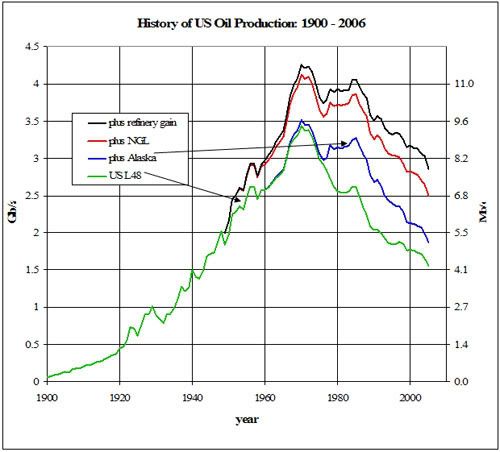 Another element of the messaging strategy that I have seen coming from, among other sources, the current administration, is to shift the topic of the conversation from the actual target of the Peak Oil hypothesis, which is directed toward conventional oil production, so start talking about “liquid supply”. As Dr. Miller notes in this article, conventional oil production has been flat, with all increases in supply coming from natural gas liquids and oil-sand bitumen.
But conventional oil is still the largest component of that “liquid fuels” production. Changing the focus of the political debate does not, in fact, do anything to change the predictive power of the Peak Oil hypothesis. And that means that we can still expect conventional oil production to begin to decline on a world wide basis just as they have been lower (and except for a few years when production from the North Slope of Alaska increased the total, declining) than our domestic peak in 1958 … first relatively slowly, and then more rapidly. And just as with the US, there may be production breakthroughs that temporarily halt or slow the decline, but since those gains are standing on top of a sinking foundation, they are unlikely to bring us back to the original peak.
As we slide down the steepest part of the downward production decline, the production of natural gas liquids ~ ethane, propane, butane, pentane ~ can only partially compensate, since they are no perfect substitutes for petroleum. And as we slide down the steepest part of the downward production decline, a major factor determining the volume of liguid fuel supplies other than conventional oil will be the price that can be extracted.
So for petroleum dependent economies, the “good news” of non-conventional replacements for what will sooner or later be rapidly declining conventional oil production is that there may be some price that is painfully high enough so that the combination of increased production of non-conventional liquid fuels and the economic slowdown due to the liquid fuel price shock will avoid a supply shock.
Of course, that price includes not just the financial cost ~ we have, after all, not quite reached the level of total employment we had at the time of the last oil price shock when crude oil prices reached $150/barrel (which is about $3.60 barrel for the raw material cost, so in excess of $4 after refining and distribution) ~ but also the ecological cost, in particular the fact that we cannot afford to burn a majority of the reserves of all carbon-based fuels in existence, and the more coal and oil-sand bitumen we consume, the less energy we can extract within our rapidly dwindling carbon emissions budget.
This is, of course, not the way that the Big Oil messaging wishes you to understand this “good news”: “hurray, we have alternative sources of carbon emitting energy which will allow us to avoid a complete lack of supply, at the cost of economic slowdown in the medium term and collapse of industrial civilization over the longer term” is not about to be the topic of a new series of “Energy Happy Talk” advertising from Shell or BP.
“I heard that there was a whole lot of XYZ being discovered/exploited”
 Another part of Big Oil’s messaging is “did you hear about this new discovery, the equivalent of big-sounding-numbers}’s of oil? This exploits the public’s difficulty in understanding quantities at the scale of millions and billions, and lack of background context as far as how much we are currently using, and how much we need innew daily production to just keep up with the decline in production from old big fields that are long past their prime.
Dr. Miller puts some of these into context for us, not just in that quote above, were the annual production decline of 4.1% is highlighted, but also with respect to the “shale oil” bonanza:
Although he is dismissive of shale oil and gas’ capacity to prevent a peak and subsequent long decline in global oil production, Miller recognises that there is still some leeway that could bring significant, if temporary dividends for US economic growth – though only as “a relatively short-lived phenomenon”:
“We’re like a cage of lab rats that have eaten all the cornflakes and discovered that you can eat the cardboard packets too. Yes, we can, but… Tight oil may reach 5 or even 6 million b/d in the US, which will hugely help the US economy, along with shale gas. Shale resources, though, are inappropriate for more densely populated countries like the UK, because the industrialization of the countryside affects far more people (with far less access to alternative natural space), and the economic benefits are spread more thinly across more people. Tight oil production in the US is likely to peak before 2020. There absolutely will not be enough tight oil production to replace the US’ current 9 million b/d of imports.”
We cannot get to energy independence on the back of shale-oil production, which is likely to peak at 2/3 of current imports … and even if we could, shale-oil production is not like conventional oil production:
“Greater reliance upon tight oil resources produced using hydraulic fracturing will exacerbate any rising trend in global average decline rates, since these wells have no plateau and decline extremely fast – for example, by 90% or more in the first 5 years.”
So if we elect to go pedal to the metal in shale-oil production, when it in turn peaks, the rate of decline in production will be even more rapid than the rate of decline in conventional oil production, which will itself be accelerating by 2020.
Peak Oil Is Real. In All Likelihood, the Peak is In Our Rear View Mirror
 In less than a decade, the floor falls out from under the whole petroleum-addiction economic system, even if we scrape the bottom of the barrel with shale-oil production as aggressively as we can. And meanwhile, the flood of money from shale-oil production will continue to flow into our political system over the political cycles between now and then, helping to elect representatives willing to sell out their constituents future for a small piece of that money, sheltered by the convenient fictions crafted by the Big Oil messaging machine.
Indeed, the odds are quite high that both candidates in the next Presidential General Election will be at least partly bought and paid for by petroleum-pusher money, to continue the petroleum-pusher policies of the Reagan, George HW Bush, Clinton, George W Bush and Obama administrations.
That suggests to me that those of use who do not wish to see the US economy placed in the rack of oil price shocks in the 20′s followed by our collapse as an industrial economy under the weight of climate chaos by the 50′s or 60′s have to focus below the level of Presidential politics, at the Congressional level and further down into the State Legislatures, Municipal and County governments with zoning authority and, yes, local School Boards to stand up against already-established Big-Oil funded efforts to spread their propaganda among our children.
38 Comments on "The Rumored Death of Peak Oil Was Greatly Exaggerated"
Meld on Mon, 13th Jan 2014 11:55 am
I love it when people say the peak oil theory is “debunked” It shows such utter and total stupidity in the person who says it that one can’t help but laugh out loud.
It’s along the same lines as saying the theory of gravity is debunked because you jumped in the air.
Davey, Hermann, MO on Mon, 13th Jan 2014 12:41 pm
The very fact that there is a desperate attempt to down play peak oil shows the truth can’t be covered up, distorted, and denied. I am a proponent of a coming collapse due to systematic risk reasons. The financial system and peak oil will be the likely drivers as far as the radar screen shows at the moment. Sometimes I wonder if it would be better if the peak oil phenomenon would not gain widespread acceptance. Loss of confidence for any reason is dangerous to our fragile global system. Living in a delocalized local means none of us can afford a breakdown in a system that supports us all. There is little left to support us locally without the global component. Yet, even if the public starts to accept this concept I doubt there will be much of a stir. The blind optimistic belief in technology and progress will continue to comfort any fears. I do not like the idea of blissful stupidity but I need and other need a few more years to plan, organize, and implement life boats and alternative arrangements. This is while the global system generated resources and facilitates capital for these endeavors.
Arthur on Mon, 13th Jan 2014 12:45 pm
It is maybe not the most diplomatic thing to say on a forum named after peak oil, but the term ‘peak oil’ is confusing if not useless and distracts from the real issue. What is really interesting namely is ‘peak fossil’ (oil + gas + coal + methane hydrates), that is the date of the maximal thermal units produced, since all these sources are largely interchangeable in their application. You can for instance even transport coal via a pipeline.
http://en.wikipedia.org/wiki/Coal_pipeline
GregT on Mon, 13th Jan 2014 2:20 pm
We have already reached, and passed, peak oil. Peak natural gas, coal, unconventional oil, and yes, even methane hydrates will come soon enough.
The real concern should be, when we will pass peak Earth? The point where we so badly screw up the environment that those they do survive will wish they hadn’t. I maintain, that peak Earth is coming sooner than most would like to think.
Continuing to burn the remaining fossil fuels at our disposal is not only irresponsible, it is downright idiotic.
paulo1 on Mon, 13th Jan 2014 2:37 pm
re: Davey Herman MO:
“but I need and other need a few more years to plan, organize, and implement life boats and alternative arrangements. This is while the global system generated resources and facilitates capital for these endeavors.”
Very sensible outlook,imho. I followed a similar path and even retired early to work on ‘the place’ which I expect my children will need and use one day. However, I would like to say that I am getting damned nervous about it all. I don’t see any possibility of some kind of change that will allow the juggling to continue much longer. Some days I am afraid, but quickly get on with living. I am building furniture these days that will endure and be handed down. I expect we will all be poorer as the days unfold. The 2020s aren’t that far away, are they it? I just hope I can still get gas for my chainsaw. I don’t relish the idea of putting up wood with crosscuts as I get into my golden years.
regards…Paulo
ghung on Mon, 13th Jan 2014 2:40 pm
@Arthur: “…all these sources are largely interchangeable…”
Largely not. Alternatives to liquid petroleum are ‘largely’ committed to other processes, and the global transportation systems are ‘largely’ committed to running on liquid petroleum. It’s ‘largely’ a problem of scale, and the resources needed to reinvest in alternatives to oil use. One doesn’t simply flip a switch.
poaecdotcom on Mon, 13th Jan 2014 3:30 pm
“followed by our collapse as an industrial economy under the weight of climate chaos by the 50′s or 60′s”
Does he really mean 2050’s & 60s? He states that “In All Likelihood, the Peak is In Our Rear View Mirror” and yet assumes that we will sputter along for 40+ years?
Our financial system leverages GROWING net energy. As soon as net energy stops growing, the REAL economy stops growing and we cannot service our debt, ergo immanent deflationary collapse.
My guess is this will play out in months not decades.
Northwest Resident on Mon, 13th Jan 2014 3:37 pm
The author of this article mentions “carbon budget” — and points out that we can’t burn all (or anywhere close to) the fossil fuels that are still in the ground without committing ecological suicide. So, talk of converting to natural gas, or finding ways to run BAU on the junk fossil fuel that is still left in the ground is pointless.
Question: If you were one of “the elites”, and you realized that the environment that supports you and your descendants was being damaged so badly by BAU that it was nearing the tipping point of no return, what would you do? Even better question: If you are a top U.S. Military commander and you recognize that the security and preservation of the country you are sworn to defend will be destroyed by climate change events IF BAU is allowed to continue, what would you do?
Behind the curtain of BAU there are powerful forces moving, positioning, preparing. This façade cannot continue much longer. “I need and others need a few more years to plan”. Don’t count on it.
adamc18 on Mon, 13th Jan 2014 3:42 pm
Talk of methane hydrates immediately brings to mind the utterly unprecedented release of sub-sea methane taking place NOW – January 2014 – from the Arctic Ocean as the region experiences temperature anomalies of up to 20C. Take a look at Arctic-news blogspot -today!
GregT on Mon, 13th Jan 2014 4:04 pm
@paulo,
“I followed a similar path and even retired early to work on ‘the place’ which I expect my children will need and use one day.”
Sounds like your plan is very much like ours. You are a bit ahead of us though. We already have seeds planted in NVI, and are pulling the plug when the wife turns 55. That would be early in 2015. Somehow, I think things will drag out a bit longer than I initially thought, at least I hope they will.
GregT on Mon, 13th Jan 2014 4:27 pm
adamc18,
The entire continent of North America is experiencing large temperature anomalies. Watched the jet stream lately? Maybe it would be a good idea to listen to some of our scientists. What they are trying to tell us is no where near as pessimistic, as the consequences will be, if we continue to ignore them.
Davey, Hermann, MO on Mon, 13th Jan 2014 4:33 pm
@Paulo & GregT, I feel that it is those of us who are resigned to a collapse as the mature ones of this limits of growth, peak oil, and financial crisis movement. We are in our 50’s and have lived the good life through our prime. As we experience loss of mind and body we accept the inevitable easier than those that are younger. I like you @Paulo worry about my chainsaw gas. I did buy a crosscut saw and felling axe. I wonder how long society will limp on. I keep saying 9 years or less. I hope this collapse is mild. We need a collapse sooner than later to relive the pressure and maybe a contraction will be less severe. I personally need 4 years more to get my cattle farm on its feet and my stash of survival gear built up. If the collapse does not come for year I still will be able to leave my kids something like you mention GregT. I see little possibility of a collapse not happening eventually if for no other reason then catastrophic climate change, over population, resource depletion, and God knows what else (black swan event).
Nony on Mon, 13th Jan 2014 5:09 pm
“Peak gas” seems to have taken a pretty serious bullet to the head. 😉
Northwest Resident on Mon, 13th Jan 2014 6:19 pm
We have now entered into a period of “Peak Hot Air”, where politicians and industry leaders are pumping giga-tons of hot air into the atmosphere to deny “peak oil” and assure us that all is well, if only we will go shopping and keep our investment dollars in energy extraction.
Dave Thompson on Mon, 13th Jan 2014 6:35 pm
Last week it was -13 here in the Chicago land I dwell, oh the cries and laughter of global warming? Duh! Now it is well above 45 the sun is shining the ground is mushy the snow almost all gone. Global warming? Duh indeed.
rockman on Mon, 13th Jan 2014 6:44 pm
Nony – Peak gas hasn’t taken a hit to head because it has never existed until it started showing up recently. I’ve been working in the oil patch for 39 years and have never seen the concept brought up until recently by some folks who seem to confuse PO with PNG. We are producing more NG today than ever before. We did have a lower peak in the mid 70’s that has followed by plateau for about 25 years. Like all other commodities the production of NG is controlled by a combination of geology and prices.
After my company began 4 years ago we participated in $400 million in drilling activity focusing on NG because the price got right. And since NG prices have collapsed we have spent exactly $0 drilling for NG. But I have dozens of NG prospects ready to drill…as soon as prices get high enough. So it’s similar to oil in one aspect: increased prices bring about increase production. The obvious difference is that we’ve been able to reach new record levels on NG today but haven’t gotten to the point with oil in the US. Maybe we’ll reach a new US oil peak down the road…maybe not.
Maybe the current NG record production levels will be PNG. Or maybe when NG prices eventually rise we’ll be producing even more than the current level. In either case PNG will only be seen in the rearview mirror and we don’t see it today.
Arthur on Mon, 13th Jan 2014 8:08 pm
Largely not. Alternatives to liquid petroleum are ‘largely’ committed to other processes, and the global transportation systems are ‘largely’ committed to running on liquid petroleum. It’s ‘largely’ a problem of scale, and the resources needed to reinvest in alternatives to oil use. One doesn’t simply flip a switch.
Converting a normal car to NG costs 500-3000 euro. If it can be done for a car, it can be done for a bus or truck.
In Arnhem/Netherlands for instance 218 busses are driving on NG. I am sure you have them everywhere on the planet.
http://www.verkeersnet.nl/8441/schoonste-bus-rijdt-op-groen-gas/
So what do you mean ‘committed’?
Northwest Resident on Mon, 13th Jan 2014 8:27 pm
Arthur — “The number of cars on the world’s roads surpassed one billion last year, according to a study that has spurred debate on what the rapidly-growing car population will mean for the world’s economy and environment.
According to a report from Ward’s Auto released last week, the global number of cars exceeded 1.015 billion in 2010, jumping from from 980 million the year before.”
Have you given any thought to how long all known and as-yet-to-be-discovered NG sources will last if we convert transportation to NG? A year or two, maybe???
And let’s consider how much standard oil and coal would be required to power the machinery and transportation that would be required to produce a billion-or-so NG conversion kits.
The idea that NG is going to keep BAU going and happy motoring fueled up into the future is a fantasy, if you ask me.
rockman on Mon, 13th Jan 2014 8:38 pm
NR – And then there’s that inevitable chasing your tale hoping you never catch it phenomenon. Justify (if it can even be done in the first place) swapping to NG fueled vehicles based on current prices, demand shoots up followed by higher NG prices and the justification disappears. And even if the public swallows the Kool-aid it would require companies to spend the $trillions to build the vehicles and the refueling stations. And I suspect they understand the risks better than anyone.
Public transit and commercial fleets…maybe. But if they expand enough they may run into the same economics brick wall.
Meld on Mon, 13th Jan 2014 8:39 pm
Arthur, the peak oilers who have been around longer than 10 years have heard all the arguments before and we’ve seen nothing come of them. We watched as conventional fossil fuels peaked at the exact date that it was calculated, and then we watched the economic fallout that had been predicted happen exactly as planned. No amount of wishful thinking or optimism or a can do attitude is going to change a physical law.
We’ve watched as the exact things we predicted happened on cue with the exact results we predicted and STILL we have to put up with daily articles about how peak oil is debunked and that solar panels, wind farms, LENR and Fusion is just around the corner. You are but one more of the cheerful voices that will soon “get it” quit your bargaining and get onto changing things in your locality to weather the coming storm.
ghung on Mon, 13th Jan 2014 9:58 pm
@ Arthur: “So what do you mean ‘committed’?”
As in ‘committed’ uncountable capital and resources to the current global liquid petroleum transportation system. AS NR mentions above, 1.015 billion cars and counting; seems like quite a commitment to me.
Of course, our looming liquid fuels problem is just one of a plethora of virtually unsolvable predicaments that will be competing for the same resources in the next couple of decades, along with about a billion more humans. Then again, we’re pretty clever creatures, as we’ve proven so far. How’s that ‘sapience’ thing going BTW 😉
dsula on Mon, 13th Jan 2014 10:53 pm
Cars have a lifetime of what? 10 or 15 years? So the complete fleet of 1B vehicles can be replaced and made NG capable within let’s say 20 years without additional costs.
Northwest Resident on Mon, 13th Jan 2014 11:13 pm
“So the complete fleet of 1B vehicles can be replaced and made NG capable within let’s say 20 years without additional costs.”
“You can lead a horse to water, but you can’t make it drink.”
James A. Hellams on Tue, 14th Jan 2014 2:00 am
To those of you who think NG can replace oil as a transportation fuel, I suggest you do the following calculations. Divide the thermal content of NG (1,000 BTUs) into the thermal content (in BTUs) of a gallon of gasoline, diesel fuel, and aviation fuel.
Next, find out the number of billions of gallons of the above fuels (worldwide) are used every year, and multiply the number of cubic feet of NG by theses billions of gallons of fuel above; and you will find out how many trillions or quadrillions of cubic feet of NG would be required to replace the consumption of the above fuels.
Add the above NG consumption to the already existing consumption of NG.
The above exercise will convince you of how poor NG is at being a transportation fuel alternative.
Makati1 on Tue, 14th Jan 2014 2:22 am
BAU is not anywhere near possible in our future. Contraction until we hit a level we can sustain (pre-carbon levels) may be possible … if there are no real wars, the climate allows it, no plagues ravage the planet, and we lose about six billion people in the next decade or so. What are the chances?
Slim to none. Prepare for the worse and be thankful if it stops at any level above that!
rollin on Tue, 14th Jan 2014 2:24 am
“But according to Dr. Miller, the actual facts on the ground are that new production of conventional oil coming on stream is not outpacing the declines in production in existing fields.”
At 2% decline rate (discover and drill at half the rate of decline) we should be over 18% below the rate of production we had ten years ago. I have read that discovery is far less than half. Things are not adding up here.
I can only believe the results, we are plateaued and discovery plus unconventional has to equal the decline rate of fields.
Tom S on Tue, 14th Jan 2014 4:04 am
Meld:
“Arthur, the peak oilers who have been around longer than 10 years have heard all the arguments before… We watched as conventional fossil fuels peaked at the exact date that it was calculated, and then we watched the economic fallout that had been predicted happen exactly as planned.”
What? Peak oilers got almost all of their predictions wrong! Every single peak oil prediction from Colin Campbell, Deffeyes, etc, showed oil peaking in the mid-2000s and then declining almost immediately thereafter at 2-4% per year. By now, those projections of future world oil production are off by a wide margin. Also, peak oilers insisted that KSA was in terminal decline in the mid-to-late 2000s (such as in the book “Twilight in the Desert”). Furthermore, they claimed that unconventional sources of oil would make little difference and would not delay the decline; they produced projections of “all liquids” which showed almost immediate declines in the mid-to-late 2000s.
Absolutely nobody within the peak oil movement was expecting a decades-long plateau of conventional oil, increasing production from KSA and FSU, and increasing production in the USA from fracking.
Also, peak oilers produced a considerable number of projections regarding peak gas. For awhile, they seriously discussed renaming ASPO to “Association for the study of Peak Oil and Gas”. They issued repeated predictions of peak gas in the mid-to-late 2000s, including Simmons’ famous “natural gas cliff”. Also, Hubbert’s original paper in 1956 included not just predictions of peak oil, but also of peak gas.
The predictions of future gas production have been very inaccurate.
“then we watched the economic fallout that had been predicted happen exactly as planned.”
What? The “economic fallout” which they were anticipating in the mid-2000s was the speedy collapse of industrial civilization, the end of international trade, permanent electrical blackouts by 2010 (“Olduvai Gorge”), relocalization, catastrophic “feedback loops”, interruptions in the food supply, “powerdown”, massive planetary die-off (die-off.org), and so on. What they predicted certainly has not occurred.
Furthermore, the economic forecasters among peak oilers (such as Nicole Foss) have disastrous track records of prediction.
Granted, other people have made mistakes about future oil production too. Lynch’s and Yergin’s predictions about galloping increases in production, and continued low prices, were also quite wrong.
However, I just don’t see how you can claim that peak oilers’ predictions have been just right.
-Tom S
GregT on Tue, 14th Jan 2014 5:37 am
” Things are not adding up here.”
That’s because unconventionals have been lumped in with conventionals. Apples and oranges. What does add up is the effect on the price we pay at the pump, and the impact on our economies.
Arthur on Tue, 14th Jan 2014 7:47 am
To Meld, NR, ghung and others,
I am NOT advocating that 1 billion cars are going to be made fit for driving on NG. I am an adherent of peak oil ever since 1972, when the report Limits to Growth came out. The issue here is the timing of the end of the fossil fuel age and that point in time is going to be much further into the future than most of us until recently thought possible. You only have to look at Greece, where in the past few years car usage/ownership has been decimated, not for geological, but for economic/financial reasons. It won’t be long until there will be many more Greece’s… the US as one of them comes to mind… slashing global fuel consumption significantly, postponing the geological defined end of the fossil fuel age even further into the future.
Meld on Tue, 14th Jan 2014 8:46 am
So what exactly is your rough vision of the future Arthur just so we can get it straight. Is it something like this
Massive reduction in cars
Local food
Local energy supply (solar, wind)
If that’s right then it’s a great vision. It was the same vision people had in the 70s (when we could have possibly negated certain effects without billions dying) and in the transition movement. The problem is nobody is that much interested in it.
I think governments around the world are all aware that renewables won’t keep growth going, in which case goodbye pensions, public transport and subsidies. You see all renewables are subsidized by petroleum energy through the government for one and through the manufacturing, transport, mining, refining process for two. If you can mine, refine, transport, construct, and install 1 solar panel with the energy from 1 solar panel then I’ll sit up and take notice.
Stilgar Wilcox on Tue, 14th Jan 2014 10:46 am
Rockman, you say we haven’t hit US peak NG yet. I’ll take that to be the case since you’ve worked in that field for a long period of time. Is there enough to replace most US ICE’s, and if so, how many decades do you think NG supplies would last at that much faster decline rate?
Arthur on Tue, 14th Jan 2014 12:48 pm
Meld,
– 100% renewable energy base. The EU is committed to this goal for 2050 and ca. 20% for 2020.
– everybody solar panels on his roof (mine this spring)
– every village their own 5 MW wind turbine(s), like this:
http://tinyurl.com/apgh7ea
(what you see here is not confined to this particular village, but pretty much the norm in southern Germany)
– massive adoption of high speed internet/cloud/Skype/headset for every office worker (ca. 60% of modern work force), eliminating necessity car ownership for commuting purposes (I am currently working for a client in Vienna; job interview via Skype. I did visit the client per car, but it was not really necessary. My next job could be 100% ‘virtual’)
– Preparing population for abandoning car and air traffic
– Local food production, but not entirely (the Dutch were drinking coffee as early as in the 17th century)
– Unconventional form of heating: wearing thermo-wired clothes, like this:
tinyurl . com/mctx4wh
(with this you can stay warm for a few $ per month and eliminate the necessitity for fossil fuel based space heating)
– Abandoning old fashioned model of 5-seater car, which is ludicrous with an average occupation rate of 1.25. There are already e-bikes with max. speed of 50 kmh/250Watt/100 km range:
tinyurl . com/lxelbhw
This is good enough for most commuter traffic of production workers, nurses and other people that need to be physically present in the work place.
The essential point is that in order for this to work you have to accept that you can have an alternative energy base without the need for fossil fuel. Many here claim that is not possible, the EU and me (lol) claim it is possible.
rockman on Tue, 14th Jan 2014 1:27 pm
Stilgar – I don’t say we haven’t reached PNG…the numbers do. If production begins to decline and we never reach the current level again this would be PNG time. But it will be many years before we can make that call.
That’s a great question. I wish I had an equally great answer. One needs to develop a model with several accurately predicted variables…none of which are very predictable IMHO. Most important is the price of NG over the next 20+ years. We do have a lot of NG resources in the US. But that resource number has to be converted from to a reserve number based upon an assumed price. When NG was selling for $12+/mcf we had a huge NG reserve base. I was part of a $400 million worth of efforts to develop those reserves. And when prices crashed that effort went to $zero. And the NG reserve base plunged along with it.
So how long would our NG reserves last at $2/mcf vs. $12/mcf? And how would the increase in NG demand for motor vehicles change that demand and thus the price? And how much more NG reserves will be added to the system at a low price vs. a high price? And then we have to take into account the geologic side of the model. At a certain NG price there is a limit of to how much reserves there are available to develop. There’s a lot of NG to develop in this country at $10/mcf but it isn’t limitless. High prices brought about the shale gas boom and then the price crash back in ’08 lead to a 75% drop in rigs drilling for those reserves. But what if prices had stayed up there how long would that drilling boom had gone until we ran out of viable prospects? I’m not comfortable even making a wild ass guess with a bunch of disclaimers.
And that’s just the beginning of the problem. The folks who would have to make the $trillions in infrastructure investments to turn us into CNG fueled motoring society need to be very comfortable predicting the above answers. If you’re one of those extremely rare individuals that has access to NG as a motor fuel today you might buy or convert the appropriate vehicle. But that would make you a very tiny market so what car manufacturer is going to tool up for that share? Conversions would make more sense but who is going to convert if they don’t have a local supply of NG to fuel their vehicle? And then the chicken/egg dance begins: who’s going to expand the NG delivery system before there’s much of a local demand? And if the govt develops some wonderful give-away for infrastructure expansion, conversions and NG drilling what happens when prices go up and kills demand? Another big bailout for another industry when the economic advantage of fuelling with NG disappears?
So the answer obviously goes way beyond a simple question of the decline rate of currently developed NG resources. And I can’t give a reliable answer to even that simple question. Looking at NG supplies the last 5+ years does not offer a reliable projection of those supplies and prices for the next 15+ years IMHO. Just looking at the volatility of NG prices over the last 15 years indicates just how unpredictable it was in the past. Why would we expect that dynamic to suddenly become static?
Northwest Resident on Tue, 14th Jan 2014 4:02 pm
Arthur — the one thing I truly admire about you is that I can see how hard your mind is working to maintain optimism for the future, and in that regard, you are very consistent. But that 100% renewable energy base that you’re thinking of is a fantasy — at least, not without a major crash-and-burn to “reset” the economy first.
For example:
“Abandoning old fashioned model of 5-seater car, which is ludicrous with an average occupation rate of 1.25. There are already e-bikes with max. speed of 50 kmh/250Watt/100 km range.”
That you are thinking people in America might one day park their vehicles and pedal their fat butts to work and to the store and to the kids’ school on an e-bike is equally ludicrous to contemplate. That you think it is a possible solution is a little on the humorous side, and an example of how your “hope” tends to take over where facts and reality drop off. Not that it isn’t a great idea — maybe we’ll get there someday, but not until after a full-on collapse, die-off and reset, if even then.
Embrace the horror, Arthur. Accept the reality. Deal with it. You’ll be better off than before.
GregT on Tue, 14th Jan 2014 4:04 pm
“The issue here is the timing of the end of the fossil fuel age and that point in time is going to be much further into the future than most of us until recently thought possible.”
This is where our biggest dilemma lies. The fossil fuel age simply cannot go much further into the future, if we hope to avert catastrophic runaway climate change.
The latest estimates give us a carbon ‘budget’ remaining, of 250 gigatonnes. That equates into a 2 degree Celsius increase in global mean temperature by around 2038. We WERE releasing around 10 GtC per year as of 2012, which would have give us about 25 years to reach the maximum safe limit. That rate is presently INCREASING at around 7% per annum. If this continues, which it appears very likely that it will, we will double our CO2 output in 10 years time, and will reach the 250GtC limit by around 2027 or in 13 years. Further exacerbating the problem, is the increase in CO2 associated with more carbon intensive energy sources with even lower rates of EROEI.
There is another minor problem associated with all of this. The current recommended safe limit of 2 degrees C is by no means accepted by many in our scientific communities. It was originally accepted that 1 degree C was the upper limit for global mean temperature increase. In 1990, the United Nations Advisory Group on Greenhouse Gases released the following statement, “beyond 1 degree C may elicit rapid, unpredictable and non-linear responses that could lead to extensive ecosystem damage”. We will reach 1 degree C sometime within the next couple of years. The science hasn’t changed, the political pressure on how it is reported, has.
Furthermore, the statement released by the UNAGG in 1990 in regards to a 2 degree C increase is as follows; “an upper limit beyond which the risks of grave damage to ecosystems, and of non-linear responses, are expected to increase rapidly.” Non-linear equates to a runaway greenhouse event in which human survival is not anticipated.
So, setting goals for 20% ‘renewables’ by 2020, and 100% by 2050, does nothing to address our biggest dilemma. If we wish to avert a catastrophic climatic event, we need to cut carbon emissions by around 6% per year, and be completely carbon free before 2030. In reality we really need to stop now. Why we would push the limits makes absolutely no sense to me.
Oh, and even at a 1% C increase, many of our scientists still give us a 50/50 chance of causing a runaway greenhouse event.
GregT on Tue, 14th Jan 2014 7:00 pm
Sorry,
Should have written:
That equates into an increase in global CO2 levels by around 2038, that will result in temperature increases of 2 degrees C.
And
We will reach CO2 levels sometime within the next couple of years, that will equate to a 1 degree future increase in temperature.
Nony on Wed, 15th Jan 2014 12:43 am
My point about peak gas was NEVER that gas can substitute for oil. It was just that the peakers made a lot of doom and gloom predictions that were (in the case of gas), not just off by a couple years, but WAY OFF.
Obviously, on the oil front, we don’t have nice 30/barrel oil. We are still dancing at 100, which is a bad spot. (and the price implies future availability). But we’re not at the 250 either that the more doom and gloomers were predicting.
In addition, I certainly remember hardcore peaker (the green advocate types) saying that unconventional oil (they just thought of tar sands) would not significantly add. So, it is definitely a little wrong to complain of apple and orange, when a while ago you said the oranges would not add much! And when you certainly were surprised by one source of oranges.
Again, I have a measured take. We don’t have the 30/barrel oil of the 90s. That said…the hard core peakers way over predicted the crash.
GregT on Wed, 15th Jan 2014 2:39 am
“not just off by a couple years, but WAY OFF.”
Actually, many called the peak within the year that it happened. They also predicted that it would be the beginning of the never ending global economic crisis. The beginning of the end, so to speak.
“That said…the hard core peakers way over predicted the crash.”
Sorry Nony, the crash hasn’t happened…… yet. You still might have some time to prepare yourself.