
Peak Oil is You

Donate Bitcoins ;-) or Paypal :-)


Page added on February 6, 2013

The Myth of “Saudi America”

Like swallows returning to San Juan Capistrano, every December some 20,000 geoscientists flock to San Francisco for the fall meeting of the American Geophysical Union. Slate readers have already heard about a presentation with a particularly eye-catching title, but for me some of the most thought-provoking news came in a prestigious all-Union session with the rather dry heading “Fossil Fuel Production, Economic Growth, and Climate Change.” (Search for it here.) This session dealt, in a hard-headed, geological, show-me-the-numbers way, with the claim that we are at the brink of a new era of oil and natural gas abundance.
The popularity of the abundance narrative waxes and wanes, and its current ascendance comes primarily on the heels of a report by Leonardo Maugeri, a former oil-industry chief and currently a fellow at Harvard’s Belfer Center. When his cornucopian fantasy came out, I smelled a rat (or at least a not-too-deeply buried fish). But the International Energy Agency jumped on the bandwagon with breathless, and equally fishy, forecasts of the coming “Saudi America.” Most of the media swallowed the story hook, line, and sinker, with even the usually sober Economist rising to the bait.
So what’s wrong with this story? Maugeri’s problems begin but don’t end with an arithmetic blunder so dumb (he compounded a percentage decline incorrectly) it would make even Steve Levitt blush. The geeky geological stuff discussed at the AGU session is more interesting and ultimately more damning. The geological considerations expose a number of common threads of faulty reasoning that pervade the current crop of starry-eyed projections of endless oil abundance.
There are certainly huge amounts of oil locked up in shale formations worldwide. In the United States alone, the Bakken and Eagle Ford shales contain up to 700 billion barrels, and the Green River shale under Colorado, Wyoming, and Utah has a whopping 2 trillion barrels. However, only a tiny fraction of this total is recoverable. For Bakken (in Montana and North Dakota) and Eagle Ford (in Texas), which account for most of the current surge in U.S. oil production, the estimated recoverable fraction ranges from 1 to 2 percent. Though all of these deposits are loosely referred to as “shale oil,” Bakken and Eagle Ford oil is more precisely called “tight oil,” because it is actual, fluid oil that is trapped in the pores of shale, and it can be liberated by fracturing the rock to allow the oil to flow. In contrast, the hydrocarbon in the Green River shale is not really oil at all but a waxy substance that must be cooked at around 500 degrees Celsius to turn it into flowing oil. The technology for extracting oil from deposits like the Green River shale is far more challenging than what is required to tap into tight oil, and it has never been profitably implemented at any significant scale. There is thus no credible estimate of how much oil can be recovered from the Green River formation.
At the high end of the estimates, predicted production from Bakken and Eagle Ford together amounts to perhaps a two-year oil supply for the United States at 2011 consumption rates. That’s significant but not a game-changer. Even if it were to prove possible to achieve production rates comparable to those of Saudi Arabia, that would only mean that we would deplete the resource faster and bring on an oil crash sooner.
What would it take to ramp up production to such high levels? Technological developments have made it possible to tap into tight oil, but these are not the same kinds of technological developments that have given us ever more powerful computers and cellphones at ever declining prices. Oil production technology is giving us ever more expensive oil with ever diminishing returns for the ever increasing effort that needs to be invested. According to the statistics presented by J. David Hughes at the AGU session, we are now drilling 25,000 wells per year just to bring production back to the levels of the year 2000, when we were drilling only 5,000 wells per year. Worse, the days are long gone when you could stick a pitchfork in the ground and get a gusher that would produce for years. The new wells are expensive (on the order of $10 million each in the Bakken) but give out rapidly, as shown in the following figure from Hughes’ talk illustrating the typical production curve.

Tight oil is headed for a Red Queen’s race, where you have to keep drilling and drilling and drilling just to keep your production in the same place. At several million dollars a pop, that adds up to a big annual investment, and eventually you run out of places to put new wells. The following figure, also from Hughes’ talk, shows that if you try to increase production by drilling wells faster, you just wind up running out of oil sooner.
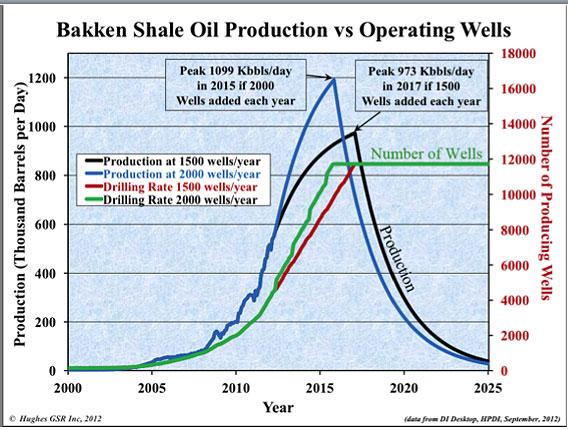
Current total U.S. oil production is about 6 million barrels per day. By way of comparison, Saudi production is currently running at 9.5 million barrels per day. To exceed Saudi production, new oil from tight-oil sources would have to more than offset declining production from existing wells. It is clear that even if we do manage somehow to temporarily exceed Saudi production rates, the party is not going to last very long.
High oil prices may make it profitable to recover more oil from unconventional deposits, but ultimately physics rules. In his talk at the AGU session, Charles A.S. Hall pointed out that the energy return on investment—the amount of energy you get out of a well vs. the energy needed to produce the oil—has been getting steadily worse over time. As long as there is some net energy gain and some profit to be made, drilling may go ahead, but the benefits to the energy supply deteriorate at the same time as the collateral damage to climate (in the form of increased carbon dioxide emissions per barrel of oil produced) goes up.
The market is not laying the foundations for an era of unending oil-based prosperity. The market is pushing inexorably toward investment in expensive technologies to extract the last drop of profit through faster depletion of a resource that’s guaranteed to run out. If we’re going to invest in expensive energy technologies, it would be better to pick long-term winners rather than guaranteed losers.
The flaws in the abundance narrative for fracked natural gas are much the same as for tight oil, so I won’t belabor the point. Certainly, the current natural gas glut has played a welcome role in the reduced growth rate of U.S. carbon dioxide emissions, and the climate benefits of switching from coal to natural gas are abundantly clear. But gas, too, is in a Red Queen’s race, and it can’t be counted on to last out the next few decades, let alone the century of abundance predicted by some boosters. Temporarily cheap and abundant gas buys us some respite—which we should be using to put decarbonized energy systems in place. It will only do us good if we use this transitional period wisely. We won’t be much better off in the long run if cheap gas only succeeds in killing off the nascent renewables industry and the development of next-generation nuclear power.
Does all the new American oil give us yet another way to fry ourselves? At 0.1159 metric tons of carbon per barrel of oil, the oil in Bakken and Eagle Ford amounts to a carbon pool of 81 gigatons, and the Green River shale adds up to 232 gigatons. Given that burning an additional 500 gigatons of fossil fuel carbon is sufficient to commit the Earth to a practically irreversible warming of 2 degrees Celsius, these are scary numbers. However, if oil analysts such as those speaking at the American Geophysical Union are right, almost all of this oil will remain inaccessible. In that case, coal—which certainly contains enough carbon to bring us to the danger level and probably much beyond—remains the clear and present threat to the climate, and the fight to leave as much coal as possible in the ground remains the front line in the battle to protect the climate. This does not mean the threat posed by the carbon pool in unconventional oil can be completely ignored. The case against oil abundance seems persuasive, but I’d hate to bet the planet against the ingenuity of future oil engineers, which is why I feel that some rearguard actions that inhibit development of unconventional oil are warranted, notably in the case of the Keystone XL pipeline, which taps into Canada’s Athabasca oil sands.
False hopes for an unending age of oil abundance provide an excuse to put off the hard decisions we need to make in order to smooth the road to a sustainable energy future. If oil cornucopians like Leonardo Maugeri are wrong, then the end of oil and gas is not many decades off (a few would say this is true for coal as well), and so even without bringing climate change into the picture, it is necessary to begin planning for new energy sources. Economists offer up a rosy picture in which gradually rising prices call into being some combination of increased production and resource substitution, but the resource depletion endgame does not always work this way. The story of Wisconsin white pine timber depletion, recounted in William Cronan’s book Nature’s Metropolis, should give us pause:
The manufacturer’s acute seasonal need for short-term credit drove them to the one market where they knew they could get quick cash, even if it meant that they were forever selling lumber at lower prices than they liked. Under such circumstances, the only way they could keep up with costs was to cut more trees, contributing still further to the overproduction and saturated markets that had created low prices in the first place. Chicago thus became the focal point of a vicious circle: Undercapitalization caused overproduction, which in turn kept prices low and accelerated the destruction of the northern forest. The Lumberman summed up the problem by attributing it to “so many men … striving to carry on a larger business than their capital will warrant” and, as a result, having to turn natural capital into liquid capital merely to survive. “The only reasonable explanation of this paradoxical state of affairs,” the Lumberman’s editors wrote, “is that the mill men … are using up their capital, as it exists in the form of stumpage, for no other end than simply keep themselves in business.”
This description is eerily similar to the last-gasp scenario described in Chris Nelder’s article on the oil endgame, “The Last Sip.” Whales were driven to the brink of extinction before petroleum replaced whale oil, and we may well fry our planet—and bankrupt ourselves while doing so—before we’re finally forced to kick the fossil fuel habit. It will be hard to muster the resources to develop replacements for fossil fuel energy if we wait until both the economy and climate are in ruins. We are in for a hard landing if we don’t use our current prosperity to pave the way for a secure energy and climate future.
12 Comments on "The Myth of “Saudi America”"
Plantagenet on Wed, 6th Feb 2013 11:03 pm
Obama says the US has a 100 year long supply of NG thanks to frakking. Who should we believe…our very intelligent president or the anonymous Slate correspondent?
GregT on Wed, 6th Feb 2013 11:34 pm
Yes we can. Yes we can. Yes we can. Keep chanting repeatedly until all sense of reality has subsided.
John Symons on Wed, 6th Feb 2013 11:42 pm
President Obama is not a geologist, a reservoir engineer or a production technologist/facilities engineer. Neither are the vast majority of his advisors. I’ve had 30 weeks of residential petroleum engineering training, 30 years in the industry and I’m with Slate.
BillT on Thu, 7th Feb 2013 1:22 am
This just supports the same comments made by Nicole Foss in the interview recently with Kunsler. We will never recover even a significant fraction of the oil and gas that is left because the economy will not permit it. The ever increasing cost of recovery in money/energy is the limiting factor. EROEI. If you didn’t take time to listen to it, you should…
http://theautomaticearth.com/Finance/the-automatic-earth-is-5-years-young.html
Dmyers on Thu, 7th Feb 2013 1:32 am
I think what we’re going to see is people staying home a lot more. That’s because prices other than gas are also going up, so no one has any shopping cash, and home these days is an entertainment center and conduit to the world via internet.
If people stay home, the economy slows down. Think of the economic consequences of less driving. Fewer tires bought, fewer traffic tickets [think lawyers, court personnel and cops unemployed], less shopping, less sales tax are a few examples of how less driving affects other sectors.
The New Oil looks to be very expensive on the way from Earth to tank. The price will climb and probably not pull back this time. Our economy runs wide open. That is the way it works. At half throttle, it coughs twice and dies.
GregT on Thu, 7th Feb 2013 2:06 am
People will stay at home more, until more and more of them get really hungry. That is when things will turn ugly.
Arthur on Thu, 7th Feb 2013 8:54 am
Slate = Washington Post = MSM.
We are getting there, finally.
This is the most important recommendation from the article: “Temporarily cheap and abundant gas buys us some respite—which we should be using to put decarbonized energy systems in place. It will only do us good if we use this transitional period wisely. We won’t be much better off in the long run if cheap gas only succeeds in killing off the nascent renewables industry”.
Leave oil & gas before it leaves us. We are already too late for a smooth transition, all we can do is trying to prevent total collapse.
As the article says, hard choices are needed. What could that mean? Answer: tax increases on a local level. A per house assessment of the desirability to have panels on your roof. Every smaller municipality should be obliged to generate a certain amount of energy (wind, solar, geothermal) on its own territory. Send a message to car manufacturers that basically their days are numbered, but that two-wheelers with a cabin, optimized for fuel efficiency are going to be tolerated for some time. Furthermore: access to longdistance highways only in cars occupied by five people, obliged to take paying lifters with you. Every house shoud get a smart meter, with the main purpose of rationing public power. Will be a stimulus to generate your own power, which cannot be rationed. Increased funding of energy and storage related research, at the cost of military-industrial complex and big oil subsidies. Nationalization of the big oil companies, like in Russia (Gazprom) and use their excessive profits for purposes stated above.
Arthur on Thu, 7th Feb 2013 9:04 am
“Cars” like this should become the norm:
http://youtu.be/Z0m-cUxMcJw
20 kw rather than standard 80 kw European car.
BillT on Thu, 7th Feb 2013 9:56 am
Cars should be banned outright and public transit used for the last years of Western civilization. But that is my thoughts and only time will prove me right. There is no ‘change’ coming only BAU until it hits the wall and then it really will be too late. I think we passed the switch time 30 years ago. Now it is just wind down the system until we level out somewhere in the 3rd world.
Arthur on Thu, 7th Feb 2013 12:04 pm
“Cars should be banned outright ”
That’s unrealistic and that way we would provoke the collapse you want to avoid. Nationalisation of oil companies, rationing and doubling fuel prices in the US (to European levels) should bring the government the reveneus it needs and at the same time impose saving fuel measures.
Tell entrepreneurs to organize a company wide monday morning session, make an inventory of all the commuting trajectories and start to combine, using google maps. Apply government regulations to what ‘extra mile’ can be expected in order to achieve ‘milage sharing’.
BillT on Fri, 8th Feb 2013 1:22 am
So let it collapse, Arthur. Why not now and get it over while there is still some resources left to build something new.
You and I know that nothing is going to change until we are forced to. “WE” meaning the elite, not us common serfs. So all these dreams of tech or transition or bio- are not going to make much, if any, difference in the long run.
We are not a species to make quick turns in our stampede to the extinction cliff. Most will go over the edge before a few will try to turn away, but those few will be swept over the edge anyway by the mob. Only the slower ones who were on the edge of the herd may survive to live another day. I’m planning to be on the back edge and survive.
Arthur on Fri, 8th Feb 2013 9:44 am
That’s a matter of perception Bill. You are prepared (or so you think, what are you going to do if the ATM in Manilla says ‘out of service’?) to watch the western trainwreck from a ‘safe’ distance. I am a decade younger than you and judging on the history of the development of the physical condition of both my parents I would guess I have until ca. 83 until some heart condition will make itself felt, so I give myself ca 25 active years in which I can somehow contribute to ‘solving’ the energy problem, probably as a consultant. Maybe I will start a bureau, as I am used to a life of uncertain income and doing acquisition myself.