
Peak Oil is You

Donate Bitcoins ;-) or Paypal :-)


Page added on May 15, 2010

Peak soil: like peak oil, only worse
Once again, Hubbert’s model can be applied to any finite resource we extract from the Earth. If it’s tragic that we are burning through all available resources with no thought for future consequences, it’s worse still to think that the payback will likely happen all together. We will probably find ourselves dealing with a widespread hydrocarbons collapse right when we have to face a greatly reduced global capacity to grow crops and find people enough water to drink.
The peak debate, although on the surface about energy security, comes back to food supply. So here I’m going to look at peak soil, peak water and peak phosphorous.
Peak soil
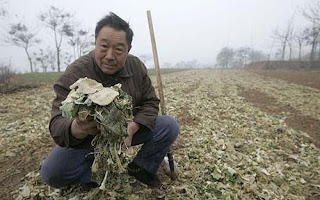
The world is losing soil 10 to 20 times faster than it is replenishing it. At the same time, population is growing exponentially – 9.3 billion by 2050, according to UN projections.
Areas of the world – particularly northern China, sub-Saharan Africa, and parts of Australia are already losing large tracts of arable land. Soil management is about more than heaping on chemical fertilizers. A 2008 New York Times article, Scientists focus on making better soil to help with food concerns, that examined the complex nature of simple dirt found that:
Soil does not arise quickly. In nature it starts with a layer of glacial grit,
or windblown sand, or cooled lava, or alluvial silt, or some other crumbled
mineral matter. A few pioneer plants put down shallow roots, and living
things begin to make their homes in and on the surface, enriching it with
their excrement, and enriching it further when they die and rot.
The resulting organic matter feeds a whole underground ecology that aerates the
soil, fixes nutrients, and makes it more hospitable for plant life, and over
time the process feeds back on itself. If the soil does not wash away or get
parched by drought, it very gradually thickens. It takes tens of thousands
of years to make 15 centimeters of topsoil, about 6 inches’ worth.
The UN’s Global Environment outlook, published 2007, states: “Deficiency of plant nutrients in the soil is the most significant biophysical factor limiting crop production across very large areas in the tropics.”
Peak water
The term peak water comes from the fact that much of the world’s drinking water lies in underground aquifers and in lakes, which behaves like a finite resource by being depleted. According to the UN’s Global Environment Outlook:
By 2025, about 1.8 billion people will be living in countries or regions with
absolute water scarcity, and two-thirds of the world population could be
under conditions of water stress – the threshold for meeting the water
requirements for agriculture, industry, domestic purposes, energy and the
environment (UN Water 2007). This will have major impacts on activities such
as farming. . .
As things stand right now, every 20 seconds a child dies from a water-related disease. Water is an urgent issue. Especially as, due to climate change, many parts of the world are becoming drier.
Leave a Reply