
Peak Oil is You

Donate Bitcoins ;-) or Paypal :-)


Page added on July 24, 2014

Mineral depletion: the trouble with gold
The main point that I am making with my latest book, “Extracted” is that mineral depletion is one of the major sources of our present economic and environmental troubles. Explaining this point is not easy: most people still seem to believe that depletion means “running out” of something. But that’s not the case. Depletion is a gradual phenomenon that goes on all along the cycle of extraction of all mineral resources. Extraction starts with the “easy”, high concentration resources, but gradually must move to more expensive, low concentration ones. As a result, the returns on extraction diminish with time (and extraction also causes more damage to the ecosystem). One of the consequences is the high prices we are seeing nowadays for all mineral commodities. It is not that we are running out of anything, but ore grades are falling everywhere, extraction is becoming more and more expensive, and that must have an effect on the market prices. The gradual disappearance of low cost/high grade ores can be seen with practically all mineral commodities, but it is especially evident with some of them. The article below is reproduced from Steven S. Rocco’s blog and it describes the present situation with gold. As you can see, the gold industry is processing more and more ore to produce less and less gold. It is the inexorable law of depletion at work: we are not running out of gold, and we probably never will. But we’ll have to face a falling supply.
___________________________________________
From “SRSRocco report”
TOP GOLD MINERS: Yields Fall To The Lowest Levels Ever
With the results for 2013 finally in, the top gold miners average yield fell to the lowest level ever. This is a surprising development considering that the average price of gold dropped to a low of $1,411 in 2013. Normally when the price of gold falls, gold miners switch to higher grades to remain profitable.
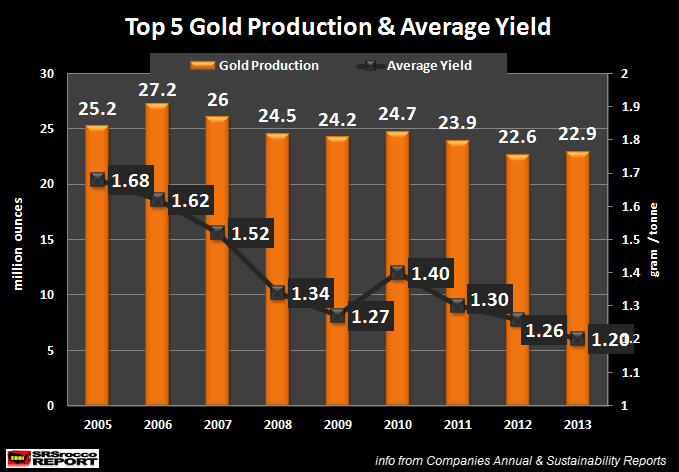
However, the top five gold miners’ average yield declined another 5% in 2013. If we look at the chart below, the top five gold miners (Barrick, Newmont, AngloGold, Goldfields* & Goldcorp) average yield fell from 1.26 grams per ton (g/t) in 2012 to 1.20 g/t in 2013.
(*Note: GoldFields spun-off three mines into a new company called Sibanye Gold in 2012. The data below includes both companies listed as GoldFields.)
Furthermore, the average gold yield for the group declined from 1.68 g/t in 2005 to 1.20 g/t in 2013. Which means these miners lost 0.48 g/t in just eight years… a 29% decline. That might not sound like a lot, but if we do the math… it’s a substantial loss.
The next chart provides the astonishing blow to the gold mining industry. In 2005, the group processed 464 million metric tons of ore to produce 25.2 million ounces of gold at an average yield of 1.68 g/t. In 2013, this same group processed 592 metric tons of ore (27% more), to produce 22.9 million ounces of gold.

This is the negative side of the gold mining industry. Moreover, the amount of waste rock removed is even greater. For example, Newmont reported the following data in their 2007 & 2013 Sustainability Reports;
Newmont Statistics
Newmont doubled the amount of waste rock generated to produce an ounce of gold in 2013 than it did in 2005. This wasn’t a straight increase over the eight year time-span. However the waste rock/ production ratio was 86 metric tons per ounce of gold in 2012… 65% higher than 2005.
The more waste rock Newmont has to remove, the more energy is consumed in the process. In 2005, Newmont consumed 19 gallons of diesel in its operations to produce one ounce of gold. By 2012, this increased to a staggering 31 gallons per ounce…. a 63% increase in seven years.
As we can see, falling ore grades become a very expensive factor for the mining industry.
Not all the top five gold miners suffered a decline in average yields in 2013. Barrick, Newmont and AngloGold saw a drop in average yields in 2013, while GoldFields (include Sibanye Gold) and GoldCorp reported a slight increase.
The company who suffered the largest decline in yield was AngloGold:

AngloGold’s average yield fell 15% in 2013 compared to 2012, while Newmont declined 10% and Barrick at 6%. Even though these declines seem quite large, I imagine we may actually see a leveling off or increase in yields from these companies in 2014.
Unfortunately, high-grading their mines to remain profitable at lower prices is only a temporary solution. Worse yet, the link provides information on how this method can leave a great deal of gold in the ground due to selecting the high-grade ore while leaving low-grade ore uneconomical to extract.
So, if these top gold miners decide to high-grade their mines, we may see a leveling (or slightly rising) of yields in 2014. However, this may actually speed up the decline rates in yields further down the road.
I am waiting for data to be released by two companies so I can update my chart on the average diesel consumption per ounce from the top five gold miners. With the majority of results already in… I can honestly say, diesel consumption per ounce in 2013 will hit a new record high.
As ore grades continue to decline, the cost to produce gold will inevitably rise. Some readers believe the higher energy price will be the factor to push the value of gold to new highs. Actually, I don’t believe this will be the case.
The world cannot afford high oil prices. We may experience temporary OIL PRICE SPIKES, but I doubt the price of a barrel of Brent crude will continue to rise towards $200.
The price of gold and silver will rise to extreme levels in the future not on the back of higher oil prices, but rather due to a falling oil supply and its impact on the $100+ trillion of worthless paper-mache floating around the world’s markets.
9 Comments on "Mineral depletion: the trouble with gold"
shortonoil on Thu, 24th Jul 2014 3:26 pm
Well – its actually a lot worse than the author paints. In the US, in 1900, the average ton of ore extracted produced 1,130 grams of gold. It is now what? Less than 3.
Extrapolate that to oil, and you see what a mess we have on our hands!
http://www.thehillsgroup.org/
Plantagenet on Thu, 24th Jul 2014 3:31 pm
If Oil is such a great investment, why is it down 25% over the last two years?
bobinget on Thu, 24th Jul 2014 4:34 pm
Gold seems to be ‘keeping up’ with oil, supply wise or visa versa.
One huge difference.
‘Almost’ all the gold (a little gets shot into space) that was ever mined is still around, oh, some of it gets lost but maybe found again some day.
Except for pitiful storage around the world, oil can never be recovered having all been converted to gases
heat, 1932 Ford Roadsters with rumble seat.
Gold can and no doubt will go thousands higher.
No one gets harmed.
Oil, OTOH is forced to stay inside affordability ranges
or everything grinds to halt. Now, I’m not saying oil will be affordable to all.
Observe today’s wealth distribution. One or two percent control most of the wealth.
For that privileged class to enjoy all of life’s pleasures
it needs a lupin proletariat to serve. In return, Mr and Mrs 2% will pay just enough to encourage 98% precent
to strive. Always hopeful for upward mobility, 98%
keep Mr 2% in facials, pussy, wax jobs, eyelid tucks.
It’s all about going first class or business or ‘tourist’.
Everyone gets to a destination around the same time
but folks who needed self assurance paid five times what the poor smucks in tourist, get off the aircraft first.
It looks like terrorism to most folks when an oil pipeline gets bombed. Was the pipeline or oil within terrorized? The old word ‘sabotage’ is more apropos.
The tribesman or male member of that overpopulation is blowing up that pipeline because he knows how much the oil inside is valued by ‘the man’. Destroying the ‘mans’ wealth, even for a short time, will get his attention. He will hire guns to punish anyone who messes with ‘his’ wealth. While that unemployed ‘terrorist’ has a chance like the American Indian to kill hired guns that are chasing him off the land into a ghetto like Gaza, he is outgunned because oil wealth
represents ALL wealth. Oil wealth can and does get all the latest weapons.
It happens over and over during what we laughingly
call ‘civilization’. Neighborhoods lose popularity perhaps because of a new invention (the automobile?)
the rich take to the hills surrounding for cooling breezes. The poor fill gaps. Generations passes, air conditioning is invented. Turns out those (poor) people need removing because living in the hills wasn’t as great as once thought. Jamestown, Harlem, closer to town offices. Now, seawater levels start to rise.
Time to remove the latest group of poor folks from favellas and take back those hill sides.
It has always been thus.
Norm on Thu, 24th Jul 2014 6:54 pm
Expand the thought to all sorts of metals, copped,aluminum, steel, brass, stainless. I am the only person I know who recycles s rap metal. Every else just chuck their old extension cord into the landfill. And now you say we are running out? Gee I thought the supply is infinite and therefore when all of you toss it into the dump, that its A OK.
MSN Fanboy on Thu, 24th Jul 2014 7:50 pm
Amen BOB
Makati1 on Thu, 24th Jul 2014 8:37 pm
bobinget, that is the best description of the rich vs poor situation these last 100 years or so. I never noticed that correlation. Thanks!
DMyers on Thu, 24th Jul 2014 9:18 pm
We’re thinned out, diluted, watered down, and attenuated. But there’s gotta be more. Shit’s gotta be made, and people’s gotta be paid.
Go another mile deeper. Take a little less yield. Believe it’s gonna get better.
Arthur on Thu, 24th Jul 2014 10:11 pm
“‘Almost’ all the gold (a little gets shot into space) that was ever mined is still around, oh, some of it gets lost but maybe found again some day”
The Fed has special processing facilities to make go away gold that is no longer needed or cannot be used anymore.
thylacine on Fri, 25th Jul 2014 1:15 am
Over the last few decades it has been possible to mine lower ore grades AND make decent profits. This was due in part to economies of scale and technological advances, but also due to a ready supply of cheap energy – usually oil. Unfortunately, these days the tech advances are mostly just marginal advances rather than outright game-changers and the cheap energy isn’t as cheap as it once was. I suppose the mining industry has managed to stay a few steps ahead of the game so far, but it’s starting to look quite grim for many sectors. There are still high grade deposits to be found out there, but it’s usually in countries with a fair degree of sovereign risk associated with them.
This graph shows average grades back to 1830 – http://images.uncommonwisdomdaily.com/766/img6.jpg