
Peak Oil is You

Donate Bitcoins ;-) or Paypal :-)


Page added on November 19, 2013

IEA World Energy Outlook 2013

The IEA World Energy Outlook was published the 12th of November. The report is available on line, in PDF form, for 120 Euros. But a friend a friend of mine at the brokerage firm of Dewey, Cheatem and Howe lent me access to his copy.
As discussed, adding unconventional oil into the equation does not have large implications for global observed decline rates, but it does increase the dependence of overall oil production on continuous investment. This can be seen by examining natural decline rates (Figure 14.6). In this case, the fall in production is even steeper, with oil output (excluding NGLs) dropping from 74 mb/d in 2012 to less than 13 mb/d in 2035, half of which would be from large onshore fields in the Middle East where decline rate are lowest. This puts a new perspective on the challenge facing the upstream oil industry. Raising production (excluding NGLs) from 74 mb/d in 2012 to 80 mb/d in 2035 might appear to be a relatively modest undertaking, involving the addition of 6 mb/d. Once, though, it is understood that the actual requirement is to add close to 67 mb/d to reach the 80 mb/d target, both through net capacity additions and efforts to mitigate decline at existing fields, the scale of the task becomes clearer.
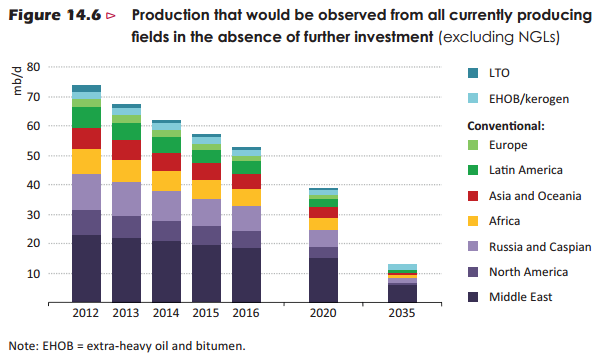
Notice that sometime after 2020 currently producing fields of LTO, (shale oil) disappears completely.
Okay, I did the math. This works out to be a decline of 7.28 percent per year. Let that sink in for a moment, the IEA is saying all existing fields, big and small, new and old, shale and conventional, have a combined decline rate of 7.28 percent per year. Just to keep production flat a total of 5.4 million barrels per year would need to be added.
And just where do they expect all that oil to come from? Well here is their chart of “Major Contributors” to the world’s oil supply in the next 22 years or so.
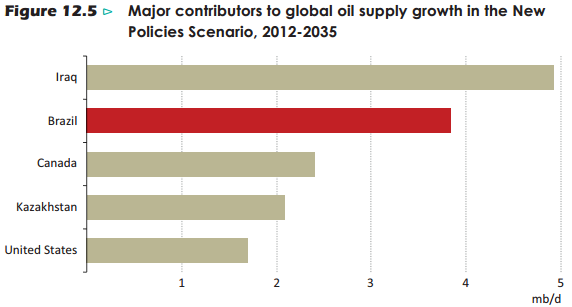
Of the five countries I see only Canada and possibly Kazakhstan of coming anywhere near those figures. And in light of what the IEA themselves say about shale oil, or Light Tight Oil as they call it, their projection of the United States to increase 1.7 mb/d over 2012 levels makes no sense at all. When LTO collapses the USA should be producing well below 2012 levels.
Also the IEA does not expect shale oil or “Light Tight Oil’ to last very long. Bold theirs:
Light tight oil shakes the next ten years, but leaves the longer term unstirred
The capacity of technologies to unlock new types of resources, such as light tight oil (LTO) and ultra-deepwater fields, and to improve recovery rates in existing fields is pushing up estimates of the amount of oil that remains to be produced. But this does not mean that the world is on the cusp of a new era of oil abundance. An oil price that rises steadily to $128 per barrel (in year-2012 dollars) in 2035 supports the development of these new resources, though no country replicates the level of success with LTO that is making the United States the largest global oil producer. The rise of unconventional oil (including LTO) and natural gas liquids meets the growing gap between global oil demand, which rises by 14 mb/d to reach 101 mb/d in 2035, and production of conventional crude oil, which falls back slightly to 65 mb/d.
Well that’s it in a nutshell. Conventional crude oil production falls back to 65 mb/d. Unconventional oil, that is oil from the Canadian Tar Sands, the Orinoco Bitumen and LTO and NGLs make up the 36 mb/d that takes us to 101 mb/d. I have no idea how much bottled gas, or Natural Gas Liquids as they call it, will becoming on line but I don’t think Tar Sands, LTO or Bitumen will add much to the total. No doubt production from the Tar Sands and Orinoco Bitumen will expand but LTO will fall off quite dramatically.
Anyway the IEA weighs in on those controversial OPEC reserves. They published the below graph which they got from BP.

Do they believe those reserves actually exist. Yes they do, at least as P2 (probable) reserves. And here is their reasoning:
Indeed our special study of Iraq in WEO-2012 confirmed that, at least for Iraq, the reported reserves correspond to oil that is clearly there, as demonstrated by the plateau production commitments taken by large international companies with access to the detailed geological information about the fields. Given what is known about the regional geology, the reserves reported by Iran, Saudi Arabia, Kuwait and the United Arab Emirates are reasonable, in a 2P sense, compared to those of Iraq.
Got that? International companies, who had access to the regional geology, bid on those contracts therefore those contracts so therefore those reserves must exist. Well I don’t know what kind of geological data they had access to but I doubt seriously that it showed that those huge reserves “probably” exist. Anyway as far as those Western oil companies are concerned: Big Oil’s hassle with Iraq is China’s gain
“The predicted bonanza for Western oil companies in post-war Iraq has failed to materialize,” the Financial Times observed.
Exactly what I would have expected.
I will likely have several other posts on the IEA’s World Energy Outlook 2013 in the coming weeks.
2 Comments on "IEA World Energy Outlook 2013"
BillT on Wed, 20th Nov 2013 1:34 am
Interesting!
Figure 14.6 looks reasonable.
Figure 12.5 looks like a bad joke.
Figure 13.8 is fiction as no one knows what they really have.
A financial collapse would make all of this just fiction.
Kenz300 on Wed, 20th Nov 2013 6:07 pm
The demand for oil is driven in large part by the demand for transportation fuels…….
If we diversify our transportation options by walking, using a bicycle or mass transit we reduce our collective need for the fuel.
The diversification of our transportation system to include more electric, flex-fuel, hybrid, biofuel, CNG, LNG, propane and hydrogen fueled vehicles also reduces the oil monopoly on transportation fuels.
In any case the price of oil is going higher. We need to adapt or die……….