
Peak Oil is You

Donate Bitcoins ;-) or Paypal :-)


Page added on March 18, 2014

How do ex-Saudi Aramco geologist Dr Husseini’s oil price spike predictions of USD 140 by 2016-17 stack up?
In an interview with ASPO USA in January 2014 Ex-Saudi Aramco geologist Dr. Sadad-Al-Husseini predicted oil price spikes of $140 by 2016/17. This post shows some graphs explaining why this could happen.
Husseini: My base oil price forecast in 2012 dollars still ranges between $105 and $120/barrel Brent with a volatility floor of $ 95/barrel and more probable upward spiking to $140/barrel within 2016/2017.
Husseini did not elaborate how he arrived at that time frame but this question and answer give us a hint:
ASPO: “In the larger context, how has your view of future world oil production supply evolved over the last four or five years? As a benchmark, I reference your slides from the 2009 Oil & Money Conference slides”
Husseini: “The realities of the 2009 O&M forecast of a limited plateau of oil supplies have been pretty much vindicated since then. The oil plateau may now be inflated by about 1 – 2 Mbd of high cost unconventional oils but all major forecasters see this as pretty much transitional. The plateau itself remains a reality and unfortunately its duration is still unlikely to extend beyond the end of this decade.”
So how did Husseini’s 2009 plateau look like and how does it compare with actual production data? The slides are contained in a presentation titled “Structural realities that define the oil supply outlook”
This was done continent by continent and country by country. In the following graphs, the grey shaded columns are from Husseini’s 2009 projection and the colored columns represent actual production (data from EIA).
Central and South America
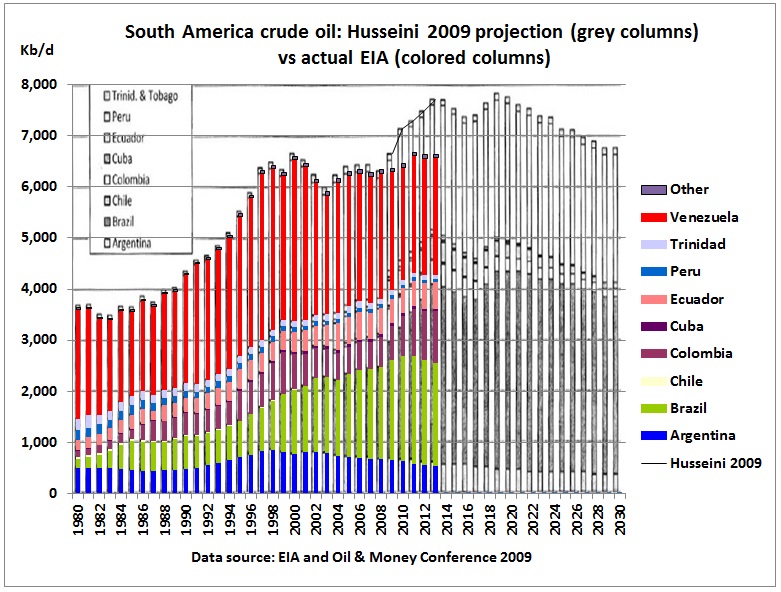
Actual production in 2013 was 1 mb/d less than in the 2009 projection, mainly due to limited Brazilian production.
Europe
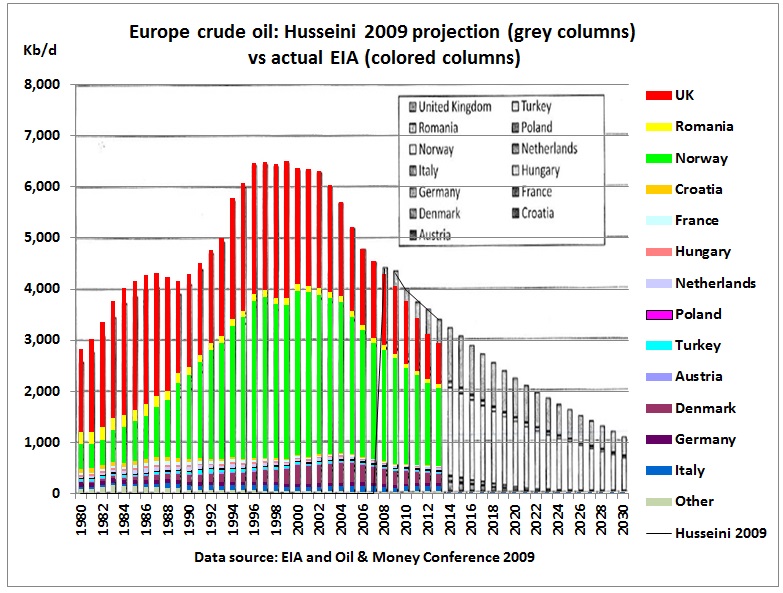
Actual production in 2013 was 460 kb/d less than in the 2009 projection, mainly due to higher decline rates in UK.
Former Soviet Union
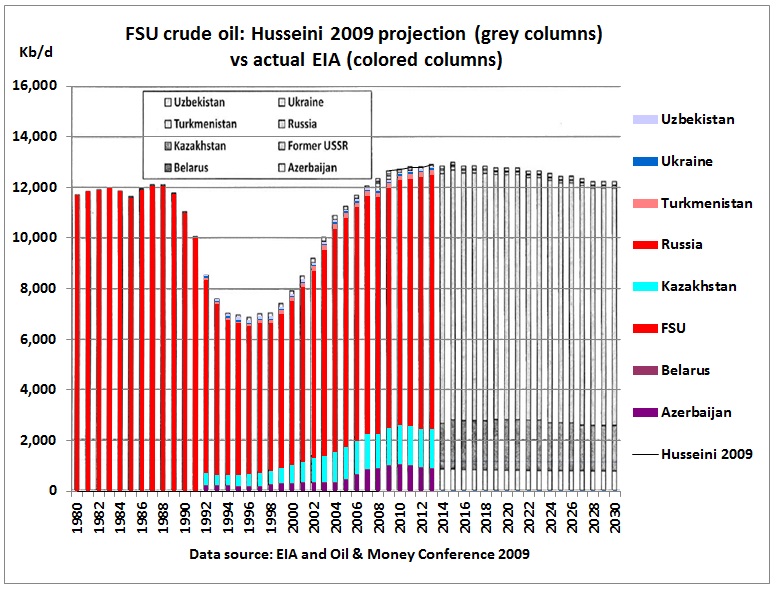
Actual production in 2013 was slightly less (80 kb/d) than in the 2009 projection due to weaker output in Kazachstan. Note that crude oil production in West Siberian fields peaked in the mid 80s, triggering the collapse of the Soviet Union.
Asia
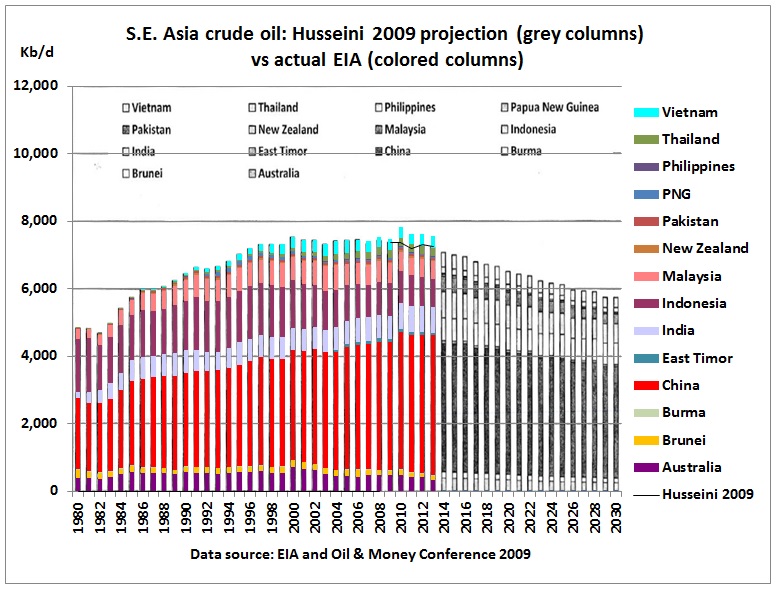
Actual production in 2013 was 300 Kb/d higher than the 2009 projection mainly as a result of higher production in China.
Africa
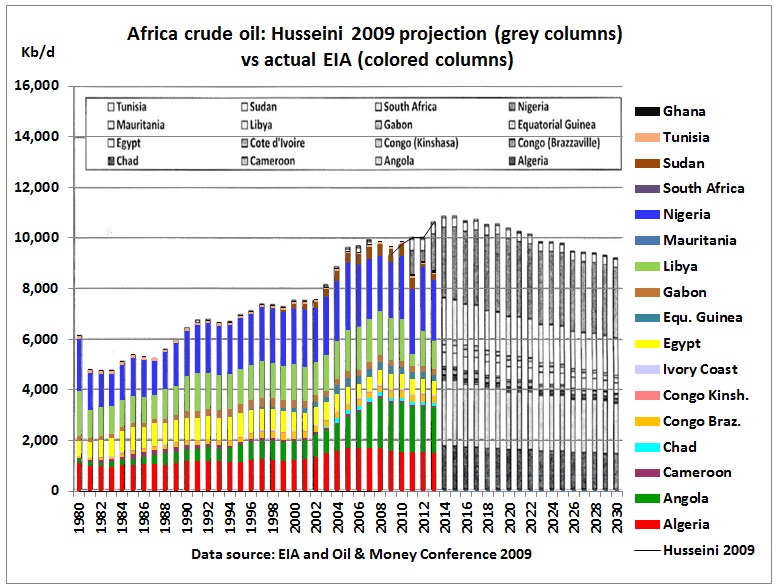
The 2009 projection estimated a peak of around 11 mb/d in 2015 but actual production in 2013 was only 8.7 mb/d or 1.9 mb/d less than projected for that year. Production was less in Angola, Algeria, Libya and Sudan.
Middle East
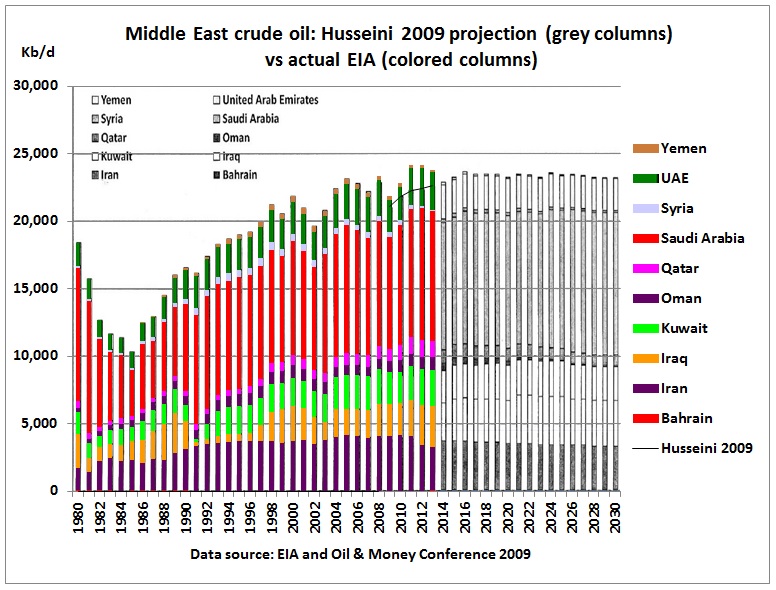
Actual production in 2013 was 1.2 mb/d higher than in the 2009 projection. While there was an actual decrease in Iran, Yemen and Syria (together -850 kb/d), this was more than offset by an increase in all other countries including Iraq (+ 440 kb/d), Kuwait (300 kb/d), Qatar (250 kb/d), Oman (290 kb/d), UAE (220 kb/d) and Saudi Arabia (+ 540 kb/d).
North America
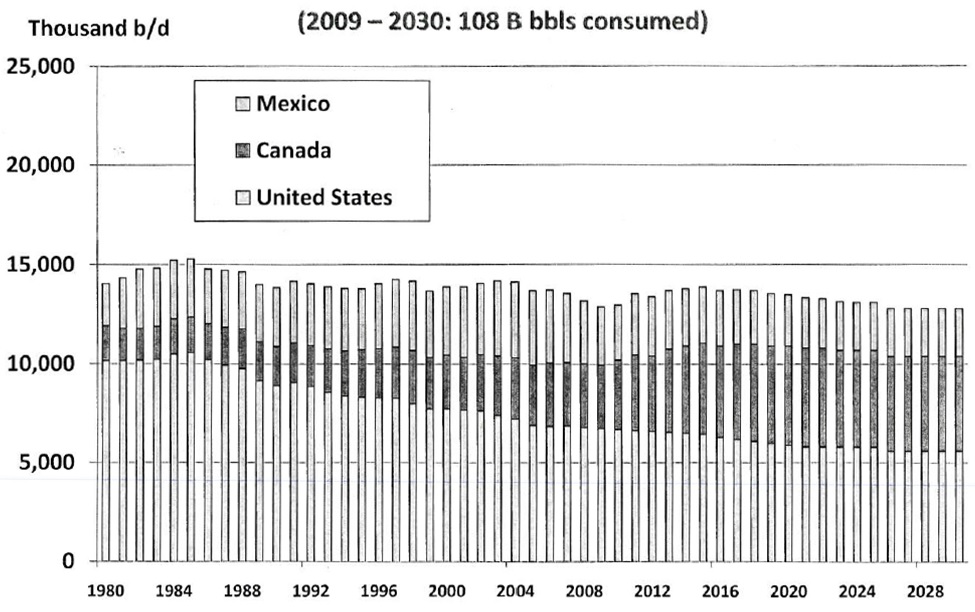
While in the above all of Husseini’s underlying 2009 graphs relate to crude oil, the North American graph includes NGLs .
First, we need to re-stack the columns to show the impact of shale oil:
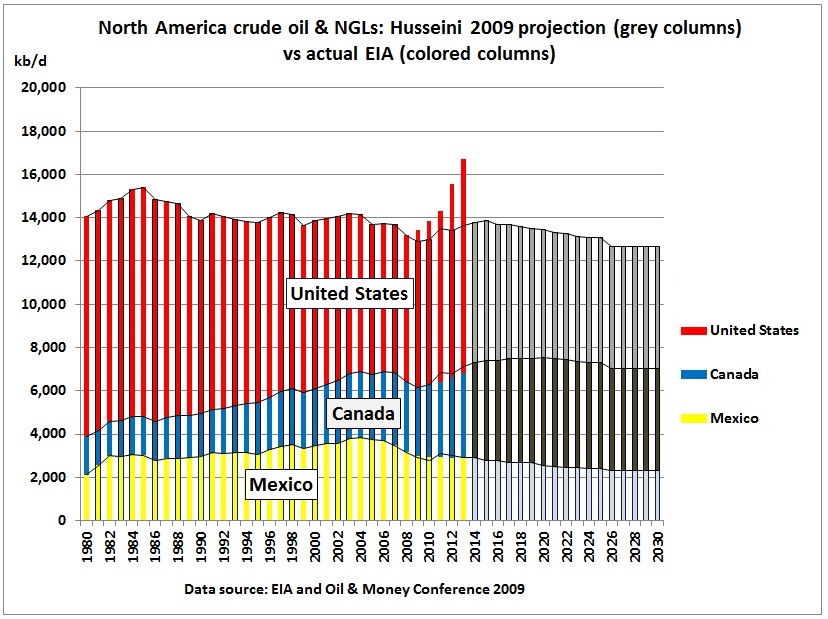
For 2013, Husseini’s projection for Mexico was spot on and for Canada slightly over-estimated. The big difference is US shale oil, 3.3 mb/d, but that contains NGLs because shale oil is a very light oil as we have seen in recent fires in oil train accidents.
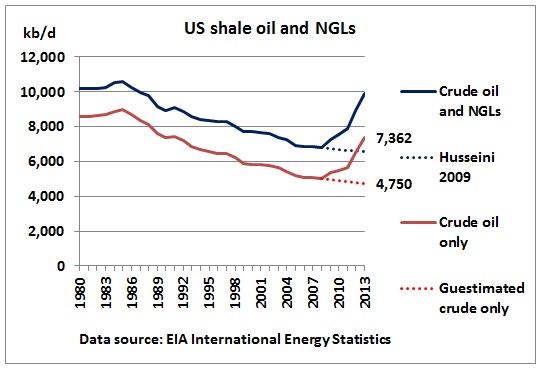
The uptick in crude was less, around 2.6 mb/d. So Husseini’s North America projection for crude and NGL has to be adjusted by the ratio crude/(crude+NGL).
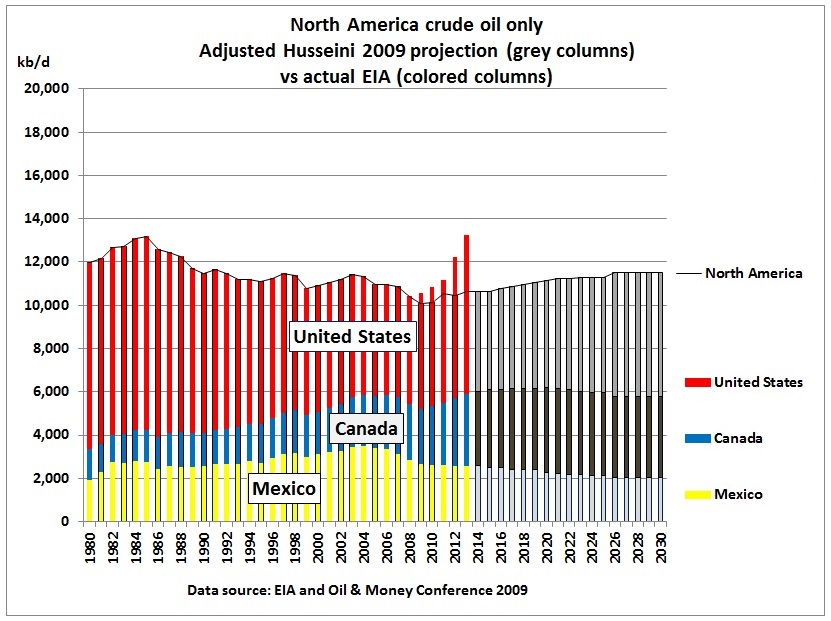
All together now.
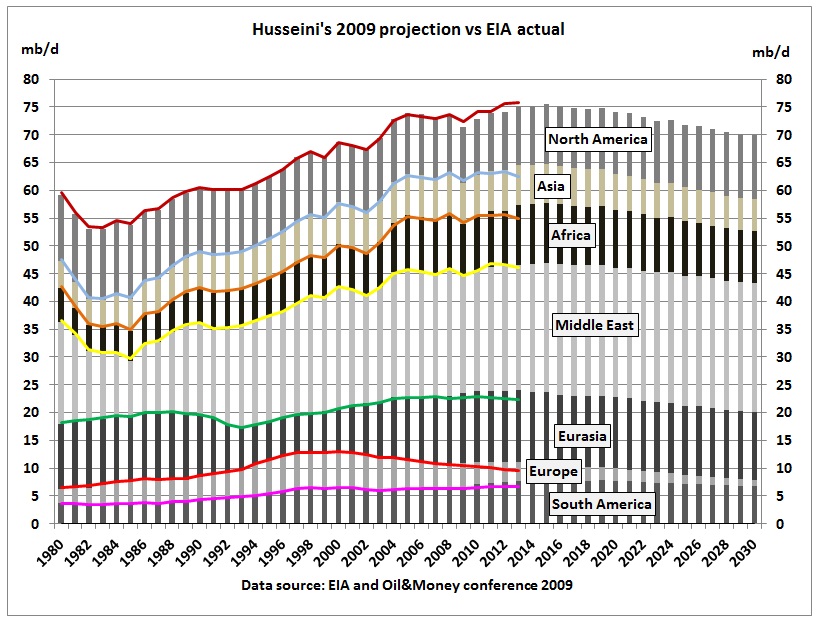
We see that total actual crude production was slightly higher than Husseini’s forecast, 600 kb/d or 0.8% in 2013, a small percentage in view of all the uncertainties. As is usual for estimates there is a lot of plus and minus.
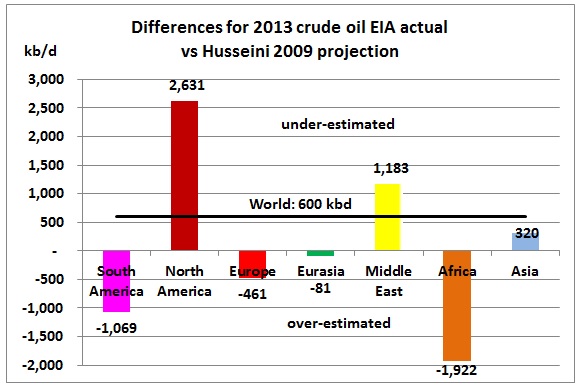
The biggest difference is the unforeseen increase in US shale oil which was, however, cancelled out by too optimistic forecasts for Africa and South America.
So how might Dr. Husseini in his interview have come to oil price spikes in 2016/17?
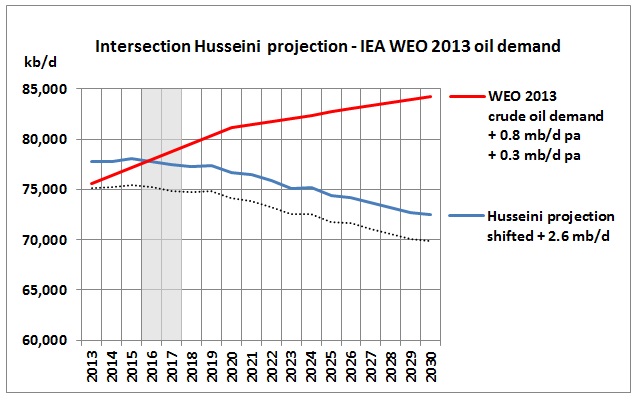
Let’s adjust his original 2009 projection as follows: + 600 kb/d to bring projected production into line with actual production in 2013, then shift his projection by a further +2 mb/d to add unconventional oil as mentioned in the interview.
On the demand side, let us take the long-term view of the IEA WEO 2013 (p. 501): “Demand for oil grows from 87.4 mb/d in 2012 to 101.4 mb/d in 2035 in the New Policies Scenario, but the pace of growth slows steadily, from an average increase of 1 mb/d per year in the period to 2020 to an average of only 400 kb/d in the subsequent years to 2035”.
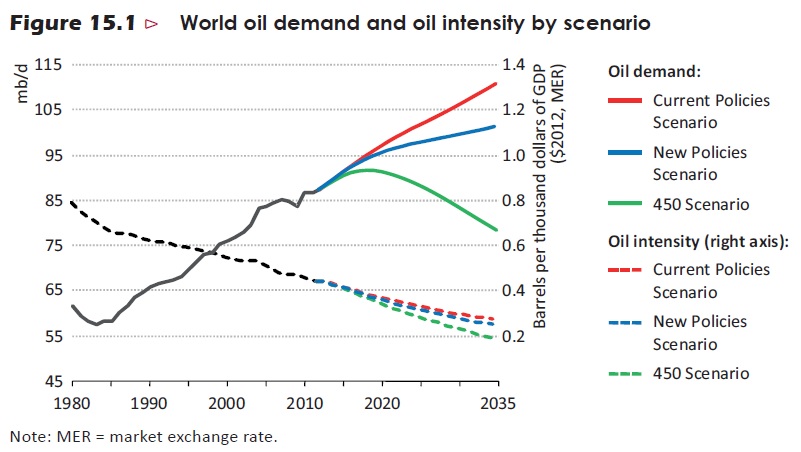
So for crude oil this means +800 kb/d pa until 2020 and + 300 kb/d pa thereafter. Let’s put that into a simplified graph:
We see that the intersection point is somewhere in 2016. What is more important than the precise year in which the next oil crunch may happen is the widening gap in the 2nd half of this decade.
Conclusion:
Whether the world wants to follow the New Policies Scenario of the IEA WEO 2013 is another question altogether. It seems governments are rather on a current policies track which increases oil demand and therefore pressure on oil prices.
9 Comments on "How do ex-Saudi Aramco geologist Dr Husseini’s oil price spike predictions of USD 140 by 2016-17 stack up?"
rockman on Tue, 18th Mar 2014 3:11 pm
It seems the key word is “spike”. Which, given the reasons we’ve seen spikes in the past it isn’t difficult to expects spikes in the future. But by the same token the timing of such spikes seems quite unpredictable. And despite the use of the eye catching “$140/bbl” right up front our stalwart geologist says: “My base oil price forecast in 2012 dollars still ranges between $105 and $120/barrel Brent.” Which isn’t very much different than we’ve experienced over the las several years so I would say it’s a reasonable guess.
Northwest Resident on Tue, 18th Mar 2014 3:50 pm
“The oil plateau may now be inflated by about 1 – 2 Mbd of high cost unconventional oils but all major forecasters see this as pretty much transitional. The plateau itself remains a reality and unfortunately its duration is still unlikely to extend beyond the end of this decade.””
IOW, let the good times roll while we’ve got all that excess unconventional oil “glut” that the MSM is proclaiming, because the closer we get to the end of this decade, the dimmer the light at the end of the tunnel becomes.
red on Tue, 18th Mar 2014 4:12 pm
it will be even much before as early as 2015 the world to see begin of shortages of oil which is only to get accelerated by the end of this decade. already the many of the worlds giant fields which make the most of the production(if not wrong) are in very rapid decline and what of their ability to keep up the numbers, the experts can add further…
rollin on Tue, 18th Mar 2014 4:38 pm
Interesting how a number of the big producers run nearly flat out to 2030. I wouldn’t be the house on that one.
Even the Saudis are planning for depletion by then.
If these projections are true, we can easily reduce demand by changing efficiency and bad habits. Most likely they are overstated.
Davy, Hermann, MO on Tue, 18th Mar 2014 5:07 pm
Naturally this article did not mention finance or it’s implications to future production numbers. I feel at this point in time with much of the new unconventional production compensating for the declining conventional production, a market correction will have more impact today as lets say 2000 or 2009. It is my bet will see a correction in the near future. This correction may not be the big one but it could easily be 20%. The excessively overpriced market currently in relation to real non-growth can easily correct much lower. The real number folks not the published ones are what I am looking at. If this happens the many expensive projects under development will get delayed, current expensive production may be shut, and projects in planning will be shelved. This will change the dynamics of the mentioned plateau.
Northwest Resident on Tue, 18th Mar 2014 5:29 pm
“This will change the dynamics of the mentioned plateau.”
Yes, it is true. The most optimistic and even the least dismal projections are based on the economy continuing at its current pace, “as is”, without significant disruption.
If we stand back and take a good hard look at that global economy, we see a monstrosity of overpriced assets, double and triple-booked debt, many trillions in visible debt, many more trillions in hidden debt, and hundreds of millions in future liabilities for Social Security, Medicare, etc… that will NEVER be paid. The whole thing looks like a bunch of sticks duct-taped together into one bundle of kindling that would burn up in a second if the right spark hit it.
In our world, sparks are flying everywhere, and it is just a matter of time. Those optimistic and least dismal projections — they’ll burn up with the economy, and then what will we be left with?
GregT on Tue, 18th Mar 2014 7:35 pm
Not that I look forward to post economic collapse, but it would appear to be our last hope for a somewhat optimistic future. As pessimistic as that may be.
Davy, Hermann, MO on Tue, 18th Mar 2014 8:01 pm
Greg, you talkin paradox
shortonoil on Wed, 19th Mar 2014 4:56 pm
“Husseini did not elaborate how he arrived at that time frame but this question and answer give us a hint”
It is unfortunate that Husseini doesn’t explain how he made his determinations. They are quite similar to our projections which give a 2016 price for crude of $143/barrel. You can see the graph at our site under study graphs, graph# 17, $/barrel vs Time. Our estimates are essentially based on the calculated production costs (future and historic). Present average world production costs are by our calculations now $109/barrel. We don’t think producers will endure the present loss for any extended period of time without reducing production.
Shale oil has been keeping prices artificially low by adding volume to the overall crude inventory. Most shale, is however, of very low quality. It does not supply enough energy to the general economy to drive its own demand. We believe, because of this, that its impact on the overall market will be of limited duration.
Crude appears to have a resilience that is now unique among commodities. With the Chinese housing market (which to them is the equivalent of the US stock market) presently rapidly deflating, almost all commodities have taken a severe hit over the last few days. Crude has maintained its $100 price level, and has actually increased marginally for the last few of days. This trend to continue over the next couple of years.
http://www.thehillsgroup.org/