
Peak Oil is You

Donate Bitcoins ;-) or Paypal :-)


Page added on November 3, 2016

Heinberg: The Case of the Vanishing Oil Reserves

Where are Philip Marlowe and Sam Spade when we need them? A crime is in progress, and only a detective who’s unafraid of stepping on powerful people’s toes is likely to get to the bottom of it.
Here’s what we know. Someone is stealing the world’s valuable petroleum reserves right from under our feet—and getting away with it. Politicians and the news media are barely mentioning the heist; maybe they don’t understand what’s happening, or more likely they have something to hide. But this is big. It could be the caper of the century.
A fat clue landed on my doorstep last week hidden in the newspaper business pages. It was an article describing Exxon’s announcement that it was writing down 20 percent of its booked oil reserves. The article noted that Exxon blamed low oil prices. That sounded fishy. I decided to do a little sleuthing and discovered that, at $50 a barrel, inflation-adjusted world oil prices are no lower now than they were in the 1980s and ’90s, when reserves were growing every year. Why didn’t Exxon mention that?

Exxon’s not alone. Other companies have been engaging in similar write-downs. They all point the finger at low oil prices—almost as if they’re working together, trying to distract attention from the real culprit. But who? Who’s stealing those reserves?
Another possible clue showed up in a report from Carbon Tracker, an organization that assesses how much of the world’s fossil fuels will have to stay in the ground if we’re going to avert catastrophic climate change. Carbon Tracker figures that a very large portion of oil reserves is unburnable, and that oil companies’ balance sheets should be adjusted to reflect that. So is climate action stealing Exxon’s oil? I decided to investigate. It turns out that, while opinions about the future of fossil fuels matter, and Carbon Tracker is trying to shift those opinions, oil companies’ assets probably won’t actually be stranded for this reason until the nations of the world adopt a hefty carbon tax. So, for better of worse, climate action is not yet leading Exxon and other companies to write down their reserves. I’m not saying the victim of this robbery is any angel. A lot of people have reasons to hold a grudge against the oil industry. But climate action is not the culprit here.
As I was dusting my computer keyboard for fingerprints, I accidentally clicked a link and landed on a Bloomberg article claiming that oil discoveries have been super-low the last couple of years. The article featured a breathtaking graph showing that the year 2015 yielded the fewest oil discoveries in decades—with 2016 on track to be even worse.
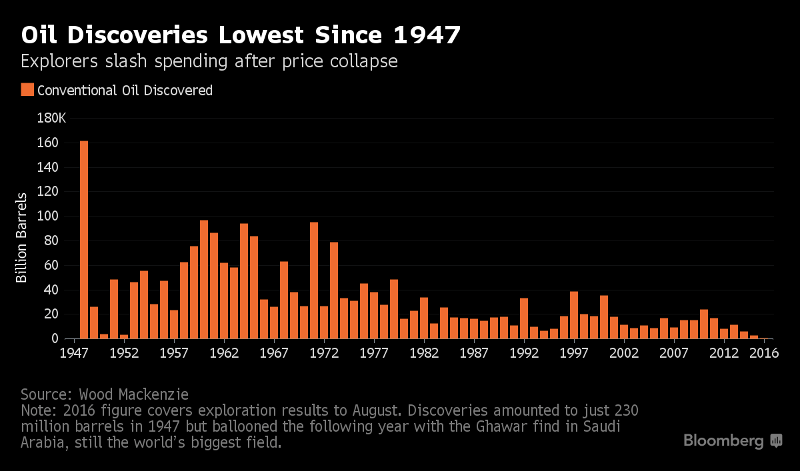
Are the petroleum companies themselves guilty? Are they stealing their own reserves by failing to look for more oil? It didn’t make sense. The oil companies are in business to make money, and the only way they do that is to find oil, extract it, and sell it. Why would they be undermining their own business? Again, it looked like they were hiding something—a secret so massive that they were willing to cut their own financial throats rather than divulge it.
Now, I’m no Hercule Poirot, but I’ve been around the block a few times. And if there’s one thing my years as a gumshoe have taught me, it’s that when somebody big wants something covered up, expect a red herring, a smoke screen, a patsy. It wasn’t long before a rosy-colored fish of the family Clupeidae showed up. And it was already starting to smell. It was called “peak demand”—an idea that a few well-placed economists were selling, which said people just don’t want oil so much anymore because they’re driving electric cars. That would explain low oil prices, which would explain lower investments in exploration. But that didn’t make much sense: as of the end of 2015, plug-in electrics represented 0.1 percent of the world’s one billion cars. And Americans were buying bigger gas-guzzling cars and trucks again. That fancy moniker “peak demand” didn’t really explain anything; it just diverted attention. Sure, a generally weak economy and a few years of high production output from frackers working in tight oil deposits in the U.S. had driven petroleum prices lower. But that just brought me back to the question: Why are those prices killing oil reserves now, while the industry operated just fine at similar or lower price levels in the past?
My head was starting to hurt. I tossed back a couple of stiff shots of bourbon; then, to put myself to sleep, I picked up what I thought was going to be another boring oil report—though it did have an intriguing title: “Drill Baby Drill.” It was written by a retired energy analyst who had worked for the Canadian government. Probably nothing here, I thought. But then I came across a graph on page 44, and a light bulb came on in my brain—more like a twenty thousand-watt movie marquee. That graph put all the clues together in a way that made sense for the first time.

After staring at the chart for a few minutes, I realized the real culprit in the vanishing oil reserves caper is a shady character known to his underworld contacts as “Depletion.” Here’s how he works his racket. We’re using more oil every single year, which means that every year we’re depleting what’s left even faster than we were the year before. Depletion always takes his cut before anyone else, and it’s bigger every time.
Also, we’re always going after the best oil first (drilling down from the top of the pyramid in the graphic), leaving the poorer prospects for next year. When we get to the “energy in equals energy out” line, it will take as much energy to drill, extract, and refine a barrel of oil as the finished product will yield to society. At that point, the oil industry, and all the other industries that depend on it (and if you think about it, they all do: how do we get raw materials, spare parts, food, or even solar panels without oil-burning trucks and container ships?) are toast. History. Already the cheap conventional oil is mostly gone; most of what remains is going to cost more to produce, refine, and distribute than society can pay for, which means the oil industry won’t be able to afford to deliver very much of it. Everybody loses—except Depletion.
The oil companies are writing down their reserves because at today’s prices they can’t afford to extract an ever-increasing fraction of their remaining oil. Depletion has already taken what’s affordable. That would be less of a problem if society could pay an arbitrarily high price for oil, or if it could afford to invest more energy in obtaining oil than the finished fuel delivers. But neither is the case.
Nobody is willing to name the culprit. Not Exxon. Not the government. Not economists. They all point to the immense size of the overall oil resource pyramid and say, “There’s enough for decades! Centuries!” That’s how he gets away with it. Depletion is stealing our future, and nobody is talking.
That’s a beautiful racket, when you think about it. It’s in nearly everybody’s interest to just go along and say nothing. There are only two ways to exit the oil depletion game: switch to other energy sources or just use less. A few people are doing one or the other, but as a society we are addicts through and through. So we all whistle a happy tune and make small talk.
And me? There’s not much I can do but write this little detective story. Sometimes you get the bad guy, sometimes you don’t. It’s all part of the job, but sometimes the job stinks.
26 Comments on "Heinberg: The Case of the Vanishing Oil Reserves"
sinnycool on Thu, 3rd Nov 2016 9:10 pm
Sure sounds like Richard is now singing from the Peak Oil Hymn book that has been translated for modern times by Gail Tverberg.
And there is nothing wrong with that, it’s well written 🙂
https://ourfiniteworld.com/author/gailtheactuary/
rockman on Thu, 3rd Nov 2016 10:03 pm
“The article noted that Exxon blamed low oil prices. That sounded fishy.” Amazing for a guy who likes to think of himself as an expert to be so completely clueless on the FEDERAL LAWS that mandate how companies value their reserves. Neither XOM or any other US publicly traded company picks the oil price used to calculate the value of their in ground reserves. The govt’s Securities and Exchange Commssion sets the price. The SEC sets the price used for a year based upon the previous year’s price:
The SEC price deck set at year-end 2014 for 2015 was $94.99 per barrel for crude oil, while companies were able to book gas reserves at $4.35 per MMBtu, even as both commodities’ prices dropped precipitously. The current estimate for SEC 2016 price deck is about $50/bbl.
IOW a company with 1 million bbls in 2015 would book a $ value of its reserves as $94,990,000. And if it didn’t drill a well or produce a single bbl of oil it would have a book value of $50,000,000 the following year. OR LESS. And why “or less”? If any of those reserves are not economical to produce at $50/bbl they have to be removed from the talley.
IOW there are two factors that public companies have no control over. First, the price of oil/NG used to calculate the $ equivalent of their reserves. The govt sets that price. Second, the companies have the economic value of their reserves audited by third party evaluation companies. If such a company consider 20% of a company’s in ground reserves to not be economic to develop at the SEC mandated oil price they are switched to the “PNC” category…Proved Non-Commercial.
The pubcos have only one little bit of control: they can start writing down reserves before doing so is mandated by the SEC.
Jerry McManus on Fri, 4th Nov 2016 1:30 am
Wow! Heinberg doing a REALLY bad imitation of the “archdruid”.
Theedrich on Fri, 4th Nov 2016 4:51 am
Rock, this seems odd. Why is the government setting prices at all? What happened to the “free” market? Anytime government gets involved in anything, all kinds of extraneous junk gets thrown into the hopper: eco-preferences, simple theft, ideological mythology…. Is there a cogent reason for this involvement? Why not let matters take their own course instead of having them “stabilized” by politicians?
Davy on Fri, 4th Nov 2016 6:15 am
This is a multilayered existential condition of a civilization in deflation, depletion, dysfunction combining in demand destruction. It is the economy and the resource but it is also everything else in a slowing of growth and possibly actual decline all combining and converging in an overall inertia to the momentum of growth. This makes this time in history the dawn of a period of destructive change.
The variable of chaos is involved. Chaos is unpredictability built into systems and especially systems in decline. Randomness of chaos is not good for a complex society like ours. We are likely in the turbulence phase of civilization where growth is breaking to decline. We are now on or near a new gradient of degrowth. It is likely ever so slight or just nearing horizontal. This horizontal could be seen as a parallel of two worlds one in decline and one in growth. I say this because our civilization and social narrative is growth based but reality is likely a decline or near decline. This means our perceptions are increasingly different from reality.
A further significance of this phenomenon is it is macro and global. This is self-organizing and self-adaptive in that we see dynamic adaptation to internal and external forces both spontaneous and with human control. It is this spontaneous inertia of degrowth grinding against a social narrative of growth that is creating turbulence. We have never been at this kind of point in our history of growth and progress. This is why many of us feel in the “Surreal”. We are caught between two worlds in a society that is playing with a deck missing cards.
Once firmly into decline we are going to see economic abandonment for irrational reasons. Occurrences will be irrational because we still maintain growth expectations. Oil is locked into this equation. The price of oil and the economy and oil are locked into this new and unpredictable period in our civilization. We are grasping at meaning with tools incapably of proper study. If we were to change our whole outlook from growth to decline this would be a shift in meaning that would properly adapt to systematic decline. Many will ask what the hell is that? It could be likened to a healthy human full of life suddenly faced with a terminal illness. There is the physical breakdown but also the psychological steps of grief. The irrational would find meaning in this kind of transformation of consciousness just as death can exhibit meaning.
We cannot fight destiny and that is what our civilization is doing. It has no choice because this is its nature. The best we can do is ride this wave of insanity with awareness of our foolishness. There are no solutions to chaos and turbulence only acceptance and acknowledgement. So if there is one result of all this it is then a rejection of the status quo but an acknowledgment of its inevitability. We are going to witness our self-destruction with no ability to change it. We will witness our future and that future is an end. The status quo is a force that has its own momentum against an inertia of “reality”. Where the two meet there is human consequences. That is where we are now.
AirlinePilot on Fri, 4th Nov 2016 9:32 am
I believe Richard is spot on here. We all knew that at some point depletion was going to catch up! Peak oil demand, global macro economic slowing, and the largest debt bubble in the history of mankind have only masked the underlying relentless and insidious machine that is depletion. I liken it to the great “hiatus” that climate change proponents pointed to a few years back. PO was taken off the table for a while for the sleeping masses, but for those actually paying attention its been sneaking around just on the periphery for the last few years. It will be out in the open again very soon. Depletion never sleeps and the only thing thats changed is the timeline. Stupid Humans.
Jef on Fri, 4th Nov 2016 10:16 am
Rock – I don’t think that Richard was arguing a different point.
Why did the SEC price deck go from $94 to $50?
Anyway we are at a point in civilization where constraints, actually multiple constraints are hindering growth. In the past, which is all we have to go from, right about now something NEW and almost magical will be reveled that allows growth to continue unabated. Fusion? Aliens? Other?????
In the mean time we will continue to cannibalize the margins to give the impression of growth. Which I believe is the way things will go down until it doesn’t.
Zarquon on Fri, 4th Nov 2016 10:47 am
“Why did the SEC price deck go from $94 to $50?”
“Why is the government setting prices at all?”
The SEC takes an average of each month’s *market prices* in the preceding year to set the “official” average price by which reserves are valued. An intern googles the numbers once every four weeks. I know that because I’ve been reading stuff on peakoil.com
I also know that the black and slimy stuff is *much* more costly to find and extract than it was in 1980. If that is a secret then it’s the worst-kept secret in the history of the industry.
“A crime is in progress, and only a detective who’s unafraid of stepping on powerful people’s toes is likely to get to the bottom of it.”
And only a writer who doesn’t treat his readers like baaah-ing sheep is likely to gain any respect and continuing attention for his work.
Or maybe it was just an attempt at tongue-firmly-in-cheek-journalism. Lay off the rye, Marlowe.
Boat on Fri, 4th Nov 2016 1:57 pm
Let’s say Russia attacked Ukraine and most of their oil was sanctioned. The price of oil would jump. With the new prices oil companies are suddenly worth a lot more. Idle rigs around the word jump into action. Suddenly reserves like Proved Non-Commercial are now back on the books. Now there are reserves out the ass. Same oil, same fields minus one Russia, price is king.
rockman on Fri, 4th Nov 2016 3:09 pm
Z – Thanks…good answer. But that’s a new method of calculating. The previous method used for decades was odd: the futures price at the closing bell of the market in December on the last trading day of the year. Not very representative of volatile oil prices.
Also the SEC makes no prediction of future prices. Consider two completely opposite dynamics, A and B. During Year A prices continued to fall X% per month every month thru December. And during Year B prices increased X% per month thru December.
And the SEC calculation for the price used to value reserves for the years following both A and B could, in theory, be exactly the same: $Y/bbl. Completely ignoring the steadily increasing and decreasing price trends. And how did the SEC get this life and death power over US public oil companies? Easy: it’s the f*cking federal govt. LOL. They make the rules. And the rules are non-negotiable.
The pricing platform MANDATED by the SEC for oil companies is just a small part (and by far the simplist) of its rule. We need a CPA here to explain the others in detail. Also something else I won’t take the time to explain: a very big impact of the SEC rules on how much undrilled acreage offsetting a new well can be classified as a proved catergory. Because of the nature of the shale plays the acreage was greatly reduced. IOW pubcos can’t just claim any amount of “proved reserves” they want.
The only impact any US oil pubco can have is how it presents the geological and engineering data to the outside independent auditors. Despite what some of our armchair geologists think it’s seldom cut and dry. Lots of wiggle room. And even though it risks hurting my already damaged rotator cups, I’ll pat myserlf on the back for having a good reputation for getting the most reserves out of the auditors. LOL. Never told a lie…but differernt ways to color the truth.
Anonymous on Fri, 4th Nov 2016 3:28 pm
OIC, its another toothless instrument of the .1%, in this case, this in-securities and Theft commision, that is responsible for, regulates and controls the price of oil eh?
How about that eh? uS oil corporations, once again, in your world anyhow, are but good compliant corporate citizens. Totally subject, and compliant to, the uSgov. Regular joes(~ net worth 1 trillion) in corporate terms, as it were. Just obeying the law, and plying their wares according prices set by gov’t fiat.
And from listening to your latest lame defence\rationalization of the world’s most successful criminal cartel, they do so happily, recognizing their subservience to the ‘uS govt’.
shortonoil on Fri, 4th Nov 2016 4:08 pm
Heinberg never says what depletion is – but fortunately 60 years ago someone else did:
“So long as oil is used as a source of energy, when
the energy cost of recovering a barrel of oil becomes
greater than the energy content of the oil, production
will cease no matter what the monetary price may
be.” (M. King Hubbert)
Also fortunately, it is pretty easy to measure:
You simply apply the following equation:
I = c*ln(T2/To)*To
and all you need to know is how much has been extracted. The EIA has done a very good job of keeping track of that.
When I become equal to the gross energy in the oil, it is depleted. Over, GaPuts, Finished.
Simple :
We just sat down and added up the numbers:
http://www.thehillsgroup.org/
Sissyfuss on Fri, 4th Nov 2016 4:12 pm
Rock you’re not trying to convince us that the govt and you oil barons are at loggerheads with each other. Are you and they inseparable like most corporation/govt bromances?
shortonoil on Fri, 4th Nov 2016 4:12 pm
PS:
How depleted is it?
It sort of looks like the bottom half of the 9th inning!
Anonymous on Fri, 4th Nov 2016 8:06 pm
Yes, Sissy, that exactly the narrative the rockman peddles on a consistent basis. His statements take, various forms, but they all boil down to the same central idea. Namely that the uS oil corporations have no particular power or influence, or at least no more than anyone else, and are ultimately subservient to, the ‘elected’ (lol), uSgov.
Like you said, he likes the flog variations on this theme, one being, that the uSgov and oil corps have some kind of ‘adversarial relationship’ going on. Presumably?, because the ‘elected’ uSgov has to occasionally enforce rules that are in the wider public interest, and not oil corporations.
LOL, sure they do.
Apneaman on Fri, 4th Nov 2016 9:29 pm
Anonymous , that’s right. the rockman expects everyone here to believe the oil&gas scum pay all those senators for nothing.
Here is a big fucking cheque, but I’ll only give it to you if you promise to control me.
From 2013
88% of Congress On Gas Industry Payroll As Campaign Donations Hit Record Level
http://www.occupy.com/article/88-congress-gas-industry-payroll-campaign-donations-hit-record-level#sthash.q0i0IIB9.dpbs
Oil & Gas: Money to Congress
All Senators
Candidate Amount
McCain, John (R-AZ) $3,326,201
Cornyn, John (R-TX) $3,001,656
Hutchison, Kay Bailey (R-TX) $2,266,371
Cruz, Ted (R-TX) $2,086,990
McConnell, Mitch (R-KY) $1,945,020
Obama, Barack (D) $1,890,806
Inhofe, James M (R-OK) $1,839,677
Landrieu, Mary L (D-LA) $1,759,467
Gramm, Phil (R-TX) $1,652,750
Murkowski, Lisa (R-AK) $1,342,394
Clinton, Hillary (D-NY) $1,336,246
Vitter, David (R-LA) $1,290,877
Nickles, Don (R-OK) $1,120,089
Gardner, Cory (R-CO) $1,112,299
Cassidy, Bill (R-LA) $1,095,870
Blunt, Roy (R-MO) $1,039,701
Lankford, James (R-OK) $1,004,435
Dole, Bob (R) $952,095
Portman, Rob (R-OH) $850,729
Thune, John (R-SD) $831,712
Roberts, Pat (R-KS) $813,450
Toomey, Pat (R-PA) $813,254
Rubio, Marco (R-FL) $804,802
Allen, George (R-VA) $783,241
Lincoln, Blanche (D-AR) $783,144
Santorum, Rick (R) $763,031
Burr, Richard (R-NC) $735,252
Domenici, Pete V (R-NM) $715,069
Hatch, Orrin G (R-UT) $705,179
Capito, Shelley Moore (R-WV) $703,461
Wicker, Roger (R-MS) $674,976
Breaux, John (D-LA) $668,026
Specter, Arlen (D-PA) $633,353
Barrasso, John A (R-WY) $631,966
Burns, Conrad (R-MT) $627,511
Hoeven, John (R-ND) $603,752
Brown, Scott (R-MA) $596,735
Corker, Bob (R-TN) $586,204
Alexander, Lamar (R-TN) $573,961
Bond, Christopher “Kit” (R-MO) $572,048
Moran, Jerry (R-KS) $563,198
Daines, Steven (R-MT) $555,876
Cotton, Tom (R-AR) $547,780
Coburn, Tom (R-OK) $540,063
Shelby, Richard C (R-AL) $532,146
DeWine, Mike (R-OH) $525,098
Stevens, Ted (R-AK) $511,691
Murkowski, Frank H (R-AK) $509,844
Scott, Tim (R-SC) $506,776
Enzi, Mike (R-WY) $504,633
Ayotte, Kelly (R-NH) $498,433
Cochran, Thad (R-MS) $464,190
Thomas, Craig (R-WY) $460,340
Bingaman, Jeff (D-NM) $454,350
Thompson, Fred (R) $439,013
Johnson, Ron (R-WI) $436,775
Allard, Wayne (R-CO) $434,730
Bennett, Robert F (R-UT) $433,213
Begich, Mark (D-AK) $431,155
Kerry, John (D-MA) $425,740
Dole, Elizabeth (R-NC) $421,245
Brownback, Sam (R-KS) $415,789
Crapo, Mike (R-ID) $413,637
Talent, James M (R-MO) $403,792
Pryor, Mark (D-AR) $400,569
Sullivan, Dan (R-AK) $396,585
Reid, Harry (D-NV) $395,236
Ensign, John (R-NV) $394,274
Grassley, Chuck (R-IA) $393,600
Campbell, Ben Nighthorse (R-CO) $391,852
Sessions, Jeff (R-AL) $391,650
Smith, Gordon H (R-OR) $387,675
Abraham, Spencer (R-MI) $386,148
Baucus, Max (D-MT) $385,579
Lott, Trent (R-MS) $385,104
D’Amato, Alfonse M (R-NY) $384,120
Conrad, Kent (D-ND) $382,163
Voinovich, George V (R-OH) $381,179
Isakson, Johnny (R-GA) $380,264
Chambliss, Saxby (R-GA) $378,592
Udall, Mark (D-CO) $378,460
Coleman, Norm (R-MN) $376,305
Coats, Dan (R-IN) $374,224
Udall, Tom (D-NM) $367,992
Krueger, Robert (Bob) (D-TX) $366,512
Kyl, Jon (R-AZ) $353,922
Heller, Dean (R-NV) $344,900
Bunning, Jim (R-KY) $341,056
Sununu, John E (R-NH) $322,530
Kirk, Mark (R-IL) $318,416
Schumer, Charles E (D-NY) $303,229
Graham, Lindsey (R-SC) $300,475
Craig, Larry (R-ID) $285,538
Coverdell, Paul (R-GA) $285,225
Manchin, Joe (D-WV) $284,150
Paul, Rand (R-KY) $282,993
Seymour, John F (R-CA) $282,216
Nelson, Ben (D-NE) $280,005
Bennet, Michael F (D-CO) $279,005
Ashcroft, John (R-MO) $278,479
Faircloth, Lauch (R-NC) $278,145
Hutchinson, Tim (R-AR) $273,245
Wyden, Ron (D-OR) $272,670
Collins, Susan M (R-ME) $268,109
DeMint, Jim (R-SC) $266,439
Tillis, Thom (R-NC) $262,900
Boozman, John (R-AR) $258,652
Heitkamp, Heidi (D-ND) $257,379
Boren, David Lyle (D-OK) $253,559
Rockefeller, Jay (D-WV) $249,925
Daschle, Tom (D-SD) $235,641
Lee, Mike (R-UT) $233,820
Feinstein, Dianne (D-CA) $229,700
Lugar, Richard G (R-IN) $224,975
Dorgan, Byron L (D-ND) $219,268
Gorton, Slade (R-WA) $219,231
Flake, Jeff (R-AZ) $219,160
Grams, Rod (R-MN) $211,670
Bayh, Evan (D-IN) $210,898
Lieberman, Joe (I-CT) $209,050
Page: 1
There are 2 more pages – of course there are.
https://www.opensecrets.org/industries/summary.php?ind=E01&cycle=All&recipdetail=S&mem=Y
Boat on Fri, 4th Nov 2016 10:43 pm
ape,
The Republican lead Supreme Court said Corporations are people. Only a Hilary can change the court make up. Most doomers are right wing and hate Hillary. Why are you against them.
Boat on Fri, 4th Nov 2016 10:49 pm
Cowboy short is back flogging that dead horse. Meanwhile back at the ranch world demand is strong and a glut continues.
makati1 on Fri, 4th Nov 2016 10:51 pm
Boat, do you see the close resemblance of the U$ to a Banana Republic? There are NO Democrat or Republican differences, only an oligarchy. It is a dictatorship in all but form. You are an “eater” peasant surf with ZERO freedoms and you are soon to find out that I am correct. Be patient.
makati1 on Fri, 4th Nov 2016 10:55 pm
Boat, I hope you have a strong fortress there in Texas if Killary wins. It could get messy with ~300,000,000 guns in the hands of the serfs. No pitchforks and torches this time. And the destruction of the financial system will be part of it. Total grid lock in Congress. Etc. Maybe Civil War 2.
We live in interesting times. ^_^
Boat on Fri, 4th Nov 2016 11:14 pm
We have pistols, shotguns and rifles in the house. What we don’t have around are off the chain doomers like you around.
The economy is fine, unemployment is good. Houston and the area continue to grow even in an oil down turn. Home prices are back up and meat is the cheapest in two decades. Gasoline is down/$1.85 and dropping. So ya, tell me how bad it is. lol
makati1 on Sat, 5th Nov 2016 12:12 am
Boat, delirious people like you are not going to be able to protect their families from what is coming down the line. Not even close. A Molotov Cocktail on your roof at 3 AM is all it takes. You cannot be awake 24/7 lol.
Arm chair warriors. I laugh at you all. Your rants about living conditions in the U$ proves your delirium is total.
Rockman on Sat, 5th Nov 2016 4:52 am
Truly quit funny when folks see FACTS with no spin attached as biased. Says much more about the mindset the reader then the writer. Paranoia abounds. LOL.
rockman on Sat, 5th Nov 2016 8:37 pm
Sissy – “Rock you’re not trying to convince us that the govt and you oil barons are at loggerheads with each other”. Loggerheads??? I expect better from you. LOL. Please pay closer attention to what I said:
In January, 2015, thanks to the evil enemy of the oil business, the US govt thru the SEC, FORCED ExxonMobil to use $95/bbl to calculate the $ value of its reserves. BTW in January 2015 the WTI spot price was $48/bbl. Do you now get the f*cking point I explained in detail about howv the f*cking SEC doesn’t take into account f*cking obvious prices trends to calculate its f*cking price deck? LOL.
Please don’t take offense, but some of you folks need to get your heads out of your f*cking asses and stop with your f*cking knee jerk prejudices when someone in the oil patch tells you a FACT that puts the govt and public oil companies in a bad f*cking light.
But earnestly, no offense meant, you f*cking cretins. LOL.
Anonymous on Sun, 6th Nov 2016 2:20 am
Your corrupt, captured gov’t is already in a bad light, like the worst.
Oh, its a PRIVATE oil cartel, not a ‘public’ one. Not by any stretch of the imagination are uS corps, ‘public’.
Fixed it for ya.
makati1 on Sun, 6th Nov 2016 3:36 am
Sissy, you and I know that the oily corporations ARE the U$ government. Why else, Iraq, Iran, Libya, Syria, etc? The oily business is all lies, just like the U$ government. Siamese twins joined at the wallet. No truth in decades, since the depletion began. The cliff for the oily industry is approaching fast and it is closer than the one for the human bottleneck. A lot closer. Maybe next year.