
Peak Oil is You

Donate Bitcoins ;-) or Paypal :-)


Page added on July 19, 2013

British Geological Survey Bowland Shale Gas Assessment

The latest exuberant shale gas news comes from a report by the British Geological Survey estimating enormous new shale gas resources in the central UK. On June 27, 2013, the British Geological Survey (BGS) released a natural gas resource assessment for the Bowland Shale in the United Kingdom stating that approximately 40 trillion cubic metres (1,300 trillion cubic feet (Tcf)) of shale gas exist in 11 counties in northern England (Exhibit 1). The BGS report, unfortunately, only addresses gas-in-place (total resources) and not extractable resources (technically recoverable resources) much less reserves (commercial supply). The most-likely reserve potential of the Bowland Shale is only about 42 Tcf (3% of gas-in-place) after applying methods used by the U.S. Energy Information Administration (EIA) and Potential Gas Committee (PGC).

Resources are the volume of natural gas in a particular formation, also known as gas‐in‐place (Exhibit 2). This has no relation to what is physically or technically producible much less commercially viable. The technically recoverable portion of total resources–Technically Recoverable Resources (TRR)–is that volume that can be produced using present technology. It similarly does not include commercial factors. This is the gas volume most often publicized and confused with reserves, the economically producible subset of technically recoverable resources. The EIA states that TRR represents approximately 25% of gas-in-place for most shale formations.
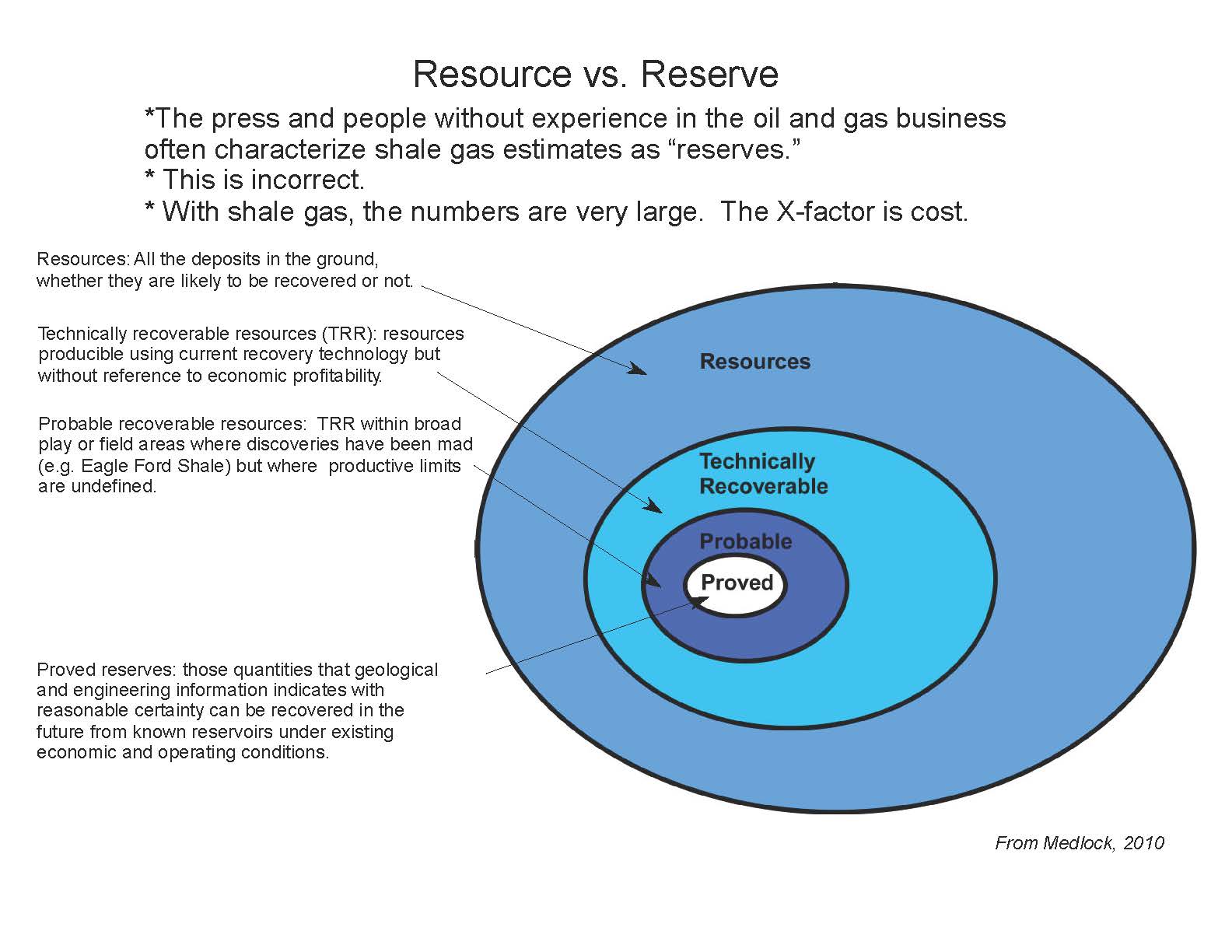
I first applied the EIA guideline of 25% Gas-In-Place to determine TRR for the BGS low, high and most-likely gas resource cases for the Bowland Shale (Exhibit 3). Next, I used the relative percentages of probable (32%), possible (43%) and speculative (25%) TRR taken from the PGC’s latest assessment of the U.S. technically recoverable resource base. Finally, I assumed that 50% of the Speculative TRR would be commercially producible, since there is no production from the Bowland Shale, and used this value as the potential reserve estimate.

While the Bowland Shale is the same geological age as the Barnett and Fayetteville shales in the U.S. and is known to be an oil source rock like the U.S.shales, there is no evidence to suggest that U.S. shale production is an analogue for Bowland gas-producing potential. Among the most important factors in shale gas play performance are high organic content, high thermal maturity and high silica or limestone content. These produce brittle shale reservoirs with large volumes of available gas. High organic content also results in creation of important porosity where kerogen is converted to gas because of a volume change.
So far, there is little geochemical data for the Bowland Shale and, while some of the data appears to be in a similar range as for the Barnett Shale, lack of comprehensive data is a risk factor in assessing the potential of the play. Each shale gas play is different and, until industry knowledge is greater, must be viewed as a “one‐off” opportunity with a considerable learning curve, unanticipated costs and commercial risk.
7 Comments on "British Geological Survey Bowland Shale Gas Assessment"
Plantagenet on Fri, 19th Jul 2013 4:30 pm
Drill baby drill comes to the UK.
Arthur on Sat, 20th Jul 2013 6:14 am
And what do the British water companies say? Britain is one of the most overcrowded countries in Europe.
GregT on Sun, 21st Jul 2013 4:28 am
Who cares about water? Europe, let me introduce you to Sarah Palin, not much for brains, but man, what a MILF.
Kenz300 on Sun, 21st Jul 2013 4:47 pm
It is time to transition to safe, clean alternative energy sources.
Renewables to Surpass Gas by 2016 in the Global Power Mix
http://www.renewableenergyworld.com/rea/partner/russtech-inc/news/article/2013/07/renewables-to-surpass-gas-by-2016-in-the-global-power-mix
rollin on Sun, 21st Jul 2013 10:51 pm
Oh no, they will be drilling in that lovely valley of Holmfirth, the setting for Last of the Summer Wine. Have they no couth, is nothing sacred?
smokeyjoe on Mon, 22nd Jul 2013 12:14 am
The U.K. has a very serious energy crisis. Coal producton is nearly depleted and they no longer can export oil. Last winter they came with in hours of running out natual gas. They are struggling to develope wind power to avoid electrical outages in the near future. But its turning out to be very expensive and unreliable. Electric rates are rising rapidly leading to energy poverty. If this shale gas doesn’t work out they are going to have real problems.
Arthur on Mon, 22nd Jul 2013 5:42 am
It looks like the editor missed the potentially much more significant development in Australia?
http://www.telegraph.co.uk/news/worldnews/australiaandthepacific/australia/9822955/Trillions-of-dollars-worth-of-oil-found-in-Australian-outback.html