
Peak Oil is You

Donate Bitcoins ;-) or Paypal :-)


Page added on April 12, 2012

Another View of Peak Oil
A rising number of people are familiar with the concept of Peak Oil, which posits that invidual wells and hence global oil production overall exhibit very predictable patterns of output, such that when the peak of that production from either a single well or all the wells will be reached is pretty easy to calculate.
The Peak Oil concept was developed all the way back in 1956 by a Shell Oil engineer named Dr. M. King Hubbert, who at that time predicted US crude oil production would peak around 1970. Most in the industry scoffed at the time. Turns out King was nearly right on the money.
On a global basis, many predict we have either already reached or soon will (next few years) peak crude production as well.
This week, we featured a Videocast on our Supply Chain Television Channel a converation with Chuck Taylor, a long-time logistics executive who has spent the last 8 years or so warning the industry about the impact of Peak Oil on our supply chains, economy, and even aspects of our way or life.
It was a fascinating discussion, and the on-demand version of this broadcast (made possible by support from Compliance Networks) is now available: The End of Cheap Oil.
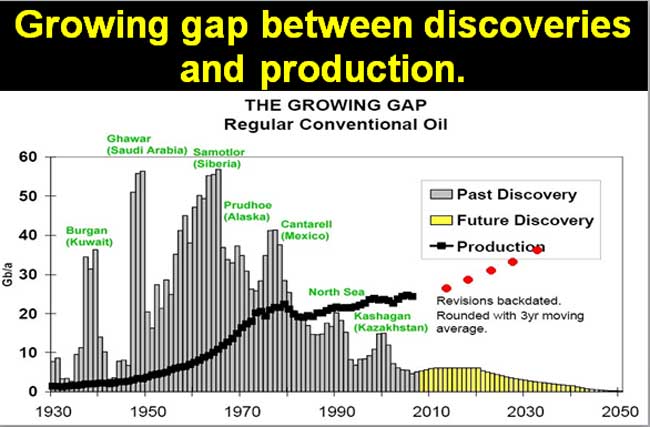
During the broadcast, Taylor used the slide below, which paints the Peak Oil concept very clearly.
Source: Chuck Taylor, Awake! Consulting
The picture it paints is not a good one. First, look how few new reserves are being discovered, versus the huge oil field finds in the 1950-80 period (gray bars, versus small expected future finds in the yellow bars).
You can also see in the black line how production levels, despite rising overall global demand, have been flat-lining in recent years: just what you would expect with nearing Peak Oil.
The red dots indicate the amouint of production needed to keep pace with demand. Somethign is going to have to give.
This is crude oil only, and does not consider other sources such as tar sands and shale oil. But as Taylor makes clear, with those sources oil doesn’t just flow, as it does for traditional wells. It is therefore much more expensive to produce.
We aren’t going to run out of oil any time soon, Taylor says. We are just going to run out of cheap oil.
We should all be concerned.
16 Comments on "Another View of Peak Oil"
Gale Whitaker on Fri, 13th Apr 2012 2:09 am
There was a raised pickup next to me on the freeway. The bumper was right next to my face. I’m thinking that this terrible death dealing machine is going to end up on the scrap heap when a fill up costs $250. The day can’t come too soon. It’s too bad we can’t put the driver on the scrap heap along with the truck.
Peak Oil Survival on Fri, 13th Apr 2012 3:08 am
We might all be riding bicycles when a fill up costs $250.
https://www.facebook.com/PeakOilSurvival
BillT on Fri, 13th Apr 2012 6:15 am
Gale, most of these truck nuts don’t realize that it will be the last one they ever own. Patience…^_^
Beery on Fri, 13th Apr 2012 11:02 am
I’ve been riding a bicycle for 40 years. I’ve always seen cars for what they are – an expensive way of becoming obese that kills over a million people per year worldwide. I don’t need peak oil to wean me off such a disgusting vehicle.
BillT on Fri, 13th Apr 2012 11:24 am
Good for you. Beery. Ionce figured that I have spent well over 100,000+, in 2012 dollars, over the approximatly 48 years I owned a car. Or should I say, that it and the bank owned me? I figure that the average guy spends at least one day per week working for his car. Is the ‘convenience’ worth it?
Rollin on Fri, 13th Apr 2012 12:25 pm
The new “green” push to convert major trucking to natural gas may take some pressure off diesel fuel, but we have too much diesel now and export it. It will also use up the limited supplies of natural gas much faster thus moving that problem closer in time. The real laugh is the “green” label on natural gas which is turning out to be as much of a greenhouse gas producer as coal. I guess the greenhouse gas is the “green” part.
Arthur on Fri, 13th Apr 2012 12:46 pm
I have 640,000 km under my belt, driven in 2 used and 1 new car in 30 years. Average fuel efficiency I would estimate at 14 km/liter –> 46,000 liter or 46 m3. Size living room: 4 * 10 * 2.5 m = 88m3. That’s my livingroom half filled with petrol. Price petrol now 1.80 euro –> 83k euro = 108,000$
Since last year I have virtually stopped using my car and have driven more bicyle than in combined 10 years before, which is still not a lot.lol
Although I have reasonable hope, based on current health situation, to live another 30 years, I do not expect to add many km to the overall tally.
Charlie Bucket on Fri, 13th Apr 2012 12:59 pm
Not only that, but you are far more susceptible to be harassed, tased, pepper sprayed, or worse by our new and improved militant police force when driving a vehicle. Arthur talked about the money spent; that probably doesn’t include getting tickets which is a multi-billion dollar a year industry. Insurance companies raise your rates when you receive tickets also and less than 5% of tickets are contested in Amerika. It’s a total racket! Bottom line….. CARS SUCK!
luap Simpson on Fri, 13th Apr 2012 3:10 pm
why is the world carrying on business as usual..maybe because nobody know`s about it,does not care about it or just simply ignores it, nothing will change untill it`s to late then the panic will set in.
War,famine and complete chaos
It`s the human way of doing things
Rick on Fri, 13th Apr 2012 4:08 pm
“A rising number of people are familiar with the concept of Peak Oil” I don’t really agree with this. I know many who have never heard of it, and many more who have their head in the sand.
Also, there is no such thing as “Green” when you have 7 billion people on this planet. It’s marketing BS.
I agree with Iuap, nothing is changing. Humans will continue doing stupid things, until we run out of oil, then the die off happens. And just imagine, if all the oil on this planet was all cheap and easy to get. How long do you think it would last, how much more damage would it do to the climate.
BTW, I’m a cyclist too, and healthy because of it.
Arthur on Fri, 13th Apr 2012 4:21 pm
@luap: “why is the world carrying on business as usual..maybe because nobody know`s about it,does not care about it or just simply ignores it, nothing will change untill it`s to late then the panic will set in.”
http://en.wikipedia.org/wiki/Elisabeth_K%C3%BCbler-Ross
“Her extensive work with the dying led to the book On Death and Dying in 1969. In this work she proposed the now famous Five Stages of Grief as a pattern of adjustment. These five stages of grief are denial, anger, bargaining, depression, and acceptance. In general, individuals experience most of these stages, though in no defined sequence, after being faced with the reality of their impending death”
We are talking here about the death of industrial society.
We are now in the first stage of denial. Anger is going to be the next stage.
Kenz300 on Fri, 13th Apr 2012 7:23 pm
Quote — ” We aren’t going to run out of oil any time soon, Taylor says. We are just going to run out of cheap oil.
We should all be concerned.”
———————–
Yes we should. Individuals, business and politicians should be developing plans to deal with higher energy prices and reduced supplies. Too few are doing so.
SOS on Fri, 13th Apr 2012 11:04 pm
He doesnt even talk about North Dakota – 24 billion barrels of recovarable crude right now and the number is growing. He doesnt even take into consideration the installation of alternative electrical generating “plants” either. They are going to flatten the production curve substantially.
This author doesnt talk about the faster solution to our problems. Change the politics from anti oil to pro oil. Engage the nation in developing and distributing its own hydro carbons to itself and the world. Welcome imports with the keystone pipeline.
This only thing stopping this is politics.
SOS on Fri, 13th Apr 2012 11:13 pm
What is causing a huge spike in the cost of bringing a barrel of oil to the surface has as much to do about lack of infrastructure as anything else. Old, developed fields can produce at 100% and efficiently move the inventory to market, without delay and at the lowest possible cost.
Right now that infrastructure doesnt exist in many major new finds for both gas and oil. Its a lot better for gas, as the price indicates, and the opening of new finds in TX wont be that expensive to tie into the long in place infrastructure there. Either way all this infrastructure is expensive and paid for at the front end.
In North Dakota huge bottlenecks exist that are currently costing about $30/barrel in trucking/rail costs. The Keystone would have dropped that to well under $1.
Because of politics one of Americas most prolific oil finds is losing about $30/barrel to shipping fees. That money is mostly going to Warren Buffet and his Burlington Northern. You know, the same Buffet that is pals with Obama and his tax plan. The same Obama that said no to a pipeline that would have cost Buffet billions in lost rail revenues from shipping all the crude.
Just a simple change of attitude, a simple change of mind and we can have all the energy we want at reasonable prices. The wealth generated will be huge and provide unknown but ample opportunities for all Americans. Thats a lot better than a book of food stamps isnt it?
BillT on Sat, 14th Apr 2012 1:46 am
SOS… the cost is in the formula: EROEI. NET energy is falling. If it now takes 2 barrels of oil energy to get 3 barrels to the gas station, where it used to take 1 barrel to get 100 barrels there, THAT is why oil is getting more and more expensive. Yes, there is some cost added by speculators, but, if oil was plentiful that could NOT happen.
Your ‘simple change of mind’ is just that…simple, but not realistic. Not in a world of shrinking resources. EROEI does not care what you think. The new pipeline is a mistake and I hope it never happens. Most of that oil will go to Asia, not the Us either way.
Kenz300 on Sat, 14th Apr 2012 2:25 am
China and India are the driving force in oil prices. Their demand for oil keeps growing every day. The world oil supply can barely keep up and will soon fall behind.