
Peak Oil is You

Donate Bitcoins ;-) or Paypal :-)


Page added on April 18, 2016

A Personal Appreciation of M. King Hubbert
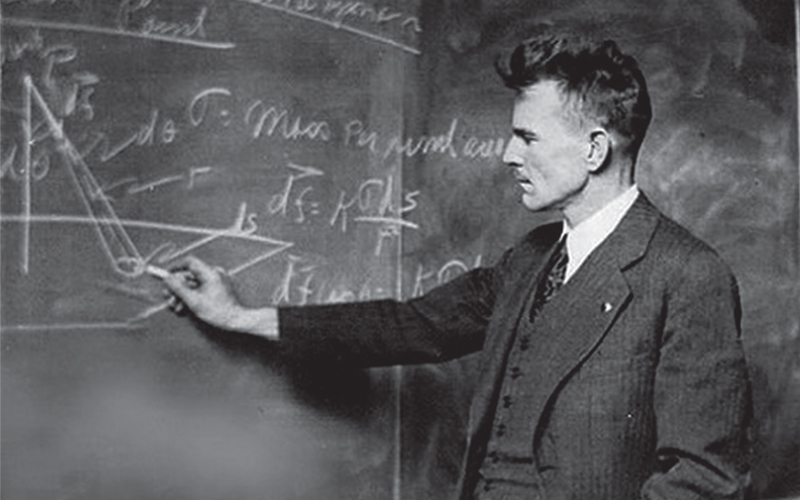
A recent vacation afforded me the opportunity to read The Oracle of Oil, Mason Inman’s excellent new biography of Marion King Hubbert. I strongly recommend it. But, rather than writing a standard book review (which might cover much of the same ground as this one by Frank Kaminski), I’m inspired instead simply to offer a few words in appreciation of Hubbert himself.
Born in Texas in 1903, Hubbert earned his Ph.D. in geology at University of Chicago, then taught at Columbia University. He later worked at Shell’s research laboratory and for the U.S. Geological Survey, and occasionally lectured at Stanford and UC Berkeley. His contributions to geophysics included a mathematical demonstration that rock in the Earth’s crust, because it is under great pressure over large areas, behaves in some ways more like a liquid than a solid. He earned every relevant scientific award short of a Nobel prize, and won lasting fame as the father of “peak oil”—the theory (by now more of an observation) that oil production in any large area will inevitably start from zero, reach one or more high points, and decline back toward zero. (Here is a brief video clip of Hubbert in 1976 explaining the very basics of peak oil).
For years I’ve had a photographic portrait of Hubbert, given to me by his nephew, hanging just above my computer in my home office. I described Hubbert’s best-known accomplishments—his mathematical modeling of oil depletion and his successful forecast of a decline in U.S. petroleum production beginning around 1970—in my 2003 book The Party’s Over, and I have spent most of the last couple of decades reading, writing, and speaking publicly about oil depletion and its consequences, so I could fairly be described as a longstanding Hubbert devotee. After devouring Inman’s meticulously researched and entertainingly written biography, I feel even more indebted to the great man than before.
King Hubbert, who died in 1989, was right on so many issues. He was a strong advocate of population stabilization (like my spouse Janet and me, King and his wife Miriam decided against reproducing). He was also a fierce critic of mainstream economists’ mania for growth, writing in the 1930s that the compounded growth of the economy, and therefore of consumption, in the context of a finite planet would inevitably lead to ruin. He went so far as to compare modern economists to medieval court astrologers.
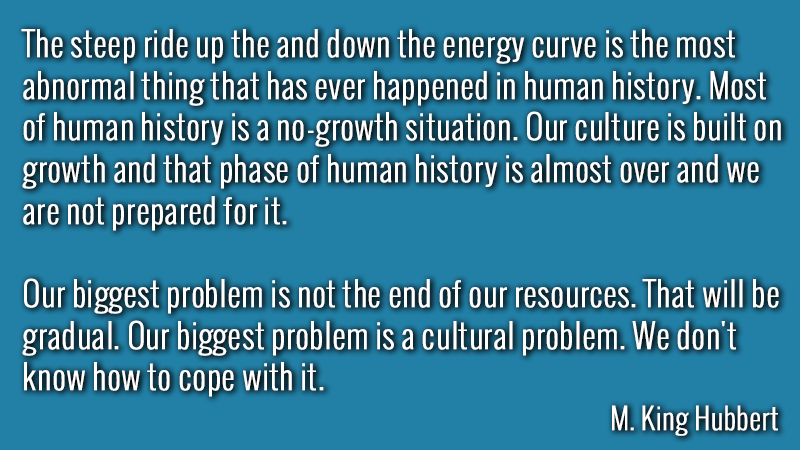
Following early support for nuclear energy and official involvement with the Atomic Energy Commission as a member of a technical advisory committee, Hubbert gradually came to see nukes as simply too risky and costly. By the 1970s, he was a passionate solar energy advocate.
In the 1980s, Hubbert became aware of anthropogenic climate change and saw it as another unavoidable reason for society to wean itself from fossil fuels.
Inman’s biography is immensely helpful in portraying Hubbert’s evolving views in the context of global events and topical controversies. At first, his bosses at Shell and USGS attempted to muzzle his work on oil depletion. Then, during the energy crises of the 1970s, falling domestic oil production and increasing reliance on imports became subjects of widespread discussion at the highest levels of government. President Jimmy Carter tried to persuade the nation to adopt energy efficiency and conservation as primary goals. But, in the ’80s, Ronald Reagan proclaimed that “there are no limits,” oil prices fell, and blind cornucopianism once again ruled national policy.
All of this is hauntingly relevant to our current situation. During the decade from roughly 2004 to 2014, conventional oil production languished, oil prices skyrocketed, and peak oil was once again a widespread topic of public discussion. Yet since mid-2014 petroleum prices have plummeted and oil depletion has again mostly disappeared from policy discourse. Pundits proclaim that “Peak oil is dead!” and insist that “No, we’re not running out of oil!”—even though peak-oil warnings never had to do with “running out,” but rather the inevitability of depletion and decline. A short-term focus on prices has thus repeatedly undercut our ability to plan for the long haul.
Today’s oil glut resulted from years of record-high oil prices and record-low interest rates, which sent torrents of investment capital flooding toward drilling projects in dismal-quality reservoirs—tight oil projects operated by many small-to-medium sized companies whose incentives were to lease land and drill as quickly as possible using other people’s money. This rapid-fire drilling flooded a depressed market, causing fuel prices to collapse and producers’ balance sheets to bleed red ink.
Meanwhile, the longer-term trend is toward higher costs to the oil industry as conventional crude production levels continue to wane and regular oil is replaced with expensive deepwater oil, arctic oil, tar sands, and tight oil. There are few if any of these new unconventional oil projects that make financial sense in today’s low-price environment, so the industry is currently investing vanishingly little in exploration. The eventual and inevitable result will be falling overall production rates and ever-more violent price swings. Without a long-term plan for weaning global transportation from its primary energy source, we face an economic whipsaw cutting first at society as a whole (when prices are high), then at the oil industry (when prices are low), with each turn of the blade made more savage by declining resource quality and by massive and growing levels of debt not only within the oil industry but throughout society as a whole.
M. King Hubbert tried decades ago to warn us about all of this, and he deserves to be remembered and celebrated. But it’s more than a little sad to see how his visionary contributions have been mischaracterized and largely ignored.
11 Comments on "A Personal Appreciation of M. King Hubbert"
makati1 on Mon, 18th Apr 2016 7:02 pm
All great thinkers were ignored or ridiculed in their time. Humans don’t like to think about negatives. Now we face the results of his prediction and there is no escape except into dreams and denial.
onlooker on Mon, 18th Apr 2016 7:13 pm
And so it is with the seminal study of Limits to Growth, The book Population bomb by Paul Erlich and other warnings by Cassandras. Society at large along with the power brokers ignoring everything. Well, consequences now are inevitable.
Boat on Mon, 18th Apr 2016 7:37 pm
mak,
All great thinkers were ignored or ridiculed in their time.
I know how they felt. Lol
makati1 on Mon, 18th Apr 2016 7:45 pm
LMAO. Thanks for the laugh, Boat.
Boat on Mon, 18th Apr 2016 9:03 pm
mak,
Have some fun mak. There is still time.
makati1 on Mon, 18th Apr 2016 9:50 pm
Boat, I am enjoying life, probably much more than you are.
I am totally free to do as I please, live where I choose, pay no tribute (taxes) to any government other than sales taxes, read, study, learn, enjoy my kids and theirs, see the world (Japan,, Dubai, London, Paris, Hong Kong, and the Ps. in the last 10 years), and not fear death.
I do not need TV, movies, porn, sex (it becomes less important after 70), or an I-toy to keep my mind occupied. I enjoy good health and have no need of meds or doctors. I eat what I want, when I want it. I do not even think about death. It will come when it comes.
Do you really understand what ‘fun’ or ‘freedom’ really is? If you are an American, living in the Police State, I doubt it.
Boat on Mon, 18th Apr 2016 10:51 pm
mak,
This may come as a surprise but in all my encounters with the police they have been polite with no problems. Taxes are needed in any society. I have always paid them to do my part. That’s what normal people do. Glad your happy. It’s good to be happy.
makati1 on Mon, 18th Apr 2016 11:25 pm
Boat, taxes, at least personal taxes, are NOT needed. They didn’t exist in the Us until the Federal Reserve came into being (1913). Taxing consumption is one thing, but taxing personal earnings is another.
https://en.wikipedia.org/wiki/Income_tax_in_the_United_States#Income_tax_rates_in_history
They are a form of slavery and a means to drain the life blood of the many up to the few.
Today, ~70% of Americans receive at least some income from the government (other tax payers). And you do not have a choice, or a say in it. The US is the only country that taxes the income of its citizens no matter where in the world they earn it. The only way to avoid it is to renounce your citizenship and pay an exit tax.
http://www.zerohedge.com/news/2016-04-18/morally-sound-tax-reform-proposal
Yes, I paid income taxes also, and now I am one of the ~70% getting a part of it back. If I live another 11 years, I will have gotten about $350,000 of YOUR tax dollars through SS. That assumes that the US is still a functioning country, which I doubt very much. At least, I hope it is not.
makati1 on Mon, 18th Apr 2016 11:28 pm
Boat, I did not say “Police” I said “Police State”, two distinctly separate things. If you don’t understand the difference, there is not enough space here to explain. You are on your own.
Davy on Tue, 19th Apr 2016 6:42 am
Makati Bill, life is good enough here where I am at. Nothing like you and the anti-mericants sowing circle preach daily. We have huge problems but so does the world. What is the difference? You can huff and puff all you like but we are doing fine. It is proving out we are the least dirty shirts at many levels and that sucks for agendist who preach anti-empire rhetoric. This board is theater much like Hollywood. If you want to be popular it is not about being smart it is about how anti-mericant you can be. Really it is about how anti-everything you numb-nuts can be except yourselves. You guys are really good at talking up yourselves. I love when you guys pat each other on the back like chums.
The American dream is dying but so is the myths of globalism and the lifting of the world through growth and development. There is no place in the world that can boast about a good life that is without risk. You can cherry pick places but all are on a knife edge of collapse. Your Philippines is one of the worst positioned primarily because of its overpopulation predicament and climate change position.
PeterEV on Tue, 19th Apr 2016 12:07 pm
>>His contributions to geophysics included a mathematical demonstration that rock in the Earth’s crust, because it is under great pressure over large areas, behaves in some ways more like a liquid than a solid. <<
I always wondered why "India" moved from where Madagascar is today to where India is today. It may have taken 66 million years to do so. I wonder how deep the rock has to be before it become "soft"/pliable. Then what pushes or pulls that section of the mantle from where Madagascar is today to where India is today??? I would think that the layer would be below where earth quakes stop occurring. How much further is it from there to lava?
There is a YouTube video where a blacksmith heats up an iron bar to well below the melting point of iron yet easily bends it out of shape. His point was that burning aviation fuel can produce enough heat over time to bring steel to point of pliability; enough to weaken and bring down a building or two.
In Sherman's "March to the Sea", his troops heated up railroad rails using wood heat alone. Once heated to something in the 1300-1600 degree Fahrenheit range, the troops easily bent them around trees. They were called Sherman neckties.
One of the things not mentioned is that he was asking questions and trying to figure out the why.