


Ed. note: Nate Hagens gave this talk on Earth Day on April 23, 2018 at The Land Institute, Salina, Kansas. What follows is an edited transcript of the talk.
The Human Predicament
Around 11,000 years ago, as the last ice age ended, our ancestors – in no fewer than 5 locations around the world – took advantage of the new conditions and tried an agricultural way of life. Fast forward through two momentous phase shifts in human history (agricultural and industrial revolutions), and here we are: approaching 8 billion, seeking freedom, experiences, and material wealth all derived from physical surplus. As many are aware, the procuring of this ‘surplus’ is also impacting the larger sphere outside our homes, (we call it “Earth”) in increasingly deleterious ways. Yet, at an annual global growth rate of 3%, which most governments and institutions expect, we would close to double the size of energy and materials it took us 11,000 years to amass, in the next 25 years.
Under current trends, a college student today would see over 2 such doublings in her lifetime. (yes, 2Xè 4X in size by the time they’re 70). Is this possible? Is this desirable? What are the variables that will influence this trajectory? What would be the impacts if it happens? And if it doesn’t? There currently is no natural entity in our society charged with such questions. Or answers to the questions. But perhaps there should be. A systems synthesis which integrates aspects of energy, the environment, the economy and human behavior is a prerequisite to understanding what is unlikely, what is possible, what’s at stake, and ultimately what to strive for and work towards.
The Key Continuums
My own conclusion is that The Next Doubling is now no longer possible. In the coming decade we are going to have to collectively deal with what I refer to as the Great Simplification. This will mean less physical throughput and fewer economic benefits to the average citizen in the developed world than the past 2 decades. If managed, the Great Simplification could result with positive outcomes and a saner system and very high standards of living vs most periods in our history.
Below is a condensation of some of the big themes relevant to this trajectory. On some of these “continuums and contrasts”, our current institutions and plans are far from realistic suggesting tectonic cultural shifts are necessarily on the near term horizon. (NB: this is the horizontal story – there is ‘vertical’ depth available on each of these points)
As we go through this list, the main 3 points of this talk will be:
- Energy underpins human economies. (We are living midway through the Carbon Pulse)
- We are headed for a world with less total consumption
- After basic needs are met, the best things in life are free
Energy/Economy
Energy vs Everything else – Human wealth and productivity is commonly attributed to our own cleverness (technology/productivity), existing wealth (capital) and hard work (labor). These inputs are important but in turn are all dependent – on energy. Modern economies eat power like animals eat food – every object and service in human economies first requires an energy input to convert it into something useful. Ergo, $1 of petroleum has orders of magnitude more value than $1 worth of pencils, paperclips or pastries. But energy, other than perhaps its dollar cost, is invisible to our society.
Flows vs Stocks – The human economy runs on natural resources like copper, iron and phosphorous. Globally $1 of GDP results in ~1KG of extracted minerals, energy and materials. We are particularly dependent on high density energy resources like oil and natural gas and from a long term perspective we are living during what might be called ‘the Carbon Pulse’, a one time bolus of fossil productivity injected into the human ecosystem. 98% of physical labor in modern world is done by machines which in turn are 85% powered by energy dense carbon compounds. Few think about it, but 1 barrel of crude oil, at 5.8 million BTUS, for which we currently pay $70, contains the work equivalent of 4.5 years of human labor, for which we pay (in USA) $140,000. The average American uses 54 of these ‘barrels’ per year directly, with an additional 10-20 via imported goods, equating to ~300 ‘fossil slaves’ supporting our lifestyles. In effect, though we eat ~2,500 calories via food, we each ‘consume’ over 200,000 calories per day overall. Our culture effectively treats all these geological inputs as ‘flows’ (like rivers, rain, sunlight, tree growth) but they are depletable stocks. No natural resource stocks are renewable on human time scales. Drilling holes is not sustainable. Our cultural stories conflate stocks with flows.
Stocks vs Abstractions – Stocks (oil, copper, phosphorous) typically follow predictable (gaussian) curves that rise, peak and decline. The amount of these ‘stocks’ we access has generally been increasing for over a century but has now started to decline in many cases (oil quality, iron ore grade, copper overburden etc). But our supply of money and credit continues to increase with no reference to the area of the curve remaining for these one-time natural stock endowments. (Globally it took over $4 of new debt to add $1 of additional GDP in 2017). We can print money, but we cannot print energy, only extract it faster with borrowed money.
Gross vs Net – We commonly count on the absolute amount of a resource, stock or reservoir available without considering the amount of it that can be technically or economically extracted. As we access the deeper, harder to find and more environmentally damaging resources, we spend an increasing amount of the key resources to get at the key resources. (E.g. static field decline for US shale oil is 30-40% per year, so production will now largely be a function of how many new wells are drilled). We have now left the era where our culture spent ~5% of our energy on finding and delivering energy, to one where we will be spending ~10% or even ~15% to 20%. This all manifests in higher costs and lower benefits for people and economies. As more energy is redirected to the energy sector, which sectors will get less/none? The net is ultimately what we are able to spend.
Joules vs Work – Energy can only be substituted by other energy. Conventional economic thinking on most depletable resources considers substitution possibilities as essentially infinite. But all joules are not created equally. There is a large difference between potential and kinetic energy. Energy properties such as: intermittence, variability, energy density, power density, spatial distribution, energy return on energy invested, scalability, transportability, etc. make energy substitution a complex prospect. The ability of a technology to provide ‘joules’ is different than its ability to contribute to ‘work’ for society. All joules are not created equally.
Economy vs Economics – The modern human ecosystem can be simply described. We use technology to convert energy and materials into products measured in dollars. We turn the dollars/products into neurotransmitters (feelings) + waste/impact. Repeat at larger scale. We often mistake a trend for a reality and a short-term pattern for an axiom of nature. In a modern (and relevant) case, we have constructed rules and ‘economic laws’ around a long-by-human-lifespan, but short-by-human-history unique period of time – where because of one-time inputs on geologic time scales, we’ve experienced continual economic growth for over a century. The constant growth we’ve experienced was correlated with human inventions and economic theories, but the cause was finding a bolus of fossil sunlight. We behave like squirrels living in a forest where a truck full of hazelnuts crashed, living off the freight and thinking it will last forever. Economic theories have -until recently – been right about describing our trajectory but for the wrong reasons – they largely ignore the physical and biological underpinnings of the human endeavor and will have to be reworked.
Behavioral
Human vs Animal – Humans are clever, unique and very capable. Yes, we are special, but we are èpart of the animal kingdom – part of the mammal and ape lineage. Our behavioral repertoire is amazing, yet still constrained and informed by our heritage.
Proximate vs ultimate – Why do we want that job? Why do we waste time on Facebook? Why do we love stock market returns? Why do we dislike that person? Why do we want to play with puppies? Why do we go to war? There are proximate – or ‘surface’ explanations for all these behaviors, but there are also ‘ultimate’ explanations based on our ancestral past. These “ultimate” explanations can predict and make sense of much of modern human behavior. Ultimately, we go through our daily lives seeking ‘brain services’- activities, experiences and behaviors in the modern world that provide the same ‘feelings’ that our successful ancestors got in a different environment.
Belief vs Facts – The human brain can imagine and speak many more word combinations representing reality than exist in reality. As such the virtual world in our minds seems more real to us even in the face of science, logic and common sense. And since we construct our own individual virtual worlds, we prefer them over the virtual worlds in others’ minds. Which is why ‘beliefs’ are far more powerful than facts. Beliefs usually precede the reasons used to explain them. Which is why fake news works and why we find it extremely difficult to convince people about climate change, energy descent, the limits of technology, etc.
Now vs Future – We are biological creatures with finite lifespans. For good evolutionary reasons we disproportionately care about the present more than the future. But most of our modern challenges are ‘in the future’.
Supernormal vs Normal – Modern technology provides stimuli orders of magnitude higher than our ancestors seeking similar feelings experienced. For them, a berry found on their path was a rare sweet surprise, while we buy sweets by the pound at the grocery store, or shipped via Amazon. We can easily become hijacked/addicted to things that ‘feel’ important but are just ephemeral action-potentials in the brain, not in the real world.
Relative vs Absolute – Fitness in nature is correlated with caloric intake per unit of effort. We each follow this simple ‘foraging algorithm’, mediated by the neurotransmitter dopamine, to get more for less. But after basic needs are met, this algorithm shifts to caring significantly more about our comparative performance, income, status, ranking vs others than we do about absolute measures of same.
Wants vs Haves – Our impulses to want something – a pair of shoes, a new car, a toy – feel more intense to us than the satisfaction we get from the possessing of that thing on ongoing basis. Which is why our basements and storage units are full of the ghosts of dopamine past. While our physical world is based on stocks, our brain and behavior is based on flows, which need to be continually experienced each and every day.
Wants vs Needs – Once our basic needs (food, water, basic services, social respect) are met, we get very little additional life satisfaction from increased consumption.
Me vs Us – We are a biological species, and as such on the spectrum of competition vs cooperation, we are generally looking out for #1 – ourselves and our family-relative to others.
Us vs Them – But our formative years (millennia actually) were in small nomadic tribes on the African savannah. The success of our tribe -in hunting, resource acquisition, and defense against other tribes, dictated – and often trumped – our own individual success. This intense favoring of ingroups and ostracizing of outgroups – be they different religions, different political groups, different sports teams or even just different opinions about the future – remains with us today.
Genes vs Culture – Human nature does not change in the short term- our great great+ grandchildren living in 200 years will be subject to all the same drives and constraints I just mentioned. But culture can manifest emergent behaviors -both positive and negative – that can happen on much shorter timelines, even less than a decade in some cases. Our genes tell us what we need, but culture dictates how we get it. We can get at least a good portion of ‘what we want and need’ using less stuff with less damage.
Environmental
Internal vs External – In the modern formulation of the market system, we internalize profits and externalize costs. The costs -of pollution and negative social impacts-, are born by the commons and the public, which includes other generations and other species. No industry in the world would be profitable if full cost pricing were to include all externalized costs (e.g. damaging impacts of coal ($0.38 kWh full cost instead of $0.04). But most other species don’t care at all about externalities, and as we become socially aware of our downstream effects, we have done more to respond to the costs. Relevant examples include DDT, chlorofluorocarbons, polluted rivers, and unleaded gasoline. But CO2 remains an impact that can’t easily be ‘internalized’.
Treasure vs Riches – The vast ecological riches of our natural world: mineral deposits, millions of species, vibrant ecosystems, lush rainforests, etc. are only counted as having value to human economies once they are converted. In our quest for treasure, we have plundered our riches, and the default plan is to continue to.
Civilization vs Community – Humans now appropriate between 30-40% of the annual productivity from sunlight interacting with soil/land on our planet. Additionally, we (and our cows, pigs, goats, dogs, sheep, etc.) outweigh the sum total of all other terrestrial vertebrates by a ratio of over 50:1. The continuum between human civilization and Earth community – at least so far – has been solely headed in one direction.
Seen vs Unseen – Many of the ‘externalities’ of human commerce we can only read about. Today looks very similar to yesterday. Yet: E.g. France (and other countries) has lost 1/3 of its bird population in the last 15 years across the board due to fewer insects (presumably due to pesticides), sea creatures 10km deep are found to have more toxic chemical concentration than in polluted Chinese rivers, we have lost 50% of animal populations since the 1970s etc. Human sperm count in the developed world has dropped ~50% in past generation. The ocean has lost 2% of its oxygen in the last 50 years, etc. We focus (naturally) on the seen – but the unseen currently tells a worrying story.
(The preceding 21 points can be (and will be in a separate document) supported by modern science. The points below are logical implications from the above synthesis, but as presented are more my own conclusions.
Cultural
Heat Engine vs Intelligent Foresight – In modern human culture we cooperate at various scales (individuals, corporations, nations) to maximize representations of surplus (monetary profits). Once we understand that 1) all goods and services leading to economic output first require a primary resource conversion, 2) GDP is highly correlated with energy, 3) to provide ‘brain services’ to as many people as possible, governments and institutions do whatever they can to keep access to energy growing. (credit creation, rule changes, guarantees, etc.) the common economic statistic Gross Domestic Product takes on a different connotation. To a reasonable approximation: GDP could be renamed as GDB – Gross Domestic Burning, as underpinning every economic transaction, a small fire happened somewhere on earth. From a birds-eye view, modern human society is thus functioning akin to an energy dissipating structure. With a collective focus on short term profits, we tacitly assume the best futures will naturally arrive. But viewed from a perspective of GDB, the market itself cannot use intelligent foresight, only march forward, 3 months at a time.
Narrow vs Wide – Each issue we encounter has different correct answers depending on how wide a perspective is used. We can look at the impact of a policy on e.g. the taxi driver, on the taxi company, on New York City transport system, on New York City itself, on USA, on the world today, on future generations, on ecosystems etc. Most current predicaments are viewed from a wider boundary perspective, but most cultural decisions are made using narrow boundaries.
Finance vs Natural Science – In the 20th century we constructed societal infrastructure and expectations on rules from finance and economics, but the rules from natural sciences and ecology: primary productivity, trophic cascades, carrying capacity, overshoot, bottlenecks, phase shifts, succession, pulses, etc. are going to be much more pertinent in the 21st.
Unlimited vs Limits – Imagine a world with 7.6 billion humans and no laws. No speed limits, no taxes for public infrastructure, no rules, no courts of law, etc. Humans instinctually have problems to self-impose limits. So, via social contracts and reciprocity, we have learned to recognize the importance of such institutions, and as a result, society is better off. Though we have recognized the importance of rules and constraint on personal behavior and impact, we have not yet matured to recognize limits for society at large.
War vs Peace – Historically in times of fewer resources per capita, earlier human societies (and tribes before them) went to war. But this continuum is so often avoided in discussions that it needs to be mentioned. We will go to war again if we don’t manage to cooperate to solve the future constraints in a constructive way, and there are ways. This time, war would be much more devastating than ever before in human history. We have had anti-war movements in the past and hopefully will again in the future – what % of our ‘carbon windfall’ is directed to military spending? In a peaceful world where might it better be directed?
Population vs Consumption – We are 7.6 billion en route to 9-10 billion. UN (and other international institutions) misunderstand the energy primacy underlying human economies. Does a carbon pulse informed synthesis imply substantially lower populations this century? No. Unless some of the 4 Horsemen of the Apocalypse show up, by far the more likely scenario is a maintained high population level, with less resources per capita (maybe considerably less). Malthus was “right” but missed the ‘vertical revolution’ of fossil carbon. Ehrlich was “right” but missed globalization and the birth of credit markets, pulling resources forward in time. Perhaps someone today hearing this story immediately expecting large population die-offs based on resource constraints will also be ‘right’ but miss the more obvious trajectory of consumption decline rather than population decline. In the developed world, where people consume 50-100x their food consumption for other things, there is a lot of room to go down without affecting wellbeing. So less consumption is still viable, and even desirable. With 350,000 new babies born each day globally but 350,000 people/families per day also entering the global middle class, with ~5:1 higher throughput than the average, the ‘population’ issue takes on a different flavor.
Intelligence vs Wisdom – Human history is replete with quite intelligent and otherwise successful cultures which simply got something about the big picture crucially wrong. Easter Islanders believed that resources flowed from the good will of their ancestors, so it was only logical to cut down all the trees to aid in the construction of ever-bigger stone heads. Their behavior was clever but not wise. Our culture similarly rewards reductionist viewpoints and expertise in solving problems. But as we increasingly reward vertical expertise within a discipline, we lose the wisdom that comes from crossing disciplines. Simply put, intelligence and wisdom work best in synergy. Modern humans, with ample intelligence but a dearth of wisdom risk becoming idiot-savants, metaphorically pushing levers in increasingly clever ways, for building modern versions of the stone heads on Rapa Nui.
Trivia vs Relevance – Our Education system is becoming less relevant for the future we are facing. Primary and secondary education are a product of energy surplus. Paradoxically, they also are one of the few investments that can contribute to ‘future surplus’. Education from a lens of intelligent foresight would focus on science synthesis, understanding our own minds, on ecological principles, dealing with uncertainty, and on the problem-solving skills which will be increasingly needed in a lower-energy-throughput society. Less specialization and more systemic understanding would be the order of the present day.
Dollars vs Humanity – Of all the supernormal stimuli in modern culture: social media, twitter, Overwatch, slot machines and meat lovers pizza, perhaps the largest and most pernicious is ‘dollars’. We have managed to parse the entire inventory of what made us function in tribal conditions over tens of thousands of decades into one variable: digital/linen markers of status and success. We certainly need currency for transacting and storing wealth, but our culture has taken it to an extreme, gradually but almost completely financializing the human experience. One can hope that a vast pool of expressions of humanity lies dormant beneath the stacks of electronic digits.
Good vs Evil – Humans are not evil, not any more than wolves or wildebeest. However, at 8 billion strong, pursuing surplus correlated with finite source and sink capacity, our actions have ‘evil outcomes’. It is important to not conflate our collective impact with who we are as individual life forms. What is happening is no one’s fault, but we are all complicit.
Should vs Will – Many people are promoting campaigns for what our society ‘should’ do to solve our myriad of? economic and environmental problems. But most of these recipes, -with albeit laudable goals – are either incompatible with our physical reality or with behavioral patterns evolved over hundreds of thousands of years. Banking on ‘sudden insight’ into the greater good by a majority of people is something environmental activists have done since the 1960s, and climate activists for almost 2 decades, yet we’re still emitting more CO2 every year. It is unlikely we will en masse prepare for the Great Simplification ahead – the cultural, behavioral and systemic barriers are too large. Relative to planned “change”, we will instead “react and respond”. Instead of advocating for unrealistic outcomes, we can put effort towards changing the initial conditions that will result in better outcomes and then make new moves – currently not on the gameboard, possible.
Popular vs Realistic – Similarly, a full accounting of the severity of our predicament – on radio, television and in papers, will never be popular. It’s much more comfortable (and profitable) to be entertained, marketed and promised various contrived solutions, usually with some unproven or physically unscalable technology, or based on hard-to-detect fantasy ignoring natural science. We should recognize that glib solutions, typically aren’t solutions. But acknowledging that would be… distressing, and unpopular.
Left vs Right – Other than perhaps climate change, both democrats and republicans are both sharply divorced from the realities of our coming challenges. Resource depletion, credit overshoot and the accompanying systemic risks are absent from any political conversations. Instead, substantial energy (and vitriol) are expended on the things an increasing polarized society disagrees on. We will one day soon appreciate (and hopefully engage with) the issues that most of us agree on: basic needs, family/friends, healthy food, peace, respect, meaning, and a safe and clean environment for our grandchildren to grow up in. As such the current arguments between Republicans and Democrats is akin to arguing about which mosquito repellent is best to put on our arms, while a crocodile has our leg in its mouth.
Economy vs Environment – If you could create a list of the 10 best ways to improve the environment, (e.g. carbon tax, protecting international fishing zones, driving curfews etc.) it would be likely all 10 would be bad for economic growth. Similarly, a list of 10 best ways to grow the economy (e.g. baby subsidy, tax rebate) would all likely make either the micro or macro environmental situation worse. This century, we are going to perpetually make decisions (or not make decisions, just act) on a spectrum between what’s best for economic growth, and what’s best for planetary ecosystems and our long-term wellbeing. It’s probably good to realize (and care about) this upfront.
Rights vs Right – There have been many social contracts in recorded human history. From the Code of Hammurabi 3500 years ago to the Magna Carta and U.S. Constitution, humans have often created rules and guidelines to properly delineate the needs and circumstances of the time. We now live on an ecologically full planet – and are aware of what we are, where we came from, what we need, what we want and what we are doing – to each other and to our surroundings. With this backdrop there is a distinction between ‘right’ and ‘rights’. This continuum will remain a back-burner item. Until it moves to the front burner.
Individual
Certainty vs probability – The future exists as a probability distribution of: very bad, bad, so-so, benign and very good futures. But people dislike uncertainty. When we hear about the all these energy and environmental scenarios we typically either a) reject or deny the implications using rationalizations along the lines of ‘technology will solve it’ / ‘we’ll think of something’ etc. or b) ‘it’s too late – there’s nothing we can do -might as well enjoy the day’. These reactions seem the opposite on the surface but have two things in common: 1) they create dissonance resolving ‘certainty’ in our minds and in turn 2) they obviate the need for personal response and engagement (which would be uncomfortable emotionally and physically). The reality is that future is not yet determined and exists as a constantly shifting probability distribution based on events, technology, wisdom, risk and the actions of individuals and communities. We need more people to avoid the two poles of denial and nihilism and stay in the center, own a bit of dissonance, and engage.
Less vs More – We have financialized the human experience, parsing everything of substance, depth and meaning from our tribal past into electronic/linen markers. Once our basic needs are met we don’t really want more, we just want more than the guy/gal next door. We are headed for a world with less physical throughput whether we choose it or not. But this does not mean we have a world of ‘less’ experiences, happiness, meaning and good lives. The average Guatemalan makes under $10,000 per year but has life satisfaction and quality the same as countries with 5-10X as much income. Less and more need to be unpacked beyond their monetary labels and the gut reaction to hearing them. As individuals we can strive to be happier with absolute wealth and focus less on relative (this takes training and effort).
Crazy vs Sane – At 50x the income of humans 200 years ago, it is no wonder the average American is so distracted by convenience and lulled by false narratives as to be asleep to the real issues. People aren’t idiots nor are (most of them) liars. But we are so often seduced and misinformed by simple narratives that those warning about the converging macro crises are generally considered crazy by the mainstream. But to be ‘woke’ to the issues of the day is perhaps the only route for sanity. Owning a bit of grief and dissonance about what’s happening is eminently rational, even if it feels bad at times. If worrying about the 6th mass extinction, energy descent, limits to growth and the coming Great Simplification makes one crazy, well perhaps the world needs a whole lot more crazy. We have temporarily confused crazy and sane.
Consumption vs Meaning – At 80x more energy than our bodies need, possessing the metabolism of 30-ton primates, even the median among us live material lifestyles above most kings and queens from centuries ago. And yet many people are miserable, over-fed, over-medicated, and unsatisfied. What we lack amidst this smorgasbord of riches is a feeling of community and a true sense of purpose. Inferred by all the other points in this presentation is the obvious fact that the future needs our help. Yet most people have no concept or even belief in ‘the future’. Perhaps from awareness of our situation, the stakes, and the possibilities there may emerge a (very large) tribe connected to Tomorrow.
Thinking vs Doing – In a world of inexpensive do-overs, we have become accustomed to large wastes of time. We spend considerable time pondering esoteric theories or distracted by gadgets without learning or understanding physical skills. As our fossil slaves cease to be woken, we will increasingly have to resubstitute human labor for carbon – and it would behoove each of us to learn a physical skill. Or three.
Grief vs Joy – We like happy, carefree stories with wonder and imagination, well, because it’s comforting and nice to be happy and carefree. Part of us knows that things aren’t right, and we strive to deny that fear in things that cocoon us in comfort. Alas, the stage of our current world, approaching social limits to growth, while squeezing out the natural world a species at a time does not lend itself to a happy and carefree demeanor. It is acceptable – and even appropriate – to carry with us some grief and dissonance about our situation – because it is a perilous one. Accompanying this grief perhaps we will be resolve, anger and creativity to direct towards future related goals. But we also need balance. While holding the grief, we have to find time to refresh the white snow in the paths in our minds, with, variously: music, Netflix, beer, golden retriever puppies, night skies, old growth forests, and deep friendships. It is a wonderful and perilous time to be alive. Let’s not forget the ‘wonderful’ parts.
Hope vs Despair – Whether one feels hope or despair depends on one’s prior outlook. If you expect 12 billion people living like the average American in the year 2100, with flying cars and all climate and ocean issues solved via tech fixes, then the future painted here might look on the dark side. If instead you envision 5-6 billion humans, living a low-tech society with renewable systems, we’ve only lost 1,000 of our remaining 5,500 mammalian species, climate has stabilized under 2C, and we’ve avoided nuclear wars, then there is a great deal to be hopeful about as that future and many like it are still on the table.
Conclusions
We cannot know the future, but we have reasonable confidence of what it will not be. The peak in fossil sunlight flow rates and resultant higher costs will mean major changes in our lifetimes. We can be reasonably sure the average energy/material throughput for Americans – and global citizens, particularly in advanced economies, will decline in coming decades. It’s important to point out that a 30% drop in material wealth per capita (for those in the United States and Canada) though sounding draconian, brings us back to 1993 levels – a 50% drop would bring us back to 1977 levels– both periods nobody considers economically challenging. How we respond to this energy descent as individuals and as a culture will be a deciding moment in our history.
All the ‘cultural’ and ‘individual’ observations above coalesce to a fine point: we are capable of much more, but are unlikely to alter our current trajectory until we have to. And when we add in the economy and environmental points: we will soon have to. Recognizing this, the next step is urgently discussing and cataloguing what initiatives might be worked on by small groups using intelligent foresight nationwide.
Given we have ~100:1 exosomatic surplus buffer, there remain a great deal of benign, and even excellent futures still on the table. But they won’t arrive without effort. The world isn’t irretrievably broken, the Great Simplification has barely started, and there are quite a few people who are discovering exactly the shape of our predicaments, and the nature of the things which could substantially change them.
NB: While I believe education itself is insufficient for major change, it is still a necessary first step so that pro-social engaged citizens work towards feasible and desirable goals and react to events in more rational ways. My own goal with this content is threefold:
- Educate and inspire would-be catalysts and small groups working on better futures to integrate a more systemic view of reality
- Empower individuals to make better personal choices on navigating and thriving during the Great Simplification coming our way
- Change what is accepted in our cultural conversation to be more reality based
Dear people of Salina and Kansas, I invite you to participate in the future.
dave thompson on Tue, 8th May 2018 7:00 am
Nate Hagens spells the human predicament out very well. The only part he leaves out is that we humans are akin to the yeast in a wine vat eating and reproducing until the sugar is consumed and the waste left behind finishes us off. End of story.
Darrell Cloud on Tue, 8th May 2018 8:29 am
I do not have to get 8 billion people through the bottleneck. I only need to get 5 through it. That is in fact possible.
dave thompson on Tue, 8th May 2018 8:40 am
When the bottleneck comes about, what happens to the 430 some odd nuke power plants and the fuel rods that need to be kept cool?
Duncan Idaho on Tue, 8th May 2018 8:43 am
Nate has clarity that must be discarded, or reality makes people whimper in a fetal position.
MASTERMIND on Tue, 8th May 2018 9:01 am
Higgens
He knows the truth but always sugar coats it with a koombaya conclusion…i watched his earth day presentation a couple years ago. and he said there would be no energy shortages in the future. And this was two months after the IEA warned about oil shortages coming in a few years in the wall street journal…
Dredd on Tue, 8th May 2018 9:07 am
“Where are We Going? … We cannot know the future”
To know where we are going all we need to know is the trend line.
We are trending toward the largest mass grave event in human history (The Simple Choice: Leave Oil In The Ground).
Sissyfuss on Tue, 8th May 2018 9:44 am
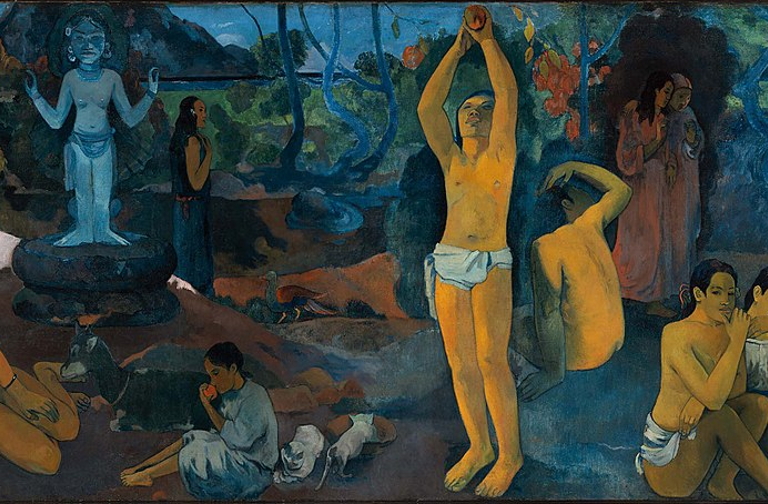
Gauguin the artist saw what the white manifest destinites were doing to the Tahitian culture when he painted this brilliance. The invaders knew better than the locals what must be done to save their souls and procure wealth for the invaders, a praxis that has been repeated throughout mankinds sordid history of denuding the natural world and enslaving those who were happy just to be. Mans maniacal lust to improve through subjugation has come to its end. Our hard driven need to explore this world and conquer it has come full circle and we come face to face with ourselves, shocked and confused as to our next move. Moving to Tahiti to paint makes as much sense as anything else one can think of.
MASTERMIND on Tue, 8th May 2018 9:45 am
Now that Trump is going to likely pull out of the Iran deal. The media will start spreading fake news claiming how evil Iran is. And that they threatened to “Wipe Israel off of the map”…..
MASTERMIND on Tue, 8th May 2018 9:49 am
Dred
Leave oil in the ground? Are you insane? We would starve to death…
MASTERMIND on Tue, 8th May 2018 10:30 am
When you have physical growth on a finite planet, pressures are going to mount to stop the growth.
-Dennis Meadows
roccman on Tue, 8th May 2018 10:36 am
Males were castrated many tens of thousands of years ago by the rulers of the day. Look into the “bull” hermes “stole” from Apollo – and the breeding snakes he separated with the olive branch (now known as the caduseus). This act gave the mob the power to breed. Up until then nature and man lived in equilibrium. Now the mob has taken over – the default action has become the Ark of Upnepishtim – The preserve of Life – The Temple of Man. Where are we going – to utter destruction for the mob – and a life boat for those that know and have diligently been building the “surface”. Read Steiner’s lecture on the Acanthus Leaf.
Darrell Cloud on Tue, 8th May 2018 2:05 pm
I don’t know Dave what happens to the nuclear plants. Their total impact is conjecture at this point. I am going to keep helping my kids right up and until the moment I stop breathing. The rest of you can do what you will.
dave thompson on Tue, 8th May 2018 2:40 pm
Yes I admit it is conjecture. No matter who tries seeing into the future. I don’t have kids of my own but I do have young people in my life I worry about. We just all have to wait and see what the future has in store for us.
jef on Tue, 8th May 2018 8:09 pm
That PhD really f#(#ed Nate up good.
Saying the same thing over and over in different and flowery ways is a total waste of everyones time but at least it keeps Nate busy and the paychecks coming in.
Plantagenet on Tue, 8th May 2018 8:31 pm
Nate Hagen speculates about decreasing US energy consumption, but seems unaware that the real problem the world faces now is continued rapid INCREASES in energy consumption in China and India.
Cheers!
dave thompson on Wed, 9th May 2018 4:10 am
Hey Plantagenet FUK U AND BEERS!!!!!!!!!!!!!!!!!!!!
Davy on Wed, 9th May 2018 6:34 am
“Question Everything: Series Indexes George Mobus”
https://tinyurl.com/yamqpf3u
“This is what we call wisdom. Wisdom isn’t the same thing as rational thinking when done in conscious working memory. For example, when one is trying to decide on a course of action based on some set of facts and conditions, they are using their best rational thinking (which, however, is still constrained by the facts they have and their perceptions of conditions, which may be faulty even if their thinking is relatively sound). Wisdom works on a very long-term time scale and produces background guidance to our rational thinking through judgements and intuitions that are barely perceived in conscious thought. The same is true for affective states of mind that operate to nudge rational thinking as demonstrated by Antonio Damasio’s work. Emotional guidance works to speed up rational choices by pruning the decision tree based on positive or negative valences for the choices themselves. Wisdom can slow down rational decision making, but generally helps speed it up but based on the “expertise” encoded in the elaborate and largely veridical models operating in the subconscious. That is the thumbnail sketch of sapience.”
“Consciousness, then, not only consists of the capacity to be aware of what is in working memory (the stuff we see and think in language) but to process information subconsciously as well. It takes sapience as well as cleverness and emotions to produce a fully competent mind.”
“We rely on ideologies because we lack the critical capacity of wisdom. It remains to be seen whether it might be possible to boost our capacity for wisdom in the general population in time to stop doing what we are doing now and understand what needs to be done in the future in order to survive as a species. Greater wisdom depends on higher consciousness — the ability to be aware of greater scales of space and time, and greater capacity to understand consequences of actions.”
“A future, new society will have to be based on quite different principles than those that guide our current ways of living in the world. Human beings will have to abandon many current beliefs and ideologies that are popular or attractive, but for the wrong reasons. They will have to adopt many attitudes and understandings that are currently only poorly received and not at all understood properly. Do we have the capacity to learn these, or do we need to undergo further biological evolution in order to accomplish this?”
Davy on Wed, 9th May 2018 6:35 am
There are parallel currents going on with the question of “Where are we going”. Really there is so much thinking that has gone into this that it is beyond a simple explanation. At some point we have to withdraw from getting detailed or otherwise we get lost in multiple thought directions. We then have to let go of controlling this flow and flow. This means living as we are with the good and bad and stop the circular reflections. Nature is being Nature through us so be natural with all the dualistic good and bad we reflect on. Nature is not dualistic except with life as it becomes self-conscious. This means at some point recognizing our solutions are natures.
We have technology and we have wisdom to utilize in our journey to “where we are going”. Wisdom at this point in time is much more important than technology. Technology has hit diminishing returns. It cannot solve our problems and in fact is making them worse. This does not mean discarding technology. It means wisdom now more than ever is required to determine what technology if any should be employed. Technology includes markets and price. Our global system is technology in force. So this is about determining where we are in globalism not where globalism is going because globalism is now a feedback loop.
Wisdom I fear is no longer capably of guiding our species at the global level. It is not that wisdom is not working because it is a natural human expression. The problem is we are out of scale and proportionality with our populations and consumption. This system as grown so large it is now self-organizing and a metastasis from a malignant growth. It has taken on a life of its own and spread to all human activity. It is now an ecosystem but of course a subset of the greater planetary ecosystem. It is linear but also nonlinear. The linear will be put to the test of limits of a finite planet. The nonlinear is our metaphysical aspects that involve myth and behavior. The planetary ecosystem is circular and finely honed. It eventually turns all linear forces circular. Keep this in mind.
Where we need to focus now is behaviors and wisdom. We need to do this locally and with community. We don’t have to withdraw from the global but instead use it to leave it. What I mean by that is live your life governed by globalism. Recognize the delocalization of your local. This delocalization is the reality your local cannot survive as-is without globalism. Take this reality and acknowledge it with humility and sobriety. From that humility go forward making your local and community more localized. I call it humility because it recognizes that you are powerless at a certain level no matter who you are and how much power you have. This is all you can do because the greater forces now are far beyond any human management at any level. Yes, we do have the ability to kill ourselves as does the individual but to manage our future it is mostly a self-organizing process. It has a shelf life so plan accordingly.
What this means is live to leave what you are living. It means using wisdom to navigate this departure. It means using technology as needed but rejecting technology as our solution. It means mostly behavioral changes. These changes are mostly of the kind that involve painful choices. Most big changes that involve important choices come with pain. As Mobus said “Human beings will have to abandon many current beliefs and ideologies that are popular or attractive, but for the wrong reasons. They will have to adopt many attitudes and understandings that are currently only poorly received and not at all understood properly.”
In crisis there is change. Enter crisis mode in your life and begin the tough journey of change now not when it is forced on you. This means knowing yourself, your community and their place in your local then this process must reflect on its place in the global. It means finding a local if yours has no hope. It means expanding on your local if it does have potential. Ultimately it means accepting this process that involves death. It is through this process that you can adapt and transcend spiritually but you cannot leave what is here. Transcendence is only at the metaphysical level. We are at the end of a way and near a new way. If you care about the higher qualities of life then you can go down this tough path. It really doesn’t matter though so be as you are but please don’t whine when your life is getting ripped apart if you could have changed things. It really comes down in the end to the attitude of choice and consequence.
Darrell Cloud on Wed, 9th May 2018 7:14 am
A number of years ago when I was forced into bankruptcy and lost a small fortune, one of my students made a wise comment. He said, “Life is composed of two things, the acquisition of things and the acquisition of experiences.” At some point you have to say to yourself, I have enough. Prepare your people as best you can for what is coming. Then, enjoy the sun set.
Dredd on Wed, 9th May 2018 10:49 am
“MASTERMIND on Tue, 8th May 2018 9:49 am
Dred
Leave oil in the ground? Are you insane? We would starve to death…”
You “We” people are too wee then.
In the thousands of years before oil was used we did not starve.
Perhaps “We” should return to we and stop being so wee (Wee The People – 3).
MASTERMIND on Wed, 9th May 2018 12:36 pm
Dredd
You think society wants to return to the pre oil days? Are you insane?
energy investor on Wed, 9th May 2018 7:28 pm
Our society is now so stratified into thousands of silos of expertise, that when we are eventually forced to make do with less, even the the remotest of preppers will probably be assimilated into the collective fate of each separate population grouping. That grouping may be geographical or in terms of interests/political and military power.
Society may not want to return to the pre-oil days, but by outlawing oil exploration and distribution processes, and in turn by making investment in fossil fuels politically repugnant, we will soon start reducing supply relative to demand.
When I started investing in oil, China was using less than 3 million bbls per day. In April 2018 they imported 9.64 million bbls per day. They have bought control of many oil sources that were once the preserve of the OECD.
So we will soon see how the eco-warriors that drive our governments in the OECD to waste money papering over the cracks in our exploitation of nature, fare by comparison with the pragmatists in India and China….and many other “poorer” places where the differences between needs and wants is such a matter of survival that it is understood.
A focus on reducing CO2 emissions is another guise for buggering our economies. This sort of behaviour in the socialist countries of the OECD will start to look foolish sometime soon. Probably too late to change direction.
If we had viable replacements or alternatives to fossil fuels, things may be different for a bit longer. Yet as Hagens describes, our future is pretty much determined, while we fritter away our resources.
Cloggie on Thu, 10th May 2018 4:48 am
I am driving a Ford!
https://cleantechnica.com/2018/05/09/ford-brings-its-go-plus-e-bikes-to-bay-area-bike-share-program/
(Bay Area e-bike)
Cloggie on Thu, 10th May 2018 5:51 am
There is no hunger in Africa. Instead a massive obesitas problem:
https://www.volkskrant.nl/kijkverder/2018/voedselzaak/artikelen/na-de-hongerbuik-gaat-het-in-kenia-nu-over-een-nieuw-probleem-overgewicht/
Even Dutch media leftists have to admit it.
There is enough healthy food in Africa and Africans can afford it, but they prefer the fat greasy stuff. Being fat is a status symbol.
The African Way of Life is non-negotiable.lol
Dredd on Thu, 10th May 2018 7:55 am
“MASTERMIND on Wed, 9th May 2018 12:36 pm
Dredd
You think society wants to return to the pre oil days? Are you insane?”
No, but repeating something expecting a different response, as you did, is.
Measure up (The World According To Measurements – 12).
Dredd on Thu, 10th May 2018 8:12 am
“Science shows that safeguarding the climate will require us to leave most fossil fuels in the ground. Can we restrain ourselves?” (Scientific American).
makati1 on Thu, 10th May 2018 9:12 pm
MM: “You think society wants to return to the pre oil days? Are you insane?”
By “society” do you mean the 1st world or the whole human race? If it was explained what the consequences are of oily BAU, and all 7+ billion were given a vote, the oil would be shut down tomorrow. You spoiled Americans think that the whole world lives and thinks like you do. Americans don’t even think any more. Just parrot propaganda. LMAO