what it is ain’t exactly clear

Don’t know if I’m going up
or down
-Jimi Hendrix
Golden years
Shu bop , shu bop
– David Bowie
Greetings
The big story in American politics seems to be that both parties have lost touch with middle america. And middle america isn’t happy. Now they are looking for someone to blame. But you can blame the government, the plutocrats, or the Chinese, but that won’t bring things back the way they were. What’s missing? The surplus. See
Surplus – What is wealth But that surplus has at its root – high eroi fuel. And in particular high eroi oil, because after all America runs on oil.
Eroi for oil has been dropping for years, and it’s been no problem. The transition from 50 eroi fuels to 25, was not significant. But recently its down around 10:1, and things are changing.
” This exponential relation between gross and net energy flows has been called the ‘net energy cliff’ [
53] and it is the main reason why there is a critical point in the relation between EROI and price at an EROI of about 10 (
figure 4).
.
Figure 4.
So a change from 26 to 25 is not noticeable, but a change from 11 to 10 makes a big difference.
“The EROI for petroleum production appears to be declining over time for every place we have data. Gagnon et al. (2009) were able to generate an approximate “global” EROI for private oil and gas companies using the “upstream” financial database maintained and provided by John H. Herold Company. These results indicate that the EROI for publicly-traded global oil and gas was approximately 23:1 in 1992, 33:1 in 1999 and 18:1 in 2005 (Fig. 4). This “dome shaped” pattern seems to occur wherever there is a long enough data set, perhaps as a result of initial technical improvements being trumped in time by depletion.
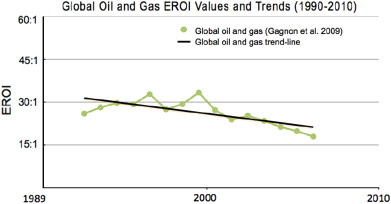
Fig. 4.
“Gagnon et al. (2009) estimated the EROI for global publicly traded oil and gas. Their analysis found that EROI had declined by nearly 50% in the last decade and a half. New technology and production methods (deep water and horizontal drilling) are maintaining production but appear insufficient to counter the decline in EROI of conventional oil and gas.
So, in 2005 it was 18 and dropping a rate of 50% every decade and a half. So if the trend continued, it would be now it would be about 12 and by 2020 it will be about 9.
These numbers may be conservative. EROI is generally measured “at the well head” Thus they do not always include the energy needed for refining and transportation. But these activities are necessary before the oil can provide any benefit to society. . Additionally, the “curve” may not be a straight line (see below)
So, if we were reaching the energy cliff, what signs should we loo for? I, like many “peakists”, had long assumed that Peak Oil would lead to higher prices. After all, economics 101 teaches that when supply goes down price goes up. And between 2000 and 2008, the market seemed to confirm that view.
But when looked from the eroi perspective, things look different. When eroi goes down, oil provides less useful surplus energy to society. more energy that used to go to society is spent producing the oil. Without that surplus, there is less economic activity, and demand would go down. And economics 101 says that when demand goes down , price goes down.
So which is it, up or down? Both! The price goes up as oil becomes more scarce, but only for a while. As long as eroi is above a critical threshold, eroi can be ignored. But, as Eroi drops past 10:1, society willingness to pay drops too. At taht point the price is no longer controlled by scarcity, but but affordability.
The Hills Group has a nice graph which illustation this. I haven’t bought the report, so I can’t really see whether the particular numbers make any sense, but the idea makes sense to me.
They show two curves, one is an unconstrained price curve, which shows how the price would rise as oil becomes more difficult and more expensive to produce. It slopes up. The second curve is the affordability curve, what the economy can afford to pay, as eroi falls. It slopes down. The Hills Group asserts that the curves intersected in 2012 and that therefore the price of oil will fall, lower and lower. ( And in fact, the price did fall starting in 2014, but it will take a while before we know what the longer term trend is.) The Hills Group asserts that the affordibility curve, (and apparently the EROI curve), is very steep, so that in a decade or so, there will be no market for oil ! see
here. This would , of course cause “the Mother of all Seneca curves” see
here So, what difference would it make to the rest of us? If this is correct, he price of oil is low and heading lower. That’s nice for Happy Motoring. In the short term, anyway. In the longer term, low price means low profit, and this removes incentives for oil companies to find more oil. Could this mean shortages? Higher prices later? Low prices also provide little incentive for the transition away from ICE transport. There is likewise no incentive for people to walk, ride the bus, buy alternative vehicles . These are the types of activities that would make an orderly transition away from oil This approach provides a slightly different view of “peak oil”. Originally Campbell and Laherrere , in their seminal article The End Of Cheapo Oil fried “peak oil” as a geological phenomenon, that would cause economic consequences . It may be more useful to see “peak oil production” as a symptom, of the underlying change – dropping eroi.




Davy on Sun, 17th Jul 2016 9:20 pm
Not enough is being said about the economic side of this oil equation discussed in this article. China began slowing down recently and this as much as any peak oil dynamic is affecting oil. The Chinese drop in her rate of growth knock on to the rest of the world and by extension oil.
http://i.investopedia.com/u53588/economist.png
I feel that the oil/economy relationship is correlated. This may sound obvious but I am digging deeper by saying depletion is to oil as deflation is to the economy and when you have both conditions operating in tandem and negatively reinforcing each other you are in a demand/supply destructive cycle with no end. We have systematically move beyond a healthy global economy now for 17 years ever since the Greenspan bubble economics was let loose along with Clinton’s gutting of Glass Steagall. China began here massive construction bubble around the same time. Bubbles are malinvestment and malinvestment leads to bad debt. Bad debt is deflationary. Mix global deflation up with the approaching dead state of oil and you get an end game of terminal decline.
Apneaman on Sun, 17th Jul 2016 11:47 pm
Blacking Out: Struggles of the California Power Grid
“The operators of the California electric grid, under a state of emergency since June, made it through the year’s first fierce heat wave, but face a near-perfect storm of setbacks as they struggle to keep the lights on until fall brings cooler weather. Be glad you don’t work there. Here is a brief list of what they’re facing:”
more
http://www.dailyimpact.net/2016/07/15/blacking-out-struggles-of-the-california-power-grid/
Hello on Mon, 18th Jul 2016 6:24 am
eroei doesn’t matter much.
Important is the absolute volume of oil available to burn. Whether half of it is burned getting more oil doesn’t matter. That’s called “economy”.
Go Speed Racer on Mon, 18th Jul 2016 9:43 am
The amount of money in your checking account doesn’t matter much. All that matters is the amount of consumer goods available to be purchased.
shortonoil on Mon, 18th Jul 2016 10:30 am
The world is producing more liquid hydrocarbons than ever. At the same time the world economy is slowing to a crawl. the Central Banks are trying to compensate by printing a huge amount of currency to fill the void created by the deflationary spiral that we have entered.
Energy starvation seems to be a misnomer with production at the level that it has presently reached. But the energy level differs accounting to were you measure it. The energy in the ground is different than the energy at the well head, than it is at the refinery gate, than it is in the consumers tank. The reason is — is that it takes energy to produce energy, and that is increasing with every barrel that is extracted.
That can be measured by determining the entropy state at each point in the cycle. Entropy is a property of matter. It says that boulders will always roll down hill, not up; that an iron bolt left in the weather will always rust, and never un-rust; that a cup of hot coffee set on a table will always cool, and never get hotter on its own. It is most fundamental law of nature that is known. It has never, ever been shown to be wrong.
The entropy level of the Petroleum Production System is increasing, as it has been since the first barrel of oil was extracted. It is pacing right along with the rolling boulder, the rusting bolt, and the constant cooling of a cup of coffee. It is taking more and more energy to get that fuel to the consumers tank. As long as production could increase faster than the effects of entropy could reduced the energy delivered to the consumer everything kept running along just fine. By 2005 that ceased to be the case. Between 1960 and 2005 production increased at an average annual rate of 5.46%. Between 2005 and 2014 it increased at an average annual rate of 0.43%. The Red Queen went flashing by.
The economy is now feeling the punch of energy starvation. The butcher, the baker, and the candlestick maker are receiving less energy today than they were 11 years ago. The world’s economy is convulsing in response. Within a decade it will have all but shutdown.
Is there a solution to this world changing disaster. There may be? One thing for sure is that it will never be found as long as we stay completely ignorant of it, and deny that there is one huge problem exploding on the scene!
http://www.thehillsgroup.org/
penury on Mon, 18th Jul 2016 11:10 am
Short, it appears that most consumers are convinced that a gallon of petrol contains amount of energy and always will. I wonder what our car mileage would be today with 1940s oil? The predicament is that it takes more fuel to produce the energy at a time of lower consumption. That means that each item purchased has a greater investment in energy and the cost should be commensurate, however deflationary pressure will prevent this. This is how the world end, not with a bang but a whimper}
shortonoil on Mon, 18th Jul 2016 1:51 pm
I wonder what our car mileage would be today with 1940s oil?
In 1930 the Model A Ford got 23 mpg. Almost exactly what the US auto fleet is getting today. The difference is that a much larger proportion of what is produced today is funneled back into the Petroleum Production Process, directly or indirectly. Since the indirect channels have growing faster than the direct ones, it is not usually recognized as a significant energy cost by economists.
Boat on Mon, 18th Jul 2016 2:37 pm
short,
Examples like that make me question you having a PHD. How could anyone with that much education come up with such a stupid example.
I finished high school and our education back then was bad. As a senior I took debate and a statement like that would have got you laughed out of the room.
You would have needed to know which energy source was used for every single part and how much.
One model a ford compared to a modern us fleet? Capabilities and designs of modern auto’s are vastly different. A hummer is different than a hybrid prius. The hybrid prius delivering less back to the petroleum process. PS keep tallying those parts.
ellsworth on Mon, 18th Jul 2016 2:39 pm
shortonoil, you have described localized oil production from stripper wells as possibly replacing the global integrated PPS in the coming decades, I wonder what kind of society can be maintained in suitable areas, possibly with the local employment of solar, maybe – by a hair’s breadth – holding on to the knowledge and skills accrued over millennia…
After a genuine systemic collapse what would oil really be good for anyway, other than powering anything that relates to food production.
Davy on Mon, 18th Jul 2016 5:25 pm
My biggest question is not if the ETP model is valid it is when will the results manifest in a cascade of collapse. It is the approach to the dead state of oil that is the important consideration. Once a cascade of collapse is in full swing then my concerns are how long will this new and disturbed state last before everything stops as we know it.
Kenz300 on Tue, 19th Jul 2016 7:33 am
Watch The Climate Change Ad Fox News Didn’t Want Its Viewers To See
http://www.huffingtonpost.com/entry/climate-change-ad-fox-news_us_57892a37e4b03fc3ee50c207?section=
Kenz300 on Thu, 21st Jul 2016 8:40 am
The top 1% want it all….. and the RepubliCON party will give it to them………..
What do RepubliCONS believe…….. depends who is paying….. follow the money……. fossil fuels….. oil, coal, natural gas…, nuclear, NRA………the top 1%
Are RepubliCONS the real EVIL DOERS………..they want to end Social Security, Medicare and access to contraception…….
RepubliCONS are the reason the middle class is shrinking…… in the past the top 1% wanted to import all the cheap labor they could get ……… now the people are finally waking up but they do not realize they have been conned by the RepubliCONS………. The RepubliCON elite want cheap labor…………They are no friend of the middle class