
Peak Oil is You

Donate Bitcoins ;-) or Paypal :-)


Page added on February 11, 2015

The Problem of Debt as We Reach Oil Limits

(This is Part 3 of my series – A New Theory of Energy and the Economy. These are links to Part 1 and Part 2.)
Many readers have asked me to explain debt. They also wonder, “Why can’t we just cancel debt and start over?” if we are reaching oil limits, and these limits threaten to destabilize the system. To answer these questions, I need to talk about the subject of promises in general, not just what we would call debt.
In some sense, debt and other promises are what hold together our networked economy. Debt and other promises allow division of labor, because each person can “pay” the others in the group for their labor with a promise of some sort, rather than with an immediate payment in goods. The existence of debt allows us to have many convenient forms of payment, such as dollar bills, credit cards, and checks. Indirectly, the many convenient forms of payment allow trade and even international trade.

Each debt, and in fact each promise of any sort, involves two parties. From the point of view of one party, the commitment is to pay a certain amount (or certain amount plus interest). From the point of view of the other party, it is a future benefit–an amount available in a bank account, or a paycheck, or a commitment from a government to pay unemployment benefits. The two parties are in a sense bound together by these commitments, in a way similar to the way atoms are bound together into molecules. We can’t get rid of debt without getting rid of the benefits that debt provides–something that is a huge problem.
There has been much written about past debt bubbles and collapses. The situation we are facing today is different. In the past, the world economy was growing, even if a particular area was reaching limits, such as too much population relative to agricultural land. Even if a local area collapsed, the rest of the world could go on without them. Now, the world economy is much more networked, so a collapse in one area affects other areas as well. There is much more danger of a widespread collapse.
Our economy is built on economic growth. If the amount of goods and services produced each year starts falling, then we have a huge problem. Repaying loans becomes much more difficult.
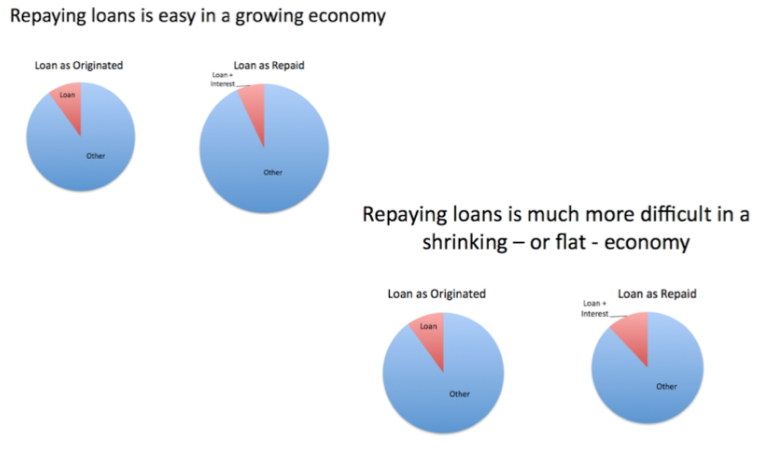
In fact, in an economic contraction, promises that aren’t debt, such as promises to pay pensions and medical costs of the elderly as part of our taxes, become harder to pay as well. The amount we have left over for discretionary expenditures becomes much less. These pressures tend to push an economy further toward contraction, and make new promises even harder to repay.
The Nature of Debt
In a broad sense, debt is a promise of something of value in the future. With this broad definition, it is clear that a $10 bill is a form of debt, because it is a promise that at some point in the future you, or the person you pass the $10 bill on to, will be able to exchange the $10 bill for something of value. In a sense, even gold coins are a promise of value in the future. This is not necessarily a promise we can count on though. At times in the past, gold coins have been confiscated. Derivatives and other financial products have characteristics of debt as well.
To understand how important debt is, we need to think about an economy without debt. Such an economy might have a central market where everyone brings goods to exchange. But even in such an economy, there will be a problem if there is not a precise matching of needs. If I bring apples and you bring potatoes, we could exchange with each other (“barter”). But what if I don’t have a need for potatoes? Then we might need to bring a third person into the ring, so each of us can receive what we want. Because barter is so cumbersome, barter was never widely used for everyday transactions within communities.
An approach that seemed to work better is one mentioned in David Graeber’s book, Debt: The First 5,000 Years. With this system, a temple would operate a market. The operator of the market would provide a “price” for each object, in terms of a common unit, such as “bushels of wheat.” Each person could bring goods to the market (and perhaps even services–I will work for a day in your vineyard), and have them exchanged with others based on value. No “money” was really needed because the operator would take a clay tablet and on it make a calculation of the value in “bushels of wheat” of what a person brought in goods, The operator would also calculate the value in “bushels of wheat” that the same person was receiving in return, and make certain that the two matched.
Of course, as soon as we start allowing “a day’s worth of labor ” to be exchanged in this way, we get back to the problem of future promises, and making certain that they really happen. Also, if we allow a person to carry over a balance from one day to another–for example, bringing in a large quantity of goods that cannot be sold in one day–then we get into the area of future promises. Or if we allow a farmer to buy seed on credit, with a promise to pay it back when harvest comes in a few months, we again get into the area of future promises. So even in this simple situation, we need to be able to handle the issue of future promises.
Future Promises Even Before Debt
Whenever there is division of labor, there needs to be some agreement as to how that division will take place–what are the responsibilities of each participant. In the simplest case, we have hunters and gatherers. If there is a decision that the men will do the hunting and the women will do the gathering and care for children, then there needs to be an agreement as to how the arrangement will work. The usual approach seems to have been some sort of “gift economy.” In such an economy, everyone would share whatever they were able to obtain with others, and would gain status by the amount they could offer to share.
Instead of a formal debt being involved, there was an understanding that if people were to participate in the group, they had to follow the rules that the particular culture dictated, including, very often, sharing everything. People who didn’t follow the rules would be thrown out. Because of the difficulty in living in such an environment alone, such people would likely die. Thus, participants were in some sense bound together by the customs that underlay gift economies.
At some point, as more of an economy was built up, there would be a need for one or more leaders, as well as some way of financially supporting those leaders. Thus, there would need to be some sort of taxation. While taxation to support the leader would not be considered debt, it has many of the same characteristics as debt. It is an ongoing payment obligation. The leader and the other members of the group plan their lives as if this situation is going to continue. In a way, the governmental services and the resulting taxation help bind the economy together.
Benefits of Debt
The benefits of debt are truly great, including the following:
- Debt allows transactions to take place that are not precisely at the same time and place. I can order goods and have them delivered to my home. An employer can pay me for a month’s work with a check, rather than needing to give me food or some other barter item corresponding to each hour I work. There is no need to have billions of gold coins (or other agreed up metal currency) to facilitate each and every transaction, and to transport around. We can each have bank accounts. From the bank’s perspective, the amount in a bank account is a liability (debt) owed to the depositor.
- Additional debt gives additional purchasing power to individuals, governments or businesses. The additional funds available can be spent immediately. Very often, repayment (with interest) is spread over several years, making goods that would not be affordable, affordable. Thus debt raises “demand” for goods and also for the commodities used to create these goods.
- Because debt makes goods more affordable, additional debt tends to “pump up” the price of commodities. These higher prices make it worthwhile for businesses to extract more minerals (including fossil fuels) from the earth, and make it worthwhile to plant more acres of food. Debt, particularly cheap debt, makes building new factories and opening new mines more affordable for businesses.
- Debt allows a steep step-up in standard of living, such as that obtained by adding coal or oil to an economy. Debt allows goods to be purchased that will substantially change a person’s future, such as transit to a new country, or purchase of a college education, or purchase of a delivery vehicle that can be used to start a business. Without debt, it is unlikely that fossil fuels could ever have been extracted; consumers would never have been able to afford the goods provided by fossil fuels, and businesses would have had difficulty financing the many new factories required to make goods using these fuels. See my post, Why Malthus Got His Forecast Wrong.
- Adding debt is self-reinforcing. Suppose a considerable amount of debt is added for what is deemed a good purpose, such as extracting oil in North Dakota. Oil companies will use the debt they receive for many different purposes–including paying employees, paying royalties to land owners, and paying taxes to the state. Employees will buy new houses and cars, taking out loans in the process. North Dakota residents who receive royalty payments may decide to take out home improvement loans to fix up their homes, expecting that the royalties will continue. The state may fix its roads with its revenue, giving additional income (which may lead to more debt) to road workers. A grocery chain may decide to build a new store (borrowing money to do so), further pushing the chain along. What happens is that indirectly, the new oil company debt makes a lot of people at least temporarily wealthier. These temporarily wealthier individuals can then “qualify” for more in loans than would otherwise be the case, giving them more to spend, and allowing yet others to qualify for loans.
- Arrangements that are not debt, but more of the nature of contingent debt, make people feel more confident of the current system. There are insurance programs for pension programs and for bank accounts, up to a selected balance per account. These insurance programs generally don’t have very much money in them, relative to what they are insuring. But they make people feel good, especially if there is a government that might come in and take over, beyond the actual funding of the insurance program.
What Goes Wrong with Debt and Other Financial Promises
1. As mentioned at the beginning of the post, debt works very badly if the economy is contracting.
It becomes impossible to repay debt with interest, without reducing discretionary income. Government programs, such as health care for the elderly, become more expensive relative to current incomes as well.
2. Interest payments on debt tend to transfer wealth from the poorer members of society to the richer members of society.
Economists have tended to ignore debt, because it represents a more or less balanced transaction between two individuals. The fact remains, though, that the poorer members of society find themselves especially in need of debt, and many pay very high interest rates. The ones lending money tend to be richer. Because of this arrangement, over time, interest payments tend to increase wealth disparities.
3. All too often, the payment stream upon which debt depends proves unsustainable.
In the example given above, everyone thinks the North Dakota oil will continue for a while, so takes out loans as if this is the case. If it doesn’t, then this is an “Oops” situation.
In the case of US student loans, many students are never able to get jobs with high enough wages to pay back the loans they were given.
4. Governments tend to put programs into place that are more expensive than they really can afford, for the long term.
As an economy gets wealthier (because of more fossil fuel use), there is a tendency to add more programs. Representative government is used instead of a monarch. Medical care and pensions for the elderly are added, as are unemployment benefits, and more advanced levels of schools.
Unfortunately, it is hard to properly estimate what long-run cost of these programs will be. Also, even if the programs were affordable with a high level of fossil fuels, they almost certainly will not be affordable if energy availability declines. It is virtually impossible to roll programs back, even if they are not guaranteed, once people plan their lives on the new programs.
Figure 3 shows a graph of US government spending (all levels) compared to wages (including amounts paid to proprietors, including farmers). I use this base, rather than GDP, because wages have not been keeping up with GDP in recent years. The amounts shown include programs such as Social Security and Medicare for the elderly, in addition to spending on things such as schools, roads, and unemployment insurance.
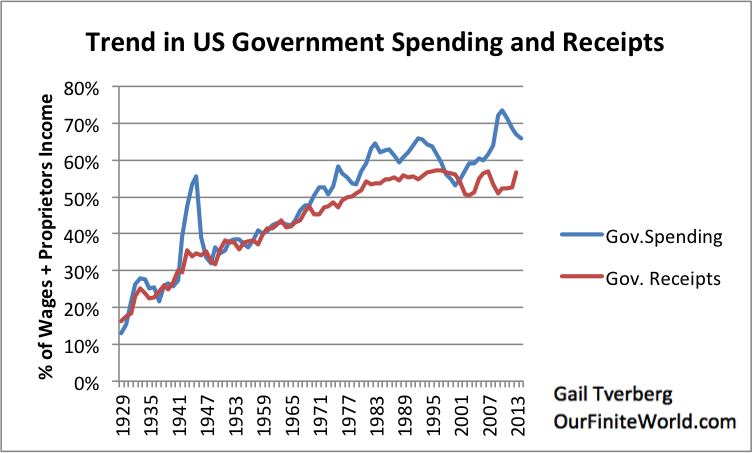
Clearly, government spending has been rising much faster than wages. I would expect this to be true in many countries.
5. There is no real tie between amounts of debt issued and what will actually be produced in the future.
We are told that money is a store of value, and that it transfers purchasing power from the present to the future. In other words, we can count on balances in our bank accounts, and in fact, in all of the paper securities that are outstanding.
This story is only true if the economy can continue to create an increasing amount of goods and services forever. If, in fact, the production of goods and services drops off dramatically (most likely because prices cannot rise high enough to encourage enough extraction of commodities), then we have a major problem.
In any year, all we have available is the actual amount of resources that can be pulled out of the ground, plus the actual amount of food that can be grown. Together, these amounts determine how many goods and services are available. Money acts to distribute the goods that are available. Presumably, the people who work at extraction and production of these goods and services need to be paid first, or the whole process will stop. This basically leaves the “leftovers” to be shared among those who are now being supported by tax revenue and by those who hold paper securities of some sort or other. It is hard to see that anyone other than the workers producing the goods and services will get very much, if we lose the use of fossil fuels. Workers will become less efficient, and production will drop by too much.
6. Derivatives and other financial products expose the financial system to significant risks.
Certain large banks have found that they can earn considerable revenue by selling derivatives and other financial products, allowing people or businesses to essentially gamble on certain outcomes–such as the price of oil falling below a certain price, or interest rates rising very rapidly, or a certain company failing. As long as everything goes well, there is not a huge problem. The concern now is that with rapidly changing commodity prices, and rapidly changing levels of currencies, companies may fail and there may be major payouts triggered.
In theory, some of these payments may be offsetting–money owed by one client may offset money owed to another client. But even if this is the case, these defaults can sometimes take years to settle. There may also be issues with one of the parties’ ability to pay.
One particular problem with many of the products is the use of the Black-Scholes Pricing Model. This model is applicable when events are independent and normally distributed. This is not the case, when we are approaching oil limits and other limits of a finite world.
7. Governments tend to be badly affected by a shrinking economy, so may be of little assistance when we need them most.
As noted previously, payments to governments act very much like debt. As an economy shrinks, programs that seemed affordable in the past become less affordable and badly need to be cut. Thus, governments tend to have problems at the exactly same time that banks and other lenders do.
Governments of “advanced” countries now have debt levels that are high by historical standards. If there is another major financial crisis, the plan seems to be to use Cyprus-like bail-ins of banks, instead of bailing out banks using government debt. In a bail-in, bank deposits are exchanged for equity in the failing bank. For example, in Cyprus, 37.5% of deposits in excess of 100,000 euros were converted to Class A shares in the bank.
This approach has a lot of difficulties. Businesses have a need for their funds, for purposes such as paying employees and building new factories. If their funds are taken in a bail-in, the ability of the business to continue may be damaged. Individual consumers depend on their bank balances as well. As noted above, deposit insurance is theoretically available, but the actual amount of funds for this purpose is very low relative to the amount potentially at risk. So we get back to the issue of whether governments can and will be able to bail out banks and other failing financial institutions.
8. More debt is needed to hide the lack of economic growth in an ailing world economy. This debt becomes increasingly difficult to obtain, as wages stagnate because of diminishing returns.
If wages are rising fast enough, wages by themselves might be used to pump demand for commodities, and thus raise their prices. Our wages are close to flat–median wages have been falling in the US. If wages aren’t rising sufficiently, increasing debt must be used to raise demand. Debt is growing slowly in the household sector, according to figures compiled by McKinsey Global Institute. Household debt has grown by only 2.8% per year between Q4 2007 and Q4 2014, compared to 8.5% per year in the period between Q4 2000 and Q4 2007.
Even with business demand included, debt isn’t rising rapidly enough to keep commodity prices up. This lack of sufficient growth in debt (and lack of growth in demand apart from growing debt) seems to be a major reason for the drop in prices since 2011 in many commodity prices.
9. Differing policies with respect to interest rates and quantitative easing seem to have the possibility of tearing the world financial system apart.
In a networked economy, not moving too far from the status quo is a definite advantage. If the US’s policies have the effect of raising the value of the dollar, and the policies of other countries have the tendency to lower their currencies, the net effect is to make debt held in other countries but denominated in US dollars unpayable. It also makes goods sold by American companies unaffordable.
The economy, as it exists today, has been made possible by countries working together. With sanctions against Iran and Russia, we are already moving away from this situation. Low oil prices are now putting the economies of oil exporters at risk. As countries try different approaches on interest rates, this adds yet another force, pulling economies apart.
10. The economy begins to act very strangely when too much of current income is locked up in debt and debt-like instruments.
Economic models suggest that if oil prices drop, demand for oil will grow robustly and supply will drop off quickly. If oil producers are protected by futures contracts that lock in a high price, they may not respond in the manner expected. In fact, if they are obligated to make debt payments, they may continue drilling even when it may not otherwise make financial sense to do so.
Likewise, consumers are also affected by prior commitments. If much of consumers’ income is tied up with condominium payments, auto payments, and payment of taxes, they may not have much ability to respond to lower oil prices. Instead of increasing discretionary spending, consumers may pay off some of their debt with their newfound income.
Conclusion
If the current economic system crashes and it becomes necessary to create a new one, the new system will have to deal with having an ever-smaller amount of goods and services available for a fairly long transition time. Because of this, the new system will have to be very different from the current one. Most promises will need to be of short duration. Transfers among people living in a particular area might still be facilitated by a financial system, but it would be hard to have long-term or long-distance contracts. As a result, the new economy will likely need to be much simpler than our current economy. It is doubtful it could include fossil fuels.
Many people ask why we can’t just cancel all debt, and start over again. To do so would probably mean canceling all bank accounts as well. Most of our current jobs would probably disappear. We would probably be without grid electricity and without oil for cars. It would be very difficult to start over from such a situation. We would truly have to start over from scratch.
I have not talked about a distinction between “borrowed funds” and “accumulated equity”. Such a distinction is important in terms of the rate of return investors expect, but it is not as important in a crash situation. Similarly, the difference between stocks, bonds, pension plans, and insurance contracts becomes less important as well. If there are real problems, anything that is not physical ends up in the general category of “paper wealth”.
We cannot count on paper wealth (or for that matter, any wealth) for the long term. Each year, the amount of goods and services the economy can produce is limited by how the economy is performing, given limits we are reaching. If the quantity of these goods and services starts falling rapidly, governments may fail in addition to our problems with debts defaulting. Those holding paper wealth can’t count on getting very much. Workers producing whatever goods and services are actually being produced will likely need to be paid first.
31 Comments on "The Problem of Debt as We Reach Oil Limits"
Makati1 on Wed, 11th Feb 2015 8:02 pm
Technically, we could just cancel all debts and start over, but the elite would lose their position and most of us would benefit when the dust settles.
Only the currently privileged would have the pain of adjustment. A small percentage of humankind.
After all, the things of REAL value would NOT disappear. Your home would still be there, if your mortgage evaporated, wouldn’t it? Your car, TV, etc. The roads would still be there. The oil and natural gas would still be there. Hospitals, factories, mines, wells, etc. do they disappear when the debt against them disappears. NOPE!
Sure, there would be a rearrangement of priorities and you may lose your job but you would not have any debts to pay, so survival would be easier. And maybe a few million extra would die over the first few months? After all, even today, over one million die every week in the world.
What would disappear? The things of NO real value. Pieces of paper called fiat currency, or any paper that was a note against debt, like USTs, mortgages. loan agreements, bank accounts, etc.
The reset would change the world, but the slaves would be freed. Problem is, most of the 1st world do not want to be ‘freed’ because it strikes them blind with terror. To be personally responsible for their own life and death is way out of their comfort space.
But, the average African, Asian, or Latin American would rejoice to be free to survive on their own. They already do, for the most part, but their governments keep putting them into bondage to the elite. (IMF/WB/etc.)
Hopefully, this reset will happen and soon. Before the missiles fly.
GregT on Wed, 11th Feb 2015 9:55 pm
Makati,
It is the banking systems themselves that are the greatest threat to mankind. There is no good reason for exponential growth, or 90% of the crap that people are brainwashed into believing that they need.
The problems lie not only with the privileged that make our laws and lobby our governments, but the very system itself that we live in day to day. Most wealthy people in North American society do not make their money off of production, but rather from skimming off of the labour of those below them in the societal structure. Taking away the debt based monetary system would level the playing field, and those that actually do the work would be rewarded more than those that do not. This will never be allowed to happen without revolution or war.
The missiles will fly first, hopefully, at some point the revolution will follow.
GregT on Wed, 11th Feb 2015 10:00 pm
Sorry,
Hopefully at some point the revolution will occur. I don’t want to see the missiles fly, but with the lack of US patriotism, it appears to be inevitable.
Makati1 on Wed, 11th Feb 2015 11:38 pm
GregT, I too hope they do not fly, but it the odds are increasing daily that they will. Until recently, some sanity still existed in DC and they were not stupid enough to attack a nuclear country. All bets are off now. Insanity rules.
GregT on Wed, 11th Feb 2015 11:53 pm
How many years did you live in the States Mak?
Davy on Thu, 12th Feb 2015 6:23 am
BS Mak, that is your deepest desire is to see the evil empire destroyed by Russian and Chinese missiles to inaugurate the 1000 year Asian Reich. You are sick old man living his sci-fi vision of death and destruction. The funny part of it is your idea of death and destruction is insane because it is a Hollywood vision. The good guys (Mak and his region) will destroy the bad guys (US and its western allies).
I would argue that you are embracing the embodiment of that which is evil and that is the deadly serious passion of resentment and hatred. That is evil in our human realm. Nature could give a shit. We are nothing more than Natures hand maiden of extinction. We will destroy the global earth ecosystem as we know it so Nature can rebuild a new one.
Mak, go into you jungle hang please and I pray there is no Wi-Fi up there so you can’t spread your message of hate and resentment. Please don’t name the monkeys because you will be eating them eventually. Wait, I imagine they will be eating you because at 70 you are not long for this world.
Makati1 on Thu, 12th Feb 2015 6:32 am
GregT, how about 64 of my 70 years. And, I am a 14th generation American. My family came to North America in 1734, from Austria, and settled in PA. Why?
Davy on Thu, 12th Feb 2015 6:32 am
Greg, you do realize there is consequences rightly or wrongly to your vision of the banking sector. You do realize that BAU will die and along with it a few Billion. The banking system is a TBTF component of BAU globalism. I also will remind you the revolution will be Natures revolution with few people in a position to inaugurate a new system. The system will be one of hunger and insecurity of a mass of dislocated people for at least a generation.
This dislocation will be within and without of all we know. We will be migrating physically and mentally. So I feel for you and your hatred for the Bankers. Yet, they cannot be decoupled from BAU. We are at the point of an extremely brittle societal structure with a foundational commodity in decline in a global systematic disequilibrium. This disequilibrium has been stable but is currently being destabilized by limits and diminishing returns of complexity.
So in conclusion when do we want BAU’s end? I hope for a softer crisis to cushion the fall. 10 years may give society enough time to build monasteries of truth to guide us into the abyss of collapse.
Davy on Thu, 12th Feb 2015 6:43 am
Mak, an ancestor of mine was a Roger’s Ranger who fought in the Revolutionary War. I imagine your family was on the side of the Crown as double agents. Your anti Americanism probably started there.
Please Mak, don’t brag about your patriotism in your blood. You are a traitor who only wishes the death of the US. What a hypocrite.
Tom Clough on Thu, 12th Feb 2015 7:13 am
Gail,
You continue to do good work in writing in clear and concise terms that folks can understand. You seem to miss one of the major reasons for why canceling debt would cause very significant problems. Pension systems are one of the major holders of debt instruments such as bonds (future promises of payment), a cancelation of debt would crush every pension system. It will happen as a consequence of accelerating defaults due to the contracting economy, but I doubt it will because of some sort of debt jubilee were debts are canceled. Bailouts are a form of debt cancelation. Setting up bad banks to hold toxic assets is another, in the end, however the amount of debt defaults will likely overwhelm the banking systems capacity to deal with them. Watching what is happening in Greece is very instructive as it is a micro model of what can happen globally.
Northwest Resident on Thu, 12th Feb 2015 9:36 am
Industrial economies are set to go the way of the Dodo as cost of credit proves to be too great for customers to bear. As oil prices fall the drilling industry calls for more support. The rationale is that drillers borrow already, there can be no harm in adding to the pile of existing debt: if customers cannot pay immediately they certainly will when prices ‘recover’.
(The prices cannot rise unless the customers begin to pay … )
Additional repayment obligations are set to be heaped upon the same customers who can’t bear the drillers’ present costs … this is what the crashing oil prices actually mean.
Credit breakdown is taking place in plain sight, under the noses of- and unremarked by ‘real’ economists. That people cannot afford their petroleum doesn’t appear to matter; not nearly as much as how the same people ‘feel’ about the economists themselves.
If the customers could pony up for high-cost fuel they would be doing so; oil prices would be unchanged from last year.
In a high-cost environment, lower prices = less petroleum: as with ‘invisible’ credit collapse, the oil extraction peak is occurring right now, but in the shadows!
There will never be more oil on petroleum markets than there is right now. (Planter’s glut that he mentions from time to time)
It is hard to see how having less petroleum available will make us wealthier or more able to borrow- or service our debts. Instead, lower prices => more oil industry failures + more credit exposure => lower prices in a compounding cycle.
The signs of credit breakdown can be seen everywhere one chooses to look. The US appears to be the cleanest dirty shirt in the laundry basket but the illusions cannot be maintained too much longer
Fatal Ignorance
http://www.economic-undertow.com/
GregT on Thu, 12th Feb 2015 10:43 am
Mak said:
“Why?”
64 years is longer than most of us here have been alive.
GregT on Thu, 12th Feb 2015 10:54 am
“You do realize that BAU will die and along with it a few Billion.”
Of course Davy, but I also realize that the longer it is allowed to continue, the bigger the die-off will be. The soft cushion would have been 40 years ago, with every passing year the concrete only sets up harder.
J-Gav on Thu, 12th Feb 2015 1:41 pm
“Will ya still need me, will ya still feed me, when I’m 64?”
Hey guys, I’m 64. And I understand quite clearly now that we’ve been living under a series of regimes with propagandistic pre-suppositions essentially made up of lies and deceit for decades (not talking about only the U.S. here).
As for big ordnance flying on a large scale, that might be the preferred ‘solution’ in the warped minds of our elites (as opposed to ‘revolution,’if ya see what I mean), but there is still an outside chance for some other, as yet undefined, outcome. “Lo peor no es cierto” as Calderon de la Barca put it several centuries ago (The ‘Worst’ is not a given). Well, it is, in a way, since we’re all gonna die, but the questions which preoccupy us most are “When and How?” or am I in error …
J-Gav on Thu, 12th Feb 2015 1:56 pm
On to the article. Yes, a debt-based monetary system is a major turd in the punchbowl.
Any kind of meaningful societal change, whether it be on a national, regional or community level should begin right there, ie the way the money works. More and more people are beginning to understand that money supply issuance and the attendant credit terms should be treated as a public service, as opposed to the mafia-like rake-off scheme we now have, to the benefit of MNCs, banksters and politicans.
The idea seems to be to make us the willing co-administrators of our own debt slavery. “Dear Sir, You neglected to fill in line 43 F-b.” “Oh, sorry Mister Scoutmaster! I’ll try to be a better slave next time.”
Davy on Thu, 12th Feb 2015 2:26 pm
Gav, I like to think “the worst is not a given”. Statistics and probabilities are not prejudiced.
GregT on Thu, 12th Feb 2015 3:08 pm
“Any kind of meaningful societal change, whether it be on a national, regional or community level should begin right there, ie the way the money works.”
Completely agree J-Gav.
End the Fed.
R1verat on Thu, 12th Feb 2015 3:38 pm
Mak I’ll bet you still cash your social security check. If you really were against the US you wouldn’t. And don’t tell me you earned it as your justification. You also come back to the states. Why bother if we that live here are all idiots. Oh yeah, you must have family here. I guess they are idiots too.
I really resent your continued stereotyping.
You state, “The reset would change the world, but the slaves would be freed. Problem is, most of the 1st world do not want to be ‘freed’ because it strikes them blind with terror. To be personally responsible for their own life and death is way out of their comfort space.
But, the average African, Asian, or Latin American would rejoice to be free to survive on their own. They already do, for the most part, but their governments keep putting them into bondage to the elite. (IMF/WB/etc.”)
I don’t supposed it has ever occurred to you that there are Americans that would rejoice to be free to survive on their own, but their governments keep putting them into bondage to the elite?
No, of course not. What was I thinking…..
Nigel on Thu, 12th Feb 2015 4:27 pm
NWR, thank you for the link. Very thought provoking.
Incidentally, not all of us are American. Personally, I live close to where HRH’s nemesis was born…
Makati1 on Thu, 12th Feb 2015 6:25 pm
R1verat, yes, I cash my SS checks, as it was paid for over 45 years of employment and I am still on the black side of the ledger. I do not expect SS to last much longer and probably not long enough for me to recover my total investment.
As for my thoughts on the UFSA, I am only talking about the weak majority, not the intelligent minority. A small percentage of Americans know what is happening behind the MSM Iron Curtain. Some have already left (about 3 million at last count) and some are without the ability/courage to leave. For those, I am sorry. Freedom has a price.
Last time I heard, some 50 million UFSA families were armed with about 300 millions guns. There is NO excuse for living under a regime that you don’t like, when you have that much firepower. It is the lack of backbone, not means, that keeps the sheeple docile and subservient. (And a government paycheck for about 145 million of them.)
The people in other countries still know how to rise up and overthrow their unwanted leaders and go to the streets by the millions. No, the UFSA deserves what is coming. The innocent will die along with the innocent that the UFSA is killing every day around the world. Payback is a bitch.
I comment about the MAJORITY that have swallowed the cool aid and are supporting the destruction and murder that the US is and has been conducting around the world in it’s desire to be supreme ruler of mankind. If you do not like hearing about the real world, don’t read my comments. They all start with ‘Makati1’.
Davy on Thu, 12th Feb 2015 6:31 pm
Riv Rat, thanks for the assistance with Mak the Wak. I ask those of you who consider our group a group more or less in solidarity. We are friends and digital neighbors yet, some of you have no issues with a wakko talking bad to your friends.
Mak, seeks division and hatred and that is not a concern to you all? I guess the hatred here of the U.S. justifies his action per the thinking of some. I often hear “Davy don’t take it personal he is soiling the leadership not you. Well I say bullshit he is talking directly to me. He is a lonely old man that likes the attention. What a pathetic attention seeking creep.
R1verat on Thu, 12th Feb 2015 8:26 pm
Mak you know you are absolutely right. I will stop reading your comments. They add little to the conversation & all I do is waste my time reading them.
ghung on Thu, 12th Feb 2015 9:02 pm
Just making sure I get this right-
Mad Mak lives and works in the corrupt and wicked USA for 45+ years, benefiting from this system while paying taxes and social security (supporting that wicked and corrupt system), makes his escape to the Philippines, and expects those he ran away from to start a revolution, even as he collects his retirement from corruption.
Sounds about right. Mak’s as guilty as he says the rest of us are. He just didn’t stick around for the consequences.
How long since your last confession, Mak?
Makati1 on Thu, 12th Feb 2015 9:48 pm
ghung, since I do not believe in some human designed god, I am not afraid of my death, like some here. I still have consequences … 12 of them that I love and care about, but I can do nothing to help them no matter where I live. That is the responsibility of their parents which I raised to be independent adults. I have invited them to come here and live on the farm, but they are not willing to do it. Their choice.
That you cannot handle the truth is your problem, not mine. I did live there, in the UFSA, until my promise to their mother was fulfilled. 28 years of marriage and then everything I owned was hers if we decided to part. That was the agreement made 30 years earlier, not that it is anyone’s business.
At that point, I decided that a change was due and was invited to come to the Ps by some friends I met in Dubai in 2006. I love it here and by being outside the propaganda flood, I was able to see through the US BS and realized that I had made a good decision. Here I will stay and prepare for the day that my SS will end and I will have to rely on my other income.
I’m sorry if you are being screwed out of your retirement, but I cannot change your future for you. Only you can do that. I paid my taxes and was as brainwashed as any other American for far too long.
You do not have to be wealthy like Davy’s family to leave. You just have to be willing to give up the fraying social safety net of the mommy government in the US. I have no Medicare/Medicaid coverage. I have no food banks to feed me if I get hungry. I have no welfare or ‘WalMart greeter’ job opportunity or other ‘helps’ if I fail. I could not even get back to the US if I didn’t have plane fare. The US Embassy will not pay the fare for me.
So, think what you want. Ignore my comments. Live your life. I will not even notice.
fred1 on Thu, 12th Feb 2015 10:47 pm
I always look forward to reading Mak,s
comments even when he was BillT he seems to have a good handle of what’s going on out there.
Makati1 on Thu, 12th Feb 2015 11:42 pm
fred1, thank you, and you have a good memory. I only tell it like I see it. If it doesn’t mesh with someone else’ picture, maybe it is because I see it from a different angle, that’s all. 70 years does give a bit of perspective a younger person might not have. It also takes away the fear of death so that you can be more impartial to consequences.
GregT on Fri, 13th Feb 2015 12:04 am
Davy,
Why do you continue to take Makati’s comments so personally? You are not the corrupt oligarchs that have hijacked the US. You are the not in the majority that Makati speaks of, and it certainly appears to me that you have removed yourself from mainstream society much like he has.
I am a proud Canadian, but that doesn’t mean that I am proud of what my country has become, and it most certainly does not mean that I am proud of the people that have hijacked my country as well. There is a huge difference. If anything, I feel a great responsibility to speak out against the corruption and the idiocy. A true patriot holds his institutions to task, he doesn’t stand up for them when they are wrong.
Davy on Fri, 13th Feb 2015 6:37 am
Greg/Fred, hey this is an issue of delivery vehicle. Mak and I are on the same page with 70% of the subject matter. This is called the facts. Agendist are good with the facts. It is the selective use of the facts for a personal message that is wrong. If you are going to deliver your propaganda admit it is propaganda. One must admit in a fair and balance way their propaganda message also has negatives.
Mak is using the evils of hate, resentment, and prejudice to broadcast a message that the US is going to die a horrible death and his Asia is a birthing 1000 Reich. He preaches the glories of Asia and his home in the P’s. The P’s and Asia could not be further from glory and safety. They are 4BIL highly urbanized people that are FF defendant. There is no question to that fact. Asian overshoot has no comparison. The western urban areas are likewise at danger but not like Asia. IMA people of means are leaving Asia not moving to Asia as a refuge.
All the anti-American talk by Mak and others invariably turns to Anti American everything. It is so hypocritical to hear the many anti Americans here talk about how bad the US is and then the lack of complaints about the same nastiness in the rest of the global group of nasty countries. I will admit US nastiness. I will point out also that the extremes of the nastiness are spread across the globe many areas with worse idiocentric nastiness. Greg, your Russia has a horrible list of nastiness. IMA Russia has more NUK’s than any other country. Mak’s China is a cancerous growth or people and industrialization that is killing the world by resource consumption and pollution.
Mak, loves to brag about Asian glories while he bashes the US. Ask Mak about feeding 7BIL people and he will always say it is possible if the US consumes less. What he will not admit is 4BIL Asia without FF can’t support 1BIL in that area. When the other 3BIL Asians get desperate they are going to strip that small area clean like locust in a wheat field.
On a personal level Mak is in continuous and redundant with criticism and prejudicial treatment of all that is American. You all can bash America but you are also bashing yourselves. Every one of you from another country that are bashing America live in a dumbass country with dumbass people just like America. The world is full of comparative advantages and disadvantages. You folks that bash the US constantly fail to see your friggen shit stinks too. You all are so upset with the circumstance you have to lynch someone. So you lynch the closest and most visible dumbass country and that is the US.
The US is a mercenary country sold to the highest bides and those plutocrats and oligarch bidders are in every other dumbass country on the globe. It just so happens a significant amount of those oligarchs and plutocrats are American. But don’t make me puke saying they are not spread throughout the globe and also own your dumbass country.
This quote from C.S. Lewis fully describes Mak’s hatred from a failed life. His cognitive dissonance of a bad decision of a refuge in Asia.
“We must picture hell as a state where everyone is perpetually concerned about his own dignity and advancement, where everyone has a grievance, and where everyone lives with the deadly serious passions of envy, self-importance, and resentment.”
― C.S. Lewis, The Screwtape Letters
That my friends is Mak. I could write a paper on how Mak’s agenda is the agenda of hate. This is the reason why our global world we all depend on will be ripped apart by those same agendas of self-advancement even though all of our locals depend on the global which is an amalgamation all of our locals. IOW if we have any chance at all it is the understanding that we all need each other at this point. If we turn to our own survival and away from cooperation we are more likely to die than survive. One in 10 are likely not to survive this bottleneck.
Mak is our local PO prophet of evil of conflict and hate. He hopes every morning he gets up the missiles will have been delivered to the North American continent and the new Asian age will begin. That is a death wish wrapped up in delusional Dr. Strangelove ideas destruction and refuge.
GregT on Fri, 13th Feb 2015 11:14 am
Davy,
“Greg, your Russia has a horrible list of nastiness.”
I’m not sure that I can say things any simpler than I have in the past Davy. I am not making comparisons, or choosing one flag over another. I see borders and flags for what they are, cages in which people are herded. A means of controlling the masses.
Borders are man made imaginary lines drawn in the sand that only apply to one species of animal on this planet. Human beings. I do not believe in nationalism, indoctrination, stereotyping, or racial discrimination. I am not drawn into advertising or propaganda. I am a free thinker, and I call a spade a spade.
Human beings everywhere are being used by their masters, they will even go to war for them and commit the ultimate transgression of taking another human life. I have no problem with defending ones self, his family, or his tribe, but I have a very serious problem with aggression, pre-emptive wars and imperialism, and I have a serious problem with enslavement be it physical or by any other means including usury.
We both live in the same universe Davy, on the same planet, and even on the same land mass. We were both given life by natural processes, we both live, and we will both die. There really is little difference between all people on this tiny little sphere floating in space, other than our indoctrination. Mine did not include militarism, exceptionalism or national self righteousness. My indoctrination did include peacefulness, equality and justice. Even my owners are now overstepping these basic principals. I cannot and will not ignore that.
Davy on Fri, 13th Feb 2015 12:10 pm
Greg, you are not selling me on fair and balance. You have a side you promote and a side that is attacked. The side attcked is the US and the sides not attacked are those allied against the U.S. why be ashamed of that? There is nothing wrong with that if you don’t glorify the others like Mak the Wak.
GregT on Fri, 13th Feb 2015 1:24 pm
Davy,
One of my closest personal friends lost two older brothers and his young sister to US shock and awe in Baghdad. His brothers were murdered in their sleep. His sister died in his arms, she suffered miserably. There is nothing fair or balanced in killing hundreds of thousands of innocent people, all in the name of controlling other peoples’ countries and resources. All in the name of greed. They were attacked, they had no means to defend themselves, and they were murdered in cold blood. I side with those that have had their lives taken and destroyed. I do not side with evil.