
Peak Oil is You

Donate Bitcoins ;-) or Paypal :-)


Page added on September 22, 2013

The House that Randy Built

One of the nice aspects of the 7+ years I have been involved with The Oil Drum has been attending conferences and meeting with some of my cyber friends, who by and large figure among the nicest bunch of folks I ever met. In 2007 I attended the ASPO meeting in Houston and it was then that I met Randy Udall for the first time. Well you know what some Americans are like – you meet, you chat a while, discover you get along, down a couple of beers and before you know it you are invited to go visit. And so it was with Randy Udall….
Three years later, my wife and I had a trip planned to the States to go visit Dave Rutledge (another cyber mate) at his mountain lodge in New Mexico and I thought it would be cool to visit Randy en route. We exchanged a couple of emails, he warned that his wife Leslie was cautious about some of his friends coming to stay and that his son once claimed that the family lived in a “mud hut” and by now I was wondering if this was such a good idea. But plans were made and we went to stay with Randy in Colorado for a couple of days in August 2011; on arrival, any trepidation melted away.
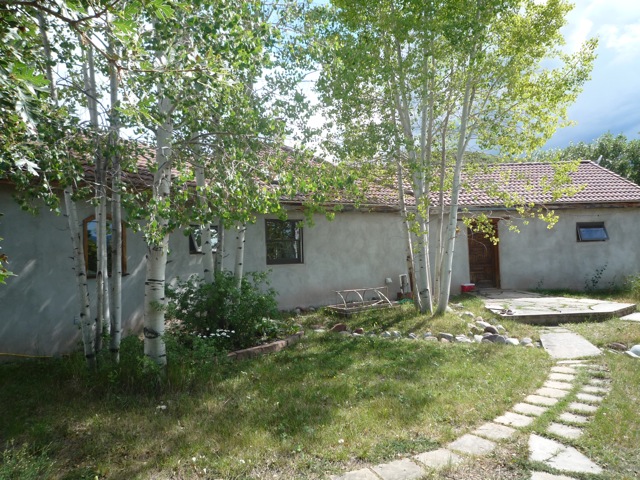
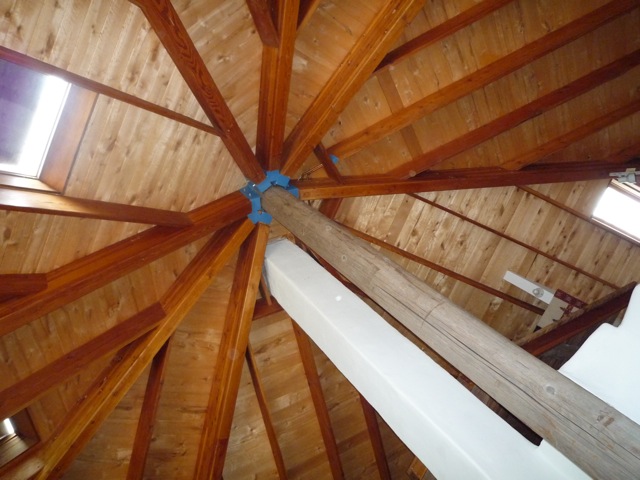
I wish I had recorded the vital statistics but the mass of bricks was carefully calculated to provide thermal inertia, keeping the house warm in winter but cool in summer. I was also very surprised to learn that all of the insulation was on the outside of the masonry structure which is the opposite of the way we build our houses in the UK. South-facing windows collect wintertime solar energy and the adobe block walls and brick floors soak up much of that heat energy, keeping the home warm through cold nights. During the summer, just opening the windows at night cools off the massive floors and walls, helping the house stay cool during hot days. Putting the insulation on the outside of the exterior walls is the only way to make this adobe wall strategy work effectively.
The house was set low in the terrain, providing protection from winter storms and from the worst excesses of summer heat. Outside you find a large solar PV array, providing a surplus of electricity and solar hot water arrays on the south facing roofs providing all the hot water required and, if my memory serves correctly, some interior heating during winter time.

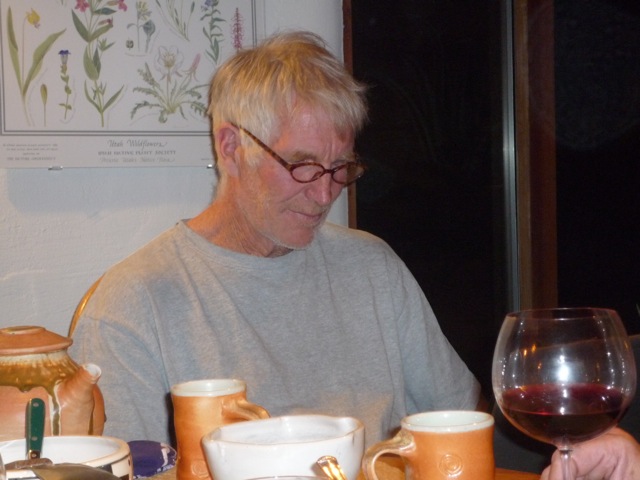
Most folks who read these pages will already know that in June of this year Randy died aged 61 of natural causes while hiking alone in the Wind River range of Wyoming, hunting for wild trout. The tragedy here is that he was snatched from his family and the sustainable living community he championed 10 to 20 years prematurely.
Thank you to Leslie Udall for consent to publish this article and to Steve Andrews for some useful editorial comments.
3 Comments on "The House that Randy Built"
DC on Mon, 23rd Sep 2013 4:56 am
It is good to see a house not constructed from compressed sawdust and PVC. No one really knows how to build houses anymore. There default actions are always the same, and they go something like this.
-‘Purchase'(rent really) a lot in a mass cookie cutter-subdivision.
-Hire ‘contractors’ who only know how to build one kind of structure. With PVC, compressed sawdust, a tiny bit of concrete for a base, and chemically soaked 2×4 matchsticks.
-These structures are nearly identical inside and out to all others-and all get immediately connected to distant and complex energy, water and waste systems. On-site backups and resilience, NEVER included.
-The ‘buyers’ of these shacks, pay exorbitant amounts of money, mostly in the form of interest,fees and labor for said shacks, and ALWAYS seek 25-50 year funding from huge corporate mega-banks.
-Virtually all the shacks are accessible only by gas-powered cars(guess who provides fuel-financing and the cars themselves?), and are almost never close to jobs, schools,transit or any source of backup water or energy for that matter.
Now maybe we cant all live like the fellow above-but its very clear, just from looking around me, that the model ‘we’ chose to live in, is deeply and fatally flawed. Not to mention chemically toxic and socially alienating to boot. If you want bricks for example were I live, where do you get them from? Why a corporate big-box store of course! Shipped from who-knows where, in a diesel ‘rig’ hundreds of miles or more. There are no brick works here, just 100,000 or more ‘consumers’. Just like there are no farmers. Lot of little wine farms-but no one growing actual food.
And so it goes…
BillT on Mon, 23rd Sep 2013 8:41 am
Having been in the home construction business for most of my working life, I know that they are built to the ‘minimum’ standard and sometimes below standard if the inspector is bought off.
I was a designer/estimator. The buyers always wanted more then they could afford and the sellers always wanted to max the profit. That is the receipt for cutting corners.
Not to mention the decline of real lumber and the quality of what is left. Most could not afford a home built like in the 40s or 50s as it would exceed $1M for a 3 bedroom, 1,400 SF, rancher. Copper pipe in 1960 was about 40 cents per pound. Now it is about $4 per pound. In-ground septic went from about $1,000 to now some exceed $20,000., if the soil is difficult. And then there are permits and the developer now pays for the streets, sewage lines, etc., and on and on. All part of the total cost to the buyer. Sawdust and plastic is all that makes a home affordable today. And soon even that will be too expensive.
Arthur on Mon, 23rd Sep 2013 9:42 am
The dollar as a reserve currency as well as the NWO empire may have the best days behind it, I keep saying that of the world’s four largest military/economic powers, US, EU, China and Russia, the US has the best conditions, from a perspective of survival of it’s citizens. The US has twice the territory of the EU and only 3/5 of it’s population. It is protected by two vast world oceans, and not really threatened by it’s northern or southern neighbours (not necessarily the other way around). Unlike Europe, the US has resources. The southern states have enough desert to generate all the solar energy it needs and more than enough mountains in the west to hydro-store solar energy harvested in the summer.
Obviously, Randy’s house is a model for the future and an illustration that the future belongs to selfmade craftsmen.
Here a similar example of a zero energy home from a much more urbanized Holland:
http://deepresource.wordpress.com/2013/09/16/zero-energy-home/