
Peak Oil is You

Donate Bitcoins ;-) or Paypal :-)


Page added on October 1, 2014

The End of Peak Oil
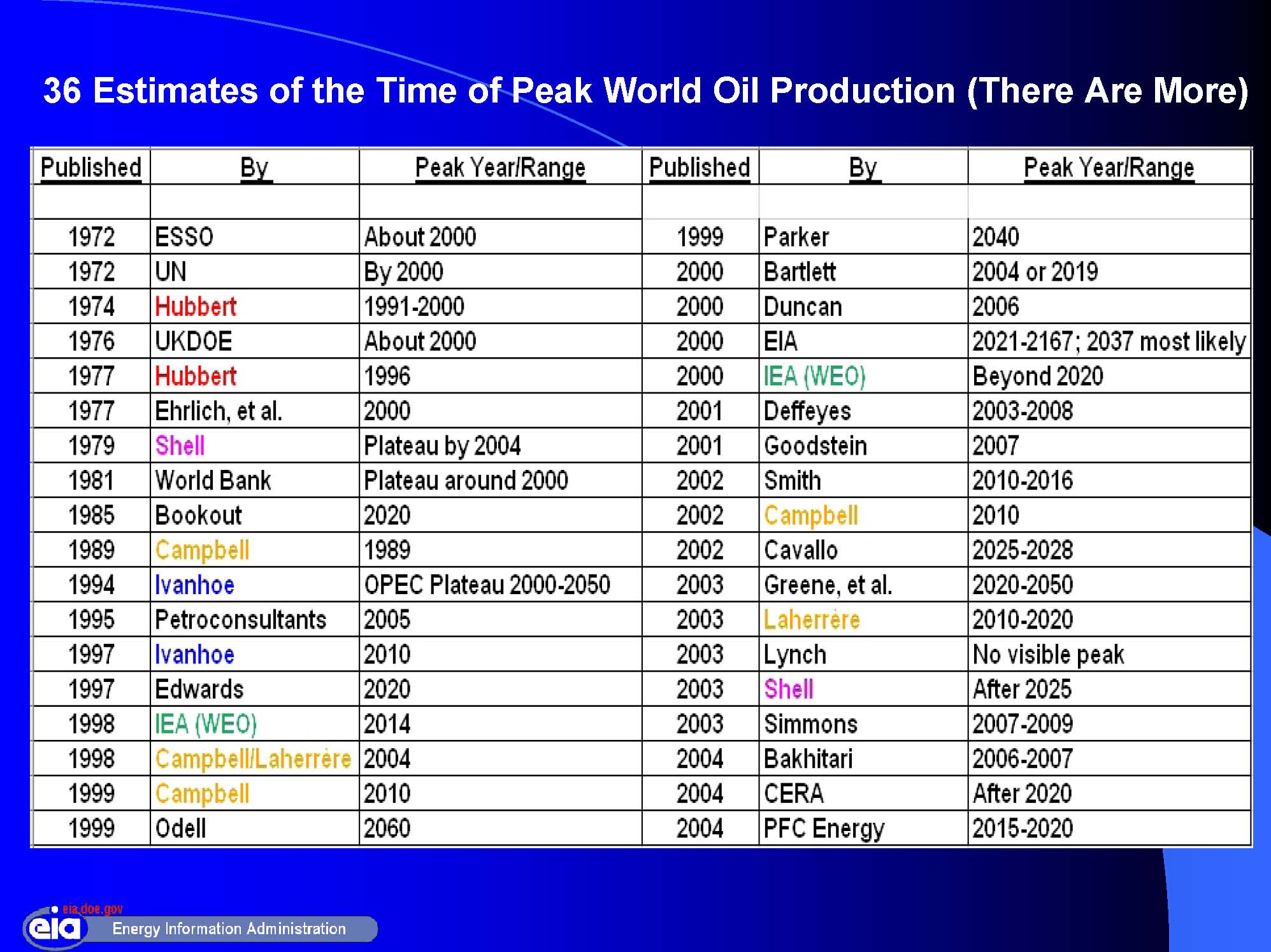
Peak oil has been an alarmist catch phrase for so long that many of us simply assume that oil production has in fact peaked and we’re well on the way to running out of the world’s favorite fossil fuel. Not so, according to this story in the Wall Street Journal:
Have we beaten “peak oil”?
For decades, it has been a doomsday scenario looming large in the popular imagination: The world’s oil production tops out and then starts an inexorable decline—sending costs soaring and forcing nations to lay down strict rationing programs and battle for shrinking reserves.
U.S. oil production did peak in the 1970s and sank for decades after, exactly as the theory predicted. But then it did something the theory didn’t predict: It started rising again in 2009, and hasn’t stopped, thanks to a leap forward in oil-field technology.
To the peak-oil adherents, this is just a respite, and decline is inevitable. But a growing tide of oil-industry experts argue that peak oil looks at the situation in the wrong way. The real constraints we face are technological and economic, they say. We’re limited not by the amount of oil in the ground, but by how inventive we are about reaching new sources of fuel and how much we’re willing to pay to get at it.
“Technology moves so quickly today that any looming resource constraint will be nothing more than a blip,” says petroleum economist Phil Verleger. “We adjust.”
Whether peak oil exists is more than just a point of intellectual debate—although it certainly has proved to be a heated and divisive one for decades. The question—and how we think about it—also has a big potential impact for governments, oil producers and ordinary people across the globe, all of whom depend on the vagaries of oil production and would be threatened by soaring costs and shortages.
The peak-oil boosters argue that instead of plowing money into new ways to find oil, we should be conserving what we have and investing in alternative energy sources so that we’re prepared when supplies run low and costs soar. Most of the naysayers agree that we shouldn’t stick with oil forever. But they think it’s wiser to invest in technology to keep expanding the available supply, until it gets too expensive to do so. At that point, they’re confident, we’ll be able to come up with an economical alternative…

[continues in the Wall Street Journal]
– See more at: http://disinfo.com/2014/09/end-peak-oil/#sthash.7MHpyAqM.dpuf
55 Comments on "The End of Peak Oil"
westexas on Wed, 1st Oct 2014 8:28 am
My comment on WSJ website:
In reality, it’s very likely that actual global crude oil production, generally defined as 45 or lower API gravity crude oil, stopped increasing in 2005.
Global liquids production, consisting of crude oil + condensate + natural gas liquids (NGL) + biofuels, has so far continued to increase. Condensate (basically natural gasoline) and NGL are byproducts of natural gas production. Actual global crude oil production probably effectively peaked in 2005, but global natural gas production and associated liquids–condensate and NGL–have so far continued to increase.
Note that when we ask for the price of oil, we get the price of 45 or lower API gravity crude oil, but when we ask for the volume of oil, we get some combination of crude oil + condensate + NGL + biofuels. Shouldn’t the price of an item directly relate to the volume of that item, not to the volume of the item plus partial substitutes?
For more info, you can search for: Did global crude oil production actually peak in 2005?
Nony on Wed, 1st Oct 2014 8:37 am
You’re the only one pushing that 46 API is not oil stuff. Practically everyone else divides at 50. For that matter U.S. export laws define lease condensate (can be up to 80 API) as crude for the purposes of export control.
And the main use of condensate, drip gas, natural gasoline, pentane*, etc. is for what? Blending into gasoline! Oh…and check the prices of condensate. It is 10-20 dollars less than WTI. IOW, about the same discount from WTI as a barrel of heavy sour!
The funny thing is people like you in 2004 were all complaining that any new oil would be too heavy…not WTI-like enough. And then comes in the Bakken and kissing cousins with WTI!
P.s. The Internet is filled with your failed predictions. Yet, you keep cutting and pasting the same ELM and Triangle of Doom (oooh…scary!)
*BTW pure pentane has an API of ~90.
Aaron on Wed, 1st Oct 2014 8:42 am
Interesting. The peak oil debunker articles seem to be increasing in their frequency.
Nony on Wed, 1st Oct 2014 8:46 am
Peak oil is passé. TOD is dead, Savinar is an astrologist(!), Ruppert is dead, Deffeyes refuses to talk to reporters, etc.
http://2.bp.blogspot.com/-hC819n9EoFM/UfkIFielYMI/AAAAAAAAAlw/wgwD7GDqfqQ/s1600/screenshot_12.jpg
paulo1 on Wed, 1st Oct 2014 8:52 am
Nony, you are extremely offensive with your replies. Jeffery is knowledgeable and a gentleman. he certainly deserves respect regardless of your opinion.
The key phrase is: “and how much we’re willing to pay to get at it.”
Peak Oilers have always admitted to the existence of expensive reserves. If the economy can’t handle the extraction costs the resource might as be on the moon. That is the point and WSJ knows it.
paulo
shortonoil on Wed, 1st Oct 2014 8:55 am
Also posted below:
Petroleum is not a magic potion, it must have value to the economy to be in demand. Like everything else that value can be stated in dollars and cents. There is a point where its price becomes equal to its value. By our calculations there is a 98.5% probability that price lies between $97/b and $117/b. Above that point it is more profitable for the economy not to use it, than to use it. Peak Price is peak liquid hydrocarbon production.
There is another dynamic at play in this scenario. Production costs, unlike price, have no cap. As time progresses it becomes ever more expensive to produce petroleum, and its products. That is equivalent to stating: “as the ERoEI goes down, the cost of production goes up.”
http://www.thehillsgroup.org/depletion2_016.htm
When the point is reached that the average cost of production reaches the maximum price, production of higher cost oil is the first to be curtained. The highest cost oil is now bitumen, ultra deep water, shale, high sulfur extra heavy. These supposed saviors of the modern age, that have been promoted so highly by industry interests, will be the first to be abandoned.
As the economy goes into decline, for lack of affordable energy, demand will fall further. Over the long term price will continue to slope downward, and production cost will continue to rise. The age of oil is not far from coming to its conclusion.
http://www.thehillsgroup.org/
eugene on Wed, 1st Oct 2014 8:56 am
I spend many years as a therapist. One thing I learned early on is when I started getting close to the real issue is the client would change the subject and/or (like Nony)get argumentative. Knew I had struck a nerve when that happened. Seeing through the client’s bullshit cover is the issue.
I like to get to the bottom line in my thoughts about things. We have used, most, of the easily obtainable oil and now after the oil bypassed long ago as difficult to extract and expensive. Plus we are depending on as yet undiscovered technologies which may or may not emerge. For me the consequences are simple. This is a downhill run. There will be flurries of “solutions” which people will frantically cling to but the reality is there. The definitions will change which is a telling sign in itself. Why switch if there’s no problem? Like my clients of yesteryear, we’ll avoid the subject, argue/debate and switch the definitions but it’s unavoidable, the slide began long ago.
westexas on Wed, 1st Oct 2014 9:03 am
As usual, Nony starts with an outright falsehood (I am the only one using 45 API gravity as a dividing line between crude oil and condensate).
Unless I am the sole owner of RBN Energy (not true insofar as I know), someone else uses 45 API gravity as a dividing line (and in fact I simply adopted RBN’s definition):
https://rbnenergy.com/Neither-Fish-nor-Fowl-Condensates-Muscle-in-on-NGL-and-Crude
Dave Thompson on Wed, 1st Oct 2014 9:06 am
Last I checked we still live on a finite planet. Some might say peak oil has been delayed. But, we know better then to think there are no limits.
poaecdotcom on Wed, 1st Oct 2014 9:15 am
” Above that point ($117) it is more profitable for the economy not to use it, than to use it. ”
I could not agree less.
6 million BTUS for $117 and the economy is not going to use it?! I’m sorry that is utter B.S.
If there was a comparable liquid fuel of stored high order energy waiting in the wings at $116 per barrel , you would have a point.
I understand and agree that the overall production will decline based on the price that the consumer can afford BUT
Parts of the economy will be just fine paying $1,000 for a barrel of liquid high order energy …
$1,000 for 3+ YEARS of hard human labor????
Still a good deal.
shortonoil on Wed, 1st Oct 2014 9:22 am
“In reality, it’s very likely that actual global crude oil production, generally defined as 45 or lower API gravity crude oil, stopped increasing in 2005.”
Our 57 page report, “Depletion, A determination for the world’s petroleum reserve” is based on an energy window that is provided by crude between API 30 and 45, or an average of 37.5. That was the world average API reported by the EIA between the years 2000 to 2005. Crude less than API 30 has much higher energy processing costs; residuals must go through a second vacuum distillation process. Crude above API 35 has a much lower energy content:
http://www.thehillsgroup.org/depletion2_011.htm
Pentane (C5H12) has an API of 93.5. It is essentially high test camel pee. You are correct, conventional peaked at the end of 2005. The industry has since been working frantically to pump anything that they can claim is oil, and the world’s economy just keeps shrinking. There is not much question as to why!
http://www.thehillsgroup.org/
Nony on Wed, 1st Oct 2014 9:32 am
WT:
Kudos to you. I just Googled it and find both breakpoints being used very frequently (45 and 50). [It does seem like you picked the one most convenient for you, though.] Other than that, the comments about the value of condensate (and how peakers all said we would be too sour and heavy!) still apply.
Paulo: You’re right. I was unkind to WT. Sorry.
On the content, I disagree about the peakers saying that we would have both increasing volume and price. Many of them discounted the price mechanism increasing supply [it’s not even mentioned in Hubbert for instance] and nearly all of them showed curves with declining volume of production: Hubbert’s pimple.
ghung on Wed, 1st Oct 2014 9:32 am
poaecdotcom: “Parts of the economy will be just fine paying $1,000 for a barrel of liquid high order energy …”
You mean which ever parts of the economy are left? Unless we find highly concentrated replacements for oil and bring it to market on a scale/price at or near current oil/btu production there won’t be an industrial scale economy to provide all of the supply chains required to get at your “$1000” oil.
I’m sure there’ll be quite a few stripper wells still producing, and maybe some low-level mom and pop operations to supply local niche markets, but those will likely look like the little refinery in Mad Max 2 (Road Warrior) at that point.
It amazes me that we have so few systemic thinkers. Without tens-of-millions of barrels a day of production, there won’t be enough food, there won’t be parts for all of our machines, there won’t be a global supply system. In short, there won’t be any sort of economy you’ll recognise.
poaecdotcom on Wed, 1st Oct 2014 9:41 am
“there won’t be….. supply chains required to get at your “$1000″ oil.”
“I’m sure there’ll be quite a few stripper wells still producing, and maybe some low-level mom and pop operations to supply local niche markets,”
Blatant contradiction.
The supply is that left post complex society extraction will be selling at an EXTRAORDINARY premium because it will still be unique, dense, liquid energy.
Please get off your system thinking high horse and realize that whatever oil production is left in Mad Max world, will be bid up to $1,000+ a barrel.
ghung on Wed, 1st Oct 2014 9:44 am
Nony: “Many of them discounted the price mechanism increasing supply…”
Perhaps, because they didn’t think the Fed/Govt. would be crazy enough to pump $trillions of funny money into a non-growing economy, signing the death warrant for the world’s reserve currency. I, personally, expected the PTB to take extreme measures to keep the wealth transfer party going as long as they could, but this level of greed and utter irresponsibility was off of even my map.
So go on, Nony. Keep telling the world how clever you are. I see it as a fiat façade. All of that ‘wealth’ will go poof in a flash.
Northwest Resident on Wed, 1st Oct 2014 9:46 am
“Parts of the economy will be just fine paying $1,000 for a barrel of liquid high order energy…”
With the price of a barrel of oil hovering around $100 these last few years or so, the debt taken on by the global economy to compensate for that ultra-high price is now in the trillion$. Demand destruction has set in. Fracking companies can’t operate without excessive debt levels, and it is a valid question as to whether or not the fracking industry is contributing much net energy to the economy if any.
I’m sure that the “$1000 for a barrel of liquid high order energy” comment by poaecdotcom is just vicious sarcasm. Come on, poaecdotcom, fess up — you’re joking around, right?
Davy on Wed, 1st Oct 2014 9:46 am
POA, you have a point but your point does not include BAU in my book. Are you talking a reboot of a post BAU? Sure we will have residuals of BAU going into a postmodern postBAU age. There will be allot of resource and infrastructure remaining in some form in some place that survives the initial descent. Yet, when energy is constrained knowledge/technology, production, and distribution will nose dive along with descending complexity and system integrity. Any de-growth in net energy will doom the current system. We have managed to absorb net energy declines currently by wealth transfer and economic decline in the west. That can’t last because the social fabric is almost gone now. The debt Ponzi scheme has hit diminishing returns. The global system is polarizing politically and fracturing economically. We simply cannot carry on without a significant growth in energy intensity to mitigate the population explosion and consumption explosion in Asia. BAU is truly doomed but when, where, and how is a mystery. Yet you can bet your Ass the Corns like Noo are getting cognitive dissonance reflux daily with all the daily dose of bad news. They can only spin poop so many ways. Poop stinks period. You can claim poop can be used for fertilizer but never perfume. Noo, wake up son. You are starting to look foolish.
bill constantinidis on Wed, 1st Oct 2014 9:52 am
we may have a good five years but when the bubble bursts were gonna be sent back into the 19th century then well see whos laughin
westexas on Wed, 1st Oct 2014 9:53 am
For all, consider the enormous decline in distillate yield in simply going from 39 API gravity crude to 42 API gravity crude (click on graph in the article for a better view):
http://www.nrcan.gc.ca/energy/crude-petroleum/4561
The Cornucopian argument was that there is no peak of any kind in sight. The new argument, which is basically the point made by the WSJ article, seems to be that there is no peak in sight because we have partial substitutes, e.g., condensate, NGL and biofuels.
In fact, as I have noted, it seems very likely that actual global crude oil production has peaked, while global natural gas production and associated liquids–condensate and NGL–have so far continued to increase.
ghung on Wed, 1st Oct 2014 9:53 am
poaecdotcom: “Please get off your system thinking high horse and realize that whatever oil production is left in Mad Max world, will be bid up to $1,000+ a barrel.”
Bid by whom? Warlords who can just take what they want? Wow, you really don’t grok the interconnectedness of our global economy. There won’t be “$1000”. Sure, there may be oil traded with whatever means of exchange exist, at a much, much lower level, but the energy/ credit/debt nexus that keeps the current world economies going won’t exist. Further, what good is a few thousand (or even million) barrels of oil to a world where billions are starving?
bobinget on Wed, 1st Oct 2014 9:53 am
Headlines: “Crude supplies off despite refinery
re-do’s to winter blends”.
Imports lower, consumption slightly higher.
Summary of Weekly Petroleum Data for the Week Ending September 26, 2014 (caps mine)
U.S. crude oil refinery inputs averaged 15.7 million barrels per day during the week ending September 26, 2014, 525,000 barrels per day less than the previous week’s average. Refineries operated at 89.8% of their operable capacity last week. Gasoline production decreased last week, averaging over 9.0 million barrels per day. Distillate fuel production increased last week, averaging 4.9 million barrels per day.
U.S. crude oil imports averaged 7.3 million barrels per day last week, up by 414,000 barrels per day from the previous week. Over the last four weeks, crude oil imports averaged about 7.5 million barrels per day, 6.3% below the same four-week period last year. Total motor gasoline imports (including both finished gasoline and gasoline blending components) last week averaged 504,000 barrels per day. Distillate fuel imports averaged 31,000 barrels per day last week.
U.S. commercial crude oil inventories (excluding those in the Strategic Petroleum Reserve) DECREASED by 1.4 million barrels from the previous week. At 356.6 million barrels, U.S. crude oil inventories are in the upper half of the average range for this time of year. Total motor gasoline inventories Decreased by 1.8 million barrels last week, and are in the middle of the average range. Finished gasoline inventories increased while blending components inventories decreased last week. Distillate fuel inventories Decreased by 2.9 million barrels last week and are near the lower limit of the average range for this time of year.
Propane/propylene inventories rose 0.4 million barrels last week and are above the upper limit of the average range. Total commercial petroleum inventories decreased by 5.8 million barrels last week.
Total products supplied over the last four-week period averaged over 19.2 million barrels per day, up by 1.1% from the same period last year. Over the last four weeks, motor gasoline product supplied averaged 8.7 million barrels per day, down by 0.7% from the same period last year. Distillate fuel product supplied averaged about 3.8 million barrels per day over the last four weeks, up by 0.8% from the same period last year. Jet fuel product supplied is down 2.6% compared to the same four-week period last year.
Plantagenet on Wed, 1st Oct 2014 9:59 am
We come here not to bury peak oil but to praise it
poaecdotcom on Wed, 1st Oct 2014 10:00 am
Of course, BAU is dead already (no real growth (except Orwellian QE/ZIRP smoke and mirror BS).
But that does not invalidate my point that what ever oil production is left over in any post BAU “economy” will be bid up.
The $1,000 tag erroneously (on my part) implied within the current economic paradigm but $1,000 is simply a fiat construct.
The supply is that left post complex society extraction will be selling at an EXTRAORDINARY premium because it will still be unique, dense, liquid energy.
To come full circle, I maintain that “it is more profitable for the economy not to use it ($117 oil)” is an invalid statement.
JuanP on Wed, 1st Oct 2014 10:01 am
“…they think it’s wiser to invest in technology to keep expanding the available supply, until it gets too expensive to do so. At that point, they’re confident, we’ll be able to come up with an economical alternative.”
LOL. Very wise indeed. What are these a..holes doing, copying and pasting this crap?
This denial is overwhelming and reaching a peak, too!
Northwest Resident on Wed, 1st Oct 2014 10:13 am
poaecdotcom — If it costs $118 to get out of the ground and deliver to market, then it would be more profitable for the economy not to use oil that sells for $117 (a loss of one dollar on every barrel used). That is simple math and should be easy enough to understand.
Your point about future (post-BAU) oil being worth a LOT — if it can be obtained — to those who have the resources (barter, use of force) to obtain it is reasonable.
shortonoil on Wed, 1st Oct 2014 10:15 am
” Above that point ($117) it is more profitable for the economy not to use it, than to use it. ”
I could not agree less.
When a gallon of oil is pumped out of the ground (API 35.7) it has an energy content of 140,000 BTU per gallon. The end user only gets a very small part of that (presently about 24,800 BTU) because most of it is used in the extraction, processing and distribution of the oil. The end consumer, however, has to pay all the cost of extracting that 140,000 BTU when they buy the oil. See Commentaries, The Energy Factor Part 1, 2, 3 at the site for more detailed information.
In 2014 one $, on average, will buy 5,869 BTU:
http://www.thehillsgroup.org/depletion2_008.htm
When waste heat is factored in, “what goes out the tail pipe, which is lost energy” the end consumer can not afford anymore than $117/barrel for the oil. It is the point where the average end user would be better off not using the oil. It is the point where they would walk, bike, or save the money from not using the oil, and buy a horse.
http://www.thehillsgroup.org/
steve on Wed, 1st Oct 2014 10:17 am
I don’t get mad at the Noonies or Noobtubes they are both just grasping at straws and I wish them well…unfortunately they are both incorrect….I wish they were right and I sometimes try to convince myself that maybe this will be a slow collapse etc…the other day I went to the library and pulled every book on peak oil….and all had their warnings but many had how you can profit from such and such…At work none of us talk about PO because we are still in BAU mode and no one would buy our services, the same is true of the media they have to offer hope otherwise their writings won’t be printed so that is why there is a bias to the subject….Climate change is an easy sell to people as long as you leave them with…it will happen but you white people will be ok….or it might happen but we can do something about it…
ghung on Wed, 1st Oct 2014 10:20 am
poaecdotcom “To come full circle, I maintain that “it is more profitable for the economy not to use it ($117 oil)” is an invalid statement.”
I can agree to a point. I would say it’s more that our current economies will have no alternative to continuing to rob Peter to pay Paul’s fuel bill, until they can’t. The only thing I’m sure of is that a big reset to all of this is baked in hard.
One could also argue that food production won’t stop, and that whatever food producers are left on top of the smouldering economic heap will see their production ‘bid up’, as long as they can defend that production. Bullets? Medicines?… These things will no longer be ‘commodities’ as such. They’ll be means of survival. I think short is pointing out that we are approaching that inflection point (in some sense, already there), and that your argument is largely semantic. He contends that $117 likely represents that inflection point. Whatever comes after is anybody’s guess. Will some Arab Sheik be trading a few thousand barrels for an armoured Hum Vee and a few virgins? Who cares at that point.
WhenTheEagleFlies on Wed, 1st Oct 2014 10:26 am
Sigh. Some never learn. If or when the economy picks up, more oil will be required and will be consumed, and we’ll be right back to escalating prices.
ghung on Wed, 1st Oct 2014 10:28 am
….on the other hand, if there’s a government intact enough to pull it off, all oil production will likely be nationalised and rationing/price controls put in place as a matter of national security. At that point, it won’t matter what the cost of production is. What was the cost to the Third Reich to produce liquid fuels from coal? Did it matter at that point?
shortonoil on Wed, 1st Oct 2014 10:38 am
Conventional peaked in 2005, and we are at, or will soon be coming to peak all liquid hydrocarbons. It may be just my imagination (what the cause and effect relationship is I don’t know) but the trolls seem to be getting stupider. Back in the good out TOD days there was some really sharp trolls about. They challenged you, and made you think. Today all we get is a rehashing of ridiculous comments. OMG, we may have hit PEAK TROLL BRAINS.
Northwest Resident on Wed, 1st Oct 2014 10:48 am
shortonoil — Agreed. The peak oil trolls that post here have an aura of desperation about them. They HAVE to reach for straws and be on the less than intelligent side of the fence because all the truly intelligent trolls reevaluated their position and switched to the peaker side long ago. But aren’t we fortunate to have a few remaining peak oil trolls on this site — I mean, who would we have to kick around if they weren’t here?
J-Gav on Wed, 1st Oct 2014 10:50 am
Re: article (quoting economist Phil Verleger) – “Technology moves so quickly today that any looming resource constraint will be nothing more than a blip.”
I’m certainly not questioning the idea that technology moves, nor that it sometimes leads to very useful products and processes. But from there to assume that technology can transform one Earth into 3 with a bit of lab work, as this economist does, might well earn him poster-boy status among those who misunderstand what the word “contraints” means.
Re: the comments – As is often the case here, some interesting ‘back-and-forth’ going on there. One important aspect seems to be missing though, even if I know that many on this board are well aware of it: if we are (or become) technologically and financially capable of making remaining fossil fuels burnable for consumers, climate science says we’re toast!!
That’s the definition of a predicament – economically damned if you don’t but environmentally damned if you do.
poaecdotcom on Wed, 1st Oct 2014 10:57 am
“but the trolls seem to be getting stupider”. I hope that snide remark is not directed at me.
Obviously oil that costs $118 to produce is clearly not viable at $117. And, BAU is not viable as available net energy stops growing, I got that.
I also agree that the majority of oil being produced at present is only being produced by virtue of current societal complexity. The barrel of oil on the margin will only be produced if, as a society, we can pony up. We are fast approaching the point where we cannot.
HOWEVER, an inflection point where “it is more profitable for the economy NOT to use it” only pertains to the marginal barrel of oil that is extracted at high cost (ultra-deep water, non-sweet spot tight oil etc.) and NOT to oil production that is clearly profitable from an ENERGY perspective (conventional – low tech).
That (>15 EROEI) conventional oil production will be bid up in the last gasps of the current paradigm (much higher than $117, in my opinion) or bid up ridiculously in whatever currency / economic paradigm comes next (gold/bullets/yuan!).
Bottom line:
There will clearly be oil priced >$117 that will STILL be profitable for the economy to use.
You are hearby challenged and I urge you to think!!
rockman on Wed, 1st Oct 2014 11:25 am
“I’m sure that the “$1000 for a barrel of liquid high order energy” comment by poaecdotcom is just vicious sarcasm.” One would hope since a $1,000/bbl expectation is ridiculous IMHO. $1,000/bbl oil = $23.80/gallon oil. Crude represents roughly 66% of the cost of a gallon of gasoline. Thus $23.80/gallon of oil = $36/gallon of gasoline.
The bulk of US oil consumption goes to motor fuels. If anyone thinks there would be a sufficient demand for gasoline at that price for any refinery to crack crude oil they are seriously ignorant of the refining business. If oil even went to $500/bbl every refinery in the US would shut down. Their fixed costs would devour whatever profit they might make from selling the very small volume that would be purchased at such high oil prices.
We’ve already had a pretty good example of the demand destruction brought on by $145+/bbl oil: it led to $40/bbl. Granted that lasted for a short while…until lower prices raised consumption. We keep seeing the same confusion over cash flow vs. profit margin. Oil exporters live and die by their cash flow…not the profit they make per bbl. If the KSA sold their oil for $1,000/bbl their cash flow would be crippled. Again, if someone doesn’t understand that dynamic they should just sit down and be quiet so not to embarrass themselves. LOL.
poaecdotcom on Wed, 1st Oct 2014 11:26 am
Not everyone who enters a constructive debate is a “troll”.
Personally, I thank all those who offer opinions on this blog as the vast majority of them hold merit.
poaecdotcom on Wed, 1st Oct 2014 11:30 am
To Rockman:
“The $1,000 tag erroneously (on my part) implied within the current economic paradigm but $1,000 is simply a fiat construct.”
Clearly as fiat -> zero, implies that at some point $1,000 for a barrel will be a bargain.
Obviously not today.
But again, please dial back on the “they should just sit down and be quiet so not to embarrass themselves”, diatribe.
I am not embarrassed.
poaecdotcom on Wed, 1st Oct 2014 11:36 am
$1,000 for 3+ YEARS of hard human labor????
Still a good deal.
Anyone going to refute that?
JuanP on Wed, 1st Oct 2014 11:40 am
J-Gav “if we are (or become) technologically and financially capable of making remaining fossil fuels burnable for consumers, climate science says we’re toast!!”
I hope that people like Short are correct and an inevitable economic collapse prevents us from using much of what’s left, but my intuition tells me we will burn enough fossil fuels to cook the planet. The way I understand things, it is not oil or gas that I am worried about, it is coal and Methane that will do us in.
On a personal level I am more concerned about how PO will affect my life, but as far as the species’ survival goes, overpopulation, Global Warming, Climate Change, ocean acidification, and environmental destruction, in its many manifestations, are the real challenges, IMO.
Davy on Wed, 1st Oct 2014 12:08 pm
Damn, I know how to stir poop up here now. You all are personal about POD! I guess that is why we are here anyway………. Value will take on a whole new dimension postmodern post BAU. Who knows what that will be. I agree with G man and Short the inflection point is near where the systematic net value is negative for oil’s net energy to value in the economy. IOW an oil based complex economy is a liability at a point where net energy value is negative. Markets and price discovery become dysfunctional with a commodity like oil that is central to our BAU. Collapsed is assured but maybe not immediately. Chaos, systematic dysfunction, irrational abandonment, irrational substitutions, and might makes right becomes the new reality. These examples of systematic unwind may be a BAU purgatory until a final judgment when complete bifurcation occurs. POA has a point to be made and that is a residual oil resource will be there for the taking. It will be immensely valuable especially in the early days of BAU fracturing. When one considers human labor equivalent of oil then oil will be the new blood diamonds. Slaves will be made to do what is needed to get oil. This is probably true of coal also. Gas is a bit too complex for a complexity descent to be of widespread value. Food will take on a similar dimension.
Davy on Wed, 1st Oct 2014 12:12 pm
Juan @
it is coal and Methane that will do us in.
Maybe Rock or Short can enlighten me. Guys what happens when gas production sites go untended because of the inability of service and maintenance. At some point will the equipment fail and dump copious quantities of methane into the atmosphere? Surely that will be an unlucky event for whoever is around post BAU.
Kenz300 on Wed, 1st Oct 2014 12:32 pm
The WSJ and Faux Noise are owned by Murdock, the spokesman for the fossil fuel industry and the top 1%.
———————
How Fossil Fuel Interests Attack Renewable Energy
http://www.renewableenergyworld.com/rea/news/article/2014/05/how-fossil-fuel-interests-attack-renewable-energy
———————-
Charles Koch Linked To Creation Of Fossil Fuel-Defending Nonprofit: Report
http://www.huffingtonpost.com/2014/08/29/charles-koch-institute-for-energy-research_n_5738868.html?utm_hp_ref=energy
Perk Earl on Wed, 1st Oct 2014 2:10 pm
Wow, I really hit this thread late!
poaecdotcom wrote:
“6 million BTUS for $117 and the economy is not going to use it?! I’m sorry that is utter B.S.
If there was a comparable liquid fuel of stored high order energy waiting in the wings at $116 per barrel , you would have a point.”
So regardless of affordability, the end user will simply do a back of the envelope calculation and determine no other liquid fuel has as many BTU’s, so a price limit is out of bounds? There is no limit?
If the price of oil was 2000 dollars a barrel, it would still have the most energy of any liquid fuel, yet be just as unaffordable. Therefore the question is what is the price limit that causes demand destruction to reduce price back down? Shortonoil says their calcs show it is 117 for Brent. What is your price limit calculation?
J-Gav on Wed, 1st Oct 2014 2:43 pm
JuanP – In my view, you’re right on some important points. To mention 2 of them: coal & methane are more dangerous than oil alone, but if you add nuclear into the equation, how does that change the balance? Won’t go into ‘renewables’ now.
The quantity of methane spewing in the Arctic and from the tundra zones is much greater than previously thought, accordingly to several scientific teams which have been there – often American, Canadian, Russian, European – some of these methane releasing zones measure almost a square kilometer in size.
The general message of those studies was humble, almost apologetic; something like: There is no way these findings can be described as positive.
We won’t go into the issue of gas-flaring when the prize is OIL, not gas. Is all that quite significant activity really generally taken into account?
The other point is more ‘gut feeling’ than analytical for me and concerns the priorities you outlined. Inner circle first, then where trust might be found beyond that, and community-wide if you’re very lucky.
By the way, my intuition tells me the same thing that yours does.
Apneaman on Wed, 1st Oct 2014 2:46 pm
“Interesting. The peak oil debunker articles seem to be increasing in their frequency.”
It always seems to get like that near the end. For example, in WWII as the noose was tightening on Germany the calls for a German victory were getting louder even amongst the rubble. Many were certain the new “Super Weapon” would be unleashed upon the enemy any day. Apparently, blind faith in techno-fixes is as old as technology itself. Denial, as a soother of the psyche, has been a part of us for a very long time.
poaecdotcom on Wed, 1st Oct 2014 2:49 pm
Price is determined by the balance of supply and demand in a free market.
Here is the dynamic:
1) Price determines the quality of resource that suppliers will bring to the market $30 = no fracking / tar sands. $100 fracking tar sands ok. $150 Artic? $300 Artic fracking!!?
2) At some point the higher price will not bring more total volume on line due to depletion of the lower hanging fruit: Peak oil production. Arguably from 2005 – 2017? depending on what exactly you are measuring.
3) Higher price of course has demand side destruction BUT conventional oil IS STILL “CHEAP” in energy terms (EROEI >20, 6 mill btu per barrel) and will go to the highest bidder.
4) Post peak there will be reduction in social complexity and less complex societies will be stuck with only lower hanging fruit – conventional oil (at best)
5) That oil will be up for the highest bidder
So to answer your question : price limit calculation?
Conventional oil at say >20:1 is about as sexy as it gets in terms of energy and will be bid up and up and up !?
Pick a number ? What is 3+ years of hard human labor in a portable liquid worth ?
Northwest Resident on Wed, 1st Oct 2014 2:54 pm
Apneaman — Excellent point. And even back before WWII, going way way back, the witch doctors would chant and pray to “the gods” ever more fervently to hold off whatever evil that threatened total doom, and the tribes people would have visions and interpret “signs” from the gods to mean that they would be saved. All of that, then the hammer fell anyway. Most humans are prone to fantasy, to faith in supernatural beings and to all kinds of hocus-pocus when they see certain doom approaching. I don’t think the peak oil deniers are a whole lot different from most people — they just feel more motivated to deny reality and preach their “faith in salvation” more than others.
JuanP on Wed, 1st Oct 2014 3:09 pm
J-Gav, Yes, all those nuclear reactors, nuclear bombs, and radioactive waste pools are quite worrying. Bombs will go off, reactors will blow up, waste pools will evaporate. It is only a matter of when, where, and how many of them.
Total agreement on the Arctic and Methane, we’ve ovbiously been reading some of the same reports and reached similar conclusions there.
My mind has always found it hard to reconcile itself with the idea of gas flaring, it seems to me such an awful waste. Totally symptomatic of how deranged the world we live in is.
nemteck on Wed, 1st Oct 2014 4:28 pm
$(oil/BTU) = $(alternative/BTU. This includes all cost such as production,distribution,infrastructure, machinery (well equipment, windmills, electricity plants), etc., but not the cost of pollution and global warming, etc, which is difficult to estimate. If an alternative becomes cheaper than oil for some applications then oil will not be used for this. So, it will be a fractured scenario, where for some parts of the economy (e.g. pharma industry with usually very high profit margins) a very high oil price is ok, while for others (heating, driving) it is not.
James A. Hellams on Wed, 1st Oct 2014 7:49 pm
Just a thought.
The total worldwide consumption of oil is 88 million barrels per day (last time I looked). This translates into 32 billion barrels of oil consumed each and every year; that would have to be found and produced.
Some one had the audacity to say that we could produce as much as 100 million barrels per day. This would be more than 36 billion barrels of oil each and every year; that would have to be found and produced.
For those who want the good times to continue rolling, you had better get very busy. You will have to find between 32 and more than 36 billion barrels of new oil each and every year to perpetuate the BAU model.
GET BUSY!