
Peak Oil is You

Donate Bitcoins ;-) or Paypal :-)


Page added on April 7, 2013

The Death of Peak Oil
This is a guest post by James Hamilton, Professor of Economics at the University of California, San Diego. This post originally appeared on the Econbrowser blog here.
“Peak oil is dead,” Rob Wile declared last week. Colin Sullivan says it has “gone the way of the Flat Earth Society”, writing
Those behind the theory appear to have been dead wrong, at least in terms of when the peak would hit, having not anticipated the rapid shift in technology that led to exploding oil and natural gas production in new plays and areas long since dismissed as dried up.
These comments inspired me to revisit some of the predictions made in 2005 that received a lot of attention at the time, and take a look at what’s actually happened since then.
Here’s how Boone Pickens saw the world in a speech given May 3, 2005:
“Let me tell you some facts the way I see it,” he began. “Global oil (production) is 84 million barrels (a day). I don’t believe you can get it any more than 84 million barrels. I don’t care what (Saudi Crown Prince) Abdullah, (Russian Premier Vladimir) Putin or anybody else says about oil reserves or production. I think they are on decline in the biggest oil fields in the world today and I know what’s it like once you turn the corner and start declining, it’s a tread mill that you just can’t keep up with….
“Don’t let the day-to-day NYMEX (New York Mercantile Exchange) fool you, because it can turn and go the other direction. I may be wrong. Some of the experts say we’ll be down to $35 oil by the end of the year. I think it’ll be $60 oil by the end of the year. You’re going to see $3 gasoline twelve months from today, or some time during that period.”
But others, like Daniel Yergin, chairman of Cambridge Energy Research Associates, were not as concerned. Yergin wrote on July 31, 2005:
Prices around $60 a barrel, driven by high demand growth, are fueling the fear of imminent shortage– that the world is going to begin running out of oil in five or 10 years. This shortage, it is argued, will be amplified by the substantial and growing demand from two giants: China and India.
Yet this fear is not borne out by the fundamentals of supply. Our new, field-by-field analysis of production capacity, led by my colleagues Peter Jackson and Robert Esser, is quite at odds with the current view and leads to a strikingly different conclusion: There will be a large, unprecedented buildup of oil supply in the next few years. Between 2004 and 2010, capacity to produce oil (not actual production) could grow by 16 million barrels a day– from 85 million barrels per day to 101 million barrels a day– a 20 percent increase. Such growth over the next few years would relieve the current pressure on supply and demand.
Let’s start by taking a look at what happened to global oil production in the years since those two very different views were offered. Total world liquids production as reported by the EIA had reached 85.2 million barrels a day at the time Pickens issued his pronouncement. It briefly passed that level again in June 2006 and June 2008, though mostly was flat or down over 2005-2009 before resuming a modest and erratic climb since then. The most recent number (December 2012) was 89.3 million barrels a day, 4 mb/d higher than where it had been in May 2005, and 12 mb/d below the levels that Yergin had expected we’d be capable of by 2010.




Data source: EIA
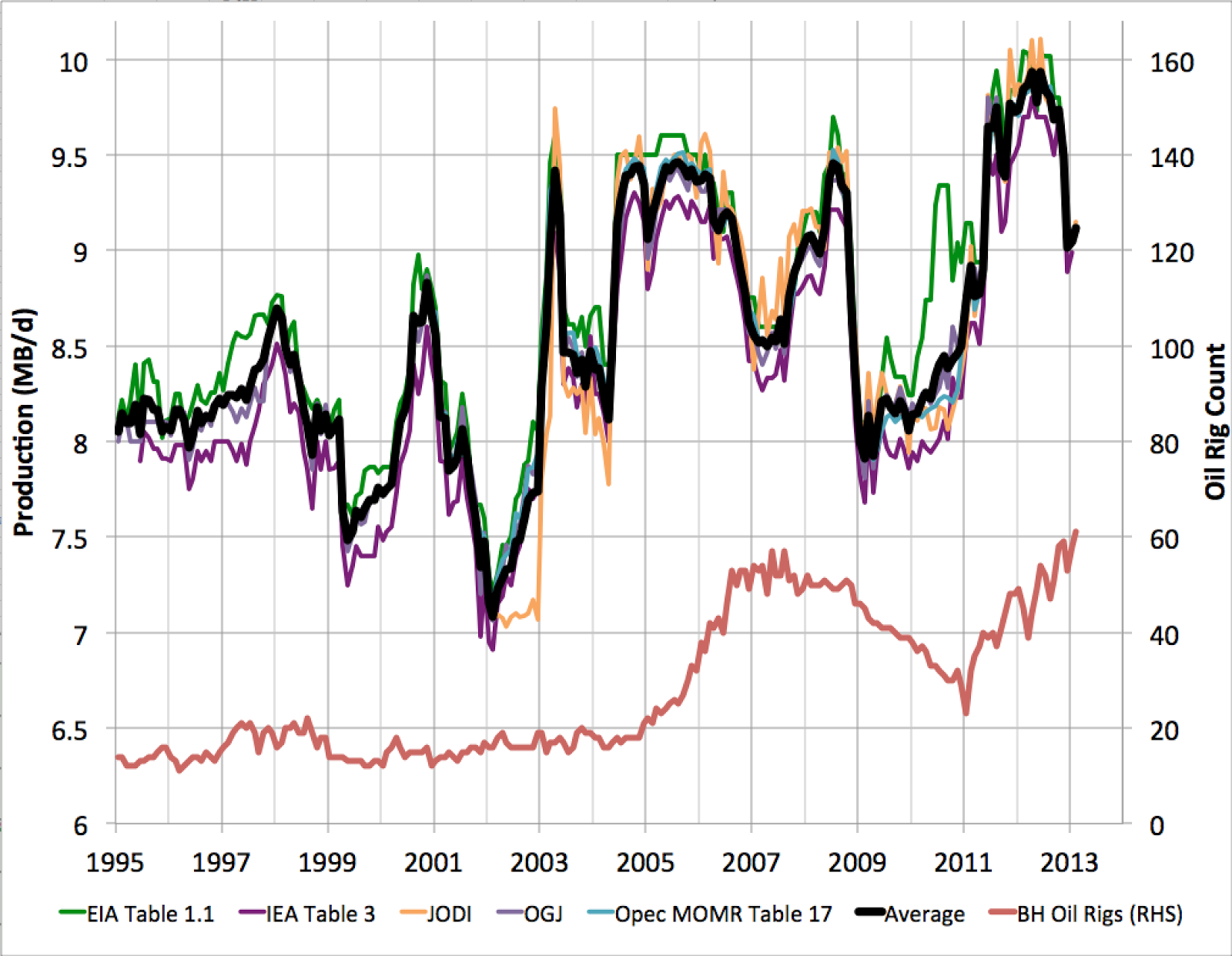
The rush to judgment seems to be based on the remarkable recent success from using horizontal fracturing to extract oil from tighter rock formations. Here for example is a graph of production from the state of Texas, one of the areas experiencing the most dramatic growth in tight oil production. In 2012, Texas produced almost 2 million barrels each day, up 800,000 barrels a day from 2010.

Perhaps it’s the case that Saudi Arabia isn’t willing to maintain its previous production levels, or perhaps it’s the case that Saudi Arabia isn’t able to maintain its previous production levels. But whatever the explanation, this much I’m sure about: those who assured us that Saudi production was going to continue to increase from its levels in 2005 are the ones who so far have proved to be dead wrong.
8 Comments on "The Death of Peak Oil"
ian807 on Sun, 7th Apr 2013 2:26 pm
Rob Wile and Colin Sullivan, in particular, are simply part of a coordinated propaganda campaign to influence google search results. Sullivan publishes on a site without user comments so that nobody can refute his absurd comments (Can’t contact peak oilers? Really?) Moreover, one look at the Stanford Research Institute’s book “Cubic Mile of Oil” would show him a fool. I don’t think he can refute SRI, academically, or in any other way.
econ101 on Sun, 7th Apr 2013 2:43 pm
The author likes to grab onto trends and project them into the future, that’s for sure. The author also likes to explain trends with broad common knowledge type reasons. One thing the author is correct about: the Saudi cutback is an attempt to control prices.
The Saudis were the greatest benefactors when 1970s peak politics started to cause shortages.
Slowly America and the world markets became more and more dependent on the Saudis and OPEC. That caused the change in the business model from the old way: ample, reliable supply in an industry operating in a favorable political climate using PRICE COMPETITION to gain market share to make profits. This is how a healthy market operates to keep supplies ample and prices low.
The new model, caused by peak oil politics, relies on SUPPLY CONTROLS to assure the highest possible price rather than competition to assure the lowest possible price. It’s typical monopolistic practice.
This was possible because US laws and policy restricting development allowed OPEC to became the world’s largest supplier.
Now worldwide non-OPEC production is beginning to chip away at that model. Not only do we have the shale developments on going around the world but we still have all those supplies that have been restricted because of peak oil politics. We have ample supplies and the Saudi actions are pointing it out. I can also see signs the business climate is becoming more favorable.
econ101 on Sun, 7th Apr 2013 2:43 pm
The author likes to grab onto trends and project them into the future, that’s for sure. The author also likes to explain trends with broad common knowledge type reasons. One thing the author is correct about: the Saudi cutback is an attempt to control prices.
The Saudis were the greatest benefactors when 1970s peak politics started to cause shortages.
Slowly America and the world markets became more and more dependent on the Saudis and OPEC. That caused the change in the business model from the old way: ample, reliable supply in an industry operating in a favorable political climate using PRICE COMPETITION to gain market share to make profits. This is how a healthy market operates to keep supplies ample and prices low.
The new model, caused by peak oil politics, relies on SUPPLY CONTROLS to assure the highest possible price rather than competition to assure the lowest possible price. It’s typical monopolistic practice.
This was possible because US laws and policy restricting development allowed OPEC to became the world’s largest supplier.
Now worldwide non-OPEC production is beginning to chip away at that model. Not only do we have the shale developments on going around the world but we still have all those supplies that have been restricted because of peak oil politics. We have ample supplies and the Saudi actions are pointing it out. I can also see signs the business climate is becoming more favorable.
SilentRunning on Sun, 7th Apr 2013 3:05 pm
Hamilton spews more BS. Is this news?
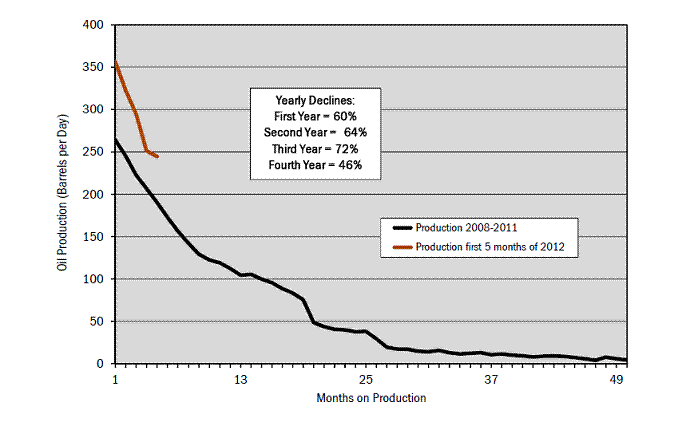
Yes. We’ve heard the “Fracking means peak oil is dead shpeal about 4000 times now. Repetition however does not change reality – that fracking produces a short burst of hydrocarbons, followed inexorably by a very rapid decline in production (“Peak Fracking, if you will). The net result: Fracking doesn’t kill peak oil, it merely delays the inevitable – and makes the resulting decline at the end phase that much sharper.
BillT on Sun, 7th Apr 2013 3:12 pm
The oil industry thinks if it says it often enough it will be true. Peak oil has passed. Now we are calling moonshine and cooking oil, petroleum. No mention that of the total barrels produced, how many of then went back into the ground to produce the oil we use? The NET is the number to record, but is usually absent and real articles about oil production. If you put 2 barrels in to get 4 barrels out, it is a net of 2 barrels, not 4.
Plantagenet on Sun, 7th Apr 2013 4:13 pm
The clearest signal of the availability of oil is the PRICE of oil, and the price of oil is going up, just as the Peak Oil model predicts.
BillT on Mon, 8th Apr 2013 1:40 am
BTW: How much faith can you put in an article by a professor of economics talking about the field of geology and petroleum? Economics as a discipline is failing faster than the supply of oil. All they can do is look back to predict the future. That no longer works in either geology or economics. We are in the ends times and it is Mother Nature making the rules today.
Lachlan on Mon, 8th Apr 2013 3:21 am
BillT and Silent running:
You appear to say that Prof. Hamilton is saying that peak oil is dead. His article actually says that Pickens was right in 2005, and that peak oil is far from dead. (Don’t be misled by the fact that his article starts with a quote by daydreamers.)