
Peak Oil is You

Donate Bitcoins ;-) or Paypal :-)


Page added on January 11, 2015

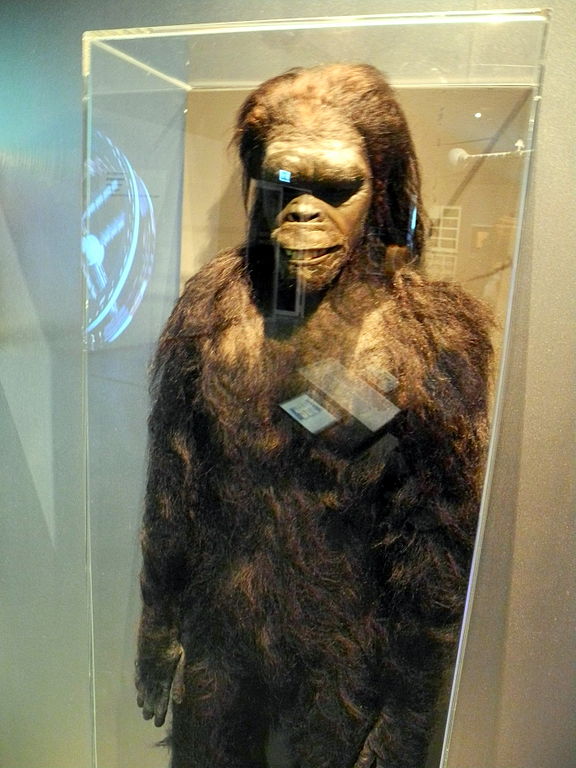
The central contradiction in the modern outlook: ‘Planet of the Apes’ vs ‘2001: A Space Odyssey’

 When talking about the perils of climate change or resource depletion, soil degradation or fisheries collapse, water pollution or nuclear waste–how annoying it is to have one listener respond dismissively, “They’ll figure something out. They always have.”
It’s a nonsense rejoinder and yet, it often gains the assent of many–as if this assertion were a self-evident truth thatonly an enemy of progress would question. And, that’s where we’ll start examining the central contradiction in the modern outlook–with a statement that is offered as if it were a scientific fact, when, in truth, it is nothing more than a piece of dogma enunciated by the religion we call modernism.
At first glance, the statement seems backward-looking because it asserts that we humans have always averted catastrophe through our ingenuity. But, of course, this is complete hogwash. History is replete with civilizations that have risen and then fallen, crumbling for myriad reasons eerily similar to ones said to threaten our own: climate change, resource depletion, soil degradation, water pollution, plagues, war, and political disintegration. The listener’s statement above can’t really be backward-looking for it would fall to pieces with only a cursory review of history.
And so, this means that it must actually be forward-looking. It assumes that the future cannot fail even though the past testifies to almost certain decline for our civilization at some point. What is the basis for this forward-looking optimism concerning a future which we cannot know?
Let us examine the issue through the medium of film using two films that illustrate perfectly the contradiction I mention above. First, there is
But for the purposes of this piece we’ll go along with the notion that in the future apes will have become intelligent and dominant on Earth. In “Planet of the Apes” these evolved apes talk and use tools and, yes, they use weapons. In this notion there is nothing particularly unscientific except perhaps the impossibility of unchanged ape vocal cords adequate to human speech. But even an ape’s vocal cords might evolve over time to become capable of human speech as they did once before if we take the fossil record seriously.
Modern science posits only change and evolution. It does not assume special exemptions for humans, and it acknowledges that the life of the human species on planet Earth will be here and gone in the blink of an eye when considered on the geologic timescale.
The arrival of another intelligent species at some point in Earth’s remaining period of habitability (1.75 to 3 billion years according to one study) seems plausible even if it is unlikely. “Planet of the Apes” is decidedly a film about evolution–a process which has no particular goal in a universe which, scientifically speaking, has no particular destiny–except perhaps an unglamorous and lifeless heat death, a possibility about which there continues to be a robust debate. Even physicists aren’t sure where we are headed.
“2001: A Space Odyssey” imagines humans in quite a different light, one that conforms to modern notions of a special destiny for humankind. If you’ve seen the film, you’ll realize that we can compare apes in “Planet of the Apes” to those in the first part of “2001” which includes scenes of a group of prehistoric apes who encounter an alien monolith.
The black monolith somehow imprints special abilities on the minds of the group’s members, abilities which allow them to learn to make and use tools for hunting and ultimately for battle. (Why this monolith which clearly comes from an advanced technical culture does not give the apes the specifications for computer chips and spaceships right then and there is a puzzle. Why wait millions of years for the apes to become humans in order to figure it all out? But then I digress.)
Apparently these abilities can be passed on genetically, a thoroughly unscientific view known as the heritability of acquired characteristics first proposed by Jean-Baptiste Lamarck. (My aim is not to pick on details of director
At the end of the film’s prehistoric scenes, an ape tosses a weapon made of bone triumphantly into the air. That weapon dissolves into a shape that roughly matches the form of a spacecraft now moving across the screen–an abrupt jump to the year 2001 on the presumably inevitable upward journey of humankind. (We are left to fill in the intervening years with progress.)
After more dazzling shots of spaceships and a space station, we join Dr. Heywood Floyd mid-flight on a space shuttle to an American Moon base near which another monolith has been excavated, one very much like the monolith we’ve already seen interacting with prehistoric apes. Oddly, in a movie supposedly presaging our techno-utopian future, the airline food has gotten worse. We watch Dr. Floyd sip from various straws the equivalent of strained carrots and corn and puréed fish from his covered tray. The toilets are tricky, too. In zero gravity there are apparently 10 steps to relieving oneself successfully.
After a briefing at the Moon base, Floyd goes to the excavation site to inspect the mysterious monolith. Evidence suggests that it was deliberately buried 4 million years ago. After Floyd approaches the structure and touches it (much like the apes on Earth before him), it emits a piercing sound, presumably transmitting data to the visiting humans (perhaps including a refresher course on laisser-faire economics or the virtues of untested chemical compounds–we are not told). Presumably, humans clever enough to find and excavate such a monolith on the Moon are ready for the next step–which turns out to be a trip to Jupiter.
(Read no further if you have never seen the film and do not want me to ruin the ending–though I tend to think of the ending as the least compelling part of the film.)
Once at Jupiter the lone surviving astronaut–it turns out really bad stuff happens in between launch and arrival at Jupiter–is transformed by alien powers into an incorporeal being, a star child–at least that’s what Kubrick and his collaborator, science fiction author
To be fair Kubrick consciously set out to make a mythic film. That’s why it includes such fantastical elements. Every good myth does. But what he does not know is that he has captured the modern myth perfectly, to wit:
Human progress is one-way and inevitable. No obstacles can prevent it. We humans are not flung into the future by the random forces of the universe. Rather, we are pulled into our future by our destiny. In the parlance of Aristotle this is what is known as final causes or
Now, here is the problem. A film which spends so much of its time enlisting realism and scientific fact (as it was known at the time) tells us a thoroughly unscientific tale. And, it is the tale of our times.
We imagine ourselves to be members of a thoroughly scientific culture and to be scientifically minded. But, what science tells us is that the evolution of the universe and thus of planet Earth and its inhabitants is random. It is following no predetermined felicitous course. This process of change could be favorable to humans or it could be horrifically dangerous to them.
Our technological innovations will not necessarily shield us from this change. In fact, these innovations are part of the change. They influence climate in a way that is deleterious to the human future; they empty fisheries with a swiftness never before seen; they lead to degradation of the soil, not in isolated areas, but worldwide; and they poison the food, the air and the water in a manner that is global in scale.
A friend refers to this as the Midgley Effect. Chemist Thomas Midgley Jr. was heralded for his work in creatingleaded gasoline and
But chlorofluorocarbons were even worse. Used primarily as refrigerants from the 1930s onward and later as aerosol propellants, they escaped into the air. No one thought to track their destination until the 1970s when one scientist,
That somewhere turned out to be high in the atmosphere attacking the ozone layer which protects humans and other living creatures from excessive radiation from the Sun. Had it not been for Rowland asking a very specific question and receiving a grant to fund the answer, we might well be living with little or no atmospheric protection from dangerous levels of solar radiation. Such are the perils of our technology. In this case, only one curious man stood between the human species and widespread disaster. Chlorofluorocarbons and other ozone-destroying chemicals were subsequently phased out worldwide by the
Midgley–who believed he was doing good things for society and received many awards for his discoveries–turned out to have “had more impact on the atmosphere than any other single organism in Earth’s history,” according to environmental historian J. R. McNeill. And, it wasn’t a good impact.
One of the pillars of our modern techno-utopian outlook is that invention is presumed to be good and should not be unduly impeded. It turns out, however, that our own science has shown that inventions can be potentially catastrophic.
So, now we come to the central contradiction of the modern outlook. We rely on science. We say we believe in science. But what science tells us about the trajectory of the universe and thus human beings is no more complicated that what “Planet of the Apes” tells us. There is no particular or preordained direction for the future development of humans or the universe we live in.
Yet, the techno-utopian vision that we cling to as modern people rejects this view even as we say our favored instrument of progress is science. Thus, we must conclude that our dissenting party guest’s reply above–“They’ll figure something out. They always have.”–enunciates a religious belief, not a scientific observation.
Science recognizes the role of chance. There are processes beyond our knowledge which generate events we can neither predict nor control. The modern outlook acknowledges chance, but views it as a bothersome bug rather than a feature in nature–one that in principle can be held at bay and ultimately overcome with increased knowledge. In fact, we need not even concern ourselves with planning because God or providence or special instructions from an alien race or perhaps Adam Smith’s”invisible hand” in the marketplace will take us to our inevitable destination of ever more dominance. This is a religious view and therefore generally immune to both proof and debunking.
And yet, as professor of environmental studies David Orr has told us our ignorance grows alongside our knowledge. The things we create to “solve” our problems are likely to create more problems which we cannot now anticipate. In short, there is no solution to the knowledge problem. We will forever (or rather for as long as the human species lasts) be subject to chance.
That should make us much more cautious in our enthusiasm for anything that calls itself progress. But it is hard to find any true conservatives in the world anymore. Those calling themselves “conservative” are even more likely than those calling themselves “liberal” to advocate for rapid, unplanned change. A true conservative would question change of any kind, asking whether it might risk ruin for the entire culture or whether its harm, if any, will be limited.
So, let me say it altogether now, this modern creed: Our future as a species is guaranteed by our inventiveness through science and technology while we move down an entirely unplanned but nevertheless purposeful, that is,teleological path that ensures not only our survival but also our dominance indefinitely–extending even beyond the Earth.
This creed purports that our destiny is the cause of present events, events which will inevitably lead to that destiny–circular reasoning if there ever was any. No true scientist would ever make such a statement. No honest observer would call such a belief modern. The only thing that sets it apart from premodern religious beliefs is the insistence that human affairs run only in the direction of progress and cannot reverse.
It’s true that an acorn can become a mighty oak. But, it is also true that pigs eat them and that the vast majority of acorns never germinate. Chance happens. Acorns have possibilities. But that is not the same as having a destiny. And, it is important to remember that oaks are subject to the same evolutionary pressures as all other species. While we cannot know the future, it is nevertheless likely that both oaks and humans will someday go extinct, joining the 99 percent of all other species in Earth’s history that have disappeared.
In the film “2001” Dr. Floyd addresses his fellow scientists advocating strict secrecy about the monolith on the Moon. He explains:
Now I’m sure you’re all aware of the extremely grave potential for cultural shock and social disorientation contained in this present situation if the facts were prematurely and suddenly made public without adequate preparation and conditioning.
I would contend that the shock to the modern mind would not be the revelation that a superior mind is guiding humans to ever greater progress. Rather, a true shock would be to find out that we are adrift on a sea of chance–not necessarily helpless, but vulnerable nevertheless as were the apes at the beginning of the film.
That would be a radical shift of consciousness for it would force us all to hew more closely to a measured and gradual approach to innovation and part far less readily with the proven technologies and approaches of the past. It would be an acknowledgement that we are not the masters of our fate and that no science or technology will ever make us so.
A special note of thanks to my dear friend and colleague, Dr. James Armstrong, professor of English at Winona State University, for conversations that led to this piece which contains several of his ideas.
25 Comments on "The central contradiction in the modern outlook: ‘Planet of the Apes’ vs ‘2001: A Space Odyssey’"
Dredd on Sun, 11th Jan 2015 3:36 pm
Agreed.
Historian Toynbee, at one time the most quoted historian of his day, pointed this out about the demise of societies:
The writer points out the fallacy “They’ll figure something out. They always have.”
“In other words, a society does not ever die ‘from natural causes’, but always dies from suicide or murder — and nearly always from the former, as this chapter has shown.” – A Study of History, by Arnold J. Toynbee
(The Deceit Business – 3).
Dredd on Sun, 11th Jan 2015 3:38 pm
typo, my comment should read:
Agreed.
The writer points out the fallacy “They’ll figure something out. They always have.”
Historian Toynbee, at one time the most quoted historian of his day, pointed this out about the demise of societies:
“In other words, a society does not ever die ‘from natural causes’, but always dies from suicide or murder — and nearly always from the former, as this chapter has shown.” – A Study of History, by Arnold J. Toynbee
(The Deceit Business – 3).
Bandits on Sun, 11th Jan 2015 3:42 pm
This is quite a good essay.
Scientists don’t build things, that area of responsibility belongs to the engineers. It’s always engineering. Humans have done it since time immemorial. Science gives us the knowledge, what we do/did with it has consequences.
Davy on Sun, 11th Jan 2015 4:49 pm
The article touches on the age old question of determinism and free will. If one looks at the spiritual science of the tree of life we see ascending levels of abstraction. We see the essence of time itself and our connections to the galactic has obsessed man from our modern beginning of civilizations. Along with that obsession has come the constant search for the end of time. It is only recently in our hyper modernism of the last few hundred years that we have turned to exceptionalism through our belief in knowledge and technology. We now look for infinite progress. You know onward to the stars and beyond.
I see the myth of exceptionalism breaking down now. The myth of my youth of ever progressing human achievements has lost something today. I feel this has happened because of our hitting subtle limits. Subconsciously this progress myth is dying with each failure of this myth. The promises from the myths of progress have turned to skepticism. We are almost rudderless today because of our dying meme of exceptionalism and progress.
Was 2012 a watershed year was it a crossing point that many ancient civilizations prophesized? Have we entered a new hemispheric reality where life behaves differently? Look at time in the Hindu perspective and we see one day is 1,000 maha-yugas (great ages). Each maha-yuga consists of four yugas (ages), each progressively shorter and more degraded. They are the golden, silver, copper, and iron ages. It is said we are in the Iron Age. This age is characterized by time speeding up as it degrades.
My point here is are we at a time of transformation at many levels? I don’t have any answers but I am proposing questions. We must question the very heart of our modern myth of exceptionalism. At some point when our world is flying apart meaning will be at a premium. Should we be talking about outposts on Mars or connection to nature? One seeks exploitation the other community. I feel if we have any hope in a collapse in the future it will be in embracing nature not scientific modernism characterized by human exceptionalism.
Apneaman on Sun, 11th Jan 2015 5:09 pm
See, now that’s the kind of doomey critique of us rapacious apes that warms my cynical heart. Nothing like a big hit of dopamine releasing doom to help me through another gray dreary Vancouver winter’s day.
I still contend that Dr Michael Huesemann’s book, “Techno-Fix: Why Technology Won’t Save Us Or the Environment”, offers one of the best critiques and explanations of techo optimism, in addition to why it can’t save us. Here is a good lecture with a question and answer session following. When a German scientist and engineer tells you technology can’t save us, you know it’s some damn serious shit!
Techno Fix – Why Technology Won’t Save Us Or the Environment
https://www.youtube.com/watch?v=1MsUypIHZhc
Go Speed Racer on Sun, 11th Jan 2015 5:20 pm
I don’t know what’s more horrible about 2001 A Space Odyssey. Its so horrible that with all those cool special effects & futuristic vision, that they could not be bothered to create a measurable plot.
Or maybe what’s so horrible of all, is that our government, clearly given all the blueprints for Space Station Alpha back in ’69, gives us a turd like the International Space Station and thinks we the taxpayers can’t tell plank-roasted Salmon, from fried dogshmit.
Maybe the most horrible thing of all, about 2001 a Space Odyssey, is the awfulness of the sequel, ‘2010’ which was painful to watch.
Perhaps its all for the best that the United Police States of America threw all the space ambitions into the schitter. “whoosh”.
Much better to take that money, and pay for food stamps, welfare, disability & pot pipes for the “great” American citizenry. The money for space exploration could also be used to give them discount cigarettes & free tattoo’s.
Go Speed Racer on Sun, 11th Jan 2015 5:21 pm
Rats. Oops. Space Station V. “5”. The rotating wheel with Pan Am airplane service.
GregT on Sun, 11th Jan 2015 5:45 pm
Apnea,
Vancouver? You mean there are actually two people here in the LM who get it? I find that difficult to believe. 🙂
Where abouts in Van are you?
Davy on Sun, 11th Jan 2015 6:19 pm
AP, Huesemann’s talk is excellent I second the recommendation. I am going to check into the book as well
Apneaman on Sun, 11th Jan 2015 7:29 pm
GregT
I have ran into a few other locals on the inter-tubes, but not many. More people know than are willing to speak about it. Not everyone is a well studied/obsessed/compelled, whole systems doomer, but many know we are in deep shit on one or more fronts. Must keep up appearances to get along; keep your job, family and friends, status, etc. Can’t really blame them too much; it’s the way we are and there appears to be no benefit and many possible negative consequences. Once in awhile I happen across someone who knows more than enough. One time it was a bus driver when it was just me, him and some teens at the very back. He was somewhat guarded, being on the job, but he said enough. Another time in a line up at a gov bureaucracy with a hardcore gov hater. Also, I overheard 3 extremely doomy 20 somethings discussing the “clathrate gun” on the Skytrain. I even started chatting with them; they knew a lot. I’m way down in South Surrey right now. I first moved to the LM in 1976. I have probably lived in 60-70% of the municipalities at one time or another. I once lived in the greater Atlanta area, but I think here is still better than many places. I fear for all my friends and my ex and her family down in Atlanta.
antaris on Sun, 11th Jan 2015 7:56 pm
Greg, make that at least 3 with me in New West
Makati1 on Sun, 11th Jan 2015 8:24 pm
Go Speed, the US decided that war was better than space stations in the 70s. Vietnam, etc. We taxpayers spend over a trillion per year on wars and the police state. Imagine what we could have done with all of that money over the last 40 years had we used it to advance science instead of perverting it into weapons of war and surveillance. It easily exceeds $20,000,000,000,000. (20 trillion)
https://search.yahoo.com/search?fr=mcafee&type=B111US0D20131004&p=US+military+budget+by+year
We chose WalMart over the moon and Mars.
GregT on Sun, 11th Jan 2015 10:45 pm
I’ve met a few myself, but very few and far between. Like I mentioned in a previous post, my sister recently finished her degree in Environmental Management. She gets it but doesn’t like to talk much about what’s coming down the pipes. Every so often we do talk, but she finds things so depressing that sometimes she just cries. I don’t dare mention much at work, and a large part of my job deals with sustainability, environmental management, conservation, and alternate energy. I mentioned peak oil once at work, and got a bunch of blank stares before everyone returned to discussing something else. I have found that it just isn’t worth losing friends and relationships over. I am fortunate to have a highly intelligent wife that completely understands, we have watched many university lectures together over the years, and I do have two close friends that I can talk with. Unfortunately one is in Toronto, and the other one is in Australia. Our son figured it out on his own with no input from us, he starting asking some pretty doomerish questions by the time he was 18. Our daughter, probably gets it more than we think that she does, every once and a while she comes up with pretty some serious topics of conversation. My Wife and myself both agreed years ago that we wouldn’t burden our kids by bringing any of this up, and we would let them figure things out on their own, or not.
I am in East South Surrey, but only until June. If all goes as planned we are out of here, this entire region is out of control. I can’t imagine what it will be like in Vancouver even five years from, it has already reached critical mass.
Apneaman on Sun, 11th Jan 2015 11:57 pm
In the early 1980s, when I was 15, I had already figured out that much of what I was hearing from authority did not match what they actually did. Part of that was due to listening to my father get angry watching the news, intentional over hearing all their social conversations and me covertly (I thought) reading his university books. He minored in history, so there was a lot for a young mind. Even modern education systems cannot crush true curiosity in everyone. The first one I ever read was The Conquest of New Spain, by Bernal Diaz del Castillo. Brutal and fascinating.
The information on all of our predicaments is pretty easy to find. Even the MSM has had some very dire pieces on Climate Change. Not enough of them and not enough context, but there are no secrets. Many people are just being willfully ignorant for reasons we have discussed.
This is from a PBS online deal aimed a younger people. I was surprised to see this.
https://www.youtube.com/watch?v=z9gHuAwxwAs&feature=youtu.be
What exactly do you mean by “entire region is out of control” and “critical mass”?
GregT on Mon, 12th Jan 2015 12:39 am
“What exactly do you mean by “entire region is out of control” and “critical mass”?”
Too many people for the infrastructure and local food base. Completely Insane traffic. Not sustainable.
When I was in high school back in the 70s, as part of an elective class that I took, we were taught about resource depletion, what was referred to back then as the ‘greenhouse effect’, and the population explosion. We were also taught that the oceans contained vast resources that we would be able to tap into when things became problematic. I guess ocean acidification wasn’t widely understood back then. I remember being very concerned at the time, but of course life goes on, and we tend to forget about things until they come back to smack us in the face.
Go Speed Racer on Mon, 12th Jan 2015 1:10 am
Make the Hal 9000 design a new energy source for us.
“I’m sorry Dave, I can’t do that”.
Apneaman on Mon, 12th Jan 2015 1:15 am
Last I heard, they are expecting 100,000 new people a year for at least a decade. Paving over the Fraser valley and delta farm land with sub divisions and strip malls seems to be one of the go to solutions. No biggie it’s just some of the most productive farm land in Canada. Who needs it. Can you believe I moved down here from Salmon Arm less than a year ago? Big mistake, but had little choice; mom’s all alone now and starting to need help. Such is life.
GregT on Mon, 12th Jan 2015 1:31 am
There was an article that made the front page of the Province last year. Dianne Watts was quoted as saying that the Surrey Regional Development board plans on bringing 1 million more people to Surrey alone, by 2025. So yah, 100,000 people per year, in Surrey. Can you imagine what that will look like? How long will it take the new Hwy 1 expansion to reach gridlock? It was completed in May, it’s stop and go traffic already.
My advice? Move your Mom, and yourself ,back to Salmon Arm.
Go Speed Racer on Mon, 12th Jan 2015 1:47 am
i was a kid in the 70’s and used to wander around in Chilliwack. Definitely was an agriculture society. Noticed in the 90’s the white guys on tractors had been replaced by East Indians on tractors. Guess now the East Indians will sell out to Wal-mart, and all that’s left is a big ole Wal-Mart and asphalt parking lot. Hope those East Indians got a good price when they sold the farmland.
Edward Boyle on Mon, 12th Jan 2015 3:08 am
I am trying to read spengler. He talks about fate vs. coincidence/chance. We feel fate, live, are becoming now. Religious animal view. Science is more random based but overlays with rationality our real feeling of fear/desire of ultimate heaven/hell fate. We see that in article.
I was wondering. I try to pray sometimes. Suppose I ask god for help, what are the limits, for me, my social environment, etc. Say a squirrel fears starving, cold and “prays” or wishes help. We imagine god in human form. In Africa jesus is black. The squirrel imagines a squirrel god.
What is god? We are conscious to an extent of certain realities with limited sensory organs as squirrel. Trees less so. Rocks? God theory postulates a being with absolute knowledge, power in all dimensions. Many say god is passive in daily life, chance rules over fate. We have limited godpower,free will. God delegates to us. Gaia would be above us in responsibility. Humans are one more
pesky critter. Other plants, animals “pray” for our demise. Next stage is conscious solar system like in astrology, planets like gods impacting fate like changing weather system. Outside of physical body posthumous souls of all “beings” move on, mix,etc.
Maybe biological life consciousness in 3D is not the be all and end all. Is this deistic?
At any rate knowing complete plan is above our pay level but we have responsibility, free will, consequences and must make best of it. Squirrel,tree, gaia, solar system and god eyeing us with various levels of interest. To the former we are a hazard, to the latter maybe ofvery little interest. To
Gaia a cockroach, fire ant type pest, playing with unfair means, destroying house and home of the family.
shamanistically, astrologically, mystically(monotheistic), scientifically all stages in human devlopment understanding big picture. There is more if we choose to stay here without destroying it all.
Perk Earl on Mon, 12th Jan 2015 3:43 am
Go Speed Racer, the worst part of 2001 was that Dave had to float around inside the biggest void in a computer ever to do a hard shut down of Hal, one plexi rectangle at a time with a key while getting it to sing ‘Daisy’, vs. just pushing on a button for 5 seconds.
The best part was the playing of ‘Blue Danube’ while that great looking Pan Am space jet moved through space, while a slim attractive stewardess served it’s ‘lone passenger’.
Who would have known then that over a decade past 2001 we would sacrifice our self dignity to be squeezed into coach like a sardine and served a tiny bag of peanuts by a drab looking attendant, while breathing everybody else’s stale, oxygen starved, virus filled air.
Dredd on Mon, 12th Jan 2015 7:10 am
Go Speed Racer on Sun, 11th Jan 2015 5:20 pm
You wrote: “Much better to take that money, and pay for food stamps, welfare, disability & pot pipes for the “great” American citizenry. The money for space exploration could also be used to give them discount cigarettes & free tattoo’s.”
There is no money left after it is plundered then distributed to the MOMCOM – A Mean Welfare Queen.
Go Speed Racer. on Mon, 12th Jan 2015 10:47 am
…. Squeezed into coach and serves a tiny bag of peanuts…..
yeah, the airline industry exec’s are busy proving their disdain of the middle class. Even the bag of peanuts has got maybe 5 peanuts in jt. Watch those busy CEO exec’s prune it down to one peanut per bag! Wait! Why not no peanut in the bag at all, how else can we boost next quarter’s margins.
In reality an in flight meal, even for a 3 hour flight, cost very little and gave the customer dignity, civility, and convenience. Absurd how they take away basic reasonable things. HEY no more roll.of toilet paper in the airccraft potty. Think of all the money to be passed to shareholders. All in favor say Aye!
Dredd on Mon, 12th Jan 2015 12:58 pm
The abiotic stars are more stable than the biotic civilizations (The Life and Death of Bright Things – 2).
Makati1 on Mon, 12th Jan 2015 7:27 pm
Go Speed, I travel to the US every year from the Philippines. It is usually 3 flights, the longest, Narita Japan to Atlanta, about 12 hours. In the last 20 or so flights, I have had only one meal that didn’t agree with me, and that one may just have been at the wrong time, not inedible. No, they are NOT as good as you got 30-40 years ago, when oil was $10/barrel, but I can get to the States for about $0.06 per mile in less than 24 hours. ($1,500 RT) Driving my car in Philly used to cost at least 10 times that much.
If you don’t like flying, don’t fly. When BAU ends, it may not be possible for anyone not wealthy or government to travel by air.