
Peak Oil is You

Donate Bitcoins ;-) or Paypal :-)


Page added on February 6, 2018

The Bumpy Road Down, Part 4: Trends in Collapse
 |
| Bamboo in Winter |
This time I’m going to look at some of the changes that will happen along the bumpy road down and the forces and trends that will lead to them. If you followed what I was saying in my last post, you’ll have realized that the bumpy road will be a matter of repeatedly getting slapped down as a result of going into overshoot—exceeding our limits, crashing, then recovering, only to get slapped again as we go into overshoot yet again.
Along the way, where people have a choice, they will choose to do a range of different things (some beneficial, others not so much), according to their circumstances and inclinations. Inertia is also an important factor—people resist change. And politicians are adept at “kicking the can down the road”—patching together the current system to keep it working for little while longer and letting the guy who gets elected next worry about the consequences.
Because the world will become a smaller place for most of us, we’ll feel less influence from other areas and in turn have less influence over them. There will be a lot more “dissensus”—people doing their own thing and letting other people do theirs. I expect this will lead to quite a variety of approaches, some that fail and some that do work to some extent. In the short run, of course, “working” means recovering from whatever disaster we are currently trying to cope with. But in the long run, the real challenge is learning to live within our limits and accept “just enough” rather than always striving for more. Trying a lot of different approaches to this will make it more likely that we find some that are successful.
Anyways—changes, forces and trends…and how they will work on the bumpy road down.
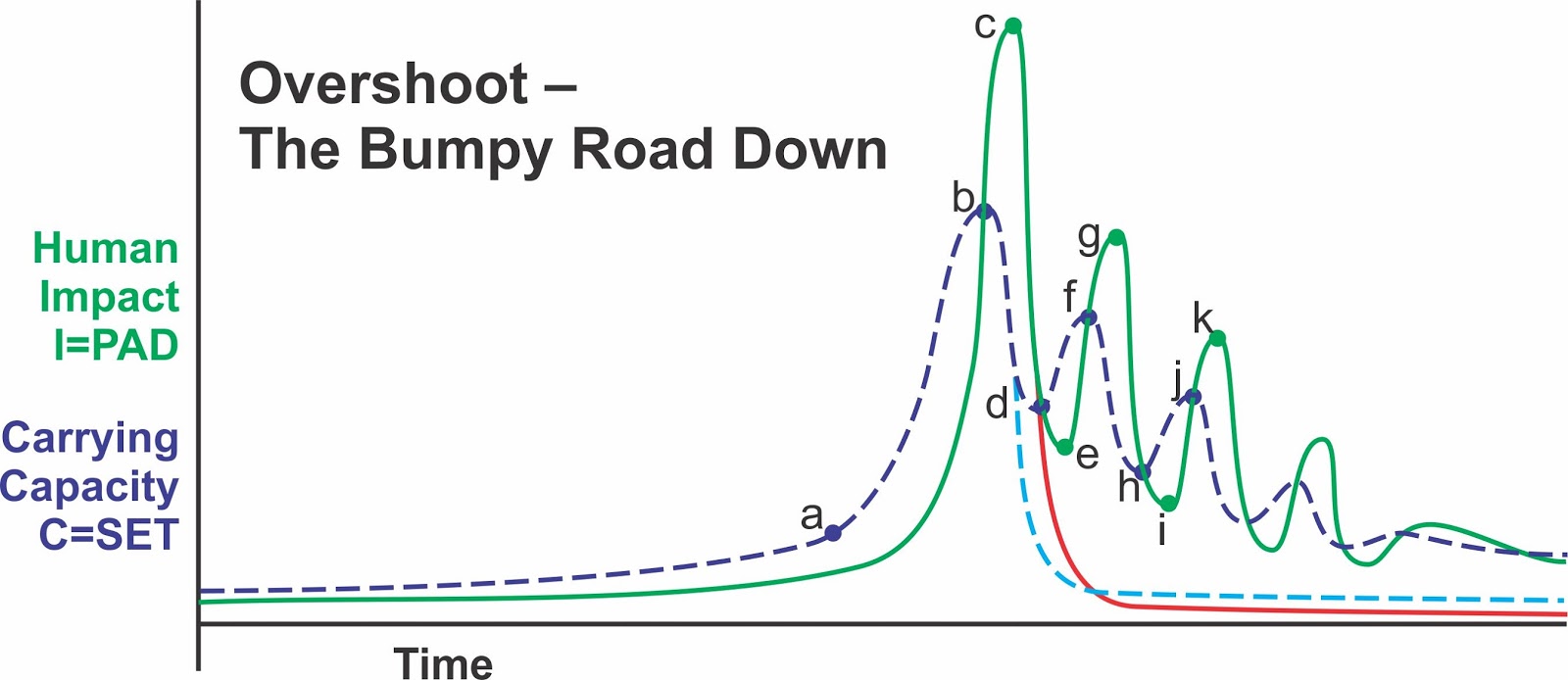
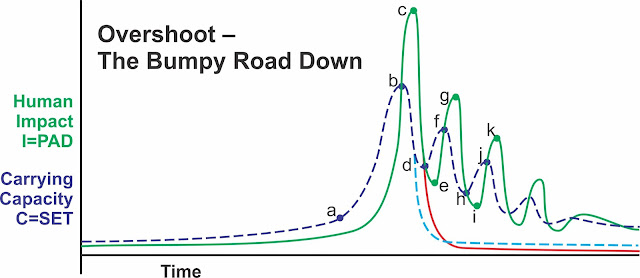
I’ve included the stepped or “oscillating” decline diagram from my last post here to make it easier to visualize what I’m talking about.
Energy Decline
Because I’m a “Peak Oil guy” and because energy is at the heart of the financial problems we’re facing, I’ll talk about energy first. As I said in a recent post:
“Despite all the optimistic talk about renewable energy, we are still dependent on fossil fuels for the great majority of our energy needs, and those needs are largely ones that cannot be met by anything other than fossil fuels, especially oil. While it is true that fossil fuels are far from running out, the amount of surplus energy they deliver (the EROEI—energy returned on energy invested) has declined to the point where it no longer supports robust economic growth. Indeed, since the 1990s, real economic growth has largely stopped. What limited growth we are seeing is based on debt, rather than an abundance of surplus energy.”
It is my analysis that there is zero chance of implementing any alternative to fossil fuels remotely capable of sustaining “business as usual” in the remaining few years before a major economic crash happens and changes everything. So the first trend I’ll point to is a continued reliance on fossil fuels. Fuels of ever decreasing EROEI, which will increase the stress on the global economy and continue contributing to climate change and ocean acidification.
Those who are mainly concerned about the environmental effects of continuing to burn fossil fuels would have us stop using those fuels, whatever the cost. But it is clear to me that the cost of such a move would be a global economic depression different only in the details from the one I’ve been predicting. Lack of energy, excess of debt, environmental disaster—take your pick….
It has been interesting to watch the governments of Canada and the US take two different approaches to this over the last couple of years.
The American approach has been based on denial. Denial of climate change on the one hand, and denial of the fossil fuel depletion situation on the other. “Drill baby, drill!” is expected to solve the energy problem without causing an environmental problem. I don’t believe that either expectation will be borne out over the next few years.
Our Canadian government under Prime Minister Justin Trudeau has made quite a bit of political hay by acknowledging the reality of climate change and championing the Paris Climate Agreement in the international arena. Here at home, though, it is clear that Trudeau understands the role of oil in our economy and he has been quick to quietly reassure the oil companies that they have nothing to fear, approving two major pipeline projects to keep oil flowing from Alberta to the Pacific coast and, eventually, to Chinese markets.
Yes, Ottawa has set a starting price of $10 a tonne on carbon dioxide emissions in 2018, increasing to $50 a tonne by 2022. This is to be implemented by provincial governments who have until the end of the year to submit their own carbon pricing plans before a national price is imposed on those that don’t meet the federal standard. It will be interesting to see how this goes and if the federal government sticks to its plan. Canada is one of the most highly indebted nations in the world and I wouldn’t be surprised if our economy was one of the first to falter.
At any rate, sometime in the next few years the economy is going to fall apart (point “c” in the diagram). As I’ve said, this may well be initiated by volatility in oil prices as the current oil surplus situation comes to an end. This will lead to financial chaos that soon spreads to the rest of the economy.
On the face of it this isn’t too different from the traditional Peak Oil scenario—the collapse of industrial civilization caused by oil shortages and sharply rising oil prices. But as you might guess by now, this isn’t exactly what I think will happen.
In fact, I think that we’ll see an economic depression where the demand for oil drops more quickly than the natural decline rate of our oil supplies and the price falls even further than it did in 2014-15. We won’t be using nearly so much oil as at present, so we will once again accumulate a surplus, and we’ll even leave some reserves of oil in the ground, at least initially. This will help drive a recovery after the depression bottoms out (point “e” in the diagram). Please note that I am talking about the remaining relatively high EROEI conventional oil here. Unconventional sources just don’t produce enough surplus energy to fuel a recovery.
But the demand for oil will still be a lot less than it is today and this will have a very negative effect on oil companies. Some governments will subsidize the oil industry even more than they have traditionally, just to keep to it going in the face of low prices. Other governments will outright nationalize their oil industries to ensure oil keeps getting pumped out of the ground, even if it isn’t very profitable to do so. Bankruptcy of critical industries in general is going to be a problem during and after the crash. More on that in my next post.
During the upcoming crash and depression fossil fuel use may well decline enough to significantly reduce our releases of CO2 into the atmosphere—not enough perhaps to stop climate change, but enough to slow it down. As we continue down the bumpy road, though, our use of fossil fuels and the release of CO2 from burning them will taper off to essentially nothing, allowing the ecosphere to finally begin a slow recovery from the abuses of the industrial age.
The other trend involving fossil fuels, as we go further down the bumpy road, will be their declining availability as we gradually use them up. Eventual our energy consumption will be determined by the local availability of renewable energy that can be accessed using a relatively low level of technology. Things like biomass (mainly firewood), falling water, wind, passive solar, maybe even tidal and wave energy. Since these sources vary in quantity from one locality to another, the level of energy use will vary as well. Where these sources are intermittent, the users will simply have adapt to that intermittency.
No doubt some of my readers will be wondering why I don’t think high tech renewables like solar cells and large wind turbines will save the day. The list of reasons is a long one—difficulty raising capital in a contracting economy, low EROEI, intermittency of supply and the difficulty (once fossil fuels are gone) of building, operating, maintaining and replacing such equipment when is wears out—to mention just a few.
Large scale storage of power to deal with intermittency will in the long run prove infeasible. Certainly batteries aren’t going to do it. There are a few locations where pumped storage of water can be set up at a relatively low cost, but not enough to make a big difference. And on top of all that, I very much doubt that large electrical grids are feasible in the long run (and I spent half my life maintaining on one such grid).
The FIRE Industries
The next trend I can see is in the FIRE (financial, insurance and real estate) sector of the economy. During the growth phase of our economy over that last couple of centuries the FIRE industries embodied a wide range of organizational technologies that facilitated business, trade and growth. Unfortunately, because they were set up to support growth, they were unable to cope with the end of real growth late in the twentieth century. They have supported debt based growth for the last couple of decades as the only alternative that they could deal with. This led to the unprecedented amount of debt that we see in the world today. Much of this debt is quite risky and will likely lead to a wave of bankruptcies and defaults—the very crash I’ve been talking about.
The FIRE industries will be at the heart of that crash and will suffer horribly. Many, perhaps the majority, of the companies in that sector won’t survive. In today’s world they wield a great deal of political power. During the global financial crisis (GFC) in 2007-8 that power was enough to see them through largely unscathed. This is unlikely to be the case in the upcoming crash, creating a desperate need for their services and an opportunity to fill that need which will be another factor in the recovery after the crash bottoms out. But of course there is more than one way it can be done.
In the 3rd, 4th, 5th, 6th and 7th posts in my ” Collapse Step by Step” series, I dealt with the political realities of our modern world, which limit what can be done by democratic governments. I identified a political spectrum defined by those limits. At the left end of this spectrum we have Social Democratic societies, which still practice capitalism, but where those in power are concerned with the welfare of everyone within the society. At the right end we have Right Wing Capitalist societies where the ruling elite is concerned only with accumulating more wealth and power for itself.
Since the FIRE industries are crucial to the accumulation and distribution of wealth in our societies, the way they are rebuilt following the crash will be largely determined by the political goals of those doing the rebuilding.
At the left end of the spectrum there is much can be done to regulate the FIRE industries and stop their excesses from leading immediately to further crises.
At the right end of the political spectrum the elite is so closely tied to the FIRE industries and so little concerned with the welfare of the general populace, that those industries will likely be rebuilt on a plan very similar to their current organization. A policy of “exterminism” is likely to be followed, where prosperity for the elite and an ever shrinking middle class is seen as the only goal and the poor are a burden to be abandoned or outright exterminated.(Thanks for Peter Frase, author of Four Futures—Life After Captialism for the term “exterminism”.)
In the case of either of these extremes, or anywhere along the spectrum between them, there are some common things I can see happening.
The whole FIRE sector depends on trust. In the last few decades (since the 1970s) we have switched from currencies based on precious metals to “fiat money” which is based on nothing but trust in the governments issuing it. This was done to accommodate growth fueled by abundant surplus energy and then to facilitate issuing ever more debt as the surplus energy supply declined. I don’t advocate going back to precious metals—what we need is a monetary system that can accommodate degrowth, of which a great deal lies in our future. Unfortunately we don’t yet know what such a system might look like.
It is clear, though, that the coming crash is going to shake our trust in the FIRE industries to its very roots. Since central banks will have been central to the monetary problems leading to the crash, they may well be set up as scapegoats for that crash and their relative lack of success in coping with it. People will be very suspicious after watching the FIRE industries fall apart during the crash and their lack of trust will force those industries to take some different approaches.
I think governments will take over the functions of central banks and stop charging themselves interest on the money they print. Yes, I know that printing money has often led to runaway inflation, but the conditions during the crash and its aftermath will be so profoundly deflationary that inflation will not likely be a problem.
The creation of debt will be viewed much less favourably and credit will be much harder to get. And of course this will make the crash and following depression that much worse. In response to this many areas will create local banks and currencies to provide the services and credit that local businesses need to get moving again.
During the last couple of decades there has been a move to loosen regulations in the FIRE industries, to let single large entities become involved in investment banking, business and personal banking, insurance and real estate. Most such entities began as experts in one of those areas, but one has to question their expertise in the new areas they moved into. In any case they became “too big to fail” and their failure threatened the stability the whole FIRE sector. Following the GFC there was only minor tightening of regulations to discourage this sort of thing. After the upcoming crash I suspect many governments, especially toward the left end of the political spectrum, will institute a major re-regulation of the FIRE industries and a splitting up of the few “too big to fail” companies which didn’t actually fail.
It is all very well to talk about business and even governments failing when their debt load becomes too great. But there is also a lot of personal debt that is, at this point, unlikely ever to get paid back. What does it mean, in this context, for a person to fail? What I carry as debt is an asset for someone else—probably the share holders of a bank. They are understandably reluctant to watch their assets evaporate, and I have to admit that there is a moral hazard involved in just letting people walk away from their debts. That feeling was so strong in the past that those who couldn’t pay their debts ended up in debtors’ prisons. Such punishment was eventually seen as futile and the practice was abandoned and personal bankruptcies were allowed.
One suspects that in the depression following the coming crash it will be necessary to declare a jubilee, forgiving large classes of personal debt. What might become of all the suddenly destitute people depends on where their country lies on the political spectrum. I wouldn’t rule out debtors prisons or work camps, the sort of modern slavery that is already gaining a foothold in the prison system of the United States.
If we were willing to give up growth as the sole purpose of our economic system, there are many changes that could be made to the FIRE industries that would allow them to provide the services needed by businesses and individuals without stimulating the unchecked growth that leads to collapse. I think we are unlikely to see this happen after the upcoming crash—we will be desperate for recovery and that will still mean growth at destructive levels.
I think the crash following that recovery will involve the food supply and still unchecked population growth and sadly a lot of people won’t make it through (more on this in my next post). Following that, it’s even possible that in some areas people may reach the conclusion that growth is the problem and quit sticking their heads up to get slapped down again. They’ll have to find a more sustainable way to live, but with it will come a less bumpy road forward.
Authoritarianism
In the aftermath of the next crash, I think we’ll see an increase in authoritarianism in an attempt to optimize the systems that failed during the crash—to make them work again and work more effectively. Free market laissez faire economics will be seen to have failed by many people. Others will hang tight, claiming that if they just keep doing yet again the same thing that failed before, it will finally work.
As is always the case with this sort of optimization, it will create a less resilient system, much more susceptible to subsequent crashes. And after those crashes government will be reduced to such a small scale affair that authoritarianism won’t be so much of an issue.
Fortunately, beyond authoritarianism, there are some other trends that will lead to increased resilience and sustainability. We’ll take a look at those in my next post.
94 Comments on "The Bumpy Road Down, Part 4: Trends in Collapse"
Mad Kat on Tue, 6th Feb 2018 6:04 pm
“I think the crash following that recovery will involve the food supply and still unchecked population growth and sadly a lot of people won’t make it through. Following that, it’s even possible that in some areas people may reach the conclusion that growth is the problem and quit sticking their heads up to get slapped down again. They’ll have to find a more sustainable way to live, but with it will come a less bumpy road forward.”
Many people (billions), not in the US or other Western countries, will hardly notice the change. The city/burbs will be hit the hardest and the pain will be greater for them. Also most of the the die-off will be centered there. With over 80% of Americans living on JIT deliveries of about everything necessary for life, millions will die in the first month.
He hits some good points, but ends with the usual unicorn farts and Kumbaya feelings. I don’t see any up in the post crash scenario. Certainly not for the West.
Darrell Cloud on Tue, 6th Feb 2018 6:11 pm
There are 300 million firearms in private hands in the United States. One hundred million were purchased while President Obama was in office. There are two to three million ARs in private hands. And there are just under 300,000 machine guns in private hands. To feed all of this weaponry, there are probably a trillion rounds of ammunition in private hands. There are roughly a million shooters who reload their own ammunition. Reloaders have the components to remanufacture tens of thousands of rounds of ammunition. Ammunition has a shelf life of half a century.
Putting a boot on the neck of these people is going to be an interesting proposition. Many gun owners are familiar with Solzhenitsyn’s quote.
“And how we burned in the camps later, thinking: What would things have been like if every Security operative, when he went out at night to make an arrest, had been uncertain whether he would return alive and had to say good-bye to his family? Or if, during periods of mass arrests, as for example in Leningrad, when they arrested a quarter of the entire city, people had not simply sat there in their lairs, paling with terror at every bang of the downstairs door and at every step on the staircase, but had understood they had nothing left to lose and had boldly set up in the downstairs hall an ambush of half a dozen people with axes, hammers, pokers, or whatever else was at hand?… The Organs would very quickly have suffered a shortage of officers and transport and, notwithstanding all of Stalin’s thirst, the cursed machine would have ground to a halt! If…if…We didn’t love freedom enough. And even more – we had no awareness of the real situation…. We purely and simply deserved everything that happened afterward.”
― Aleksandr Solzhenitsyn, The Gulag Archipelago 1918-1956
Davy on Tue, 6th Feb 2018 6:13 pm
“Many people (billions), not in the US or other Western countries, will hardly notice the change.”
Just the twang of hunger billyT, as famine sweeps these overpopulated polluted places you call paradise.
Mad Kat on Tue, 6th Feb 2018 6:34 pm
Darrell, yes the US is an armed camp and the resulting future events are unknown. But how many are going to be able to actually defend themselves? With the gangs better armed and already killers, will the individual have a chance? The gangs can stand off 100s of yards from you, out of sight, and pick you off one by one. Only groups, living together and supporting each other, will have a chance in the US, and those will be few.
Davy on Tue, 6th Feb 2018 6:47 pm
Sure billyT, all 360MIL of us across a continent will be picked off. You are a loon. I am glad I am not going to be stew meat like you. Imagine that you could be mixed in with your pet cobra and monkey.
Darrell Cloud on Tue, 6th Feb 2018 7:28 pm
Mad you are absolutely correct. A man alone stands no chance in the unraveling. In my community a loose confederation of locals jokingly talk about the Zombie Apocalypse. Everyone understands that there are no real zombies. Most understand that a zombie is some good old boy with a deer rifle or an AR that has not eaten in a week. We don’t run around in the woods dressed in camouflage and play army. We have on the other hand secured the interest of quite a number of people with interesting skill sets. All of us have battle rifles. Some of us have night vision. A few of us have class III weapons. We have talked to local cattlemen about securing their herds and one pig farmers goes and shoots with us on occasion. If we bring in the friends and immediate families, our group numbers about 150. My Dillion RL 550B will crank out about 400 to 500 rounds an hour. It has interchangeable heads and I reload for all the main battle rifles of the 20th century. There is aloading outfit just north of us that has produced 100 million rounds of ammunition to date.
Mad Kat on Tue, 6th Feb 2018 7:46 pm
Darrell, it sounds like you have a good plan and the associates to back it up. Some here have no idea that rifles have a long range and a good sniper can easily kill you without you even knowing he/she is there.
The idea is to be surrounded by friendly people who share your plans and have your back. Not to say that you still cannot be killed, but the chances are lower. I guess we will have to wait and see how it all works out, but I would not want to be in a US city or burbs when the SHTF. Drugged up, desperate people already and the collapse has not even happened … yet.
Darrell Cloud on Tue, 6th Feb 2018 8:08 pm
Mad we are concerned about a couple of local gangs. We are seeing a few 13’s in the area. Our little rural county would have difficulty feeding itself. There is no way that we can feed Miami, Orlando and Tampa. Central Florida is flat as a pancake. There no natural defensive positions. We have talked about motte and bailey fortifications. A few front end loaders could put those up in half a day. Collapse would not be a cake walk.
Mad Kat on Tue, 6th Feb 2018 8:26 pm
I am familiar with Florida’s flatness. A definite challenge. Gangs are everywhere in the US. According to the FBI, there are some 33,000 of them with millions of members. They will definitely be a problem. If you build a motte and bailey, you should have a moat where you excavate dirt/sand for the island. That’s how they built Disney World. I wish you luck and straight shooting.
Mad Kat on Tue, 6th Feb 2018 8:27 pm
PS. Maybe you could populate the moat with gators? They would discourage swimmers. lol
Mad Kat on Tue, 6th Feb 2018 8:29 pm
PPS. Plus, gators are edible. Just a thought.
Boat on Tue, 6th Feb 2018 8:44 pm
I golfed several parts of Florida in my younger days. Flat, scruffy trees and ugly except for the weather and the golf courses. White sand bunkers and lots of palm trees. The restaurants were good but the small strips of beach were a let down.
Boat on Tue, 6th Feb 2018 9:13 pm
Most US guns are owned by a small percentage of the population. Every time Obama farted, off to the gun store they would go. Now days you about need to own a lease to hunt. As a kid we just drove and hunted at will.
Today you see assault rifles at gun ranges. As a kid we walked the land with a shotgun.
MASTERMIND on Tue, 6th Feb 2018 9:32 pm
You are going to see mass suicides in America like no other when the oil starts to run out. People will lose all hope and then they won’t give a flying fuck! Life will seem futile! And it will be game on for the 1 percent! Remember you can run but you can’t hide !
Mad Kat on Tue, 6th Feb 2018 10:38 pm
Boat, you need to check your facts before posting them.
Boat, 47% of US households own at least one gun in 2017. Out of the 126 million households in 2017, that is about 60,000,000 households with a gun or more. Not to mention the illegal ones that may outnumber those 60 million plus legal ones.
The gangs do not register theirs, or the backwoods types that have owned guns from the times before they had to be registered.
https://www.statista.com/statistics/249740/percentage-of-households-in-the-united-states-owning-a-firearm/
https://www.statista.com/statistics/183635/number-of-households-in-the-us/
You cannot assume anything in the future. Granny may pull a derringer* on you someday. lol
Cloggie on Tue, 6th Feb 2018 10:42 pm
Reading the comments in this thread it becomes obvious that Europe has fortunately a few decades “backlog” as compared to the US. But what a disaster in progress this US empire aka “the West” really is. Not difficult to guess what the nature of these “gangs” really is, a euphemism for inter-ethnic warfare. And there are still some virtue-signaling peer-reviewed empire nutters here who keep insisting how ‘anti-racist” they are, where the truth is that they are piling up the boxes with dynamite, bringing the great unrevelling ever closer, all the while whining about that peak oil non-event as a fig-leaf. And yes, if the Ps can avoid becoming located in the crosshairs of a potential Chinese-US conflict in the South-China Sea, I would prefer that archipello over the US any time of the day. There is no such thing as good or bad ethnicities, what sucks is are multi-ethnic societies, tinderboxes that can explode any minute.
In a couple of years (2022) expect South-Africa to explode (english video): https://www.geenstijl.nl/5140590/trailer-binnen-5-jaar-burgeroorlog-in-zuid-afrika/
Pat Buchanan predicts 2025 for the demise of the US vempire and the US itself. I see these dates as realistic. 2025 could be for the West what 1989 was for the East, coinciding with the retreat of Trump as the last president of European America, so these f* Democrats can return and finish off whitey once and for all, causing the outbreak of CW2 and breakup of the US, giving us in Europe, without the US f* in our neck, finally the opportunity for some major house-cleaning operations and throw out Islam for a fourth time in history…
https://altright.com/2018/02/06/german-feminist-admits-she-was-wrong-about-muslim-migration-flees-to-poland/
…before we, in unification with Russia, in response to the growing Chinese threat, turn our attention to the US itself and help create a white ethno state and as such pacify that hapless territory by giving it a major geopolitical haircut in the process, while the Chinese have a great time digesting the undefended Down Under, doubling their overpopulated territory in one stroke. Exit Anglosphere.
It’s about time. Just like a human gets 80 years or so on average, geopolitical top dogs in the modern era get a century until their inevitable downfall:
https://goo.gl/images/wmjbmV
Forget about the UN taking over, that club will go under together with the US. Eurasia is the future, again.
Cloggie on Tue, 6th Feb 2018 11:17 pm
The independence of the United States was prepared from the Dutch-Caraibian island of Sint-Eustatius, from where Dutch weapons were smuggled into North-America. This was the result of a Franco-Dutch desire of kicking the British in the nuts after the later had dared to throw out all European competitors from North-America, a very unfriendly act, making the British a little too powerful to the taste of the continental Europeans, so the British needed to be disciplined and boy they were. At the time nobody in Europe took North-America very serious, a state of affairs that urgently needs to return, after another group, not to be confused with the British, urgently needs to receive a European haircut.
https://goo.gl/images/U2HAx2
Americans can’t be trusted to get the job done, just like they could not achieve independence from the British without European intervention when their uprising was going nowhere.
Back to Sint-Eustatius. The general modern opinion is that after the liberation of the darkies from ghastly European colonizers, their independent future could only become brighter with every passing day.
Not so fast.
https://www.nu.nl/binnenland/5118608/kabinet-neemt-bestuur-sint-eustatius.html
The truth is that Sint-Eustatius is descending into chaos, so The Hague so itself forced to intervene and take the island back under control away the drug lords, em, make that local “authorities”.
https://deepresource.wordpress.com/2014/11/25/the-second-american-revolution/
European decolonization, another American invention to the detriment of dark man.
Mad Kat on Wed, 7th Feb 2018 12:34 am
Cloggie, interesting comment(s). I do hope the Ps can stay out of the US/China “war”. Duterte is getting flack from the US sponsored war mongers here because he sees who is the most important ‘partner’ for the Ps future and is leaning that way. China. He is smart enough to know that the Ps is a chihuahua and China is the bull mastiff in this neighborhood. Better to be under the Chinese umbrella than a new battleground for the dying US ’empire’.
GregT on Wed, 7th Feb 2018 2:52 am
“Cloggie, interesting comment(s).”
Without a doubt a brilliant guy, concerning history and geopolitics. He missed his calling however, when he decided to became an engineer.
🙁
Mad Kat on Wed, 7th Feb 2018 3:07 am
Third world America:
“Little Barbies: Sex Trafficking Of Young Girls Is America’s Dirty Little Secret. … Children, young girls—some as young as 9 years old—are being bought and sold for sex in America. The average age for a young woman being sold for sex is now 13 years old. … Sex trafficking—especially when it comes to the buying and selling of young girls—has become big business in America, the fastest growing business in organized crime and the second most-lucrative commodity traded illegally after drugs and guns. … On average, a child might be raped by 6,000 men during a five-year period of servitude. … This epidemic is largely one of our own making, especially in a corporate age where the value placed on human life takes a backseat to profit. It is estimated that the porn industry brings in more money than Amazon, Microsoft, Google, Apple, and Yahoo.”
https://www.zerohedge.com/news/2018-02-06/little-barbies-sex-trafficking-young-girls-americas-dirty-little-secret
“It is estimated that there are 100,000 to 150,000 under-aged child sex workers in the U.S. … “Human trafficking—the commercial sexual exploitation of American children and women, via the Internet, strip clubs, escort services, or street prostitution—is on its way to becoming one of the worst crimes in the U.S.,”…
Slipin’ down the slope to the 3rd world…
GregT on Wed, 7th Feb 2018 3:30 am
Not fair Mad Kat.
Continuing to cite articles from Davy’s most trusted news source, that are in complete contradiction to his agenda, are likely to drive the poor guy even further down the abyss into complete insanity.
GregT on Wed, 7th Feb 2018 3:32 am
Sorry, Not fare.
Dumb piece of shit asian iPhone.
Mad Kat on Wed, 7th Feb 2018 3:35 am
Greg, we can only hope. Maybe it is a short drive? lol
Davy on Wed, 7th Feb 2018 5:24 am
“Pat Buchanan predicts 2025 for the demise of the US vempire and the US itself.”
references?
“before we, in unification with Russia”
You mean when Russia takes care of you like the Americans do now.
Davy on Wed, 7th Feb 2018 5:27 am
“Without a doubt a brilliant guy, concerning history and geopolitics. He missed his calling however, when he decided to became an engineer.”
Wow, the backslapping of the closet Nazi with his Nazi buddy. You revisionist need to get a room and play.
Davy on Wed, 7th Feb 2018 5:34 am
“continuing to cite articles from Davy’s most trusted news source”
greggie at least I say something. Your last stab at relevance you said two sentences of your finite planet, infinite growth, impossibility and mathematics regurgitate. Before that it was the same thing copy paste, rinse repeat. I call that a broken mind. It is funny watching you groupies support each other. You think you are more right if your buddy compliments you. When you are all broken minds this process is hilarious.
pointer on Wed, 7th Feb 2018 5:37 am
Most of the weapons in the US are concentrated among about 7% of the population, and I doubt they will happily share their arms with those who do not have any. I personally know only two people (aside from the police) who own a gun, and one has only a 9mm pistol. The other is a hunter with a few rifles. The area I live in is very poorly equipped to resist, aside from the using the methods Solzhenitsyn lists.
What’s more, most Americans I know still have too much to lose to think about any form of armed resistance. And I think the relative comfort and security we Americans live in is deliberate in order to keep the population docile as sheep.
Davy on Wed, 7th Feb 2018 6:11 am
One thing is certain and that this market is not dad’s market of bygones.
“Market Drop Mystery Solved, And How To Trade The Next Few Days”
https://tinyurl.com/ycnhzm9z
“#1. US equity markets remain unsure of valuation, but not fundamentals. No one we talk to thinks the US economy is on the brink of a recession. The question is how hot the economy gets on the back of tax reform and what that does to yields. We’ve gone from a market used to playing checkers (rising earnings, low rates equals higher prices) to being forced to compete in grand master 3-dimension chess (worries over growth versus rates, equity valuations, and the strength of the dollar, plus now market structure concerns).”
“#5. There is also a tremendous amount of buzz/concern regarding how different sorts of investors are positioned and what their exposure means to near term stock price movements. A sample of these: Volatility/Options Traders. Options prices got very skewed in January as the market melted up. Call options became expensive and puts were close to free. Anyone who bought into those prices to get long “on the cheap” is now forced to unwind in a hurry. Risk Parity Investors. Picture the classic 60/40 stock-bond portfolio, but juiced up with leverage and a computer algorithm to allocate capital. When the historically negative correlation between stocks and bond goes positive (as it has in the last week), the computer models sell both to reduce risk exposure. Trend followers. US equity markets have traded in largely predictable patterns for years. Traders who simply follow those trends (again, with leverage to boost returns) must now sell as the trends reverse.”
“#8. Even if you find the near term trading low, we will have to retest it before equities can move sustainably higher. In all the chatter about comparing 1987 to the current market, that is the one lesson worth remembering. The October 19th lows that year were NOT the lows for the year. Those came in December. Our bottom line: even if the inverse VIX ETF story proves true and markets see a relief rally, don’t assume the worst is past. We remain positive on US stocks but recognize that viewpoint will likely leave some scar tissue once the current volatility has passed”
pennzoilbill on Wed, 7th Feb 2018 8:29 am
Hopefully I will not see you on the flat lands of Florida in the future. Man there are some dumb people here and if it wasn’t fory faith,e thinks I would go about stirring the pot until it boils over, very soon now here in Tampa, especially after the storm season, we are becoming the Houston Texas of the Caribbean and we are still waiting for our BIG on over the Pinellas peninsula that will flood all but the poor part of town. Maybe this summer. If not, I have a property for sell in Seminole heights.
Darrell Cloud on Wed, 7th Feb 2018 10:49 am
Point, where is your source for only 7 percent of the population being armed? Snopes is saying that 3% of the population owns half the guns. USA Today is pushing the same story line. Snopes is a husband and wife team that has become an internet legend, but they are not what you think they are. This three percent meme makes gun confiscation seem feasible.
http://truthmovementnews.com/can-snopes-be-trusted/
The American Revolution was kicked off by an attempt at gun confiscation by the Crown. One third of the population supported the American Revolution, one third was ambivalent and one third was against it. Only three percent of the population took up arms and fought in the revolution. If those numbers hold true today, three percent of the population would constitute an army of 9,775,739 men.
Let’s assume that your assumption is correct that 7% of the population is heavily armed. That gives us a heavily armed force of 22,810,056. Three percent of that population would field a force of 684,301 men. Half a million men coming out of flyover country to take on their urban betters will turn the lights out in this country.
Maybe that is the reason deagel.com thinks the U.S. population will be 54 million in 2025.
Davy on Wed, 7th Feb 2018 11:07 am
Deagel dot com is unrealistic attempt at sloppy forecasting by someone harboring an agenda. If these population and economic declines were more evenly spread I would agree these declines are possible. Deagel does not rationally account for the interconnectedness of the global system and collapse. Just read their reasons bellow for a drop of 260MIL in the US. This is completely bogus anti-American forecasting. They also forecast 50MIL drop in Germany without much explanation. I would say the same thing if China was singled out for the “hit”. This is BS anti-Americans love to salivate over.
https://tinyurl.com/ond5eda
“The key element to understand the process that the USA will enter in the upcoming decade is migration. In the past, specially in the 20th century, the key factor that allowed the USA to rise to its colossus status was immigration with the benefits of a demographic expansion supporting the credit expansion and the brain drain from the rest of the world benefiting the States. The collapse of the Western financial system will wipe out the standard of living of its population while ending ponzi schemes such as the stock exchange and the pension funds. The population will be hit so badly by a full array of bubbles and ponzi schemes that the migration engine will start to work in reverse accelerating itself due to ripple effects thus leading to the demise of the States. This unseen situation for the States will develop itself in a cascade pattern with unprecedented and devastating effects for the economy. Jobs offshoring will surely end with many American Corporations relocating overseas thus becoming foreign Corporations!!!! We see a significant part of the American population migrating to Latin America and Asia while migration to Europe – suffering a similar illness – won’t be relevant. Nevertheless the death toll will be horrible. Take into account that the Soviet Union’s population was poorer than the Americans nowadays or even then. The ex-Soviets suffered during the following struggle in the 1990s with a significant death toll and the loss of national pride. Might we say “Twice the pride, double the fall”? Nope. The American standard of living is one of the highest, far more than double of the Soviets while having added a services economy that will be gone along with the financial system. When pensioners see their retirement disappear in front of their eyes and there are no servicing jobs you can imagine what is going to happen next. At least younger people can migrate. Never in human history were so many elders among the population. In past centuries people were lucky to get to their 30s or 40s. The American downfall is set to be far worse than the Soviet Union’s one. A confluence of crisis with a devastating result.”
GregT on Wed, 7th Feb 2018 11:39 am
” The collapse of the Western financial system will wipe out the standard of living of its population while ending ponzi schemes such as the stock exchange and the pension funds.”
Difficult to argue with that.
“The American standard of living is one of the highest, far more than double of the Soviets while having added a services economy that will be gone along with the financial system.”
Ditto.
My own personal views on the subject?
I think that Canada will be hit much harder than a 25% reduction in population numbers. I also see the rest of the world following the same trends within a decade or so after the fall of the west.
GregT on Wed, 7th Feb 2018 11:55 am
“I also see the rest of the world following the same trends within a decade or so after the fall of the west.”
With a couple of caveats:
Russia is still a net exporter of coal, oil, and natural gas, and countries whose citizens are already used to living in what we would consider to be abject poverty, don’t have anywhere near as far to fall as we do here in North America. The psychological impact alone, will be devastating.
Darrell Cloud on Wed, 7th Feb 2018 12:01 pm
I concur that deagel.com is unrealistic because it does not take into consideration the interconnected systems that keep all of this together. I made a mistake mentioning it because it distracted attention away from my key point.
My key point is that the Marxists are putting out a narrative that the concentration of privately owned firearms is in the hands of a tiny portion of the population. This narrative supports an effort at gun confiscation which would result in civil war. Civil War would serve the agenda of Saul Alinski acolytes intent on ushering in a revolution. They imagine that such chaos would bring about their socialist utopia.
They do not appreciate the fragility of the system. If some crackhead playing with matches can take down a bridge in Atlanta disrupting traffic for months, imagine what a determined swarm of a few hundred men could do. The grid depends on nine key substations.
https://spectrum.ieee.org/energywise/energy/the-smarter-grid/attack-on-nine-substations-could-take-down-us-grid
Davy on Wed, 7th Feb 2018 12:24 pm
Difficult to argue Asia will not be included in that greggie or is that your argument?
Russia is not immune to such a fall. They have become dependent on their natural resource wealth which will dissipate once the rest of the world declines.
Greggie, too bad your agenda gets in the way of rational thinking.
Boat on Wed, 7th Feb 2018 12:30 pm
Mak,
Pew says 30% of individuals own at least one gun. Out of that 30% another 30% have more than 5 guns. Hell my house hold has more than 5 guns, they just seem to accumulate over the years. That just doesn’t seem like big numbers to me.
8% of those gun owners are required to have them for their jobs.
To prepare for the invading hordes, lol many of the guns around won’t be worth much. It would be fun to see stats of gun ownership that have stopping power. I would bet a large percentage of owned guns are 22 cal, shotguns and other small game weapons.
Out of that 30% of gun owners what percentage is prepared for a mad max scenario? Maybe 1%?
LetStupidPeopleDie on Wed, 7th Feb 2018 12:32 pm
There is no climate change. In my opinion a couple of things will happen simultaneously. Peak oil, financial collapse, magnetic earth pole reversal cause by low solar activities, global cooling and a new ice age caused by low solar activity. It almost like God is aware the human race is done and cleaning up the earth by shutting down the sun.
http://www.iceagenow.info website keeps track of new cold records, something that climate alarmist never talk about.
GregT on Wed, 7th Feb 2018 12:39 pm
You are the one with an agenda Davy. Which you have continued to make crystal clear.
To be fair, a rough tally of the deagel model prediction shows an overall global population reduction of roughly 600 million people by 2025.
Also, as per the explanation dated Sunday, October 26th, 2014:
“Take into account that the forecast is nothing more than a model whether flawed or correct. It is not God’s word or a magic device that allows to foresee the future.”
It is only a model Davy, nothing to get your shit all in a knot about. It isn’t real.
Darrell Cloud on Wed, 7th Feb 2018 1:38 pm
I have an H&K G-3. Both of my neighbors have ARs. Two guys within my circle of acquaintances that have RPK’s. There is a lot of stuff out there.
https://en.wikipedia.org/wiki/RPK
Davy on Wed, 7th Feb 2018 1:53 pm
Then why is your shit in a knot?
Cloud9.5 on Wed, 7th Feb 2018 2:22 pm
Dave if you are referring to me, I am very concerned that misconceptions of what the gun owning public looks like and had that might cause gun abolitionists to push us over the line.
GregT on Wed, 7th Feb 2018 2:33 pm
“Then why is your shit in a knot?”
It isn’t. I see a huge change coming our way. We (~5% of the global population) are no longer going to have the privilege of consuming 25% of the world’s energy and resources, and there isn’t a damn thing that I can do about that.
GregT on Wed, 7th Feb 2018 2:45 pm
“Russia is not immune to such a fall. They have become dependent on their natural resource wealth which will dissipate once the rest of the world declines.”
Russians would still have a surplus of energy for domestic consumption, and a military more than capable of defending themselves. I’m sure they would be able to figure out what to do with them.
Cloggie on Wed, 7th Feb 2018 3:20 pm
“Pat Buchanan predicts 2025 for the demise of the US vempire and the US itself.”
references?“
https://www.amazon.com/Suicide-Superpower-Will-America-Survive-ebook/dp/B004YD36HS/ref=sr_1_1
Do you at least know who Buchanan is?
https://youtu.be/3GG1rFA_QEk
Buchanan from 9:50 – “you are risking a giant Kosovo in Amerika”
https://youtu.be/z0Nt14AImq0
Buchanan goes revisionist, blames Churchill (correctly).
You mean when Russia takes care of you like the Americans do now.
https://goo.gl/images/npqLzS
Complete delusional fool.
Cloggie on Wed, 7th Feb 2018 3:22 pm
https://altright.com/2018/02/06/art-jones-denies-the-shoah-should-the-alt-right-care/
Holocaust non-believer runs for Congress and will probably win. Poor Davy, the world around him is crumbling.
Davy on Wed, 7th Feb 2018 4:46 pm
Sure your shit is in a knot you took an inordinate amount of effort to comment. You are serious about pushing your agenda but trying to hide the emotions.
Russia has been globalized like everyone else. This issue of decline is about more than energy greggie. Get a grip the issues of collapse and survival are related to many variables including luck. Again your emotional agenda bleeds into your comment.
Davy on Wed, 7th Feb 2018 4:53 pm
Fantasies of hate from the nedernazi. When I ask for references I mean ones that are not empty. Give me the wording calling for a 2025 collapse. Lol. You love those dates that occur in the future. You are all about an unrealized future. You are a nothingburger nedernazi. You are all talk with no substance. Greggie sure likes you. Maybe you have a new friend.
GregT on Wed, 7th Feb 2018 5:29 pm
“Get a grip the issues of collapse and survival are related to many variables including luck.”
Unless a runaway greenhouse event is triggered, the issues of survival will remain the same as they always have. Food, water, shelter, and security.
Russia has a rather large landmass, with a relatively small population. They still have a surplus of fossil fuels available for domestic consumption, a military far more than capable of defending themselves, and a culture and people who are very familiar with adversity.
Don’t kid yourself, Russia will carry on just fine after a western economic collapse.
GregT on Wed, 7th Feb 2018 5:32 pm
My bet is that they’re planning on it.
MASTERMIND on Wed, 7th Feb 2018 5:32 pm
Don’t any of you fucking retards get it? When the oil supply shortages hit that will crash the global economy and it will be the end of the world!