
Peak Oil is You

Donate Bitcoins ;-) or Paypal :-)


Page added on June 18, 2014

Systems Thinking and Complexity 101

This is a synopsis of a talk and mini-workshop I gave recently in Vancouver. It introduces a model for identifying and dealing with both the complicated and complex aspects of issues we face in our own lives, in our organizations and in the world, and presents an elementary method of thinking about and diagramming systems (both complicated and complex) as a means of better understanding and appreciating them.
~~~~~
There are four main purposes for learning about complexity and systems thinking:
- To appreciate how organic (complex) systems (bodies, organizations, cultures, ecosystems) really work
- To appreciate why mechanical, analytical approaches to change in organizations usually fail
- By studying and diagramming complex systems, to be able to anticipate how they might respond to interventions
- To be able to embrace complexity in all its ‘unknowability’, instead of fearing it as most people instinctively do
The book I recommend for studying the nature of complex systems and how to think about and diagram systems is Rosalind Armson’s Growing Wings on the Way: Systems Thinking for Messy Situations. If you buy the Kindle edition, you’ll find the illustrations unreadable, but you can download and print them in legible format free from her website.
Rosalind is a British engineering PhD, and what makes her book exemplary to me is the accessibility of her examples, that run from the destruction of downtowns by big box malls to the challenge of coping with an ill and aging parent living in another town. She uses the term “messy situations” where many of us refer to “complex predicaments”, and doesn’t specifically differentiate between “complicated” and “complex” the way Dave Snowden and others do (she calls all fully-solvable problems “simple” rather than separating them into “simple” and “complicated”), but otherwise we’re totally on the same page. Here’s an excerpt from her introduction, which includes a wonderful definition of complex predicaments and some excellent examples:
This book is about dealing with messy situations. Sometimes known as ‘wicked problems’ [or complex predicaments] they are fairly easy to spot:
- it’s hard to know where to start
- we can’t define them
- everything seems to connect to everything else and depends on something else having been done first
- we get in a muddle thinking about them
- we often try to ignore some aspect/s of them
- when we finally do something about them, they usually get worse
- they’re so entangled that our first mistake is usually to try and fix them as we would fix a ‘simple’ problem
Examples of messy situations might include: the healthcare system in your country, dealing with a family break-up, exploring change and making it happen in your organisation, and worrying about how to look after your elderly parents. [Other examples include coping with poverty, addiction, inequality, a fragile economy, and runaway climate change].
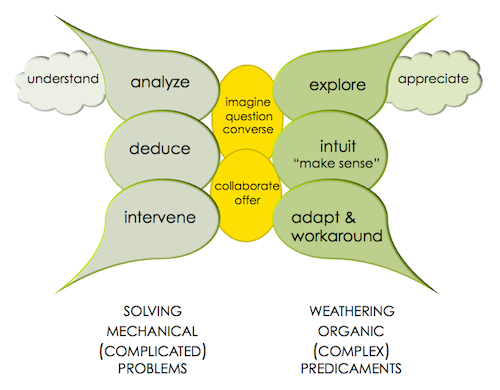
The ‘butterfly’ model above includes elements of Dave Snowden’s ontology of systems, Rosalind’s approach to dealing with complex predicaments, and some of my own thinking about complexity and systems thinking. It differentiates between
- Complicated systems: those that are not so obvious as to be ‘simple’, but are fully-knowable with study, where it is possible to thoroughly understand the causality relationships between the variables, which are finite in number, and to use that understanding to predict the outcome of interventions in the system with some degree of reliability, and
- Complex systems: organic systems, such as the human body, organizations, cultures and ecosystems, which are not fully knowable, have an infinite number of variables affecting them, and cannot be understood with sufficient precision to assess causality with any certainty or to predict the outcome of interventions reliably. Studying complex systems and issues will allow you to appreciate them (see why they are the way they are, how they probably got that way, and what keeps them going), but you can never fully understand them.
Many of the issues we deal with in our lives involve both complicated and complex systems, and hence have both complicated and complex aspects that need to be teased apart. I use the terms ‘problem’ and ‘solution’ in dealing with the complicated elements, and the terms ‘predicament’ and ‘approach to addressing’ in dealing with the complex elements, since predicaments by definition cannot be ‘solved’ or ‘fixed’. The approaches to addressing them often entail accepting and working around them, or adapting to them. Trying to intervene to change them in a desired direction is usually ineffective and can often lead to paradoxical results that make the situation worse.
Pollard’s Law of Complexity: Things are the way they are for a reason. If you want to change something, it helps to know that reason. If that reason is complex, success in changing it is unlikely, and adapting to it is probably a better strategy.
The left side of the model describes the steps involved in dealing with a complicated problem (or the complicated aspects of an issue with both complicated and complex components). If my car won’t start, for example, this model would instruct me to, first, analyze the situation (what are the possible reasons for it not starting, how do I diagnose the problem by testing each possible reason etc.), by imagining what might be wrong, questioning why and how it failed to start and whether each possible diagnosis makes sense, and conversing with others who might have useful insight or experience with the problem.
From this, I can understand the situation and deduce the most logical causes of the problem and the appropriate solution to each possible cause. And finally, through collaboration with others, and through accepting offers from people who know and care about the issue, I can intervene ‘systematically’, until the right solution is pinpointed and my car starts again. It may be an iterative process, but it is not a complex one. There are only so many variables, causes, and things that can have gone wrong, and there are only so many ways to rectify the mechanical malfunction.
The right side of the model, by contrast, describes the steps involved in dealing with a complex predicament (or the complex aspects of an issue with both complicated and complex components). As an example, I suffer from a chronic disease called ulcerative colitis. Although the incidence of the disease is soaring and globally it seems to correlate closely with affluence and stress, its causes are unknown (and, despite medicine’s hubristic claims, probably never will be known), so we can only treat the symptoms. Unlike my car problem, I can’t analyze and understand the possible causes and ‘fix’ the problem. All I can do is explore what is known about the symptoms, and the hypotheses about how some treatments appear to alleviate symptoms in different sufferers, and appreciate the complexity of the predicament and the options available to me.
Then, by imagining what might have happened to make me vulnerable to this disease (e.g. taking high doses of oral tetracycline as an acne treatment in my teenage years), questioning theories and options (e.g. will taking a ‘maintenance dose’ of an anti-inflammatory help or hinder), and having conversations with people who have studied the disease and people who know my lifestyle, and by rigorously tracking correlations between my diet and lifestyle and my feelings of well-being (something I’ve been doing since it was first diagnosed), I can begin to make sense of its sudden occurrence in 2006 (after I received some extremely stressful news), and its non-recurrence since then (except for two mild flare-ups in 2007 and 2013).
And then, by collaborating with and accepting offers from others (e.g. acknowledging the wisdom of my GP’s recommendation to immediately quit my high-stress job, discussing my situation with other sufferers and seeing how they have dealt with it, and accepting a low-stress job that came to me most fortuitously late in 2006) I can adapt my diet, exercise regime, work life and other aspects of my lifestyle to try to reduce the risk of flare-ups and work around this disease that will be with me the rest of my life.
Here’s an example of how this model might be used by an organization which is going through a ‘culture transformation’ process to deal with a lack of knowledge-sharing and collaboration among its people. This is a predicament that has both complicated and complex components:
- First, the issue at hand must be separated into its complicated and complex aspects. One of the complicated aspects might be poor IT systems that don’t provide a means to capture and disseminate what people know and have learned. Two of the complex aspects might be cynicism that useful knowledge can be ‘captured’ at all in a database that lacks context of the situation, and a performance assessment system that rewards individual achievement and provides no incentive for sharing or collaboration.
- The complicated aspects of the issue are then addressed using the analyze to understand / imagine, question, converse / deduce / collaborate, offer / intervene process. Why don’t the existing IT systems have a mechanism to capture knowledge? What is the most useful knowledge to capture and what are the options for structuring it so that entering it into the system is easy? How does this new database fit with existing IT architecture and how might it most effectively be accessed? What technical problems does this present? Who do we need to talk with to understand how this will be used, updated and maintained, and whose ‘job’ will it be? Who will we need to promote this new resource, and how will this be done? Who has real passion for testing this, and whose collaboration will we need? It’s not simple, but it’s not a complex process. It should not be hard to deal with these ‘merely complicated’ aspects of the issue.
- The complex aspects of the issue are more perplexing; they need to be addressed using the explore to appreciate / imagine, question, converse / intuit & ‘make sense’ / collaborate, offer / adapt & workaround process. Why aren’t people explicitly sharing knowledge already? The exploration might reveal that knowledge is already being shared generously, through mostly-informal iterative context-rich conversations. Then what? Should we tell the boss that trying to capture this in databases might seem to be efficient but is actually very ineffective? How might we, instead, enable and encourage more such conversations? Is it fruitful, and practical, to try to record and ‘reuse’ such conversations? The exploration might help us appreciate that most of these conversations are based around stories that don’t lend themselves to capture in rigid data entry formats. How might we then capture and organize stories in a way that would be useful, or can we do so at all? Rather than capturing stories, should we be training our people how to be better story-tellers? How do we deal with the fact that we grade performance individually on the curve, which necessarily provides a disincentive for collaborating and helping others improve their performance? How do we ‘make sense’ of the fact our people collaborate and share generously despite this disincentive? As you can see, this is a very different process than the one that worked for the complicated aspects. It generally leaves us with a greater appreciation of why things are the way they are, and how people have worked around the existing formal processes to do their jobs as well as they do. It can be a pretty humbling process, one that leads more to actions around “how can we help you do what you already do more easily and effectively” than “how can we get you to change your behaviour”.
It’s no surprise that, for many organizations that have tried to introduce a ‘knowledge-sharing’ culture, the job quickly focused on the easier merely-complicated aspects — it became all about IT, and in fact many people began to see Knowledge Management as being just an aspect of IT (all about content and collection). No one really wants to deal with the complex aspects (having the hundreds of challenging conversations necessary to appreciate the status quo and the very human motivations behind it, and helping people in modest ways to do their best work better) because this work is hard and thankless and difficult to measure meaningfully.
Because of that, and the lack of insight, imagination and courage by executives in charge of such ‘culture change’ programs, most such programs, in my experience, fail. It requires a very different skill set to deal with the complex aspects, a skill set that in most organizations is in short supply, and is much underrated by the mostly-analytical left-brained thinkers who make the final decisions. Sadly, the only truly successful large-scale culture change programs I have seen entailed the firing of a large proportion of the staff and the hiring of new people who already embodied the desired ‘new’ culture. For the same reason, many organizational ‘consolidations’ and ‘mergers’ (takeovers), both in the private and public sector, end up with almost all of the acquired organization’s people leaving.
This incapacity is equally true, unfortunately, in our attempts to deal with complex predicaments like poverty, inequality, our fragile economic system, the exhaustion of cheap energy, and runaway climate change, in our larger society. And in this larger society there is no one ‘in charge’ to make the decisions that would be needed to bring about large-scale imaginative adaptation to the challenges we face.
So we’re left to deal with such predicaments personally, and in communities that are sufficiently small-scale and sufficiently enlightened to appreciate both the predicaments and how imaginative adaptations and workarounds can alleviate their pain and their harm, at least locally. Most people don’t want to hear or believe this; they want to believe there are miraculous ‘fixes’ to these now-global predicaments. But the more you study complex systems, the more you realize there are none. Geoengineering proposals now being made to ‘fix’ our atmosphere are a classic case of trying to ‘solve’ a complex predicament as if it were a merely complicated problem, and its outcome will almost surely be disastrous.
[At this point I gave participants their first exercise: Thinking about some of the challenges facing them in their industry currently, what are the complicated vs. complex aspects of each? We drilled down into 5 such challenges, and they all had both complicated and complex aspects; the complex aspects were the harder ones to deal with in each case.]
Systems diagrams are a useful tool to help with both the analysis and understanding of complicated systems and challenges (and the complicated aspects of systems and challenges that have both complicated and complex aspects), and with the exploration and appreciation of complex systems and challenges (and the complex aspects of systems and challenges that have both complicated and complex aspects). Here are the basic steps in using such diagrams:
- Identify the elements (variables) in the system
- Show the apparent or possible causal connections with arrows
- Discover reinforcing loops (“vicious cycles” and “virtuous cycles”) in these systems
- Identify the balancing elements that keep the system in stasis
- Consider how interventions, adaptations and workarounds might affect the system and what outcomes they might produce
These diagrams are used differently in complicated vs complex systems. In complicated systems, they can be used to analyze, understand, predict, and intervene optimally. In complex systems, many of the benefits of diagramming emerge from the process of diagramming rather than the finished diagram, i.e. from the exploration and appreciation of the predicament.
The diagram, and the system, are models of reality – they are inherently incomplete and flawed. The map is not the territory!
There are many different ways of documenting systems and challenges, and Rosalind’s book explains a number of them. For purposes of this workshop I introduced just one systems diagramming technique that’s easy to learn and quite intuitive and robust. Here’s an example of this technique, looking at the complex predicament of introducing a big box mall supermarket into a town and its impact on the downtown (called the ‘high street’ in the UK) retail stores:
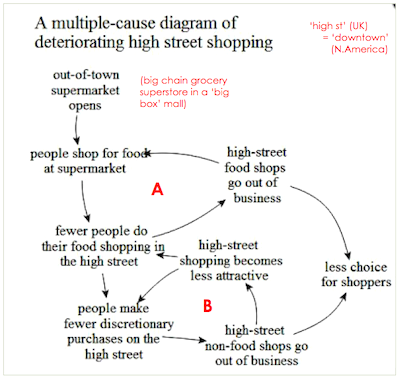
The chart shows two ‘vicious cycles’ shown as A and B on the chart. The first of these leads to the bankruptcy of downtown food stores, and the second to the bankruptcy of other downtown stores and the deterioration of the downtown as a whole.
The next exercise for the group was to watch or read the Jack Kent children’s story There’s No Such Thing As a Dragon. The synopsis of the story is:
This is the story of Billy Bixbie, who finds a tiny dragon sitting on the foot of his bed. His mother is firm in her assertion, “There’s no such thing as a dragon.” Yet, the more she denies the dragon and, in turn, convinces young Billy to ignore the dragon, the bigger he grows. By the story’s end, the dragon is filling the Bixbie’s home, with his head and tail spilling out of the top and bottom windows. Finally, Billy can no longer deny the dragon and points this out to his mother. As soon as they acknowledge that there indeed is such a thing as a dragon, the fire breathing fellow returns to his original size–small, like a lap dog. Mrs. Bixbie asks how it was that he grew so big. To which Billy ends the book by saying, “I guess he just wanted to be noticed.”
The group was asked (1) to identify and diagram the “vicious cycle” (a type of reinforcing or “resilient” loop) in red, then (2) to add the “balancing element” that pulled the system out of the cycle before it collapsed, then (3) to identify a possible “virtuous cycle” (another reinforcing or “resilient” loop) that might result in the dragon disappearing entirely, in green, and finally (4) to add another “balancing element” that might pull the system out of the virtuous cycle and back into the vicious cycle. The finished diagram looked like this:
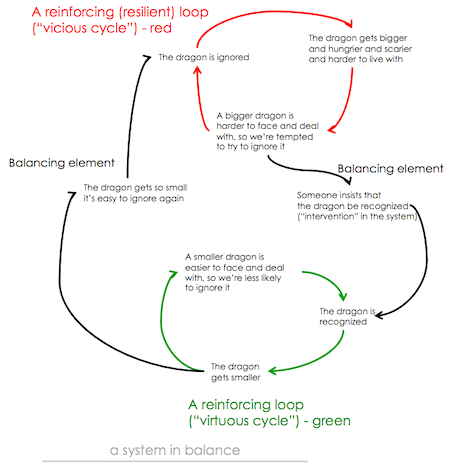
This is a simple example of a system in balance or stasis, where the cycles that might tend to collapse it are held in check. Because it’s a complex system, and we are only identifying the more obvious variables, it’s a delicate balance, and another variable of which we’re unaware, or a “black swan” event, could pull it out of stasis. You could substitute the word “addiction” or “trauma” or “urban decay” or “economic inequality” or “climate change” for “dragon” and the model would still more-or-less work.
There are three reasons why such system diagrams are useful, especially for complex predicaments:
- To appreciate why something is happening that might not be obvious or intuitive
- To appreciate why well-intentioned interventions are failing to work
- To identify possible workarounds and other interventions that might be useful, and their possible consequences
The next exercise was to draw a system diagram to appreciate the challenge of never-ending annual budget cuts, a predicament in both the private and public sector. The task was to diagram the “vicious cycle” in both sectors, and then to explore possible ways to imaginatively adapt or work around the predicament. The vicious cycle diagrams looked like this:
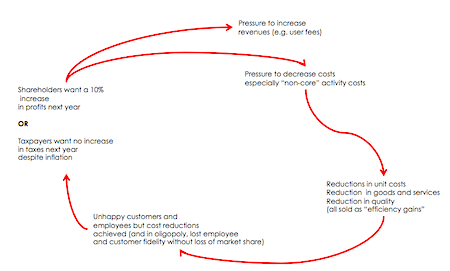
We discussed the fact that because of oligopolies in the private sector, and because government employees often can’t just leave and find comparable work when their job gets difficult, the kind of ‘market factors’ that might end this vicious cycle and produce a system in stasis just aren’t present. So both sectors add user fees endlessly without improving service, and eliminate or cut back or outsource or offshore services to reduce costs. Customers and employees are both unhappy but have nowhere else to turn in oligopoly markets, so the demanded profit increase and cost cutting are achieved. And since it was achieved, shareholders and citizens believe it can be achieved again each year, and keep demanding it. Such a cycle can only end in collapse.
We discussed possible collapse ‘end games’ that could result if this cycle continues — complete privatization of government services, for example, or, to introduce another variable, wide-spread business (government) failure if customers (taxpayers) are no longer able to pay for the industry’s products (their taxes) because of a continuing stagnant economy. We also came up with some imaginative adaptations and workarounds that might pull us out of these cycles (the ones we came up with were industry-specific and not particularly useful to document here).
We briefly looked at climate change as another complex predicament, studying the vicious cycles in the systems charts I developed for my SHIFT magazine articles. There was an appreciation, I think, that most of the current “solutions” to climate change (cap-and-trade, carbon taxes, sequestration etc.) can’t be expected to work because they’re defeated by the reinforcing feedback loops in the system, and there was an appreciation of why saying that “if we all just did x it would solve the problem” is mostly wishful thinking, and an improbable way to get out of the predicament.
Finally, I discussed six other tools that I’ve found useful in systems thinking:
- Visualizations, especially other kinds of systems diagrams, such as the famous Lawrence Livermore graphic showing all the sources, uses and losses of energy in the US.
- Cultural anthropology and specifically ‘business anthropology’ to observe and document behaviours in organizations as they actually occur rather than as the ‘procedure manuals’ say they should.
- Future state stories to imagine how things might work x years in the future, and then, after collecting current state stories, and engaging a cross section of participating and affected people in iterative conversations, devising a realistic ‘map’ to get to that future state from the current state.
- Games and simulations and ‘table-top’ exercises to explore more deeply the variables in play in complex systems and how they are correlated, and to envision the impact of attempted interventions, adaptations and ‘black swan’ events.
- Whole system in the room exercises — that allow multiple perspectives on how the system really functions and what diverse ‘stakeholders’ think would make a difference, leading to some convergence and viewpoint shifts.
- Biomimicry: the appreciation that nature has been adapting to and working around the predicaments and challenges of complex systems for billions of years, and the value of studying natural systems to appreciate how that has happened.
It was a challenging session, and obviously just touched the surface of this difficult subject. I’m grateful that the audience was an exceptionally bright and animated group, and not too large, and would like to thank them for their participation and helpful suggestions. They seemed to appreciate it and find it enlightening, so I may get called upon to talk with others on this subject. I would welcome any thoughts on how to tweak or add to this workshop.
19 Comments on "Systems Thinking and Complexity 101"
Davey on Wed, 18th Jun 2014 11:40 am
Read Any of David Korowiczs reports. They are short and sweet and will inform you to all you want or need to know about system, complexity, and collapse. He applies these ideas to PO and other predicaments to show how a near term collapse is immanent. This article is fine for other apications not collapse preparedness.
J-Gav on Wed, 18th Jun 2014 1:21 pm
Well okay, Davey, Korowicz is a fine reference as far as I’m concerned but “Short and sweet?” Some of his best stuff is longish and shows a nasty set of canines …
bob on Wed, 18th Jun 2014 1:34 pm
you and your collapse preparedness!! Such a waste of time!!! Are you going to personally man all the nuclear power plants in your area? You will be dead within a year—- of them all melting down in your area…I seem to recall there are a lot in missouri….Sorry don’t mean to hurt your feelings just trying to get you to see the truth….just like the people who complain about fracking but still use the oil that comes from it….Just seems so futile…
Davey on Wed, 18th Jun 2014 2:39 pm
Gav, true, my meaning was Korowicz says as much in a longish report as others do in a book.
Bob, it is easy to himhaw but another thing to know what is coming. Bold statments are easy. Decent will be characterized by randomness, dysfunction, and irrationality. The nature of these chaotic states does not lend well to stable predictions. I can say I know this decent will be ugly but how ugly, where and when are another matter. Who knows if the wmd’s and NUK industry will explode in global suicide. TPTB may for a time keep a handle on them for self preservation. They know the risks. Bob, show some openness and balance in your attitudes to doomers and preppers. You appear to me to be one that is unable to prep so you bash those that do.
bob on Wed, 18th Jun 2014 5:04 pm
Davy I just think you are fooling yourself if you think you can survive all by yourself or the help of a a few people….Let me guess you have lived a privileged life all your life with an occasional backpack trip…but for the most part you have pushed the pencil back and forth and have been rewarded for that….now in retirement you have time to see Ahahh!! there is a flaw in the system…. I have known about this since 1996 when you were living your comfortable life in the burbs….Work is hard and if you have not been doing it for long…in a collapse scenario I don’t give someone like you very good odds….mentally or physically…And I don’t think it is a good idea to try to have people aspire to your ideal of survival…..better for them to live life for today and if it happens so be it…
Davey on Wed, 18th Jun 2014 5:12 pm
Bob, i work 12 to 14 hour days of hard farm work. How about you stud muffin?
bob on Wed, 18th Jun 2014 5:35 pm
oh please! you are a blabbermouth hothead! And on here all the time…got a computer in your tractor! I know where you live how old you are and how many kids you have…in a collapse scenario people like you are easily pushed off there rock….
Davey on Wed, 18th Jun 2014 6:39 pm
Got an iPhone bob and I take breaks and enjoy the the conversation as a matter of fact in the tractor earlier cutting hay. Early mornings on laptop I am on PO board. I am alone during the week. It is nice to talk to you guys. I live day by day bob. My dooming is my intellectual passion and my prepping is my hobby/life passion. There is no way to know if any of this will matter. I work too much bob. It is hard work and many times dangerous work and I am alone. My biggest worry and danger is injury. I work out twice a week and fast twice a week. I am in great shape and take pain well. I may talk too much and I am on here obsessively but who frigen cares. Ignore me bob. I don’t care what you know about me nor if you like me or dispise me. I make my own bed and do not worry about what folks like you think of me. The end of easy and normal is near so I suggest you open your mind to some kind of preparations. If not bob friggen enjoy life now that all there is
Jimmy on Wed, 18th Jun 2014 8:35 pm
“Thinking about collapse is very useful because it allows you to prepare for it. And preparing for collapse is very useful too—from the pragmatic perspective of risk management. Consider the possibilities.
-if you prepare for collapse and it doesn’t happen, then you look a tiny bit foolish.
-If you don’t prepare for collapse and collapse does happen, then you look a tiny bit dead.
Now, which would you prefer to be, foolish or dead?” ~ D. Orlov
Northwest Resident on Wed, 18th Jun 2014 8:44 pm
bob — To see danger coming and not prepare for it is what people who have given up on life do. People who enjoy life, have confidence and strength and who want to live another day take appropriate measures to deal with threatening danger. Your belief that preparation is a useless activity is no doubt true in your case, but definitely not true for others. Don’t worry bob, plenty of fighters and smart people who prepare will survive into the future. The weak and those who have lost all hope before it even begins are likely to be quick maggot food when it all comes down.
Makati1 on Wed, 18th Jun 2014 9:23 pm
Arrogance is not confined to government leaders but is more prevalent the higher your income.
Me, I’m doing what I can to make my life easier no matter what comes. I’m also still using electric and my annual trip back to the States uses a few barrels of jet fuel but far less oil than if I lived in the auto-bound US. I’m obviously on the internet and will use it until I cannot, as are all of you on here. I live a fairly good life now, while I prepare for the not-so-good life to come in the near future.
To not prepare for a hurricane or a severe snow storm is stupid. Will you say that you will just “take it as it comes” because there is nothing you can do? I doubt it. True, collapse will be far worse than any storm, but if you didn’t even try to prepare, it will surely be worse than if you made some preparations to mitigate the event’s harshness.
Davy, Hermann, MO on Wed, 18th Jun 2014 9:32 pm
Arrogance is arrogance Mak, income is not the determinant. I have known plenty of “poor but proud” folks. Your pretty arrogant yourself, your humility will come when food shortages start in your mega third world city.
Northwest Resident on Wed, 18th Jun 2014 10:19 pm
My girlfriend is from the Philippines. She seems to think that a white man living in the Philippines will be just fine in a total collapse scenario as long as he:
a) lives in the mountains, far from any city
b) gets along really well with his neighbors
c) doesn’t have any money, or doesn’t show that he has money — not even a few bucks — in other words, he appears by his living situation and overall appearance to be on a more or less equal financial level with his neighbors
d) has access to water and is growing his own food
The girlfriend says that not many people have cars or any form of transportation in the Philippines, and that if you live far enough away from the population centers, just about everybody would die before getting to where you live because of the heat and miles of walking required.
Interesting perspective from a native Filipina!
Makati1 on Thu, 19th Jun 2014 12:21 am
Northwest, she describes my situation 100%. She knows the Philippines I see here every day. As for her thoughts:
a. I’ll be five miles inland on the Pacific coast of Luzon and 80 miles from Manila by road across a mountain range.
b. We are working with our three neighbor families, that are within 1/2 mile of the farm, to get prepared by being more diverse in their food and water sources.
c. I knew when I came here to not appear too much better off than the surrounding people. That is true in the US also. Nothing new there. We share what we have equally. we are paying for our caretaker’s daughter’s college education, nursing (P8,000/yr = $200./yr) along with his salary of P2,000 ($50) per month. And gifts of tools and meds. Being American, they still think we are all rich, and comparatively, we are, but I don’t dress better than they do. Or have any other obvious ‘riches’ that I don’t share with them.
d. Water: 2 springs, a river down the hill and ~10′ of rain per year to collect in ponds and cisterns. Yes, 10 feet, not inches, and about evenly distributed over the 365 days as showers and occasional storms.
Land: 5 hectares (12.5 acres) already producing pineapples, coconuts, avocados, bananas, yams, etc.,with a variety of trees growing into producers of coffee, cocoa, and various nuts and fruits, not to forget the kapok trees that produce fiber for pillows, mattress’, cloth, etc.
So, We feel we are prepared as best one can be in this world.
Davy, Hermann, MO on Thu, 19th Jun 2014 5:04 am
Mak, you posted earlier you upper middle class life in Manila but then you talk about your future life on a farm as a peasant. Which is it and do you think at your age you can make that transition? I think you do the talk but it is to be seen if you can do the walk. I think you live in a fantasy world and suffer a condition known as narcissistic personality disorder. You say whatever sounds right and are always talking up yourself and downgrading others.
NR, my first wife was Spanish and studied with me at college in the States. One of her best friends was Filipino so I know them well. My daughter had a Filipino maid in Spain. They are great people but the situation is bad in their country with classic overshoot and an ecosystem in collapse with deforestation, dying oceans, and severe soil erosion. This is magnifies by climate change and population. Maks bragging about a wonderful climate will end soon enough with heat waves and destructive storms from climate change,
Juan Pueblo on Thu, 19th Jun 2014 8:27 am
Davey, I like your iPhone in your tractor break. I do the same thing when boating and fishing. I am a married loner, so I don’t post that much because I got my wife to talk to, but I read most of the comments here at PO, even if I skip most of the articles.
Juan Pueblo on Thu, 19th Jun 2014 8:41 am
Mak, that sounds like a nice setup you got there. You have made interesting lifestyle choices. You are, in that much at least, an extraordinary person. Far from ordinary, literally.
Davey on Thu, 19th Jun 2014 9:16 am
Juan, I am a loner and enjoy the interaction. Most people I am surrounded with here are not interested in our topics hence the need to be here. The end is near and any edge I can get talking to you folks will help. When I say end I me the end of normal like driving as needed and unlimited food choices. We can make a good prediction food and fuel supplies will be problamatic.
Northwest Resident on Thu, 19th Jun 2014 9:18 am
Makati1 — Sounds like a nice setup. Ten feet of rain per year?!! Even if Davy is right about most of your island group, and I think he is, there will still be plenty of scattered “survivors” who are in the right place and prepared, but since the vast majority of people in the Philippines live in or near the big cities, I don’t expect many of them to do well at all in a collapse scenario. The one thing I don’t understand about you Mak is I know many many people from the Philippines and they all love America and have good relations and attitudes toward Americans. How did you end up so full of hate toward America? Are they just not as smart as you, or did they somehow escape the bitter experiences that lead you to hate America?