
Peak Oil is You

Donate Bitcoins ;-) or Paypal :-)


Page added on February 10, 2014

Remembering where we live: Physics vs. biology

It is awe-inspiring to view images of galaxies and nebulas brought to us by high-powered, space-based telescopes. And, it is even more amazing to see depictions of such phenomena as if we, the viewers, are suspended in space a long, long way from Earth. In fact, in modern science fiction movies and television shows we are regularly treated to adventures that take place wholly outside of our solar system and even outside our own galaxy.
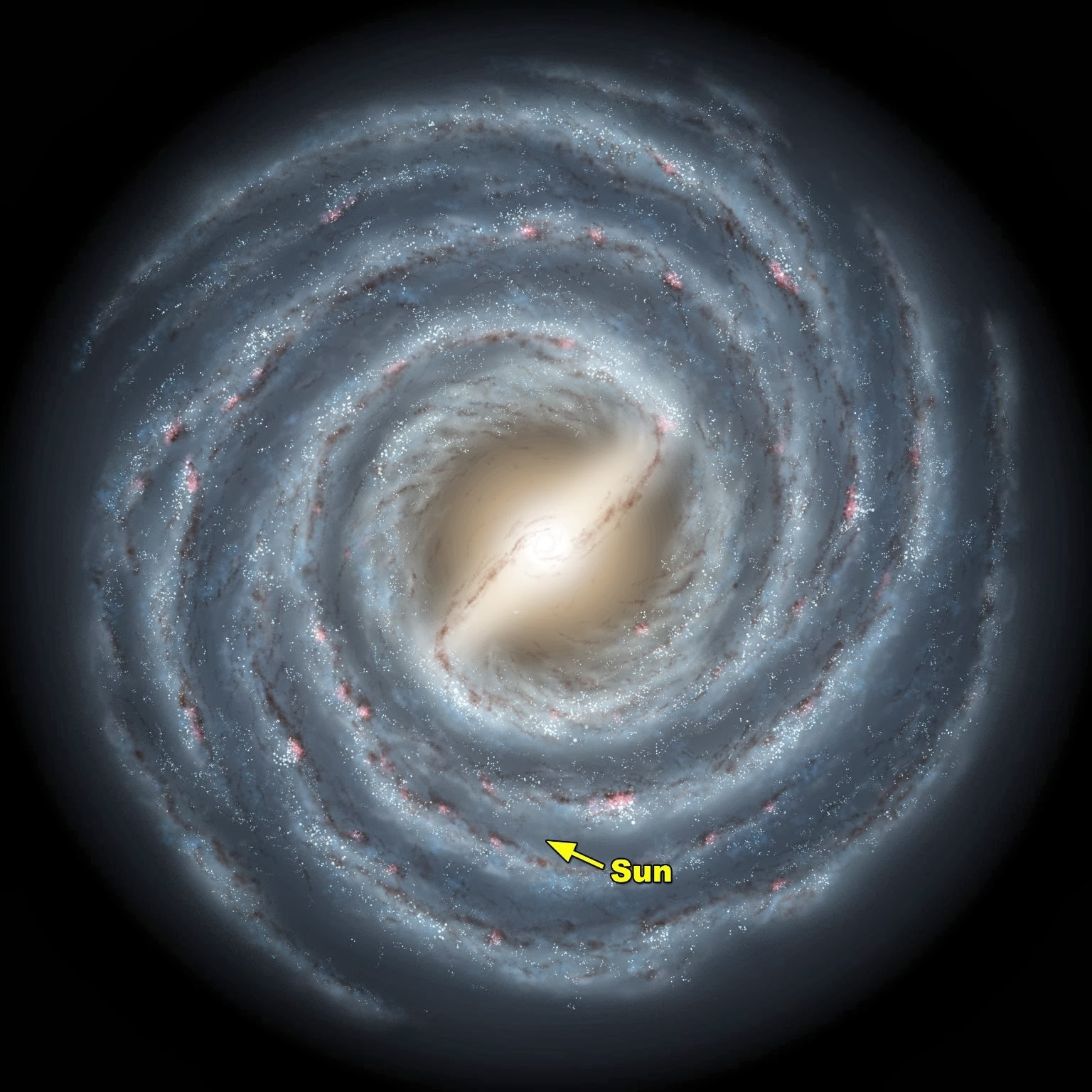
Artist’s Rendering of The Milky Way Source: NASA
But there arises an obvious question when one looks at, say, an artist’s rendering of the Milky Way with our place in it highlighted: Who is seeing the Sun, the solar system or the Earth from that vantage point? The answer, of course, is no one. No human has ever seen the Sun, the solar system, or the Earth from that distance. And yet, we can conjure such a point of view and imagine through special visual effects that we might someday actually see such sights with our own eyes. In fact, some people claim that it is only a matter of time before we do.
This is the distance the mind can travel using physics. Physics is “the science that deals with matter, energy, motion, and force” according the dictionary. It is the world of “res extensa,” literally, “extended things.” It presumably operates without respect to humans. If we humans weren’t alive, physical laws would still hold in the universe; and, the world of objects, of “res extensa,” would still exist. Physics offers a bodiless, infinite view of where we live. According to physics we live in the universe.
In reality, we are biological creatures. Our existence is entirely enmeshed in a web of life and necessary resources that runs from the deepest oil wells to the upper reaches of the atmosphere. If the Earth were an apple, we would live within the equivalent of the skin. Yes, we have on a few occasions sent humans beyond this narrow band of life, but no further than the moon and only for short periods of time. Long-term human presence in space is problematic; we aren’t made for it.
And yet, our lives, our outlook, our policies are all geared toward the view that we live in an infinite universe–that we can grow our population and our consumption infinitely. After all, we’ve got the whole universe to draw from for whatever we need–which accounts for the occasional proposals to mine asteroids and scoop helium off the Moon. (This physics-based mindset is so deeply embedded in our culture that it affects our actions even if we are not fully conscious of it and even if we do not buy into some of the more fantastical claims related to it.)
There is also the dream that we will terraform other planets, that is, transform them from rocky, atmospherically challenged wastelands into Earthlike havens. I am reminded of the opening of the short-lived television series “Firefly” which begins with the narration: “Here’s how it is. The Earth got used up. So, we moved out and terraformed a whole new galaxy of Earths.”
Which begs the question: If we have or will have such powerful technology, why not just fix the Earth? The answer, of course, is that it is not that simple. We are not the Earth’s masters, just one set of its inhabitants with very, very limited knowledge about how it works. That being the case, it is hard to imagine that we could ever figure out how to remake another planet in Earth’s image, let alone do it in any time frame that matters to humans.
And so, our home remains in the biosphere including to some extent the hydrosphere and the lithosphere. In relation to the universe, this home is limited, tiny and fragile. All the other rocky planets in our solar system–Mercury, Venus, and Mars–either have had most of their atmosphere ripped away or, in the case of Venus, developed one so thick that it would press down fatally on Earth’s large life forms. Atmospheres friendly to advanced life appear to be rare.
Compared to the feeling of limitlessness provided by physics, our biology seems like a prison that keeps us close to the Earth. Science studies scholar Bruno Latour refers to those who accept our biological limits as “earthbound”–as distinct from normal humans who continue to believe that we will one day transcend our biospheric prison and populate the stars. It is the latter view which prevents us from thinking clearly about the limits of our earthbound existence.
Billions of people are not going to rocket off the surface of the Earth anytime soon for a rendezvous with all those planets terraformed in the television series “Firefly.” Instead, we are faced with the difficult task of salvaging our existence on this planet through the tedious work of completely reworking modern civilization in order to harmonize it with the limits of the narrow envelope of life we inhabit on Earth.
That work can only succeed if we remember where we actually live.
5 Comments on "Remembering where we live: Physics vs. biology"
Makati1 on Mon, 10th Feb 2014 1:48 am
“… this home is limited, tiny and fragile …”
Nuff said.
rollin on Mon, 10th Feb 2014 2:19 am
Science studies scholar Bruno Latour refers to those who accept our biological limits as “earthbound”–as distinct from normal humans who continue to believe that we will one day transcend our biospheric prison and populate the stars.
It’s normal to want to leave the planet? Delusional, maybe.
And when these people get dropped off on this far off planet, won’t they be stuck there too. A planet that is probably hostile to our kind of life. Smart move there.
Davy, Hermann, MO on Mon, 10th Feb 2014 8:37 am
Good point Rollin!
Well, I think the reason I don’t believe in UFO’s is I doubt the thermodynamics are there for space travel necessary for an intelligent complex life form to come visit our solar system. I do believe there is intelligent complex life out there somewhere. The science just does not add up for space travel. Now, I would not discount a seed hitching a ride on a comet falls on a planet with ingredients for life. Like Rollin said “delusional” thoughts. We have so many delusional thoughts on the future and most are from technological optimism. Mining asteroids, outpost on Mars, geoengineering climate change are mostly fantasy. Geoengineering climate change is one of the few possibilities where this technological exuberance may succeed. It will probably be a lower-tech permaculture approach way, not a high-tech fantasy like mirrors in space!!!!
J-Gav on Mon, 10th Feb 2014 2:56 pm
I’m wary of stark dualistic dichotomies like Descartes’ ‘res extensa’ vs ‘res cogitans’ but Cobb doesn’t really go out on a limb there and his conclusion seems on the money.
rollin on Tue, 11th Feb 2014 1:01 am
We have so much more to learn about the fundamental forces of the universe before we could possibly think about interstellar space travel. Even more needs to be learned about our own planetary ecosystem before something as huge as terraforming can successfully occur.
Since we are facing predicaments that could end all thought of expansion and even end the species itself, it would be best to put aside the adolescent dreams of grand adventure for a while and focus our energies on easing the upcoming disasters.
After that, if we still wish, then think of moving outward. If we actually understood gravity there might be no need to have a rocket.