
Peak Oil is You

Donate Bitcoins ;-) or Paypal :-)


Page added on May 1, 2013

Principles for the Pulse that is Peak Oil

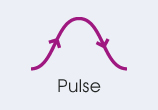
From PatternDynamics (TM) by Tim Winton
A comment has just appeared below my post on The Wave/Pulse of Human History. “The Emergist” writes:
Nice article. Fun to see you weave together the separate stories. I didn’t know Holmgren was into Odum. How do you see the idea of pulsing as changing your approach to design, specifically bridging the gap between pulses? Or do you think there isn’t much we can do as individuals to bridge larger scale pulses?
I thought I’d answer here, as my Earth Day blog post. It seems appropriate to honor David Holmgren and Howard T. Odum on Earth Day, so much of this post will be extended excerpts from Holmgren’s 1994 article Energy and Permaculture.
Yes, Odum has been a huge influence on Holmgren (perhaps as much or more as his ‘in the flesh’ mentor Bill Mollison). As far back as the first Permaculture book (“Permaculture One”), with Holmgren as lead author, the first footnoted reference was to Howard T. Odum.
In the 1994 article, Holmgren writes:
The work of ecologist Howard Odum provided a theoretical framework and conceptual tool which was critical in the development of the permaculture concept. In the 1970′s there was a flurry of research in this field but it declined along with oil prices in the 1980′s. Odum was one of the leading ecologists who developed a systems approach to the study of human/environment interactions. He uses energy as a currency to compare and quantify the whole spectrum of natural and man-made elements and processes.
Odum’s ecosystem approach:
- Analyses ecosystem elements and processes in terms of energy flows, storages. transformations. feedbacks, and sinks.
- incorporates non-living and living elements of the natural environment.
- and incorporates human systems and economies as an integral part of the natural world.
As I wrote in my post about the Pulse, “Howard Odum was of the opinion that all systems on all scales pulse. Storages gradually accumulate, consumers consume and develop, and eventually decline, and then dispersing materials that will be used in the next pulse.” And if “energy flows, storages, transformations, feedbacks, and sinks” are central to any system, man-made or otherwise, we can see that the peaking of world oil production is going to have a huge effect.
So, how does the idea of pulsing change one’s approach to design?
First, you’ve got to estimate where you are in the pulsing cycle. In this case meaning, where are we currently on Hubbert’s Curve? And second, if your trajectory on the pulse is changing, then you’ve got to change as well. Time to do a reset on your design. Adapt or die.
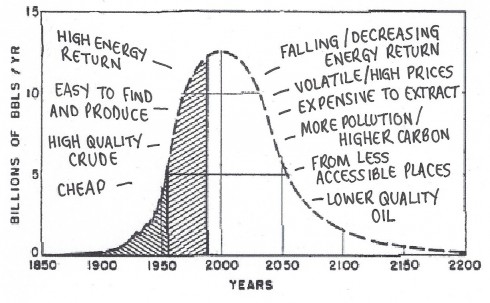
[M. King Hubbert drew this graph circa 1956, showing his estimate for the peaking of world oil production. Comments inside the graph from Rob Hopkins, published in The Transition Companion]
Many of us believe we are now at or near the peak of this graph. This means two things. One, we don’t have to judge as “wrong” our culture’s past use of oil (at least until we learned of its affect on climate) – Odum told us that all systems maximize use of available power. Two, when you approach and enter the downside of the pulse, you can’t continue operating as if the pulse were continuing to climb upwards. Systems have to adapt to changing circumstances – especially when it’s a change in available energy.
Howard Odum, in A Prosperous Way Down:
What is appropriate during one stage may be poor policy in another stage,” he wrote. “For example, for a system in a stage of descent, it will not be good policy to foster growth that is no longer possible.”
And here is how Holmgren put it (more from Energy and Permaculture):
Odum’s work shows exactly how and why it is impossible to avoid those rules in any case without the need to resort to moral injunctions. High-energy industrial society is revealed as a quite natural response to fossil fuel abundance but maladapted in every way to a low energy future.
…If there is a single most important insight for permaculture from Odum’s work it is that solar energy and its derivatives are our only sustainable source of life. Forestry and agriculture are the primary (and potentially self-supporting) systems of solar energy harvesting available. Technological development will not change this basic fact. It should be possible to design land use systems which approach the solar energy harvesting capacities of natural systems while providing humanity with its needs. This was the original premise of the permaculture concept. While available solar energy may represent some sort of ultimate limit to productivity it is other factors which primarily limit it.
Here is where the Permaculture Principles come in. Our culture is currently embedded in principles (acknowledged or not) that are adapted toward energy ascent, the left side of the pulse. We need now to consciously embrace principles that are adapted for energy descent, the right side of the pulse. The principles that will serve us best will be those that “use energy as a currency to compare and quantify the whole spectrum of natural and man-made elements and processes.”
Holmgren continues:
Odum states, “Those systems that survive in competition among alternative choices are those that develop more power (rate of energy flow) inflow and use it to meet the needs of survival.” They do this by–
1. developing storages of high-quality energy
2. feeding back work from the storages to increase inflows
3. recycling materials as needed
4. organizing control mechanisms that keep the system adapted and stable
5. setting up exchanges with other systems to supply special energy needs, and
6. contributing useful work to the surrounding environmental systems that helps maintain favorable conditions, e.g.. micro-organisms’ contribution to global climate regulation or mountain forests’ contribution to rainfall.
When fossil fuel energy is abundant, systems can achieve the above differently than when fossil fuels become scarce. When the net energy yields decline from fossil energy, then we change our approach to design by aligning more with natural systems to achieve the above. Holmgren’s 1994 article laid out some of the foundations that were later developed into his Permaculture Principles (you can read them online here) that were discussed in his classic book Permaculture: Principles and Pathways Beyond Sustainability. I agree with Stuart B. Hill, who wrote, “If the ‘Permaculture Principles’ that David Holmgren discusses in this extremely important book were applied to all that we do, we would be well on the road to sustainability, and beyond.” But here are the ideas as expressed by Holmgren in 1994:
- Does the system work to catch and store water and nutrients for as long as possible and as high as possible within its catchment landscape?
- How does it compare with the performance of pristine natural systems as well as wild and naturally regenerated ones (weeds included)?
- It is possible for managed productive landscapes to collect and store energy more effectively than pristine systems by the careful use of external, often non-renewable energies.
To summarize…
-
Reduce, Reuse, Recycle (in that order).
-
Grow a garden and eat what it produces.
-
Avoid imported resources where possible.
-
Use labor and skill in preference to materials and technology.
-
Design, build, and purchase for durability and repairability.
-
Use resources for their greatest potential use (e.g. electricity for tools and lighting, food scraps for animal feed).
-
Use renewable resources wherever possible even if local environmental costs appear higher (e.g. wood rather than electricity for fuel and timber rather than steel for construction).
-
Use non-renewable and embodied energies primarily to establish sustainable systems
(e.g. passive solar housing, food gardens, water storage, forests). -
When using high technology (e.g. computers) avoid using state of the art equipment.
-
Avoid debt and long-distance commuting.
-
Reduce taxation by earning less.
-
Develop a home-based lifestyle, be domestically responsible.
3 Comments on "Principles for the Pulse that is Peak Oil"
J-Gav on Wed, 1st May 2013 7:59 pm
Good article. Just don’t forget to link permaculture up with sound livestock and land management practices and you’ve got one of the better formulas to at least reduce the pain during the mayhem over the coming years.
GregT on Wed, 1st May 2013 8:42 pm
It would be a much better idea to practise living sustainably now, while there is still a functioning modern industrial society to fall back on. It takes years of experience, and a great deal of trial and error, to figure out how to keep one’s self alive.
BillT on Thu, 2nd May 2013 1:44 am
“… for a system in a stage of descent, it will not be good policy to foster growth that is no longer possible.”
BINGO! But the plethora of denial articles have been like a tsunami since the peak has obviously been passed and it is becoming more and more obvious every day. Growth is over. Ditto, for profit Capitalism. It is only a matter of time until that too becomes obvious.
Renewable energy is that provided by sunlight on plants. Nothing more and nothing less. Plants reproduce themselves, solar panels do not. End of story.
But, I doubt we will even get the chance to try that life style as the powers that be are doing their best to destroy all life on this earth over the next few decades. Mass extinction.