
Peak Oil is You

Donate Bitcoins ;-) or Paypal :-)


Page added on December 21, 2012

Preparing For Collapse: Non-Attachement, Not Detachment

There is something seemingly unfathomable to the human mind about exponential curves. As I wrote last fall:
There is an old story about the invention of the chessboard, in which the inventor as his reward asks for one grain of wheat on the first square, two on the second, four on the third, and doubling until all 64 squares are full. The seemingly modest request adds up to many times more than all the wheat the world has ever produced. The purpose of the story is to teach about our inability to grasp the impact and unsustainability of accelerating increases in anything, particularly in the final stages. Even when more than half of the squares have been filled the inventor’s request still seems manageable. It is only when it is too late that its impossibility is realized.
Even when almost all the squares have been filled, the request still seems manageable. We are now living in a world where almost all the squares have been filled. We have used up the easy-to-get half of the Earth’s resources, which accumulated over billions of years. We have used most of that in the last two centuries, and most of that in the last two decades. In the process we have destabilized the planet’s climate systems. We are nearing what is now being called “peak everything”.
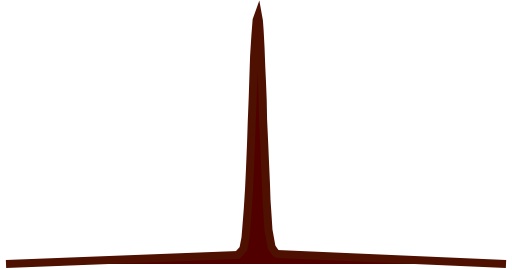
And there is certainly nothing “normal” to human eyes in what mathematicians call a “normal curve”, at least when time is the independent variable. We always seem to perceive the future as much like the present, only more so, and our favourite works of utopian and dystopian fiction turn out to be mostly somewhat hyperbolized reflections on the best or worst of the world as it was when the authors wrote them.
Even when we try to conceive of the downside of the normal curve — sharp at first and then tailing off slowly — we can only see everything going backwards, back to the way it was when the curve was at that height before. A simple, rapid decline, like those that befell previous civilizations and unsustainable cultures, is unimaginable. We can’t picture it because it’s never been that way for us. Even the current set of collapsnik writers, like James Kunstler, portray a post-collapse future that is almost nostalgically like the old American West.
In recent months, we have seen the news from climate scientists become exponentially worse. A decade ago we were hand-wringing about a 1C rise in average global temperature by 2100. A year ago it was a 2C rise by 2050 and a 4C rise by 2100. Now it appears all but certain that our failure to consider the “positive feedback loops” inherent in our astonishingly delicately-balanced climate systems made us absurdly optimistic, and a 6C rise by 2050 is quite possible. I can’t blame you if you haven’t been keeping up — neither had I. Two recent videos, one by Grist’s David Roberts and a second, even more recent one by fellow collapsnik Guy McPherson, will bring you up to speed.
The message of these videos, and the data underlying them, is simple, but it’s a lot like hearing news of a terrible and sudden loss in the family, the death of someone you knew was at risk but somehow believed would get through it, or at least last a while longer. It’s too soon. It can’t be that fast. We cannot accept it, as the trickster piles a mountain of grain onto the third-to-last square of the chessboard.
The message is two-fold:
- Not only are we fucked, but it’s coming much sooner than we expected. It’s coming in the first half of this century, not the second. By 2050 life for all but the simplest and most well-protected species on this planet will almost certainly be impossible, except for small numbers in a few marginal areas.
- The whole issue of mitigation and the need for activism is now more-or-less moot. Even if we were to collectively and massively change our behaviour starting tomorrow, it would only delay collapse by a few years, and quite possible make the collapse even more catastrophic. Until recently there was at least a chance that perhaps a combination of behaviour change and the reduced availability of cheap fossil fuels might combine to pull us back from the brink, or at least make a much-changed and simpler life possible for a much smaller population of humans and other creatures. That chance is gone.
The climate scientists, abetted by the ecological economists, have pronounced the certain and imminent (i.e. within most of our lifetimes) death of the vast majority of life on our planet, including the human species. Now, we can mourn. Most of our human family will continue to fall into one of the three categories of non-acceptance of this pronouncement that I wrote about in my If We Had a Better Story post:
- The incredulous: Those who either know so little or haven’t had the opportunity to think about what they know, that they find the idea of collapse preposterous, unimaginable, and/or unthinkable.
- The hopeful: Those who believe that collapse is not inevitable or can be significantly mitigated, or believe that even if it is inevitable and can’t be significantly mitigated, we should try anyway.
- The deniers: Those who are intimidated or offended by, or overwhelmed with anger and/or guilt at, the very idea of collapse.
None of these are unusual reactions to horrific news, but they’re likely to be crazy-making to those of us who are past this stage, and trying to get on with preparing ourselves and those we love for what is to come.
The most intriguing reaction is from collapsniks like Derrick Jensen and John Duffy who, against hope, want us to work (as they do, indefatigably and to their great credit) to kill the economy. John starts out his essay by saying “We are going to go extinct.” and near the end says:
If we want to not die, then we need to stop doing the things that are going to kill us… We need deindustrialization, and we need to wring the bloody neck of capitalism, before hanging it, drawing it, quartering it, and setting the remaining bits of its corpse on fire to make sure it can’t rise from the dead like the unholy zombie that it is… This is all to say, I can’t fight my enemies and my allies at the same time. Liberals, lefties, environmentalists and everyone else who purports to give a damn has to give up on being capitalism apologists who somehow think we can keep this gravy train of mass consumption going.
It’s a great rant, but he’s like the lover of the recently-declared-dead patient who insists on trying CPR interminably and punching the people trying to take the defibrillators away from him. Or, perhaps, he’s like the angry griever trying to assemble a posse to kill the ones he believes caused the death of the one he loves. It’s understandable, but it’s futile. It’s too late.
In the comments to John’s post, Paul Chefurka writes:
I’m not particularly angry or outraged any more. Once I was, but now I’m just fascinated, amazed, amused, bemused, curious. I attach no moral dimension to this unfolding any more, though once I did. Now there is no blame, no more agonized wishes to rewrite the past, no more fearful visions of a shattered future.
We are what we are, we did what we did, we ended up here.
I’m very curious to see what comes next. Aren’t you?
Paul didn’t get a terribly sympathetic response, so I wrote to Paul and asked him how he had managed to reach this stage of acceptance. I also asked him about a gorgeously-written and deeply-moving recent article in Orion, Gaze Even Here, about “evoking a consciousness of brokenness”, in which the author, Trebbe Johnson, says that she and her companions found solace in spending time “gazing” at clearcuts and videos of animals dying in oil-slicks until their grief and anger and revulsion turned to curiosity, acceptance, compassion and even love. I mentioned that some people in my circles had seen my attempts at non-attachment, at letting go of what I know I cannot change, as detachment, as an emotional shutting down or turning away. Paul replied:
I’ve faced the same accusations about detachment. They generally come from activists for whom action is the inner imperative, and who have no exposure to Buddhist principles. Also, they haven’t hit bottom yet, which is why the still think that action is an answer. Only once someone hits the bottom and bounces off the rocks do they usually start looking for truly radical responses like non-attachment.
As a first thought – perhaps what Ms. Johnson is suggesting isn’t really that radical at all. What she’s suggesting is a starting point for someone who wants to wake up in this new world. It’s where Joanna Macy begins as well. The bigger question may be, where do you go once you’ve taken the grief on board – how do you find the will to move, and how do you pick your direction? This is where doing deep inner work around grief, shame and the Shadow come in.
Out of that work comes the beginning of non-attachment. To people who conflate it with detachment, I explain that non-attachment is what allows me to confront the big issues directly, to engage fully but not be paralyzed by emotion. It’s not an abdication of feeling, but a way of seeing the world around me with complete clarity and doing what the world needs, rather than being selfish and getting mired in my own suffering.
Sometimes that helps people understand, but for a lot of activists it’s still a step too far. They are still focused on their own suffering, and in order to validate their response they have defined that suffering as a virtue. It’s not, it’s a trap. Non-attachment is the most functional way out that I’ve discovered so far.
What are the elements of non-attachment that might be applied to coping with the knowledge of the inevitable collapse of organized society amidst the chaos of economic collapse and runaway climate change? What makes sense to gaze at, and what should we, for our own sanity, leave unseen? How can we be, and act, in a fully engaged, joyful, curious, productive, useful-to-others way, without becoming either “detached” (emotionally disconnected or inured) or exhausted? Here are some of my early thoughts on this:
1. We cannot, must not, prescribe one “right” behaviour or approach for everyone. We are all different, and the best way for each of us to cope will be different. What’s important is to patiently wait for those we care about to realize what is ahead, and then support them to find their own way to cope with it productively.
2. I think it could help to develop, working with climate scientists and enlightened (non-classical) economists and energy analysts and artists and musicians and film-makers, a set of nuanced, candid, non-idealized, non-sensationalized visions or stories of what our world in collapse will look like, by 2020, 2030, 2040 and 2050, and then, as Trebbe might put it, to “gaze” at them. These stories would be based on data, and on an appreciation of history of how people behave in an accelerating (but not relentless) series of cascading crises where there is no scapegoat, no one to blame, where everyone is largely in the same boat. These stories would be focused on what collapse will mean for the day-to-day lives of people living in cities, towns, the country, in nations at different levels of “development”. My guess is that for most of the world, in the already-struggling nations and places, life will not be much different, except that the death rate (mostly from disease and malnutrition) will be somewhat higher and the birth rate much lower. We have a lot to learn, I think, from people in the third world, in impoverished cities, and in the streets, who are already living with collapse. The image below shows in red/purple/white areas that, due to climate change-induced chronic drought, will be largely ununhabitable within a few decades, so our stories for them, billions of people, would likely be stories of migration. The stories would be varied, and stark, and, perhaps to our surprise, inspiring and astonishing.
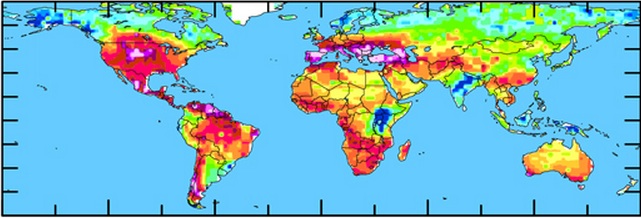
Map of serious chronic drought areas, per research simulations by UCAR/NCAR, an agency of the National Science Foundation. This map is forecasts for the 2060s, but is based on outdated climate change data, so it is likely to come true considerably earlier. Thanks to resilience.org for the link.
3. Perhaps most importantly, we will all be better off, I think, if we were to learn non-attachment, empathy, presence, resilience, relocalization, community building, and a host of other skills and capacities, technical and ‘soft’, so that we can tolerate the changes we will face to our way of living and the very foolish actions many (with the most to lose, in wealth or power) will inevitably try to do, unsuccessfully, to “control” the situation. We must expect the emergence of charismatic dictators, genocides, civil wars, geo-engineering, the burning of almost everything flammable for fuel and electricity, and cults, and deal with them the best we can without letting them unhinge us. We may be fortunate enough that as our centralized systems collapse, the resources for possible authoritarian atrocities will rapidly diminish, so the decline could be relatively peaceful, if not free of suffering or misery. We may well discover that crisis brings out the best in us, but should be prepared in case it brings out, in some, the worst. We may find that, with a sufficient voluntary decrease in birth rates (not an unlikely scenario), over the coming decades we might reach a human population level well below one billion without a dramatic increase in death rates, though we should be prepared for a rising death toll and what it may do to our collective psyches. In all of this, non-attachment and presence can enable us to live, even through these crises, lives of love and joy and appreciation for the miracle of life.
A final thought, and one that perhaps is the most unimaginable of all for those of us brought up to believe the way we live now is the only way to live. What’s on the right side of the normal curve, after collapse, isn’t another growth cycle. It’s the proverbial long tail. We may become an endangered species by century’s end, but we’re unlikely to become extinct for several millennia after that — just increasingly few in numbers and increasingly irrelevant to the ecosystems and recovery of the planet from yet another great extinction. Without vast amounts of cheap energy to power technology, we’re just not going to be very well adapted to post 21st-century Earth. Just as we don’t notice the 200 species going extinct every day, I doubt that the species that thrive after the great extinction will notice the death of the last of the species that once believed it could rule the Earth forever.
Thanks to Tree for the link to the Orion article, to the authors of the articles/videos cited above, to Sue Bullock for the link to Kill the Economy, to John Duffy for the link to the Grist video, and to Paul Chefurka for the ideas prompting this article.
15 Comments on "Preparing For Collapse: Non-Attachement, Not Detachment"
ken nohe on Fri, 21st Dec 2012 10:33 am
All this idea of collapse is in a way rather funny. There will simply not be any general collapse of society, there are too many factors against it including billions of people doing their best to find solutions. But if no collapse then what? Well, exactly what we have now, just more of it every year until it becomes painful but by then we’ll be used to it. Wars, certainly but we already have quite a few. Countries falling into hardship, that’s already the case, think Greece, Spain; General impoverishment, this has been going on for the last 15 years in most developed countries, it will just go on and accelerate; but New York will not look like Mogadishu anytime soon, that impossible. Simply because not enough to feed 8 billion people is enough to feed 7 and luxury for 5. We just need to get rid of a couple of billion people and we will, one way or another.
Another amazing thing to consider which I believe is quite relevant is that late in the 6th century when the Roman empire was just a faded memory most people in many places were still living the “Roman” way scavenging the remains of the empire. It would most certainly be the same for us. Even in a Mad Max world there will be some oil left and life will go on.
BillT on Fri, 21st Dec 2012 1:46 pm
ken, there are NOT billions doing their best to find a solution. There are not even millions. Maybe a few thousand, but most of them work for big corporations that are trying to get cut into the pie before it is gone.
Perhaps you do not understand the nice map that is pretty colors? It is NOT going to be anything like today’s world climate wise. Not even close! All those dark read areas are basically desert. Yes, desert! And it is coming within YOUR lifetime if you are under 40. When it gets to the 30s, there will not be 7 billion,5 billion or 3 billion people left. Maybe none. The Us will be a dust bowl. I suggest you go to the website listed under the pretty picture and read ALL of it and look at the maps that lead up to 2060.
Rick on Fri, 21st Dec 2012 4:05 pm
2060 is 47 years from now.
On a planet scale timeline that is not even measurable, because its so small.
I’ll be 100 years old in 2060????? 🙂
DomusAlbion on Fri, 21st Dec 2012 4:40 pm
I guess it is a matter of time scale in a reader’s mind. Ken, what you describe after you say there will be no collapse is, in fact, a collapse. Just a prolonged one over a few decades. In the long view of history it will appear as a rather rapid event; in the lifetime of an individual it will be protracted and for most, painful.
Arthur on Fri, 21st Dec 2012 4:45 pm
With a little luck Chuck Hagel becomes the new secretary of defense and WW3 collapse is deferred again. I do not believe any longer that collapse before 2030 is inevitable. Slow decline, possibly
GregT on Fri, 21st Dec 2012 5:08 pm
BillT,
Unpleasant but true. Keep in mind that the above map is outdated and warming has accelerated much more quickly than the models had predicted.
The author begins with the subject of exponential curves. When anything increases at a certain percentage over a period of time, the same said thing has a doubling period. Every time that something doubles it is greater in number than the sum of all previous doubling periods. If one takes the percentage of increase and divides this number into 70 one gets, more or less, the period of time that the doubling period takes.
If, for example, our economy slugs along at a 2 % increase per year, it will double every 35 years. During the next 35 years, the economy will require the resources exceeding the sum of all of the previous doubling periods combined. If our population increases by 2 % per year the same is true. Greenhouse gas emissions, ditto.
Exponential curves accelerate over time, until they get to the point that they turn vertical. By the time that we realize that we have a problem, it is too late. Pretty much what we are facing on this planet right now. With everything.
The only way to solve this dilemma is for us to end growth. As a matter of fact, we need negative growth. This will not, unfortunately, entirely solve our problems. Many of our resources are finite in nature, and are non-renewable. Once they run out they are gone, forever. Including the earth’s bio-systems, which inconveniently, we will not survive without.
I find it very sad that we, as a species, are so arrogant to believe that we are in control of this planet. Our intelligence and technologies will save us. Nothing could be further from the truth. Expecting solutions to our problems to come from the very things that created the problems to begin with is nothing more than foolish.
Our scientists have been warning us for over 40 years, but we are not listening. Growth at all costs, as we march faster and faster towards the abyss.
rollin on Fri, 21st Dec 2012 10:56 pm
People have seen these problems coming for over one hundred years, written about them in serious scientific journals and other writings as well as novels. No wonder the people are getting scared, they know something is wrong, they can see that the whole system is a house of cards. How many giant storms, how many floods, how many winters without much snowfall, does it take to convince people.
Another documentary is not needed, action is needed and some good paths forward.
ken nohe on Sat, 22nd Dec 2012 2:00 am
Domus, decline is not collapse. I do believe that we will see a decline very similar in scope as what happened after the “fall” of the Roman Empire but not collapse “Maya style” where a whole civilization just vanished overnight. That is the nuance.
The way it will happen is also quite predictable since it has already started. We are currently bumping against natural resources limits and it is likely that at some stage a climatic event will push us over the limit. (Quite likely a major volcanic eruption but it could be something else.)
Personally I do not believe in global warming not because it is not happening: I have traveled all over the world and frequently travel above polar areas where you can see the effects de visu. But I am convinced that the models are incorrect and that the complexity of the earth thermal machine is still beyond our understanding.
The main reason is in fact… deserts. I love deserts and consequently have visited most of them over the last 30 years. When I was young, quite some time ago, they were supposed already to be expending. The Sahel was one but many others too. Did you notice how little we hear nowadays about this “expansion” of the deserts? Well, there is one good reason for that: Right now, they are not and mostly haven’t been for the last 20 years.
The last great trek I did was crossing the Australian central desert earlier this year. I amazingly found it greener than the English countryside. Every place where I have seen desertification, it is man-made not nature-made. We certainly see more violent events than in the past but the current weather patterns are more like those of the 60s than the 80s and 90s (when the trend towards warming was far more obvious than today.) So dust bowl in the Midwest? Yes sure but that’s only the second year and it is not yet as deep as in the 1930s. And nothing compared to the 100 year mega-drought that destroyed the Anasazi Indians culture.
GregT on Sat, 22nd Dec 2012 5:14 pm
Ken,
There is consensus amongst the world’s scientific community that climate change is real and will be catastrophic.
Whether you believe it or not, is inconsequential.
ken nohe on Sat, 22nd Dec 2012 11:43 pm
Greg, this is not true. The climate is changing, sure enough but there is no consensus in the scientific community that it is man-made, only in the medias. (The issues are complex but what gets out for public consumption are just “tweets”. I have worked with Hitachi on the World Simulator Computer and you would be amazed how different the outcome is depending on different assumptions. The truth is: We still don’t know.)
This does not mean we should not change our ways which are amazingly destructive but focusing as we do right now on just one factor: CO2 is absurd and counter-productive. (There are thousands of factors, some of which are still completely unknown: We know, for example that the oceans store huge quantities of carbon… but we don’t know where! The interface between air and water is now relatively well understood although not yet perfectly, but below that there are hundreds of different layers with different salinity, temperature, composition and we still now almost nothing there except that overall this represent 100 times the thermal potential of the atmosphere.)
And if we really wanted to do something about it (CO2) the solution would be simple: tax oil/coal/gas until consumption goes down. But you can’t do it uniformly among countries so it won’t happen. As a consequence, the rest does not matter. These are just pretexts for governments to increase tax and keep the system humming another day.
GregT on Sun, 23rd Dec 2012 10:50 pm
Sorry Ken,
Not so. From the IPCC report in 2007 the consensus was “greater than 90 percent” that climate change is anthropogenic. Since that time over 30 separate national science academies around the world have issued reports saying the same.
The solution is simple. We need to stop putting more CO2 into the earth’s atmosphere. The repercussions of doing so, however, would also be catastrophic.
ken nohe on Mon, 24th Dec 2012 12:13 am
Here’s a quote from the BBC yesterday in an article about warming of the Antarctic:
“We’re seeing a more dynamic impact that’s due to climate change that’s occurring elsewhere on the globe translating down and increasing the heat transportation to the WAIS.” said Dr Monaghan.
But he was unable to say with certainty that the greater warming his team found was due to human activities.
“The jury is still out on that. That piece of research has not been done. My opinion is that it probably is, but I can’t say that definitively.”
This view was echoed by Prof Bromwich, who suggested that further study would be needed.
This typical. Scientists are very cautious in their statements because they still don’t have a full picture. Many believe climate change is due to our activities, many others don’t but nobody knows for sure, it is still beyond our abilities.
This said, too much CO2 is probably not good, but as are many of our other activities: Too much tropical forest clearing is probably not good, too much heavy metals in the sea is probably not good, etc…
In the end, I am not saying we should not curb CO2 production, just that we can’t. All the “results” in the US and Europe over the last 20 years are due to moving production to Asia, mostly China. Not exactly spectacular! So we should probably focus more on other more achievable goals.
GregT on Mon, 24th Dec 2012 6:45 am
Ken,
David Suzuki:
The overwhelming majority of scientists who study climate change agree that human activity is responsible for changing the climate. The United Nations Intergovernmental Panel on Climate Change (IPCC) is one of the largest bodies of international scientists ever assembled to study a scientific issue, involving more than 2,500 scientists from more than 130 countries. The IPCC has concluded that most of the warming observed during the past 50 years is attributable to human activities. Its findings have been publicly endorsed by the national academies of science of all G-8 nations, as well as those of China, India and Brazil.
After 15 years of increasingly definitive scientific studies attesting to the reality and significance of global climate change, the deniers’ tactics have shifted. Many deniers no longer deny that climate change is happening, but instead argue that the cost of taking action is too high—or even worse, that it is too late to take action. All of these arguments are false and are rejected by the scientific community at large.
To gain an understanding of the level of scientific consensus on climate change, one study examined every article on climate change published in peer-reviewed scientific journals over a 10-year period. Of the 928 articles on climate change the authors found, not one of them disagreed with the consensus position that climate change is happening and is human-induced.
ken nohe on Mon, 24th Dec 2012 12:38 pm
Just to make things clear; I am not a “Global Warming denier” but I am not convinced either. Unlike most people, I have seen the effects of warming everywhere and I have talked to many people but I still believe that the question is open.
Officially, as most scientists, I would support the position that the warming we observe may be related to human activities, but in my heart, I am not so sure. As I mentioned earlier the models are just that: Models. And paleo-history shows that the weather has been violent in the past… and in most cases we do not know why.
We are well on our way to modeling the atmosphere but we do not understand the oceans very well. The worst is of course the sun: We know it’s short term cycles but what’s happening inside is not yet very clear. Nuclear reactions are understood but magnetic fields are not. And why is the heliosphere so hot? It would be ideal to have another 2 or 3 suns to observe. Until recently we expected cycle 23 to be a strong one, but now it is clear that it will be historically weak. So much so that some people are comparing it to the solar sunspot gap of the XVII century which of course coincided with the little ice age…
One thing is sure: It is bloody cold outside! Most certainly the coldest December I can remember in Japan.
Merry Christmas by the way. 🙂
GregT on Mon, 24th Dec 2012 5:46 pm
Merry Christmas!