
Peak Oil is You

Donate Bitcoins ;-) or Paypal :-)


Page added on March 23, 2014

#PeakOil, end of story?
In the past few weeks there were several new publications from renowned institutes with titles like ‘Peak Oil’ Concerns Should Ease, Experts Predict, More Signs of ‘Peak Us’ in New Study of ‘Peak Oil Demand’ and The receding threat from Peak Oil
A you undoubtedly know I am a true PeakOiler, so when institute like the ones above start questioning your most basic beliefs you read those text with extra attention. First a resume of “my PeakOil” before I axe down their version.
My PeakOil
“PeakOil” is the moment in history when the AMOUNT of cheap crude, 30 buck a barrel, that drove the 150 year exponential growth curve of the economy, can no longer be increased. The production VOLUME of this magic fluid “Peaks”. There’s still plenty left, it just doesn’t let itself be produced any faster. The moment of peaking happens approximately when half of the original oil in place has been produced. This is because of physical reasons (lower pressure, longer sucking straws, lower quality (thicker) oil), not because the Rednecks don’t want to produce any more.
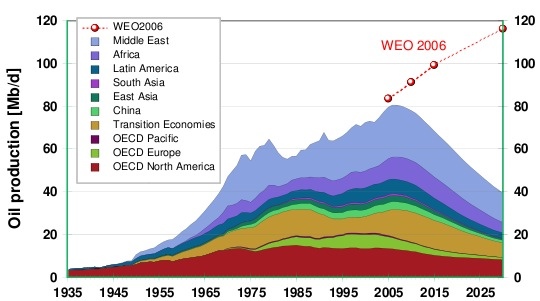
If you can estimate the total amount of oil that was originally there, and you count the barrels pumped out, than you can guesstimate when you’re halfway. Hubbert had this rather brilliant insight in the 1950′s and correctly predicted that the lower 48 states would peak in 1970, 20 years before the date. The historic production and realistic future production are shown below:

Because the top of the graph is so broad one can only tell the peak in the rear view mirror, but I guess we will read in the history books that it happened somewhere between 2005 and 2015. Market laws predict that if less of a desired good comes to market its price will rise. That’s exactly what happened in 2007, $100 a barrel oil shocked the economic world, it’s been the new normal price ever since. Expensive oil is not compatible with exponential economic growth. Lehman discovered that when they put heavy bets on infinite economic growth. Crisis followed. Expensive oil led to expensive agroindustrial food, this led to social unrest in South America, the Middle East and Indonesia : revolutions! Because TBTF stopped playing financial trickery games the lies of Greece, Portugal, Italy and Spain were unveiled and the €urocrisis began.
Now we needed a really smart plan to keep kicking the can down the road: more fuel at any cost was the mantra. This trick was found in a financial innovation: dropping money from helicopters. Not above the sheeple, but above TBTF-banks that had no where to go with their money but invest in tar sand, shale gas, polar projects and pipelines. The state made sure these Oiligarchs had access to unlimited “resources” to do their thing so we could enter an prosperous new era of “economic growth”.
That’s a scenario we PeakOilers hadn’t counted on. If you offer all the wealth in the world to break open the earths crust, to gather the last puffs of gas to use that to smelt tar from the cold Canadian sands so environment destroying factories can turn it into “oil”, you do indeed get some extra oil.
So we missed that glitch. But we are now 6 years down the road, and even the oil producers are getting sick and tired of the game, and are giving up megalomanic new projects in the Arctic and on the shale plays.
Without credit crisis the ShaleBoom would never have happened. Period.
So the revival of the fossil industry we have seen in the past few years is nothing more than a death struggle to me.
Alright, that was MY PeakOil, now the modern variant.
PeakDemand

The logic of this new philosophy goes something like this, please try to bare with me:
Because more and more rich westerners travel less because they are doing so well (one can only drive one Porsche Cayenne at a time) the demand for oil flattens. Joblessness anybody?
At the same time Chindia is asking for more and more oil, but the flow of “unconventional liquids” described above is so large that that the market is flooded with this sour fluid gold that the buyers look away from regular crude, presto: PeakDemand
Questions about Peak Demand
I’m unsure what brand of pot the writers smoke, but when they recapture their senses I have the following questions:
– why does the demand for conventional crude decrease when the total demand increases. This is just ridiculous, it’s like going to a vegetable market and asking the salesperson for a box of rotten strawberries for $5 when the table is loaded with delicious sweet ones for $2.50 a box.
– allow me to call the red hump in The graph “PeakOil” and the brown hump “The death struggle of the fossil industry”
– Am I correct that there are just 30 years between PeakOil and PeakEverything. Conventional Oil peaked after 150 years, and now we’re going to destroy our planet for 3 decades of extra oil?
– how long do you think governments will keep pumping free money into the fossil industry? People are going to ask questions at some point.
– what do the authors think of the recent peaking of shale gas in the US, leaving no extra gas for new tar sand projects.
– a large part of the so called “unconventional” is biofuel. This fuel may well be more devastating to our environment than tar sand projects or shale gas projects.
I’m happy the authors finish their piece as follows: “Our study is agnostic on what mix of oil substitutes emerges, but we do know that if we don’t manage them well, there will be big consequences.”
I fully agree with that last part, but I think that PeakUnconventional wil hit us a whole lot faster than the pieces I linked to. Time to switch to Nuclear Fusion!
Whoopsy, I meant conventional nuclear fusion there: The Sun
Final thoughts
“PeakOil, end of story?”. I don’t think so. The holy gathering grounds of the PeakOilers “The Oildrum” may have closed its doors (although the published articles remain archived), probably because all the relevant knowledge had been thoroughly documented and discussed, the discussion continues all over the web, including on my blog.
I am not pessimistic about the future but we do need to realize that “Oil” was a one time gift from Mother Nature and that we need to back to what was “business as usual” for over 100,000 years : solar energy and a way of living that matched that energy amount.
31 Comments on "#PeakOil, end of story?"
Dave Thompson on Sun, 23rd Mar 2014 3:20 am
Peak demand is a total ruse, that should fool none of us.
rockman on Sun, 23rd Mar 2014 3:33 am
“That’s a scenario we PeakOilers hadn’t counted on”. And beings us around to the point I’ll continue to make: predicting PO timing or any other future rate is meaningless if it doesn’t including the price assumptions. This is where a lot of peak predictors shot themselves in the foot. They didn’t say what they were probably thinking: global oil production was going to peak in X years IF OIL PRICES DON’T SIGNIFICANTLY INCREASE. If they had made that qualification they wouldn’t be subject to criticism today from the utopians. But I also don’t recall many of the optimists admitting they were basing their expectations on a 300% increase in the price of oil.
Nony on Sun, 23rd Mar 2014 4:14 am
I just skimmed Hubbard 1956. Did not see any discussions of price, of expected future demand (which drives price). Bad, bad Hubbard.
peter on Sun, 23rd Mar 2014 5:58 am
Your mixing Hubbard with Hubbert. In 1956 L Ron Hubbard said there wont be any peak oil as the aliens come and secretly replace it every 50 years.
Meld on Sun, 23rd Mar 2014 6:44 am
fossil fuels are infinite, everyone knows that! as long as you have capital to pay for it you can make your own in a lab. easy…….
GregT on Sun, 23rd Mar 2014 6:54 am
“fossil fuels are infinite, everyone knows that! as long as you have capital to pay for it you can make your own in a lab. easy…….”
Gee, where did we ever hear that before?
Perhaps like gold? Or diamonds?
Arthur on Sun, 23rd Mar 2014 11:35 am
Good story, embrace the conclusions. No need for panic, mount solar panels on your roof, pick up hobby gardening, and heehaa fifties, here we come.
http://media-cdn.tripadvisor.com/media/photo-s/01/66/8a/85/bei-der-arbeit-p.jpg
Picture showing smiling women from 3000$/year Kherson Oblast, Ukraine, in the middle of their vegetable garden.
Davy, Hermann, MO on Sun, 23rd Mar 2014 11:50 am
Rock, I would like to expand on the price idea affecting PO. I would again model it around your Peak Oil Dynamics idea. IMHO, the financial side of the equation is the number one theme at work at this time in history. This is a new normal for PO. I say this with the understanding that all the other variables are present. These variables are people, machines, reserves, potential sources, and critical production resources. Some of these resources may be nearing peak themselves but still adequate. “IF” we had a very healthy economy, a population not in overshoot, and not at limits of growth we could throw lots of money at this PO issue. Finance allows trade and exchange at the earliest stages of the process. If, the price of money goes up, the availability of credit drops, and or confidence in a positive economic direction turns bearish you will not see growing oil production. Normally in the past, the economy and society were reasonably healthy. The sentiment was any down turn would turn up within a normal business cycle. This was the case up until 2008. Since then our society and economy are being ripped apart by dysfunction, distortions, manipulations, corruption, wealth transfer, huge unfunded liabilities, and a Ponzi scheme of debt. In such a case I am claiming we have financial PO. “Financial Repression” is the artificial manipulation of economic fundamentals like, cost of money, price discovery, and normal business cycles. The “financial repression” may continue but it can’t continue very long because eventually the unintended consequences lead to uncontrollable economic and social reactions. This is especially the case when the current tools of financial repression are a classic global financial bubble benefitting a very small minority. One other mention. I hate when people show me PO graphs that have a nice gentle decent after peak. That is intellectual “BS”. When and after we hit peak and the plateau breaks lower for good, we will see chaos in the form of feedbacks and dysfunction. The demand and supply dynamics will most likely show a very dangerous break downward in jagged and unpredictable drops. We know from the study of systems the decent of an ecosystem is generally much more jagged and chaotic then the growth. Growth follows a relatively smooth arch relative to a decent. In a decent with chaos entering the equation nodes of vital support are not affected in a rational way so the decent is anything but smooth and rational. I am not saying it not possible for a gentle soft landing. I am saying these forecast are unlikely. These gentle forecast are in effect a lazy eye on the future. We know the history of oil production and how quickly planned projects are shelved. We know how quickly unprofitable production can be shut. We know how oil production will function in a time of volatility and uncertainty.
Pops on Sun, 23rd Mar 2014 1:06 pm
Of course Hubbert considered price. In his ’56 paper he mentions “current production practices” repeatedly and those practices of course are dependent on price/profit. Or they were until the Fracking Scheme.
He also talked about tar sands and oil shales as well as enhanced recovery improvements. His point was the framework in which the of ultimate recoverable reserves could be input. In fact, he didn’t himself estimate URR in the ’56 paper, he used (and actually increased) the estimates of URR developed by L.G. Weeks and Pratt from the same era.
Remember that in Hubbert’s time – and until very recently – production had always responded to increases in price, so the controversial portion of his model then and just as much if not more today, was not that US production would peak in ’70 or world production in ’00 or any other specific date –
but that it would peak at all.
http://www.hubbertpeak.com/hubbert/1956/1956.pdf
paulo1 on Sun, 23rd Mar 2014 1:40 pm
Davy
re: “We know how quickly unprofitable production can be shut. ”
Production in all things are vulnerable to this rapid decline. I am sure all of us have at one time or another been amazed to see locked gates on operations, overnight!! Afetr a few days or weeks the details leak out as to why.
It used to be some guy couldn’t keep his fly zipped and divorce triggered it with an asset divide. Or, financing costs or restrictions. They’ll be all kind of reasons with the same meme of ‘costs vrs market’, etc.
I am sure it will be the same with PO. Braniff, (they just couldn’t….oh yeah, already done. TWA, they just….oh yeah). When it’s Boeing, GM (again), it will be fricking mayhem and maybe not so slow mo.
Paulo
Davy, Hermann, MO on Sun, 23rd Mar 2014 1:55 pm
Amen Paulo!
red on Sun, 23rd Mar 2014 2:03 pm
amen oil!!!
Pveroi on Sun, 23rd Mar 2014 2:43 pm
I have enough friends on Wall Street to know that they are last people to even pretend that they care about the world. They care about profits, and social status or lifestyle quality (which are relative to those of others), in other words they care mostly about being on top and they aren’t afraid to say so (or they wouldn’t be there). In order to maintain this position they only need to know what is going to happen in the near future (1-3 years at a time is very good for them). This is why BAU is so important – they know how it works and are better than most at making money from it.
What I’m trying to point out is that they are not talking about the real future, or really anything that we care about. They are talking about the next three years at most and they aren’t worried about it because they know how they’re going to make money off it. Anything that challenges this process will be met with serious resistance.
In short, these guys aren’t stupid or high, they have a completely different point of view and set of goals than you and I do, and they say so (just not usually in public). If you read their work in this light, you understand why they’re always happy and things will be great (not for you, for them silly). Why would they care about anything else?
Nony on Sun, 23rd Mar 2014 3:58 pm
Pops, you’re forcing me to actually read the 1956 Hubbard paper. Very readable. TTYL.
DMyers on Sun, 23rd Mar 2014 4:28 pm
In the past, various ones discussing the PO phenomenon have made reference to “the bumpy plateau.” The term was meant to describe an extension of the true peak, where market forces resist decline, and supply bounces up and down in a narrow range, before the inevitable decline turns down against all resistance. This comes to mind because it has been my understanding the “the bumpy plateau” incorporates the principles of temporary demand destruction and supply enhancement from more difficult and expensive sources, such as so-called “unconventional oil.”
The down jags on the plateau result from lower demand due to higher prices. The up jags result from the introduction of more difficult oil in the supply mix, as justified by higher prices- altogether driven by economic inertia and systemic self-preservation. I note this, from over here in the idiot’s corner, to point out that the phenomena discussed have already been recognized and incorporated into general peak oil thought. If the bumpy plateau is confirmed by observation, then peak oil withstands alleged demise, as it correctly anticipated contentious demand and supply variations in the immediate post peak period, independent of the precise drivers of such variations (i.e., technological v. investment v. consumer restraint,….).
Nony on Sun, 23rd Mar 2014 4:46 pm
OK, I read the paper front to back. It is very readable. I don’t see an analysis of demand projections or cost curves. IOW, cost curve tranches of oil.
Maybe you can say that’s inherent, but he doesn’t really explore them and they’re important. His whole emphasis is on calculation of reserves (acknowledging some uncertainty) and distinguishing proven versus possible. And then he posits zero at the beginning and zero at infinity. And says we have a slinky with area under the curve matching the resource. But he doesn’t really explore how the reserve number itself is a function of price.
Little bit of discussion of technology (IL seismic in past, extended recovery getting better). But he seems to discuss it in terms of “running out” versus the price mechanism driving some improvements to tech.
So, there’s a little disconnect (Rock) in saying “don’t beat up on Hubbard” and “prices affect extraction”. And, you’re right on the latter. And most of your fellow peakers (Campbell, Deffeyes) have been off in not addressing it. Someone like Hamilton is a little better.
P.s. The gas call (a substantial part of the paper) is really way, way off.
rockman on Sun, 23rd Mar 2014 4:58 pm
Just a repeat of the point made before about what the projection of his US PO was referring to: the peaking of the US oil production FROM JUST THOSE TRENDS the analysis was based upon. As pointed out that while he was aware of other potential oil resources they were not a part of the model. And as I’ve said before not to slight his work but he was projecting the future production of some rather mature trends. Those trends that had been undergoing significant development for more than 20 years. A field I’m working in today was one of that population he used and it was discovered in 1936…about 35 years before his estimate of US PO. Lots of debate today on the URR’s of the Bakken and Eagle Ford. But imagine you’re trying to do so in the year 2030. Probably a good bit easier. Hubbert was making his projection 20+ years after those trends began developing. While he doesn’t focus on the price dynamic of his model the maturity of those fields and the relatively static price of oil reduces the effect.
Nony on Sun, 23rd Mar 2014 5:04 pm
He could have looked at the history of discovery and the like and realized that resource estimates would continue to evolve.
And the US gas call (is that a mature trend?) was really off.
And I think it was more than a “this is my model, realize the limits” type of call. He doesn’t make a lot of caveats about things outside the model. And he also posits a massive change to nuclear energy.
rockman on Sun, 23rd Mar 2014 5:23 pm
“The gas call (a substantial part of the paper) is really way, way off.” And for good reason: NG fields, unlike oil, didn’t become a serious exploration targets until the 70’s. When I started at Mobil Oil in 1975 the NG boom was just beginning. In 1973 it was selling for around $.20/mcf. In just 7 years the price increased more than 700%. Obviously this is where the price factor totally dominated the dynamics. The difference is that Hubbert didn’t have a population of mature NG fields to model because until the 70’s NG was typically just an unfortunate side effect of oil exploration. It would be similar to trying to project DW GOM oil peak production in 1995…there wasn’t enough history developed at that time. Probably around 2020 someone may try to make that call. At that time we’ll have a 40 year history. Kinda like it’s often a lot easier to predict the winner of a football game with 3 minutes left to play than before the kickoff. LOL.
rockman on Sun, 23rd Mar 2014 5:28 pm
Davy – Bro, you need to get off this kick of linking fossil fuel development and macroeconomics. It really just about geologists trying to prove they are smarter than Mother Earth. LOL. I’ve actually known a few who actually thought that way.
Nony on Sun, 23rd Mar 2014 5:33 pm
Thanks, Rock. You are a nice guy. Hope I did not come off as counterpointing without reflecting.
P.s. He was off on uranium availability also (much less need for breeders than posited because we found a bunch more concentrated ores). Now, are you going to try to tell me that atomic energy was not mature in 1956? 😉
Nony on Sun, 23rd Mar 2014 5:41 pm
BTW, if you like interesting old duck geologists who are dead now, you should check out some of these correspondence and old papers of Price, Lefever, and Bardin.
http://www.undeerc.org/News-Publications/Leigh-Price-Paper/Default.aspx
Kind of touching how much of a booster old Price was for the Bakken before its time. And he died right before being validated. But I bet he is smiling down on the Williston Basin.
And yes, there’s plenty to criticize in his estimates…cost has been much higher than he said, total oil in place is probably half of his estimate (but throw in TF and it almost works). And I really doubt we will get 50% (!) extraction.
But he did make an interesting call when no one else did. And he did bottoms up analysis of the cores and such available. He even argued for evolution of completion methods as enabling technology.
Nony on Sun, 23rd Mar 2014 6:02 pm
I just read Hubbert’s wiki page and clicked on the links to Technocracy. Guy was a hard core non-believer in markets. Very hard to argue that his paper discusses market implications for production when it’s not in the paper and when we learn his world view.
You are really better than him, Rock. I mean that.
Pops on Sun, 23rd Mar 2014 6:11 pm
“He could have looked at the history of discovery and the like and realized that resource estimates would continue to evolve.”
Fig. 20 shows 250 billion bbls of proven reserves and almost a trillion of yet to find. That seems to me like he was expecting to see reserves continue to increases, no?
“And then he posits zero at the beginning and zero at infinity.”
The reason his presentation set all the jaws wagging was this seemingly very obvious point. I’m thinking prior to his presentation the very idea that production would ever peak and decline, let alone return to zero was never broached publicly or privately – obviously never-ending oil is an emotionally loaded belief that persists to this day.
You can quibble here and there with this and that but the fact remains that since he is considered the “father” of peak oil he must have contributed something to the discussion. Oh, and then there is the bit about C+C peaking around 2000, looks like he was off about 10% at a time when his colleagues main contribution to the dialog was: “Harrumph!”
Nony on Sun, 23rd Mar 2014 7:10 pm
Pops, I understand figure 20. The undiscovered refers to the total recoverable reserves calculations of Pratt, etc.
We’re in 2014, so a 2000 world peak is pretty far under. But more damning is that the amounts are WAY under. (I’ve actually read the paper, now. His main point is area under the curve. We might peak later, lower or earlier, higher according to him. But he’s gonna be way off on the area under the curve if we are later AND higher.)
Figure 20: world peak at 12.5 MMM bls/year
Current world production: 76 MM bbls/day = 27.7 MMM bbls/year
Figure 21: US peak at 2.75-3 MMM bbls/year
1970 peak: 10 MM bbls/day = 3.65 MM bbls/year
Figure 23: Texas peak at 1.2 MMM
bbls/year
Peak Tx: 3.65 MM bbls/day = 1.3 MMM bbls/year
***
So, he was about 10% off on Texas, 25% off on the US and then more than 100% off on the world.
And that’s not even going into how US and Texas are rising recently. Area under the curve is going to be even more off than he predicted.
Why do you Malthusians always estimate LOW? Piccolo Bakken estimate, Run Bakken estimate. It’s a pattern. Makes me think you aren’t being objective…or if you are, your weltanschauung blinds you from the problems with your depletion based estimates. And then when you’re off, you don’t fess up and learn.
Davey on Sun, 23rd Mar 2014 8:09 pm
I’m on a role Rock! Actually I tried to be a geological engineer and the math kicked my ass. Geologist are a strange breed. I must say geologists are pretty popular these days. The new gods of industrial man. Amen
Pops on Sun, 23rd Mar 2014 9:13 pm
Nony, A billion extra barrels of oil moves a simple logistics peak less than 5 days, an additional trillion about 8 years at this level of consumption.
http://oi42.tinypic.com/xnuvb9.jpg
Production has only grown a couple of percent in the last 7 years, compared to a couple of percent per year previously, while at the same time price and investment has grown several hundred percent. The average real oil price has been higher, longer than at any time since oil. Econ 101 says that means the oil supply is constrained and a constrained supply is what Hubbert was forecasting for about now. That is really inarguable, calling me a malthusian or whatever name doesn’t change a thing, LOL
Basically I give Hubbert credit first for coming out and saying out loud that oil production would peak in the first place and then guessing that the peak would happen around 2000 when everyone else at the time just snorted – heck, it sounds like you are still snorting, yet aside from US LTO the rest of the world has been flat since 2004.
http://crudeoilpeak.info/wp-content/uploads/2014/03/World_without_US_shale_oil_Jan2001_Oct2013.jpg
As for the area under the curve, there is no guarantee that global peak will eventually be seen to have happened at the midpoint. Could be that all the kerogen and bitumen and CTL, not to mention the last ditch attempts at profit etc drags the tail out a long way, could be the plateau is made to extend way out with high depleting fracts, deepwater, etc and result in a very steep decline – or both. Who knows?
Whether Hubbert was off by a decade in oil’s 200 year lifespan means very little at this point.
Pops on Sun, 23rd Mar 2014 10:05 pm
I should come “out” here more often and invite you all into the forums. There are 10 years worth of threads on any aspect of PO you can name and they never disappear off the page.
Most of the PO forums are viewable by non members but you’ll need to sign-up to post and get access to all the discussions and archived threads.
Use the links at the top of the sidebar menu
Nony on Sun, 23rd Mar 2014 10:13 pm
Most proper God-fearing forums ban me for trolling and name calling. I’m surprised I’ve lasted so long in the article comments. 😉
Pops on Mon, 24th Mar 2014 12:26 pm
Not saying I wouldn’t ban you, but I’d toy with you first.
LOL
Davy, Hermann, MO on Mon, 24th Mar 2014 2:06 pm
Nony, you are a troll light (LOL) and fun to parley with. I enjoy your comments! Hell I am a wordy “know it all” that will not shut up. I can’t spell nor have decent grammar. What I do have is a compulsive persistence to get a message out. If someone complains my response is ignore me. I enjoy the mental exercise here. Obviously very smart people are on this site and those of us not so smart appreciate the intelligence floating around here.