
Peak Oil is You

Donate Bitcoins ;-) or Paypal :-)


Page added on August 7, 2014

Peak Oil: Derring-Do Part Two!
Recent publications featuring the impressive tales of the billions made by oil industry entrepreneurs does have a certain appeal to it, whether one is a cynic or fawning admirer. The levels of success and wealth enjoyed by those few—ignoring the not-always idealistic paths ushering them to the top—is indeed astonishing, and so far-removed from the lives most of us lead it’s hard not to be captivated at least in part by what they’ve accomplished.
But as with most stories, there is always at least one other side to the story, and too often it’s one which doesn’t get nearly as much airplay as it should. When the stakes are this high: properly informing the public and helping them prepare for the not-so-pleasant consequences which arise from even the happiest of happy tales, that’s a failing difficult to ignore and even harder to justify.
Another example of bowing down to the genius of American wherewithal came courtesy of an NBC News story from late in 2013, profiling “Harold Hamm, the billionaire behind America’s ‘great renaissance of oil.’”
The article begins as one might expect in a story about an immensely wealthy businessperson:
In the history of oil, this fall is a tipping point, the moment America gurgles past Saudi Arabia and Russia to become the world’s petroleum king.
The man most responsible is Harold Hamm, 67, a drawling, blue-eyed billionaire, a sharecropper’s son who grew to be the richest energy mogul in America. He was the first to profitably ‘frack’ North Dakota oil wells, leading a revolution in the way the nation coaxes energy from the earth and draining momentum from the search for cleaner fuel sources. His company, Continental Resources, has quintupled in value in a matter of years, emerging as a swaggering promoter of eco-friendly, effectively infinite oil — along with all the supposed good that flows from it.
Now Hamm seems ready to fight anyone who says otherwise. ‘Anti-frackers are disingenuous,’ he said. ‘They bow to the religion of environmentalism.’
A fine piece of dismissive red-meat snark right off the bat! No facts, just the keywords from Page One of the Playbook. Give ‘em credit: the message is the same no matter who delivers it. Hypocrisy; fabrications; hype; their own full dose of disingenuous … doesn’t matter. The message is the message because it serves the interests of the few at the expense of the many, and who really cares about the public when there’s a big bottom line awaiting?
‘Some of the extremists are calling it carbon pollution,’ [Hamm] joked between appreciative bites of cheeseburger. ‘I mean, all of us breathe out carbon dioxide. Are we going to quit breathing?’
That’s a good one! Except for all the times that climate change deniers have uttered their own variations of the same ignorant nonsense, it’s quite original! Hard to imagine someone who’s accumulated that such wealth and enjoyed as much business success as has Mr. Hamm is that clueless. So why offer that pronouncement if it’s not intended to steer readers and listeners away from the truths which paint a less-than-flattering light on his successes and the consequences to all of us?
Referencing the Bakken Formation (located primarily in North Dakota) which is one of the two regions here in the U.S. almost entirely responsible for the recent surge in fossil fuel production and Mr. Hamm’s foresight in recognizing its potential, the article adds:
North Dakota’s Bakken oil field … now produces more crude than Alaska’s Prudhoe Bay, and his company remains the area’s largest lease holder. This month Continental Resources told investors that the region contains enough recoverable oil to double the official count of U.S. reserves and enough ‘oil in place’ to meet the nation’s needs for hundreds of years. While those claims have not been verified by regulators, Hamm’s track record makes them hard to doubt.
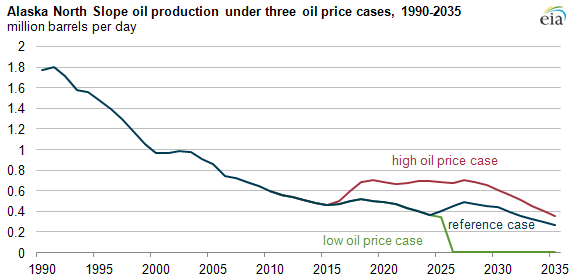
Except that they should be. Nice of the author to glide right past the Prudhoe Bay comparison. But if context is going to added to the conversation—say, if the comparison is to a field on a steady decline since 1988—then a different conversation takes place, and that would not be quite so appealing a story. Look at this chart from the U.S. Energy Information Administration:
Here’s another for-example:
[Alaska’s] top producers recently renewed their forecasts, predicting a continued drop in production….
The good news: The decline can be slowed. The bad news: Production won’t exceed the 550,000 barrels of oil that flowed down the pipeline in 2012, at least not anytime soon, according to recent statements by BP and ConocoPhillips….
Dave Lachance, BP’s vice president of reservoir development in Alaska, laid it out clearly during an engaging talk at the Resource Development Council’s annual conference last month. ‘We can’t stop the decline,’ he said. ‘We’re producing a diminishing resource.’ [1]
So why wasn’t the very obvious fact of Prudhoe Bay’s quarter-century-long decline added to the conversation? It’s not a secret!
Less than a decade ago America seemed poised for a fifth straight decade of shrinking oil production, part of an alarming global dry-up. Experts warned of ‘peak oil,’ an imminent time when demand for the world’s black oxygen would race ahead of supply.
‘We’re addicted to oil,’ declared President George W. Bush, who admitted that supplies of our drug were ‘limited.’
Today, to Hamm’s delight, the panic seems misplaced. ‘The peak oil people have all been wrong,’ he said. ‘They completely missed the boat.’ Since reaching a high of 60 percent in 2005, net oil imports have fallen by nearly half and domestic production is at a 25-year high and rising faster than ever.
Exhibits A and B of how to ignore facts when they interfere with self-serving narratives. First: do not address the issues. Deflect attention with a criticism or a pronouncement, just keep facts out of the discussion. How exactly have the “peak oil people … all been wrong”? Which “boat” was missed?
A typical citizen with relatively little knowledge of oil production details will of course accept such statements from someone glowing with as much success as a Harold Hamm! What greater authority might there be? He certainly must know what he’s talking about!
He does. He just chooses what he wants to share for his benefit, not yours.
And as for Exhibit B? “[D]omestic production is at a 25-year high and rising faster than ever.” It may be at a “25-year high” but it is not the same as the all-time peak production total of nearly 10 million barrels per day from 1971. Why not point that out? Why not explain the more generous definitions of production totals now employed, and the qualitative—and meaningful—differences between the crude oil peak from 1971? And “rising faster than ever” means what, exactly? How about a fact or a context?
‘It’s a different age’ says Hamm. ‘We’ll be producing oil for hundreds of years.’
Good to have dreams, of course! But when those dreams aren’t serving the best interests of those relying on others for information and the truth, those dreams stop being quite so pleasant. Sometimes, in fact, the truth sucks!
Perhaps giving the public an opportunity to decide for themselves with all the facts at hand might be a worthwhile exercise?
One Comment on "Peak Oil: Derring-Do Part Two!"
Keith_McClary on Fri, 8th Aug 2014 12:29 am
“effectively infinite”
Is that bigger than
“relatively boundless”
???