
Peak Oil is You
Donate Bitcoins ;-) or Paypal :-)


Page added on January 8, 2011

Lifeboats: A Memoir

During the early days of The Farm,1971-1973, we learned a number of lessons that will be useful againnow that a rapid petrocollapse scenario is likely to come to pass.The Farm spiritual community emerged from a 50-bus caravan of 320Haight-Ashbury refugees fleeing hard drugs, exploitation andcounterculture tourism. After a year on the road the gypsy vagabondspooled inheritances and purchased 1050 acres (450 hectares) of land80 miles (130 km) from Nashville. It was US$70 per acre.
The Farm grew to a standing populationof well over 1000, with 20 satellite centers, then, in the early1980s, declined and decollectivized, bringing its population to under200. Since then it has experienced something of a renaissance,finding new popularity amongst permaculturists, ecovillagers, androving students. But let’s begin at the beginning, when our grouplanded in Tennessee.
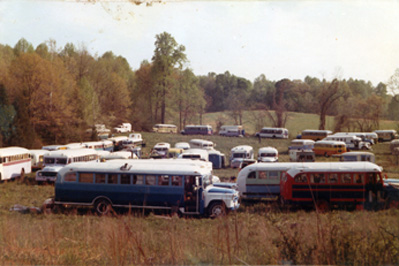
Living in remodeled school buses wasquite an adequate introduction to “roughing it,” especially forthose of us who had never gone camping as children. The “honey pot”latrine bucket, mosquito-proof backpacker tents, canteens,flashlights, storm lanterns, and two-burner Coleman stoves werefamiliar to the pioneer settlers by the time they first stepped offthe bus.
The land itself was barren of amenitiessave a small log cabin, a horse barn and a line shack, and so thefirst order of business was setting up facilities for bathing,sanitation, kitchen and sleeping. I’ll skip over the organizationalaspects here because they would require a lengthier and more nuanceddiscussion; suffice it to say that circumnavigating North America ina 50-bus caravan required a degree of organization similar to runninga rock-and-roll band tour. That’s enough organization to get youstarted in designing and constructing a settlement, although perhapsnot enough to keep it intact for very long.
For pumped water, an engine was liftedfrom a Volkswagen Bug and set on blocks in a springhouse. A well-usedand rusting 5700 liter (1500 gallon) water tower was purchased forscrap value, repaired and erected atop a hill above the springhouse.This required minor welding and auto mechanics, as well as acontinuous supply of petrol. Some years later, when power lines camein, the VW engine and springhouse were replaced with a submersiblepump and well. Today it would have been built with photovoltaics orwind power, but such technology, while already available in the1970s, was well beyond the reach of a community that subsisted onaverage per capita cash income of US$1 per day for its first 13years.

After the first winter, a second,larger water tower was erected near a 100 meter (300 foot) well withgood aquifer recharge. The tower was salvaged from a railroad companyfor a purchase price of US$1, but moving and erecting the tower andtank required a crane. From the towers, water was delivered to homesin 20 liter (5 gallon) jugs by horse wagon.
While the buses provided initialshelter, with more than 6 residents per bus on average, after 8 to 12months of living on the road most people wanted to get out intobetter housing, as quickly as possible. At the time, the governmentof the State of Tennessee held monthly auctions of surplus property,and Korean War vintage army tents could be bought for as little asUS$15. These formed the basis of our first foray into homeconstruction. With salvaged materials from construction sites anddumpsters, they morphed into “touses and hents.” Going into apartnership with a nearby sawmill allowed us to add some beautifultimber-frame buildings and D-frames. Common buildings such as thecommunity kitchen, motor pool, canning & freezing, print shop,clinic and school sprang almost entirely from salvaged materials.Scraping mortar off cement blocks and straightening nails becomewell-practiced skills.

There was limited electricity to thesite, and for an entire decade almost all of our electricity camefrom 12-volt DC systems powered by car batteries. Initially thebatteries were charged by switching them through vehicles every day,but full discharge cycles make for short battery life, so aftertrying novel methods of pedal power, bamboo wind generators and otherwacky ideas, most houses went to a “trickle charge” system — along copper cable run through the trees to a central power centerthat took its electrons from Tennessee Valley Authority (although wealways sent them back in the next nanosecond).

At one of these power centers, where wedid our canning and freezing, we erected walk-in coolers andfreezers. Refrigeration was a necessity that is as difficult to avoidas it is to achieve. A few of the buses came with propane-poweredfridges and they were a blessing. Most of the households relied on asystem of 5-gallon (20 liter) buckets that rotated to the walk-incoolers and freezers near the cannery. Buckets with tight lids wereobtained from dumpsters behind the McDonalds in town. The otheressential item was a Flexible Flyer wooden wagon with slatted sides.If you couldn’t get your parents to give one of those to theirgrandchildren for Christmas, the next best thing was to weld a biketrailer or pushcart to get your buckets to the neighborhood cooler.
Buckets were also employed to carrydiapers and laundry to a communal laundromat, which was set up nearanother trickle-charge node. Salvaged coin-op equipment was purchasedin bulk, the coin slots replaced with toggle switches, and a largediaper rinse and centrifuge babe-manure extractor installed. Thegrey- and black-water flowed to a constructed wetlands and rainbird,creating what today, 40 years later, are some of the richest soils onthe property.
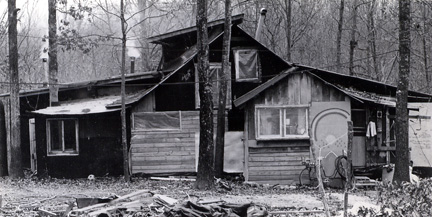
Communal unisex showering facilitieswere constructed in places with good supplies of water and a way toheat it: downhill from the original water tower; beside Canning &Freezing and the Farm Store; at the Farm School and print shop.
A flour mill took over the tack room inthe horse barn. Initially we used a small stone mill to grind cornmeal. Later we bought a larger, 3-break steel feed mill and set it upin the line shack, connected to 3-phase AC power. Arrayed around theroller mill were Clipper seed cleaners, sifters, a coffee roaster, anoat huller, and bagging racks. Within a year the mill was churningout a ton per day of wheat, corn, soy and buckwheat flours, pastryflours, corn meal, grits, groats, mixed cereals and porridges, horse feed, soy nuts, popcorn, coffee, and peanut butter.

Transportation and communications werepriorities, because our sustainability depended on commerce, andwithout good transportation and communications any attempts to createa business would have been hampered. Bear in mind that for the first13 years the experiment was communal, meaning shared purse. Just asmany societies throughout history, we have found that in times ofdifficulty a reversion to communal economics provides greatersurvival advantages than the exercise of individuated privateproperty rights. After achieving stability, most drop the communalform in order to stimulate greater enterprise. This was the pathtaken by Amana, Oneida, many kibbutzim, The Farm, the People’sRepublic of China, and, now, Cuba.
Any group that can cross the country in30-year-old school buses will learn something about automotivemechanics. Our motor pool and junkyard became one of the technologyhubs for The Farm, a place where anything from a hay rake to a firetruck could be machined and rebuilt, nearly from scratch.
The first two teams of horses, blackBelgians and white Percherons, were acquired from neighboring OldOrder Amish. They laughed at our feeble attempts, as vegans, toreplace leather harness with more hippy-kosher canvas and Naugahide.“How’d you raise that nauga?” they’d ask. Interesting koan!

Communication was accomplished througha rapid succession of home and business devices. The log cabin becamethe business center with two phone lines. On US$1 per person perday, personal long distance charges were unaffordable, but one of ourcaravaners was an Eagle Scout with a ham radio merit badge, and hemade a radio shack in the horse barn and began training ham radiooperators to staff an amateur band Farm Net. Before the Internet Iwas WB4LXJ.
A 12-volt telephone system wasinstalled to link every bus, tent, home and business. The dial tonewas replaced with a Grateful Dead or reggae melody or a publicservice announcement (1000 jars of catsup planned today, cannersneeded; line at the laundry is now 90 minutes; bean shucking andbanjo at horse barn 7 pm). The dial itself was replaced with apushbutton that you used for Morse code to signal where you werecalling. Four shorts meant “all points.” It was a party line, butthere was a second carrier band, the “Hot Line,” used foremergencies. A toggle switch flipped you over to that band where anoperator was always on call, sitting at a phone console to summonfire, police and ambulance and to assume management of the emergency.This pre-dated most emergency telephone services.
Emergencies were taken seriously, andfire marshals, gate and patrol security, and emergency medicalresponders were treated as actual jobs from the very beginning. Eachbecame more sophisticated as the body of experience grew. Naivehippies learned to adjust to the rigors of self-reliance, which couldsometimes be terrifying, such as when a kerosene lamp tips over in acanvas tent, the Ku-Klux-Klan rides up to the front gate or a deputysheriff wanders into the marijuana patch while hunting deer.
Finding additional uses for the copperwires we passed through the treetops, we sent a TV signal throughthe phone lines, and could download direct network feeds from a12-foot (3.7 meter) dish made of pine 2x4s and chicken wire. We watched theWatergate hearings that way. We produced our own shows, too, sentfrom the Bandland Studio tent to 12-volt TVs in tents and buses. Ifyou were within 30 feet of the phone line, you could pick up thesignal on channel 3. We watched Greenpeace work out its chess moveswith the Spanish Navy in real time, using a slo-scan ham TVtransmitter installed on the bridge of the Rainbow Warrior, sortof a proto-Animal-Planet pilot.

Eventually, when CB radios becamepopular, we were able to install them in our vehicles and interfacethem with the ham radio and “Beatnik Bell” phone system. Freeinternational calls became possible. Our “Extra Class” hams grewin proficiency and could link to satellites, monitor police, militaryand secret service sidebands, and bounce audio, digital and TVsignals around the world to an expanding Farm Net.
A weekly newspaper, Amazing Tales ofReal Life, began coming out of the print shop, along with a hostof do-it-yourself books that turned into a brand. A brisk traffic indaily visitors, more than a hundred some days, required tour crewsand a large hostel tent, but also supplied nearly free labor for thefields.
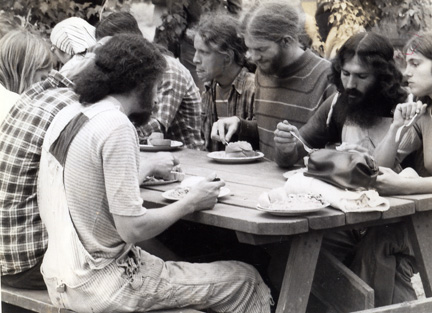
From the very first arrival of thebuses and through the first 5 years a community dining facility wasan essential efficiency, and one of the main reasons that livingcould be so cheap. Milk was made from soybeans, which became tofu,mayonnaise, yogurt, sour cream and ice cream. Soybeans were also madeinto coffee, tempeh, soysage (from okara), soyburgers andstroganoffs. A bushel of dry soybeans (35 liters) cost US$3 (US$7today). The protein needs (with all 8 essential amino acids in goodproportion) for a hard-laboring farm worker can be supplied on lessthan a pound (450 grams) per day, rehydrated and made into gourmetvegan cuisine. Thinking of storing food for emergencies? Includesoybeans.
Tracing back down memory lane to myexperience then: a young man of 25 arriving at The Farm in 1972 withjust a backpack; being greeted by the Night Sentry and shown a placeto sleep; going for a breakfast at the Community Kitchen, porridgeand sorghum molasses, soysage and corn biscuits; then to the field ina horse wagon; harvesting sorghum cane with a machete and piling itinto the wagon; at the end of the day returning to my assigned,dirt-floored army tent lit by candles; supper of bean soup andcornbread with pickled japapeños; guitars and song around a fireunder the canopy of stars; abiding sense of harmony in the world;community.

2 Comments on "Lifeboats: A Memoir"
cusano on Sat, 8th Jan 2011 10:47 pm
As events begin to unfold, we will transition back to local economies. Having a neighbor(s) will take on a whole new meaning. In 1975 we started home steading in Vermont. We managed to cob together 160 acres of land, raise or grow most of our food, start a maple sugaring operation, heat entirely with wood, and for the most part, remain debt free. If two people can do this (my wife and I), just think what an entire community can do if they worked together.
Kenz300 on Mon, 10th Jan 2011 1:18 am
Sustainability …..
How does it become more ingrained in individuals, business and political leaders?