
Peak Oil is You

Donate Bitcoins ;-) or Paypal :-)


Page added on May 17, 2016

Helicopter economics and the relevance of ‘Peak Oil’
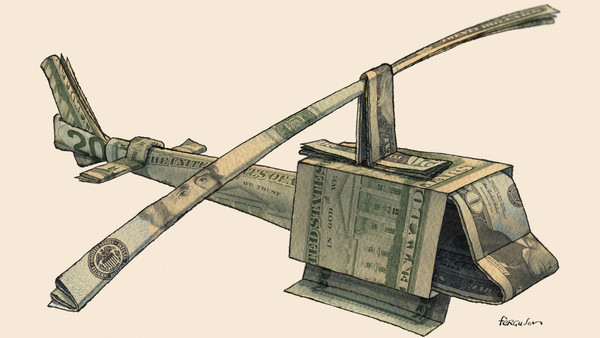
The lingering relevance of the heady days of “Peak Oil” and the prospects of “helicopter money” from central banks find a place in our round-up of the week’s best markets comment and analysis from the Financial Times. Taken from our Markets Insight and Smart Money columns, the pieces come from our line-up of industry contributors and in-house journalists.
Stephanie Flanders called for some sympathy for the publishers of monetary policy textbooks, as policymakers worldwide look to the skies for signs of helicopter drops. Such deliveries of cash straight from the printing presses to the public have long been seen as a theoretical last resort for economic stimulus.
“In the past decade a slew of topics have moved from the realm of academic footnotes to the centre of economic debate. Now we can add ‘helicopter money’ to the list,” wrote JPMorgan Asset Management’s chief market strategist for Europe.
“If another downturn threatens while policy rates are still close to zero and balance sheets are still enlarged, it is a reasonable assumption that at least one central bank abandons the pretence and monetary financing will complete its move from the unthinkable to the merely ‘unconventional’.”
Meanwhile, the rise in credit provision from Chinese banks prompted Henny Sender to ponder the potential of another distressed debt cycle there. While conceding that China’s credit cycle will deliver opportunities for the brave, she warned that defaults were also rising.
Nonetheless: “Many bold foreign investors are beginning to consider the opportunity either in buying up loan portfolios, or in extending rescue financing to those sectors where the banks are forbidden to lend. Options include offering funds to property developers for acquiring new land banks, and taking as collateral existing projects.”
There was a more upbeat look at conditions on Wall Street from Richard Turnill, BlackRock’s global chief investment strategist. He said it was too early to call time on a US stock rally this year after the rebound from February lows.
“Stock returns have primarily come from multiple expansion, or a general investor willingness to pay more for each dollar of earnings, together with huge increases in dividends and share buybacks as corporations have been rewarded for returning capital to shareholders,” Mr Turnill wrote. “While this means valuations are no longer cheap, we have reason to believe the US stock market is in a sweet spot — despite declining earnings.”
Stephen Foley got his fill of positivity at the Milken Institute’s global conference in Los Angeles. He decried the “strangely optimistic” tone of the gathering, often called Davos West. Our columnist asked how the future-gazing members of the world’s financial and business elite could be so upbeat while “state and local governments’ $1tn pension hole” still loomed.
John Authers issued a pointed reminder of the importance of recalling the accuracy of past predictions. In our Long View column, John reminded readers of the heady days of “Peak Oil” — and its prediction of permanently rising prices — in the context of the forecasts about crude prices being mired at their current relatively low levels.
“Treat 2008 Peak Oil as a cautionary tale when listening to new narratives, promulgated after the oil price collapse of the second half of 2014. Since then, oil has lurched wildly but is roughly where it was at the start of last year. Because so many have borrowed so much on the assumption of high oil prices, fear remains intense.”
In a separate column, John also looked at why active managers need to join the ‘arms race’ for big data as the forces of disruption hit the investment management industry.
Dan McCrum took a tilt at the self-interested nature of much of the talk swirling around the markets under the headline This column is great — or how market chatter changes.
“This column is brilliant . . . Some might suspect the opinion to be less than disinterested, but that is the point. Markets are a conversation between self-interested individuals, and it is rampant promotion of those interests that determines what tends to be heard.”
3 Comments on "Helicopter economics and the relevance of ‘Peak Oil’"
onlooker on Tue, 17th May 2016 7:39 am
“Treat 2008 Peak Oil as a cautionary tale” As always the economic publications are the most out of step with reality. Cautionary tale as though this was some kind of fable and 2008 just a chapter in a book. It happened and it happened for reasons related to the underlying status of the economy and the state of the Oil patch. 2008 has in fact heralded the new reality of helicopter money to try and bail out the floundering Industrial Civilization. Well it is like paddling upstream. Every day that passes depletion of oil continues. Every day also seems to promise more indebtedness for most entities big and small. So, we sail on our fictitious money making contraption trying in this way to hide from the realities of a world wide population in overshoot and of our principal lifeblood resource becoming every less economically viable. Oh and that is the less of our worries. The Environment is the 800 pound gorilla in the room no respectable economic publication wishes to speak of.
Davy on Tue, 17th May 2016 9:04 am
If you are in the tunnel vision of the markets and fail to connect all the other dots you will have an article like this. We have multiple issues converging. These are not exclusive and they will be reinforcing economic decline. These are not only economic issues they are ecological, climate, political, and social. The economy is in a free fall of demand and supply destruction. We don’t see this free fall now because we have so many distortions but the real underlying economy is being destroyed. The networks and the “goodwill” of systems and abstract structures is being deflated and confidence eroded. Normal price discovery and the moral hazard of the disregard for the rule of law is firmly entrenched and cannot be dislodged. It is now a common and accepted business practice. The talk about helicopter money is in the first place a sure sign the global system is far into decline. Oil prices gyrating between high and low with the corresponding destruction in the economy and the oil complex itself is saying something is fundamentally wrong. How anyone could be optimistic in this kind of economic period is absurd. It is in fact “peak absurdity”.
ghung on Tue, 17th May 2016 9:13 am
More how to keep extracting faux wealth from a failing system without admitting it’s actually failing blabber. These financial worms can’t imagine anything else.