
Peak Oil is You

Donate Bitcoins ;-) or Paypal :-)


Page added on September 18, 2013

Heinberg: Ten Years After
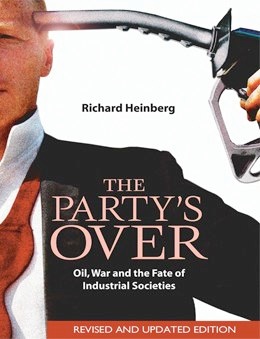
This year marks the tenth anniversary of the publication of my book The Party’s Over: Oil, War and the Fate of Industrial Societies, which has seen two editions and many printings, translations into eight languages, and sales of roughly 50,000 copies in North America. The end of The Party’s Over’s first decade coincides with a widespread re-evaluation of what has come to be known as peak oil theory (which the book helped popularize). So it’s a good time to take stock of both. The following is part memoir, part re-assessment, and part reflection.
Memoir: What a Party It Was
Prior to the publication of The Party’s Over I was a writer on environmental topics and a teacher in an innovative college program on “Culture, Ecology, and Sustainable Community.” In 1998, I happened to read an article in Scientific American titled “The End of Cheap Oil?” by two veteran petroleum geologists, Colin Campbell and Jean Laherrère. At that time, oil was trading for roughly $10 a barrel—about the cheapest it has ever been in real terms. The article made the case that “When the world runs completely out of oil is . . . not directly relevant; what matters is when production begins to taper off.” The commencement of that tapering, the authors said, could happen disturbingly soon: “Using several different techniques to estimate the current reserves of conventional oil and the amount still left to be discovered, we conclude that the decline will begin before 2010.” History had already shown (in the 1970s) that a significant constraint to the availability of oil could have dramatic and widespread economic, financial, and political repercussions.
Around the same time, I began receiving an occasional series of emailed essays titled “Brain Food” by a retired software engineer named Jay Hanson, which discussed energy’s importance in world events. I also joined an email list called EnergyResources. Hanson and others were discussing books like William Catton’s Overshoot and Walter Youngquist’s GeoDestinies, which I quickly devoured. As I began to recognize the central role of energy in human society, big questions I’d had about economic history—especially ones concerning the origins and significance of the industrial revolution—began to find answers. Further, “The End of Cheap Oil” led to the realization that, because humanity was on the cusp of a decline in available, cheap transport fuel, a contraction in trade and economic activity in general was fairly inevitable.
I waited for someone to write the peak oil book that would tell the story of energy, portray the politics and economics of petroleum, and lay out the world’s prospects in the coming post-peak era. Surely a petroleum geologist or energy expert would step up to the plate. But none did (with the exception of Kenneth Deffeyes, whose 2001 book Hubbert’s Peak was not quite what I had envisioned). After a couple of years, I started researching the subject in earnest and put together a book proposal, which I sent to Chris and Judith Plant at New Society Publishers. They replied favorably. New Society would go on to become the foremost publisher of non-technical books in the peak oil genre, with titles by John Michael Greer, Dmitry Orlov, Sharon Astyk, and others.
The publication timing of The Party’s Over proved to be pivotal: it came out in the same year the US invaded Iraq. In the spring of 2003, millions of Americans thronged streets in dozens of cities to protest the Bush-Cheney administration’s stupid, horrific, and illegal war. Since Iraq had large, relatively untapped oil reserves, there was widespread speculation that the invasion was an exercise in trading “blood for oil.” My book offered some support for this line of thought, and so most of my early speaking invitations came from anti-war groups. All I had to do was remind audiences of Dick Cheney’s words in a 1999 speech to the London Institute of Petroleum: “Producing oil is obviously a self-depleting activity. Every year you’ve got to find and develop reserves equal to your output just to stand still, just to stay even. . . . By some estimates there will be an average of two per cent annual growth in global oil demand over the years ahead along with conservatively a three per cent natural decline in production from existing reserves. That means by 2010 we will need on the order of an additional fifty million barrels a day. So where is the oil going to come from? . . . [T]he Middle East, with two-thirds of the world’s oil and the lowest cost, is still where the prize ultimately lies.”
In late 2003, I received a speaking invitation from Julian Darley and Celine Rich in Vancouver, Canada. They were in the process of organizing a local peak oil conference, and had just started a new non-profit organization called Post Carbon Institute. They soon invited me to become a board member (and later, Senior Fellow).
The next year saw the first of several “Peak Oil and Community Solutions” conferences in Yellow Springs, Ohio (the second one was reported on at length in Harper’s). In 2004 I also attended the Association for the Study of Peak Oil (ASPO) international conference in Berlin, where I met Campbell and Laherrère, Matt Simmons, and other oil experts.
The year 2005 saw speaking tours in South Africa and Britain, along with dozens more appearances in the US. Especially memorable was a conference in Kinsale, Ireland organized by Rob Hopkins—who immediately impressed me as someone capable of doing great things (he started the Transition Towns initiative just a year later). That summer New York Times Magazine published a long profile article about Bill Clinton, mentioning that The Party’s Over was on his current reading list and that he had underlined many passages and scribbled comments throughout. Also that year, James Howard Kunstler published The Long Emergency, which introduced an even wider audience to the dilemma of oil depletion.
By 2006 it was possible to speak of a peak oil “movement”: Totnes in the UK had become the world’s first Transition Town; both ASPO International and ASPO USA were holding annual conferences to highlight relevant technical issues; the Arthur Morgan Institute for Community Solutions was hosting annual peak oil gatherings in Ohio for the activist crowd; several peak oil websites, including TheOilDrum.com and EnergyBulletin.net, reported brisk traffic; the list of peak oil books and peer-reviewed papers was lengthening; and a growing roster of public speakers was lecturing on the dim prospects of the oil industry and the dimmer prospects of the world’s oil-dependent economies.
My personal career morphed in tandem: I moved from teaching to a full-time position with Post Carbon Institute. When I wasn’t on the road speaking, I was writing more books—Powerdown (2004), The Oil Depletion Protocol (2006), Peak Everything (2007), Blackout (2009), The End of Growth (2011), and Snake Oil (2013)—as well as blogs, articles, essays, reports, and forewords to, or endorsements of, other authors’ books.
Post Carbon Institute meanwhile recruited 28 fellows; compiled a Post Carbon Reader that is now used in college curricula around the nation; published other books (including Energy: Overdevelopment and the Delusion of Endless Growth, and the Community Resilience Guide series); produced award-winning video animations; and commissioned several important papers and reports, including David Hughes’s “Drill Baby, Drill.”
A thrilling decade it was. And here we are now . . . with press articles appearing almost daily featuring some variation of the title, “Peak Oil Is Dead.” What the hell happened?
Re-Assessment: Was (or Is) the Party Really Over?
The central claim of many recent “Peak Oil Is Dead” articles is that peak oil theorists were simply wrong. Were we? Well, let’s use The Party’s Over as a representative example of peak oil literature and see. I re-read the book (for the first time in several years) as preparation for writing this essay, and the following are a few critical notes.
Chapters 1 and 2, which tell the tale of energy’s role in ecology, history, and the economy, are the book’s foundation. Leaving aside the question of how skillfully it’s presented, it still impresses me as a story that deserves to be known and understood by everybody. There’s very little that needs revision here.
Chapter 3, which explains peak oil, is pivotal to the book’s overall argument. By current standards, much of this material is simplistic and dated. I fixed some problems in the revised 2005 edition, but that version itself is now stale. The Party’s Over doesn’t offer an original analysis of oil reserves or production data; instead it surveys the forecasts of “peakists” who were active at the time, many of whom are now less active or deceased.
The most obvious criticism that could be leveled at the book today is the simple observation that, as of 2013, world oil production is increasing, not declining. However, the following passage from page 118 of the 2003 edition points to just how accurate the leading peakists were in forecasting trends: “Colin Campbell estimates that extraction of conventional oil will peak before 2010; however, because more unconventional oil—including oil sands, heavy oil, and oil shale—will be produced during the coming decade, the total production of fossil-fuel liquids (conventional plus unconventional) will peak several years later. According to Jean Laherrère, that may happen as late as 2015.” On page 121 of the book I explicitly endorsed the forecast of a peak sometime in the period between 2006 and 2015.
From today’s perspective that’s still an entirely defensible assessment of global oil supply prospects. Worldwide production of regular, conventional oil (excluding deepwater oil, tar sands, tight oil, biofuels, and natural gas liquids such as propane) did indeed begin a gentle, continuing decline around 2006, and a peak for all petroleum liquids by 2015 is still likely though by no means certain. True, no peak oil theorist in 2003 was forecasting that US petroleum production would soar during the 2011-2013 period due to the hydraulic fracturing and horizontal drilling of tight (low-porosity, low-permeability) oil-bearing rock formations in North Dakota and Texas. But tight oil and tar sands are substantially different from the conventional resources that drillers targeted in previous decades: the former offer a low energy return on the energy invested in production (EROEI), require high rates of up-front investment, and imply increased environmental costs and risks. Tight oil wells show such steep production decline rates that a peak and sharp drop in output from the Bakken and Eagle Ford plays—which have driven the recent boom in US production—is probable in just the next few years. Meanwhile, the ongoing erosion of global extraction rates of regular, conventional crude means that an ever-larger proportion of total supplies must come from unconventional sources. Conventional oil, with its high EROEI and low production cost, fueled unprecedented levels of economic growth during the 20th century. That party is indeed over.
On page 117, I summarized Colin Campbell’s view that “the next decade will be a ‘plateau’ period, in which recurring economic recessions will result in lowered energy demand, which will in turn temporarily mask the underlying depletion trend.” That forecast appears to have been spot on. Meanwhile, Daniel Yergin (of Cambridge Energy Research Associates) and other petroleum industry-friendly energy commentators now tell us that peak oil is nothing to worry about because, instead of a peaking of crude supply, we are instead seeing peak demand, as consumption of oil in the US, Europe, and Japan has fallen. Why? Yergin and company cite improvements in vehicle fuel efficiency, but in reality most of the reduction in oil consumption in the older industrial countries has come about simply because fuel prices are so high that people are driving less: they can’t afford to fill the tank as often. And prices are high because the only new sources of oil available to the industry are ones that are very expensive to develop. Analysts critical of peak oil failed to predict that petroleum prices would skyrocket to such an extent; indeed, during the past decade Daniel Yergin himself repeatedly (and wrongly) forecast falling oil prices [chart]. “Peak oil demand” appears merely to be a rhetorical device that admits the reality of peak oil implicitly while denying it explicitly. Meanwhile a comparison of forecasts by the peakists and their critics shows the former were generally far more successful in modeling oil production and price trends.
The critics say peakists (like me) neglect basic economics: as oil prices go up, that makes more supply available. This is correct up to a point; again, no peak oiler I know specifically foresaw the scale of the current US tight oil boom. However, Campbell and Laherrère did clearly forecast that higher prices would promote the development of unconventional petroleum sources (that’s why Laherrère pegged the peak of “all liquids” several years later than the peak for regular crude). On the other hand, the peak oil critics themselves showed a lack of understanding of economic reality by ignoring the feedback between oil prices and the economy as a whole. Energy is what moves the economy; money is just a means of keeping track of wealth. Economics 101 tells us that supply of, and demand for a commodity like oil (which happens to be our primary energy source) must converge at the current market price, but no economist can guarantee that the price will be affordable to society. High oil prices are sand in the gears of the economy. As the oil industry is forced to spend ever more to access ever-lower-quality resources, the result is a general trend toward economic stagnation. None of the peak oil deniers warned us about this.
The petroleum industry has undergone a profound shift in the past decade. Levels of investment in exploration and production have doubled, rates of drilling have likewise doubled, but output has risen only modestly—and all of the increase has come from costly, problematic, unconventional sources. The world’s ten largest publicly traded oil companies have collectively seen their production decline by more than 25 percent. And the industry has taken on far more debt: this is especially true for the smaller companies that specialize in producing tight oil. This industry transformation was completely unforeseen by the peak oil critics, but it is exactly what should have been anticipated by anyone who carefully read “The End of Cheap Oil” in 1998, or The Party’s Over in 2003.
So much for Chapter 3. The following chapter discusses non-petroleum sources of energy, highlighting their various drawbacks and strengths. The section on natural gas requires substantial revision in light of the recent boom in US shale gas production (which I examine in my latest book, Snake Oil: How Fracking’s False Promise of Plenty Imperils Our Future); otherwise, aside from the need for a general updating, there’s little cause here for author embarrassment ten years hence.
Chapter 5, “A Banquet of Consequences,” discusses the likely societal impact of peak oil. While some of the more alarmist peak oil authors who were blogging during the years 2005 to 2010 suggested (or seemed to suggest) that society would effectively collapse before decade’s end, The Party’s Over paints a picture of developments likely to transpire over a longer period, from now until about 2050. A decline in available, cheap oil will impact the financial economy, agriculture, and transportation. We’ve already seen some problems along these lines as a result of oil prices at over $100 per barrel; more are on the way. There’s not a lot here that needs revision ten years after the book’s publication.
The final chapter, “Managing the Collapse,” offers suggestions for what individuals, communities, and society as a whole might do to answer the challenge of peak oil and to adapt to having less energy overall. If I were writing or re-writing this material today, I would point to recent efforts to prepare for the peak such as those organized by the Transition Initiatives or by the city-sponsored Peak Oil Task Forces of Portland, Oakland, San Francisco, and Bloomington. And I would cite several more recent books that do part or all of what this chapter attempted, but succeed more fully, elegantly, and entertainingly—such as Rob Hopkins’s Transition Handbook and Albert Bates’s Post-Petroleum Survival Guide and Cookbook.
One possible criticism of the book: while it briefly discusses climate change, it does so at insufficient length. This issue now dominates just about all energy policy discussions and it deserved a more thorough treatment.
Altogether, nevertheless, The Party’s Over fares pretty decently upon today’s re-reading—even if I do say so myself!
Reflection: Lessons from the Peak Oil Decade
What has been achieved in ten years by efforts to warn the world about peak oil? The book authors and bloggers who turned the subject of oil depletion into a cottage industry inspired hundreds of thousands—perhaps millions—of individuals worldwide to change their thinking, patterns of consumption, and expectations about the future. Some who read about peak oil changed careers or fields of study at university.
We peakists also changed the energy conversation: peak oil has become a recognized term and concept. In a way, the current “Peak Oil Is Dead” campaign is a testament to our success: the petroleum industry’s public relations arm has been forced to expend resources putting out a fire that hardly amounted to a spark a decade ago. As a result of that campaign, even more people have heard of peak oil than before—though most probably have a highly erroneous impression of it.
Peak oil bashing is not entirely the province of the industry: a very few leftist writers have argued that peakism is a conspiracy covertly organized by the petroleum industry itself to talk up prices (and profits) through invoking a false anticipation of scarcity. In my years researching the topic, and in my many interactions with oil geologists, engineers, and company representatives, I have seen no evidence to support this view. Instead I’ve heard industry spokespeople use every possible rhetorical trick to draw attention away from the process and consequences of oil depletion. Peakists within the industry are usually technical staff (geologists or engineers, not economists or PR professionals) and are only free to speak out on the subject once they’ve retired. The industry has two big reasons to hate peak oil. First, company stock prices are tied to the value of booked oil reserves; if the public (and government regulators) were to become convinced that those reserves are problematic, the companies’ ability to raise money would be seriously compromised—and oil companies need to raise lots of money these days to find and produce ever-lower-quality resources. It’s thus in the interest of companies to maintain an impression of (at least potential) abundance. Second, the industry doesn’t want society to mount a serious effort to reduce its dependence on petroleum. People who take peak oil seriously are understandably nervous about petroleum dependency and look for a way out. The oil industry wants more highways, not more streetcars and bicycles; more pipelines, not more “passive houses.”
Resistance to the idea of peak oil has also come from mainstream economists. That’s because (as The Party’s Over explained on pages 169-172) peak oil effectively means the end of economic growth as we knew it during the 20th century. Growth is sacred to most economists: even credentialed insiders (economists like Jeff Rubin or investment fund managers like Jeremy Grantham) who question growth get pilloried by the priesthood. Politicians and businessmen love growth and hate anything that might call into question our ability to maintain it from here to eternity. For this reason alone, peak oil theory was destined for a public thrashing regardless of its accuracy.
Some within the peakist movement now say the term “peak oil” has outlived its usefulness, and it is time to find new ways to name and frame the issues of resource depletion and energy scarcity. Others say we’ve invested years of effort in popularizing the term and we’re irrevocably identified with it anyway, so we simply have to do what we can to rehabilitate it. Either way, most peakists are pretty dispirited these days.
Our public relations failure pales in comparison to our inability to achieve our real goal—which was to convince society to prepare for the end of the brief age of cheap, abundant energy. While individuals, a few organizations, and a handful of communities have indeed responded, the numbers are relatively small. National governments have done almost nothing. The best broad-scale policy would have been an international agreement to reduce production and consumption of oil in tandem (this idea was mooted as a proposal known as the Uppsala Protocol, the Rimini Protocol, or The Oil Depletion Protocol). But aside from resolutions of support from the Portuguese Parliament and city councils of Portland, Oakland, and San Francisco, there has been no real governmental interest in such an agreement.
What have I learned from the past decade? That it’s hard to change the direction of society, but—given what’s at stake—that it’s worth trying. Knowing what I knew in 2003, I could not have lived with myself during the past ten years had I not at least attempted to alert the general populace and to change the thinking of policy makers.
It’s impossible to foresee how far ripples will spread from the efforts undertaken to raise awareness about our precarious energy ecology. Even though society is still headed toward a wrenching collision with resource limits, educated and aware people have begun to build model low-energy alternative food, transport, and building systems that can support organized human life during the transition to a post-fossil-fuel future. How much more can be done in the time we still have? Let’s find out.
For a book, it’s the end of a decade. But it’s not the end of the story.
11 Comments on "Heinberg: Ten Years After"
LT on Wed, 18th Sep 2013 5:48 am
Although apple, orange, banana,…, all are fruits, they are not the same. And if one wants to do some honest analysis or statistic, one should put each type of fruit in a separate chart or graph in order to show how much of each type one got.
Similarly, light oil, heavy oil, kerosene, shale oil, tar-sand are not the same, although they are all collectively called fossil fuels.
Honest analysis/statistics dictates that each type of these fuels should have its own chart or graph so that it can give clearer picture for everyone.
I still hold peak oil occurred in 2005 +/- 5%.
actioncjackson on Wed, 18th Sep 2013 2:13 pm
Peakists should not feel dispirited, they are correct and the truth residing in their arguments has opened mental doors for me and understanding I never thought possible. Sure, this world is hell thanks to the cunted cunts that specifically engineered it this way, but at least I got to perceive it and them for what they are thanks in large part to peakists.
Don’t be discouraged that in all likelihood no significant changes will be made, growth and profits will remain dominate ideals, and they have all the money anyways so there’s nothing that can be really done short of pulling them out of their homes and torturing the murdering cunts in the worst ways possible until death and then destroying fiat currency.
Peaceful protest won’t accomplish anything unless the protesters are growing their own food and not using the system at all, and even then they could end that. This is again because the money and power has already been made, they’ll keep the public poor until the end of time. Demanding more money is self defeating, they are the money and that’s their game.
No, there will have to be energy collapse, complete and permanent, and when that happens I have serious doubts that the people will be able to govern themselves and instead mayhem is my prediction, there are so many people with so much anger, and when that is mixed with empty bellies…
robbo on Wed, 18th Sep 2013 3:30 pm
i jacked off over peak oil last night
bobinget on Wed, 18th Sep 2013 3:31 pm
Agreeing with LT with only a minor scold for leaving out natural gas. NG, because of its AFFORDABILITY may be the single most important element instrumental in helping America cope with depression.
Not only providing employment for at least a million white and Blue Collar workers but inspiring Big Chemical and Fertilizer to repatriate factories.
Sasol and Shell are busy building GTL refineries (here) to make diesel and lubricating oils. DuPont and other chemical companies will be hiring tens of thousands.
Hienberg smirks here that he predicted ‘fracking’ would be controversial but ignores, as he must be aware, most experimental technologies have major hick-ups. After 100 years, Passenger aircraft still make more safe take-offs then landings. Nuff said.
LT on Wed, 18th Sep 2013 3:36 pm
“there will have to be energy collapse, complete and permanent, and when that happens I have serious doubts that the people will be able to govern themselves and instead mayhem is my prediction, there are so many people with so much anger, and when that is mixed with empty bellies…”
>>Good comment, especially the last paragraph as shown above.
Kenz300 on Wed, 18th Sep 2013 4:12 pm
10 ways to get ready for the end of oil | SmartPlanet
http://www.smartplanet.com/blog/take/10-ways-to-get-ready-for-the-end-of-oil/1189?tag=nl.e660&s_cid=e660&ttag=e660&ftag=TRE4eb29b5
rollin on Wed, 18th Sep 2013 4:47 pm
Heinberg is such a positive and perceptive man. He does see problems and tries persistently to warn others about them and show them ways to cope.
Still he misses the core of the problem, the basic view and perception of humans. What needs to be changed is the view and perception of the world and our self-view. Until that is done, very little will actually be accomplished.
Of course a collapse would change the outlook of many, but the object should be descent not collapse.
MrColdWaterOfRealityMan on Wed, 18th Sep 2013 6:25 pm
I suppose I came late to the party. I’ve maintained for years that we don’t have an oil supply problem as much as we have an *energy* problem and a price problem.
We’re not extracting oil, coal or gas; we’re extracting *net energy.* Worldwide, hydrocarbon net energy is decreasing.
Net energy comes with a price tag. Oil in 1998 was $10 a barrel. 13 years later, it’s over $100 a barrel. Prices are increasing.
We use all this net energy to maintain an interdependent supply chain web that delivers goods and services. This web depends on *cheap* transportation energy, made possible almost exclusively with petroleum fuels, making petroleum fuels a special, “critical path” form of energy.
As net energy decreases and prices increase, the supply chain starts breaking down as it becomes unprofitable to manufacture or ship critical products. All commodities get scarcer and more expensive. Effectively, we all get poorer, but here’s the kicker…
Higher energy prices increase the cost of everything, INCLUDING THE PRODUCTION OF ENERGY ITSELF. At this point energy price feedback starts, and prices don’t just rise. They *spike* and fall after they collapse the economy, and spike again as the economy recovers, until reaching a permanently high plateau. $3000 a barrel of oil, anyone?
At that point, we’re done with oil as a major player in the energy game. Natural gas buys us some time. Conservation too. But sometime before 2050 or so, it’ll be time to pay the piper.
We have a chance. Thorium nuclear and better battery storage could yet keep industrial civilization running without a large die-off, but I’m guessing the elites of the world don’t actually want to prevent this. Population control solves so many of their problems.
Jerry McManus on Wed, 18th Sep 2013 9:57 pm
Civilizations collapse when they burn through their available natural capital.
The historical record shows that even relatively advanced civilizations are unable to avoid this fate due to the insidious nature of the “progress trap”, a concept described with alacrity in the book “A Short History of Progress”.
Unfortunately, one of the first things to fly out the window in that situation is social capital, at which point the most likely outcome is a catastrophic convergence of poverty and violence.
Something that can be seen today in the countries currently being devastated by climate change disasters, as documented in the book “Tropic of Chaos”.
Resource depletion is just one aspect of the multiple converging catastrophes that is the global ecological overshoot of the human race.
Collapse will follow as surely as night follows day.
GregT on Wed, 18th Sep 2013 10:28 pm
Welcome to the party Mrcoldwater.
The elites of this world do not want a die off, at least not yet. They want to keep the game going for as long as they can. The more of us to fleece, the better. If they truly wanted to ‘cull’ the population, all they would need to do is to shut down all oil production tomorrow. I am sure that a few nukes would pretty much take care of that.
Overpopulation is the 10 ton elephant in the room. It is overpopulation and it’s associated problems of resource depletion, biosphere destruction, species extinction, ozone depletion, ocean acidification, Arctic sea ice loss, climate change, desertification, etc., that is destroying the only planet that we will ever have to live on. Many of these trends are irreversible, at least in a timescale that will do our species any good.
It is excess energy, and our associated technologies that has caused overpopulation. It is modern industrial society that must end, if we hope to have a future on this planet.
We are already paying the piper. Economic contraction and climate change have already begun, and both will continue to get worse for decades. Economic collapse has bad implications for our future, runaway climate change has the potential to end our future, forever.
The longer we keep doing to the Earth what we currently are, the less of a chance there will be for human survival, and we may very well have already gone too far.
We need to stop this insanity now, or we really will pay the piper the ultimate price.
BillT on Thu, 19th Sep 2013 1:27 am
The race is on. What will bring down the human race first:
1. Climate Change
2. Financial collapse
3. Energy/food scarcity
4. Nuclear war.
My take at the present time? Financial collapse, followed by a nuclear war and extreme climate the end game.
We can have a nuclear war where some humans survive, but they will then pay with a long nuclear winter and maybe even an ice age if we tilt the scales far enough. I have no optimism that the race can change in time to make a difference. Exciting times!
As for the 1/100%, their future is tied to ours and I think they are beginning to see that fact but cannot change either.