
Peak Oil is You
Donate Bitcoins ;-) or Paypal :-)


Page added on December 19, 2013

Crash on Demand: David Holmgren updates his Future Scenarios
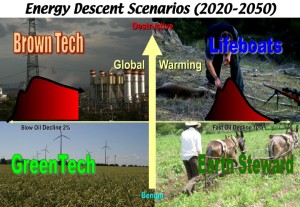
 David Holmgren, co-originator of the Permaculture concept, published Future Scenarios in 2007, originally as a website, and then published by Chelsea Green in 2008 as a small book (126 pages). He explores four possible human futures as the two great crises of Peak Oil and Climate Change converge into what he has coined our energy descent future. In my view, this is essential reading. Adam Grubb, founder of Energy Bulletin, characterized it like this:
These aren’t two-dimensional nightmarish scenarios designed to scare people into environmental action. They are compellingly fleshed-out visions of quite plausible alternative futures, which delve into energy, politics, agriculture, social, and even spiritual trends. What they do help make clear are the best strategies for preparing for and adapting to these possible futures.
Three years later, in 2010, Holmgren contributed an additional important essay, Money Vs. Fossil Energy: The Battle for Control of the World. Holmgren describes this essay as “a framework for understanding the ideological roots of the current global crisis that I believe is more useful than the now tired Left Right political spectrum.” Like all of his work, it is based on a profound energetic literacy, and is quite startling and original, and “challenges much of the strategic logic behind current mainstream climate change activism.”
A year ago, in a December 2012 interview, Holmgren was asked:
What do you see as the biggest challenges in our struggle to control our resources today?
His Answer:
After a lifetime of focusing on the biological basis for existence, and then the energetic basis, I’ve now become more and more interested in money, ironically, after ignoring it for most of my life. On the downside of the energy peak, it’s actually the bubble economies that can unravel so fast, that become almost the most important thing in shaping the immediate future. That bubble economy is, of course, actually falling apart right now. So a lot of the mainstream sustainability strategies assume we have a growing and steady economy. Permaculture works from the basis that we can adapt and do these adaptions in an ad-hoc way from the bottom up, and we’ve been doing that essentially for 30 years without the support of government and corporations. I’m not saying that we’ve got all the answers, but there’s a lot of people out there who are modeling and have been modeling how creative responses are going to happen.

David Holmgren
The 2013 Update
And now a year later, as 2013 draws to a close, David Holmgren has published a new essay (a 24 page pdf download), which is an update of Future Scenarios, builds on Money Vs. Fossil Fuels, and expands his new focus on money and economy. The essay is titled Crash on Demand: Welcome to the Brown Tech Future.

Six years on, of the four scenarios outlined in Future Scenarios, Holmgren is seeing the Brown Tech scenario as the one currently in play, where the decline of fossil fuels unfolds slowly, “but the severity of global warming symptoms is at the extreme end of current mainstream scientific predictions.” The political system is Corporatist, and emphasis is placed on replacing declining conventional fossil fuels with lower grade fossil fuels, which are both more expensive and also release more GGE (Greenhouse Gas Emissions), which exacerbates Climate Change even further. The introduction to this essay states:
David’s argument is essentially that radical, but achievable, behaviour change from dependent consumers to responsible self-reliant producers (by some relatively small minority of the global middle class) has a chance of stopping the juggernaut of consumer capitalism from driving the world over the climate change cliff. It maybe a slim chance, but a better bet than current herculean efforts to get the elites to pull the right policy levers; whether by sweet promises of green tech profits or alternatively threats from mass movements shouting for less consumption.

In the extensive discussions about money and economy, the influence of systems analyst Nicole Foss (Stoneleigh -The Automatic Earth) and economist Steve Keen (Debt Deflation) are strong and freely acknowledged. Holmgren believes that deflationary economics is the most powerful factor shaping our immediate future.
The basic recommendation (as noted in the quote above) is not much different from what David Holmgren has been recommending for 30 years: to engage in a shift away from being a dependent c0nsumer, and toward being a responsible self-reliant producer for your household and community, and to shift a significant portion of assets out of the mainstream economy and move them into building household and community resilience. These actions not only put us in a more secure position, they also, if engaged by perhaps 10% of the population of affluent countries, might be just enough to shift our economies out of the perpetual growth paradigm we’ve been inhabiting since at least the industrial revolution, and is now only hanging on via a rising debt bubble. The collapse of the current bubble economy will be painful. However, given that current growth is only being made possible by rising debt, we are not doing ourselves any favors by perpetuating it. As he had previously pointed out in Future Scenarios:
…without radical behavioral and organizational change that would threaten the foundations of our growth economy, greenhouse gas emissions along with other environmental impacts will not decline. Economic recession is the only proven mechanism for a rapid reduction of greenhouse gas emissions and may now be the only real hope for maintaining the earth in a habitable state.
Holmgren makes the case that while it may be too late for the Green Tech scenario to materialize, it may still be possible to avoid the worst effects of the Brown Tech scenario (a 4 to 6 degree “Climate Cooker” Lifeboats scenario). A severe global economic collapse could switch off enough GGE to begin reversing climate change, so that the Earth Steward scenario of bioregional economies based on frugal rural agrarian living, assisted by resources salvaged from the collapsed global economy and the defunct national governments, might emerge in the long term future.
It’s not a picture of a bright and shiny future, granted. The last 10 pages or so, however, I found to be quite stimulating, and opened up more possibilities for positive engagement. Topics discussed are Nested Scenarios (different scenarios co-existing at different scales); Investment and Divestment; Formal and Informal Economies; Alternative and Non-monetary Economies; Labor and Skill Vs Fossil Fuel and Technology; Brown Tech Possibilities; Actors at the Fringe; and Not Financial Terrorists (but Terra-ists with hands in the soil). There are also many great footnotes/links worth following up on.
This is a highly recommended essay – essential reading for those trying to make sense of our long term future and how we can best make a positive difference.
Related, on Integral Permaculture:
Lessons from the Ages, Part 1
Lessons from the Ages, Part 2
Other Related Articles
Conversation with David Holmgren (a 15 minute radio interview, where Holmgren is forced to give concise answers to key question)
Retrofitting the Suburbs for a Resilient Future (Excellent David Holmgren video presentation of his famously practical vision for the future of suburbia)
Powerdown: Let’s Talk About It (popular recent post by Joanne Poyourow of Transition US)
Downloading Responsibility (Extraenvironmentalist interview with Nicole Foss and Laurence Boomert)
Climate After Growth: Why Environmentalists Must Embrace Post-Growth Economics and Community Resilience (Rob Hopkins and Asher Miller appeal to environmental activists, urging to let go of the growth paradigm)
7 Comments on "Crash on Demand: David Holmgren updates his Future Scenarios"
Davy, Hermann, MO on Thu, 19th Dec 2013 11:28 am
Korowics said it best in his landmark “Tipping Point
Near-Term Systemic Implications of a Peak in Global Oil Production
An Outline Review” “We are at the cusp of rapid and severely disruptive changes. From now on the risk of entering a collapse must be considered significant and rising. The challenge is not about how we introduce energy infrastructure to maintain the viability of the systems we depend upon, rather it is how we deal with the consequences of not having the energy and other resources to maintain those same systems. Appeals towards localism, transition initiatives, organic food and renewable energy production, however laudable and necessary, are totally out of scale to what is approaching.
There is no solution, though there are some paths that are better and wiser than others. This is a societal issue, there is no „other‟ to blame, but the responsibility belongs to us all. What we require is rapid emergency planning coupled with a plan for longer-term adaptation.”
Makati1 on Thu, 19th Dec 2013 12:07 pm
No mention of the 3 letter word … war.
If you really believe that we can get through the next 10 years without a new world war, you are whistling in the dark. What is left will be what we have to work with, if anything.
risa bear on Thu, 19th Dec 2013 2:24 pm
And any new world war will surely target spent fuel pools. Then what?
J-Gav on Thu, 19th Dec 2013 2:32 pm
I’ve always liked Holmgren for two reasons: 1 – he is totally aware of how dire our situation is (though it did take him some time to bring the economic aspect into the mix), giving local movements only a “slim chance” of success.
2 – Nevertheless, rather than just throw his hands up in the air, he’s constantly on the look-out for ways to improve those chances, knowing full well it’s for a limited number of people, as a majority will continue to wait for ‘solutions’ to come drifting down from on high.
Makati – I hope you’re wrong but my gut feeling tells me you aren’t. Neither the Middle East nor Asia-Pacific are looking particularly stable at the moment, are they? And war is something governments often do after they mess things up so badly they fear a social explosion. Better to get people focused on an external enemy.
As for Holmgren’s failure to talk about war here (and even in the 24-page version via the link, there’s only one brief mention of the connection between money, energy and conflict), I guess he figures he has enough on his plate without bringing geopolitics into it. He might just be honest enough to admit he lacks competence in that area, or maybe what he fears most is getting entangled and losing precious time in something he considers peripheral to his core action. It’s a question I’d like to ask him.
J-Gav on Thu, 19th Dec 2013 2:34 pm
Risa Bear -If that happens, all bets are off, for Permaculture and everything else.
GregT on Thu, 19th Dec 2013 2:38 pm
“There is no solution, though there are some paths that are better and wiser than others.”
Correct, and the path that we are on, is not one of the wiser or better ones. The longer we continue down our current path, the harsher the consequences will be. The time for ’emergency planning’ has already run out, for the vast majority of us. If we don’t wise up, it will run out for all of us.
bob tatnell on Thu, 19th Dec 2013 8:51 pm
Which ever way you try to figure it out, more hands in the soil (John Seed’s ‘terra-ists’)is the essential ingredient. By itself and to some extent it keeps you off the streets, out of the shops and airports and is described well in what David says here:
“investment is not just of money, but our time skills and assets. Often it is these non-monetary assets that can be most effectively put to good work, while our finances are tied up in systems that are causing the very problems we wish to avoid.”