Communities that abide: Finland
[This week we continue the series with an article on Finland, by Eerik Wissenz. Few people know that before Russia came to exist as a country, and for many centuries after, communities of Finns were widely distributed over what is now Russian Federation territory, surviving mostly by hunting and fishing, and not making much of an impact. The Finnish way of relating to the land, which Eerik describes in this article, is nothing new: it is at least a thousand years old.
I have a strong personal connection to Finland, having grown up in Karelia, on Finnish territory which came to be annexed by the USSR during the winter of 1939-40. Due to a disasterous misreading of the operetta-like Finnish politics of the period, in which self-styled “communists” and “socialists” battled self-styled “fascists” over numerous pints of beer, Stalin had become frightened by the possibility that the real Fascists (i.e., German Nazi) troops would use Finnish territory to put themselves within artillery range of Leningrad (which they later did anyway). The war was a disaster for both sides.
Now, over 70 years later, peace reigns and a curious reversal has taken place. Every year, thousands of Russians stream across the border into Finland (a five-hour drive from St. Petersburg) and pay quite a lot of money to enjoy what Karelia once offered them for the price of a cheap railway ticket. Karelia has been fenced in, the remainder of it trashed, and the few resorts to which the public can still gain access are outrageously priced. The place where I grew up, called Kellomäki before the war and renamed Komarovo afterwards, used to consist of piny woods filled with clusters of cottages, many of them unfenced, and people walked diagonally across the woods on footpaths that snaked between the cottages rather than taking the long way along the streets. Now Komarovo is crisscrossed by tunnel-like paved streets that run between endless, featureless fences that one can’t see through or over. Walk beyond the walls and into the surrounding unfenced woods, and you will find them full of trash and construction debris. This is the new Russia: over the course of Western-inspired economic liberalization and privatization during the 1990s the Russian commons has been savaged. And the places that most resemble the one where I grew up are now across the border, in the supposedly “capitalist” Finland.
As Eerik is careful to point out, there is no “perfect”—there is only “better.” Finland offers us an object lesson on how to better manage and control our commons, should we still have any.]
In my last series of articles on the Travesty of the anti-commons I meant to resurrect in the mind of the Western reader the long-forgotten concept of the “public good,” a concept that has all but vanished from the intellectual landscape of today. To quickly summarize this prelude, the key victory of “private wants” over the good of society as a whole is tied up in the concept of private property. Key tenets are: 1. that a private property holder should be able to dispose of his private property even in ways that harm society; 2. that society has no right to demand that a private property owner contribute to the common good, whether through taxes or by engaging in honest good-faith discussions and compromises; and 3. that a public official has no moral obligation to act for the good of society beyond his bureaucratic incentives, the highest of which is to take over as much of the bureaucracy as possible for their career advancement and private enjoyment.
 |
|
Irja Hannosen polku
|
In this private-wants-come-first framework there is no room for the “public good,” and, unsurprisingly, nothing good ever happens for the public. The self-proclaimed “scientists” of economics may claim that when everyone is working for their private interest, this results in the greatest public good, but clearly they construct and peddle this fantasy in pursuit of their own private interests. This is how their ethical code is formulated, in a circular fashion, so there is no reason to believe their analysis to be honest. Honest discussion is difficult enough; engaging with dishonest interlocutors is a pure waste of time. Dmitry Orlov has been kind enough to provide a good analysis of this foolishness for the benefit of the honestly confused. Delusions aside, the real result of this moral framework is that all value is being extracted from society, monetized and moved offshore, where it will be kept safe from the dirty feeble hands of the poor once the system finally collapses.
My previous articles outlined a philosophical alternative to this strip-mining of society, which boils down to a single rhetorical question: Why would society defend an individual’s right to harm it? The answer is that there’s no reason for society to do so. Insofar as an individual asks society to enforce some notion of property on his behalf, the only coherent answer for society to make is that such assistance, assuming it is granted at all, is never without specific conditions designed to safeguard the public good, and, should such conditions prove ineffective, more conditions can be imposed, or the assistance withdrawn, at any time.
 |
| Karihiekka |
In his writings, Dmitry Orlov has explained what happens when a society does not place conditions on defending private notions of property, but instead elevates selfishness and greed to stand as its highest moral principles. This next series of articles explores a society that has chosen otherwise: Finland.
By every standard measure of success,
Finland is a success. In international rankings of countries across many categories it is consistently near the top, which is quite a feat for a small country near the Arctic Circle with a long history of foreign occupation and domination, with little fossil fuels. Now, whenever something, someone or some group is presented as a model to be learned from, it quickly turns out that it is far from perfect, and, sure enough, Finland is not without its faults. Certain people will choose to pounce on these faults in an attempt to discredit the entire argument. This, let us decide at the outset, is not going to be considered a valid move.
The best way of capturing what I mean is by quoting from a Finnish tourist guide I read when I moved to Finland. There is a chapter on the environmental history of Finland, which, after a brief description of all the environmental problems Finland faces, notes: “Apocalyptic as this may sound, one should remember that, in comparison with extremely polluted areas of Europe, Finland is a model of purity.” The same tourist guide tells us: “Finland’s problems are effectively those shared by industrial nations all over the world: air and water pollution, energy conservation, destruction of the natural landscape, endangered species and waste management.” So in explaining the positive things that exist in Finland I do not mean to say that these problems aren’t there, or that these problems aren’t essentially the same as elsewhere. The difference is in the attempt to solve these problems in a coherent way that serves the public good. Where there are successes, even if they are limited, qualified successes, I think that it is still worth reporting on them, so that others may consider whether similar things cannot be done in their own communities. Also, I don’t mean to say that such successes do not exist elsewhere. But I will largely ignore Finland’s failings, because the reader is probably already painfully familiar with this sort of depressing subject matter.
 |
| Kirkkokivet |
One way to think about this success is in terms of its effect on the speed with which the Finnish boat is sinking: significantly slower than elsewhere. When a boat is taking on water slowly, the crew has many more options on how to deal with the situation: they can just keep bailing, they can try to fix the boat while it is afloat, or they can reach land, careen it and patch the hull. So, yes, on the whole, Finnish society’s course is toward destruction, financial capture, loss of cohesion, general debauchery and environmental collapse. But its progress is slow enough that something can still be done about it, short of a total collapse and complete do-over.
For, indeed, Finland has received a lot of good press in recent years because it scores near the top in many “best in” lists. These lists are formed from various statistics. Due to its high performance across so many categories, from time to time articles appear that discuss these statistics, and try to establish, or, more often, to speculate what has incentivized Finnish students, citizens or bureaucrats to perform so well according to this or that metric. These articles generally cannot draw any useful conclusions, because the Finnish social system does not operate by trying to incentivize one group or another to achieve one metric or another. I believe it evolved in such a way as to value the pursuit of the common good by the population as a whole, but those who lack the concept of the common good would probably find my analysis as useless as I find theirs. The goal of the analyst is to find some point of policy to copy, but here they would have to copy an entire culture, one whose principles are fundamentally at odds with theirs. Finnish culture continuously debates the public good and the conclusions of this discussion are translated into political platforms, laws and administrative programs. The process is fairly slow and the average Finn might be only dimly aware of it, but when decisions made in the interest of the public good have been accumulating over many centuries, the result is that numerous good ideas come to be taken for granted and are no longer debated, making debates on new or still unresolved questions far more efficient. Examples include the concept of nature having intrinsic value and the equality of the sexes.
 |
|
Kirkonkylä-Kuortti luontopolku
|
Some of these good decisions were made possibly millennia ago and are enshrined in the structure of the Finnish language itself, which is the bedrock of Finnish culture. One of them was the evolution of a gender-neutral language: in Finnish, there is no way to distinguish “he” from “she”; the word hän refers generically to everyone. This has helped Finland to build one of the most gender-equal societies in the world, and one of the best in terms of outcomes for women. It turns out that gender equality allows fewer artificial privileges and offers fewer opportunities for creating “old boy networks” that maintain artificial privileges while undermining the public good. Another good evolutionary turn resulted in a grammar that lacks a future tense: the present and future are described the same way, leveling the distinction between being and intent. The English word “will” is a liar word which causes native English speakers to unconsciously accede to a future over which they have no control. Yet another evolutionary windfall resulted in a language that, of all the European languages, is perhaps the most organic, with most of its vocabulary, including much of the technical terminology, home-grown. It has few foreign loan-words, few grammatical irregularities and a purely phonetic orthography. This combination has allowed Finland to maintain a literacy rate of 100%. There is no such thing in Finland as functional illiteracy, since anyone who has learned the alphabet can go on to read and write the entire Finnish language. (In contrast, the functional illiteracy rate in the United States has been estimated at 40%.)
The most direct and also the most highly symbolic implementation of the logic of the public good is something that Finns call jokamiehenoikeus or “every person’s rights”. It is sometimes translated as “every man’s rights,” but this is incorrect, since Finnish has no gender-specific pronouns. There is no “she” or “he” but only hän, which is used in place of both. And even hän seems to be a modern invention; one friend of ours comes from Lapland and speaks a dialect where objects, animals and humans are all indicated with the same generic pronoun se. So what is “every hän‘s rights”? Very simply, the law of the land allows anyone to travel across, camp and pick berries on anyone else’s land. That is, all Finnish territory is Finnish society’s land. Finnish society has defended it all these years from both foreign and domestic encroachment, and has also organized and enforced an intricate system of private stewardship that attempts to safeguard it in perpetuity. In most other countries, intrinsic to the concept of private land ownership is the right to exclude others from its use and enjoyment, so strictly speaking Finland can be said to lack private land ownership. A better word to describe a tender to a piece of Finnish land that by law must remain accessible to the general public is stewardship. Quite reasonably, this law only governs open land; Finland does have private property, and actual dwellings are not covered by this law. Home owners can exclude others from their home, personal spaces adjacent to homes, but not their forests or fields they look after.
Under this law, some prerogatives are delegated to private individuals, who then act as stewards of a piece of land, generally exploiting some aspect of it for commercial gain. But such private title to a piece of land is not without society’s conditions. There is a host of environmental regulations designed to keep the land intact. The level of sustainability these regulations achieve is, as ever, debatable. But the point is that society has made it clear that new regulations can be made at any time, based on the advancement of scientific understanding and social values, for it is society that still owns the land, and any member of society can venture onto it, enjoy it and use it in non-competitive ways. These explicitly include hiking, camping and picking berries (I single out picking berries because it’s explicitly written into the law as a basic human right). There have been some legal cases to resolve various grey areas in the law, and these have consistently been settled in favor of the public, not the private land steward.
 |
|
Kissakosken luonto- ja kulttuuripolku
|
I wish there was a way to illustrate what this right of “trespassing,” as it would be called in many other countries, looks like in practice. But in Finland it’s nearly impossible to tell when you are on private land. Because of the law, no one bothers to put up fences around their land or mark boundaries. Quite the opposite: homeowners have to specifically put up barbecue grills and trash barrels that anyone who decides to stop by there can use. Is Finland a hiker’s, camper’s and backpacker’s paradise? Well, the subarctic summer is short, and the bugs are often relentless, but then, as I mentioned, nothing is ever perfect.
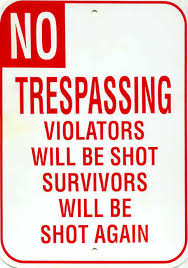
And what would happen if someone bothered to put up a sign such as the one at the top of this article? (
Quite an astoundingly large collection of these is available from Google image search!) Would there be a scandal, or an arrest, or a lawsuit, or a fine? Probably not; chances are, the person in question would be called using a certain choice foreign loan word, one of the few in the Finnish language:
idiootti. Because the actions of any one
idiootti, or even an organized group of them, would not be sufficient to create a system of private property. The decision would have to be society’s as a whole. And that’s simply not happening.
Club Orlov



Arthur on Tue, 29th Oct 2013 1:00 pm
“Stalin had become frightened by the possibility that the real Fascists (i.e., German Nazi) troops would use Finnish territory to put themselves within artillery range of Leningrad (which they later did anyway). The war was a disaster for both sides.”
BS. Finnish archives (‘Mannerheim files’) reveal that the Soviet attack on Finland was done in close cooperation with the Churchill ‘shadow government’ (behind PM Chamberlain’s back) and the French (plan dating from Jan 1940). The Germans intercepted the plans in Feb 1940 and informed the Finns (which is why Finland is the key to understand WW2, when the archives will open after Washington will ‘fold’). The idea was to encircle Germany under a pretext. The Soviets would invade Finland and the British/French would invade Norway… ‘to come to the aid of the Finns’, through Norway and Sweden. The French & British did indeed invade Norway, but the Germans knew what they were up to and invaded Norway on the very same day (a fact never mentioned/downplayed in the official version of history). After a month of combat, predictably 8000 Germans defeated 25000 British and French. The real aim of the British & French had been to cut off iron ore supply from Narvik and to connect with the Soviets and complete the encirclement of the Germans. The real reason why the Soviets withdrew surprisingly from Finland was because the Germans had threatened via diplomatic channels (after all they had a non-aggression agreement) to bomb them if they would not back off. From then on the Finns knew that the Germans were the only ones willing to protect the integrity of Finland and thus became allies of the Germans. The Finns knew all too well that the British and French were willing to hand over Finland to Stalin, as they later did with Poland and the rest of eastern Europe.
“In this private-wants-come-first framework there is no room for the “public good,” and, unsurprisingly, nothing good ever happens for the public. The self-proclaimed “scientists” of economics may claim that when everyone is working for their private interest, this results in the greatest public good, but clearly they construct and peddle this fantasy in pursuit of their own private interests.”
There is absolutely no guarantee that the state or corporations will manage natural reserves better than private parties will. The Canadian government for instance happily supports the destruction of the Canadian environment, in close cooperation with the corporations. Usually, protection of the environment comes from private grass root forces, if at all.
Ten years ago I took the ferry from Tallin/Estonia to Helsinki and drove all the way to the north cape, that Norwegian/Russian border. Finland is an empty, flat and little melancholic country, I like the route back via Norway better. In the north of Finland the roads were narrow and you had to be attentive and drive slowly to avoid run into a herd of elks.
““Apocalyptic as this may sound, one should remember that, in comparison with extremely polluted areas of Europe, Finland is a model of purity.””
That was indeed the impression I got. But Finland is blessed with merely 5.3m inhabitants on 337,000 km2, almost exactly the size of Germany with 82m people.
“Is Finland a hiker’s, camper’s and backpacker’s paradise? Well, the subarctic summer is short, and the bugs are often relentless, but then, as I mentioned, nothing is ever perfect.”
No it is not. I hated the bugs and even more the 24h sun above the arctic circle, making it very difficult to catch sleep.
solarity on Tue, 29th Oct 2013 2:43 pm
“The victory of ‘private wants’ over the good of society” is not an outcome of private property. It is caused by the ‘tyranny of the majority.’ A concept strongly embraced by the doofus potus: ‘we won the election, we make the rules…’ and the good of society be damned.
PrestonSturges on Tue, 29th Oct 2013 4:25 pm
“The idea was to encircle Germany under a pretext….”
You know what, here’s a whole archive of speeches by Joseph Goebbels, which is what you seem to be using as your source:
http://www.calvin.edu/academic/cas/gpa/goeb21.htm
Arthur on Tue, 29th Oct 2013 4:56 pm
Who needs Goebbels if you have the secret documents of ‘His Britannic Majesty’s Government’:
http://gerard45.bloggertje.nl/note/15367/geallieerden-schonden-in-1940-als-eersten.html
The allied archives are full with these covered up lies. But everybody with a IQ120+ and an internet connection can now reconstruct the truth about WW2 on his own account… and disperse the message. This is going to be fun.
Poor Preston, you think you can dine out for free just by pressing the usual PC buttons. Watch out Preston, you will be surprised about the number of Euro-Americans willing to lend an ear to alternative interpretations, now that the way the US is developing is no longer in their best interest.
In 2017 the British are obliged to open their WW2 archives, but Vladimir the Great probably will open his archives before that date, to pave the way for a German-Russian alliance, after China has ‘de-americanized’ (their words) the world. I mean, Russian client state Iran already denies the holocaust (not difficult to guess the source of their information) and than there is this shocking revelation:
haaretz . com / jewish-world/jewish-world-news/1.530857
Putin the stormfront-poster.lol
The great American prophet Samuel Huntington of the coming multi-polar world order wrote his last book with the title ‘Who Are We?: The Challenges to America’s National Identity’.
The question contained in this book title is going to be answered soon by the majority of Euro-Americans and the answer will be: ‘European’.
PrestonSturges on Tue, 29th Oct 2013 6:40 pm
“……The allied archives are full with these covered up lies. But everybody with a IQ120+ and an internet connection can now reconstruct the truth about WW2 on his own account… and disperse the message. This is going to be fun…..”
Yep there are whole archives of Nazi propaganda out there which are free to accept at face value so you too can be convinced Hitler was a great guy.
Arthur on Tue, 29th Oct 2013 7:05 pm
I was talking about the British, American, French and Russian archives, bro. Like the link I presented to you. Possibly escaped your attention. And Haaretz, Nazi propaganda? LOL. You do realize that Haaretz is the largest Israeli newspaper, do you? But let me guess, you watched Schindlers List and visited the Holocaust museum in your village and now you are an expert in history, right?
PrestonSturges on Wed, 30th Oct 2013 3:44 am
By all means keep posting your Hitler fan-boy bullshit so that I can point other people to your comments and they can laugh at you.
Arthur on Wed, 30th Oct 2013 9:05 am
If you insist… the greatest madman ever lived:
http://i.dailymail.co.uk/i/pix/2013/10/28/article-0-009B464E00000259-453_634x805.jpg
This story was offered to you for free by the notoriously noble mass raping Soviets, city nuking Americans and testicle kicking British, who happened to defeat him. That story had it’s day and I already know who is going to have the last laugh.
Roman on Thu, 31st Oct 2013 12:08 am
Abide? They’ll be finnished before Americunts are. One word: ice age.