
Peak Oil is You

Donate Bitcoins ;-) or Paypal :-)


Page added on November 14, 2012

China Energy Outlook: An Inside Look at Chinese Energy Thinking
Globally, only two reports are published on an annual basis wherein the world’s energy situation is fully scrutinized. These have a huge impact because in many government and company decision boardrooms – at least in Western Europe – everything which is written inside the two reports are seen as the truth, the whole truth, and nothing but the truth.We are talking about the International Energy Outlook of the United States Energy Information Administration, and the World Energy Outlook of the International Energy Agency funded by the OECD.
A number of years ago China decided it needs its own version of the truth. To develop an expertise in generating models which encompass energy-economy-environment to understand how energy policy affects the future of China. It was decided at the highest levels to create 1) a short term outlook to 2015 which has just been published, and 2) A long term outlook to 2050 which will be published next year. They both encompass the Chinese and World energy situation. However, as usual the communication/language barrier – Mandarin is difficult to read for Westerners – makes this unbeknownst in the western world.
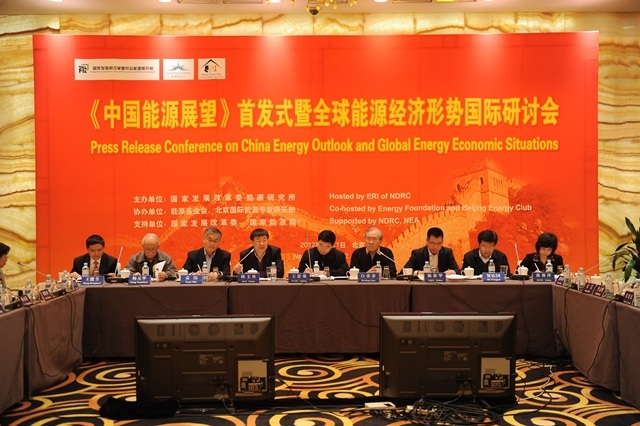
Fortunately, I had the opportunity to attend the first presentation in the western world of the new China Energy Outlook, on 16 October at the Grantham Institute in London, delivered by Professor Han Wenke and Dr. Yang Yufeng. Both work for the Chinese Energy Research Institute, which is a part of the National Development Reform Commission of China, the government body in charge of macroeconomic planning.
More details below the fold for a summary of their talks and the China Energy Outlook (Executive Summary part 1, part 2)
At the meeting we received the summary of the report in English; since the full report is only available at this moment in Chinese (Mandarin), with the stated intent of an English version published down the road. I scanned the Executive summary of the first China Energy Outlook of the China Energy Institute, which can be downloaded here (link part 1, part 2).While there is a lot more to say about the Chinese view, I highlight what I see as key perceptions/expectations from the meeting and the report:
Expectations on short-term changes in the Chinese Energy Mix
The China Energy Outlook expects China’s energy demand to grow more slowly (4.7% per year from 2011 up to 2015, versus 6.7% on average between 2006 to 2011). The reason is that exports will grow more slowly because of weak demand.
“Many developed countries have been trapped into the vicious circle of sovereign debt crisis, fragile banking system, weak demand, high unemployment and policy paralysis.”
The energy intensity of the Chinese energy economy is expected to decline. “from 1.03 tons of coal equivalent (tce) per ten thousand yuan at the end of 2010, to 0.87 tce per ten thousand yuan in 2015, down 16%.”
The Asia-Pacific region is expected to be oversupplied with coal due to slow growth in global energy demand.
The perception is that an abundant supply of coal in China exists (I asked this question to Dr. Yang Yufeng at the meeting, about which he replied that China has more than a 100 years of supply left.), with production being estimated to stay around 3.8 billion tons at maximum (China has put a political cap on its coal production at 4 billion tons in the 12th five year plan). But, there is a demand-supply mismatch between West and East China, which by now has resulted in high costs of long-distance coal transportation, more railway capacity demand and traffic jams caused by coal transportation.
In general, decreased output of old oilfields is expected to be roughly offset by increased output of new oilfields, keeping the total domestic crude oil production around 200 million tons. The gap between oil demand and supply will continue to widen during this period. It is estimated that in 2015 China’s oil import will reach 320 million tons, up 41% from 2010. [A ton is approx. 7.33 barrels, which means an import level of 6.4 million b/d by 2015, in 2011 China imported about 5.1 million b/d].
Natural gas imports are expected to rise by 18.5% per annum up to 2015. “The past decade saw a strong growth of China’s natural gas consumption, increasing from 24.5 Bcm in 2000 to 126.8 Bcm in 2011, up 416%. Natural gas consumption in China will maintain the upward momentum to reach 229 Bcm in 2015, with an average annual growth rate of 18.5%.”
A quite pessimistic view is given over the developments in renewable and carbon mitigation technologies.
“There will be hardly be any breakthrough in two core technologies that are highly related with gloal energy security and climate change…According to field measurement and estimates, lithium batteries will suffer from high energy consumption and high pollution under current technologies in the Chinese market. Coupled with high costs, inconvenient weight and short life, the lithium battery is unable to bring revolutionary changes to electric vehicles. Second, Carbon Capture and Storage is the best hope to reduce carbon emissions from fossil fuel power generation in the world, is facing some fatal problems, including lack of some integrated commercial demonstrations, increasing total costs, falling energy efficiency, lack of legislation support and low public acceptance.”
Perceptions on the changing US fossil fuel situation and US energy independence
The US is seen to have an oversupply of oil and gas due to the introduction of shale oil and shale gas. Note from author: some of the perceptions may have come/have been influenced from this meeting of the China Energy Outlook’s authors with members of the US Senate’s Energy and National Resources Committee.
In relation the Chinese expect a further change in the US from coal-fired to natural gas-fired power generation:
“Gas-fired power generation will be more competitive in the US and might completely replace coal-fired power generation. It will also widen the cost gap from nuclear and renewable power generation. The latest statistics in 2012 suggest that cost per unit for newly built CCGG (Combined Cycle Gas Turbine) plants in US is 30% lower than that of coal and wind power, half of nuclear power, and a quarter of solar power. Notably in April 2012 the US EPA published CO2 emission standard for new fossil fuel-fired power plants, which limited those plants to a maximum CO2 emissions rate of 1000 pounds per MWh (453g/kWh). This standard is close to that of gas-fired power plants and is half of that of coal-fired power plants.”
“North America has huge potential of energy resources. According to the news issued on April 19 of 2012 by the US Senate Committee on Energy & Natural Resources, the US has 26% of world’s technically recoverable conventional oil resources. This news was a significant change on president Obama’s earlier statement that the US had only 2.2% of the world’s proven oil reserves. Although the technically recoverable conventional oil resources and the proven oil reserves are different concepts, and the data 26% still need to be confirmed further, it still can indicate that a great change had taken place not only in US unconventional oil/gas reserves, but also in US conventional oil reserves. Clearly, this situation means that the North American market will enjoy a lower oil price than either the Asia-Pacific region or Europe in the long run.”
The Chinese seem to hold a rather sobering view of the US strive for energy independence. From the report:
“Unconventional oil and gas resources, represented by shale gas and shale oil, have helped the US take a great stride on its “way to energy independence”. That also helped the Americans win time and raise the possibility for the US government to keep its promise “to rely mainly on slow development of new and renewable energies as well as technologies such as electric vehicles, biomass, wind energy and solar energy.” But we should understand the concept of America’s energy independence more accurate, America’s enormous potential of energy self-sufficiency makes it less dependent on imports year by year. Against the backdrop of oil market globalization, America may import relatively cheap oil from Saudi Arabia and other countries (e.g. Canada and Mexico, etc.) . The U.S. has no need, and indeed would not be able to achieve 100% energy self-sufficiency. America’s energy independence is more a political slogan than an actual policy objective. The essence of “energy independence” is to improve oil supply security.”
Perceptions on international energy policy
Dr. Yang Yufeng during the presentation voiced quite clearly that China has not intent to join the International Energy Agency. As stated in the report:
“Developed countries should cooperate with developing countries in a more active and inclusive manner. This is especially true for global information sharing. With open, transparent, objective and accurate information, IEA should give full play to its advantages and serve the whole world, not just its member countries. Only in this way can the IEA publications strengthen its influence on developing countries and enhance the mutual understanding and cooperation between IEA and developing countries…China should actively cooperate with other international energy organizations. However, China will not and should not join IEA which is dominated by OECD countries. Instead, China should improve its position in global energy governance by joining other developing countries to improve the analytical systems of energy statistics.”
In the report a strong view is given on the importance of progressing to more technology transfer, whereas the international community should re-evaluate the importance of technology transfer in the global energy revolution.
“Wider use of advanced energy technologies can increase both the global energy supply and energy efficiency, so as to popularize low-carbon technology and to accelerate the coming of the era of non-fossil fuel. Therefore, under the framework of the UN or G20, the international community should build a global mechanism of sharing advanced technologies. This may aid developing countries, including those least developed counties, to access the advanced energy technologies, and the whole word to achieve sustainable energy development.”
Perceptions on Energy Policy & Climate Change
In the presentation Dr. Yang Yufeng mentioned that he US nowadays has an easy position thanks to the revolution in natural gas supply to deal with climate change relative to China. The general view seems to be that while China is doing all its can to control fossil fuel consumption, it needs more time and understanding from developed countries because it is in a much more difficult position.
“Developed countries should show more understanding and tolerance to developing countries in coping with climate change issues. The international community should show full understanding of the relatively fast growing energy demand in developing countries, especially those emerging economies. Most developing countries have unfavourable natural conditions (such as drought, harsh climate, fragile ecosystem, heavy pollution, limited energy resources, etc.), while most developed countries enjoy comfortable natural conditions (such as small temperature differences all year round and plentiful rainfall in Europe, fertile lands and abundant energy resources in North America). In addition, developing countries are lagging behind in advanced technologies. Therefore it costs more for the developing countries to develop themselves than that for developed countries. Apart from that, developed countries only have to cope with the challenges of climate change while developing countries have to tackle the problems of local pollution and ecological damage at the same time. Under these circumstances, at the same time as striving for the survival and development of their own people, developing countries must also give priority to solving the problems of local ecological damage, environmental pollution and technology progress.A s the largest developing country located in Asia, where energy resources are most expensive and scarce, China is paying more and more for energy resources for its people’s survival and development while having to consume coal as the basic energy resources.”
On Climate Change targets the view is given that the 2 degree target as addressed by the UNFCC is not realistic, and that international governance lacks any mechanism to promote renewable energy, whose development is still based on national government support.
Key recommendations for Chinese energy policy – control over energy demand
The Energy institute suggests to the National Development Reform Commission to institute demand side control measures. In the words of Dr. Yang Yufeng, “Make our demand more Scientific!.” Whereas currently China has great control at the macro level of energy, it lacks mechanisms to install incentives and management options at the micro-level. Therefore the Chinese Energy Institute recommends bottom-up energy data measurement, based on which control measures (both technology wise and behavioural constraints) can be instituted:
“Energy demand management should be improved by controlling total energy consumption at the local level. On one hand, China should improve the functions of local energy authorities by incorporating the local energy conservation departments into them. The authorities should control total energy consumption. National energy authorities should instruct local authorities on statistics and measurement of total energy consumption. Based on that, they can manage to achieve the total volume control goals according to relevant regulations. On the other hand, local energy authorities should gradually establish a system of total energy statistics and accounting so as to balance energy supply and demand and to make it more scientific and practical.”
The Chinese Energy Institute sees non-fossil energy as a means to control energy consumption.
“The key to control total energy consumption is to control the consumption of fossil fuels, especially coal and oil. Therefore by increasing the supply of non-fossil energy, total energy consumption will be kept under control. To be more specific, the government should implement all kinds of financial and tax policies flexibly to increase non-fossil energy supply according to local characteristics.”
Key recommendations for Chinese energy policy – disconnect energy transports West from East
Currently there is more and more transport on-going from the West where energy is mainly produced in primary form, to the coastal regions in the East where energy demand is growing rapidly. The Chinese Energy Institute recommends to take a different route as to A) stop the idea of meeting all supply of fossil fuels from internal production as far as possible for coal. B) Increase both coal and LNG imports in the East to meet demand growth, C) Halt the construction of more coal power stations in the Eastern coastal region, D) Halt the construction of large-scale long distance DC current transmission lines because of the potential impacts of accidents if the network breaks down.
“Based on the assumption that south-east coastal region accounts for 23% of total demand, the coal consumption of south-east coastal region will increase to 880 million tons by 2015 and incremental demand (i.e. the volume of coal import) will be about 300 million tons. Assuming that the coal imports of south-east coastal region is about 70% of total, China will altogether import 430 million tons by 2015, about 11.3% of the total coal consumption. Therefore, if south-east coastal region imports 300 million tons of coal, it will not only meet its demand at a relatively low environmental cost (because the damage to the ecosystem in West China in terms of producing 300 million tons of coal will be avoided), but also relieve the pressure on transportation, and maintain China’s key and advantageous position in the global coal market…If the coal incremental demand of south-east coal region is completely met by import, it will greatly reduce coal mining intensity of the west region, protect the western ecosystem and mitigate rail transportation pressure. At the same time, the method will provide the west region with moderate space to develop coal chemical industry with relatively high added value according to market demand and local conditions. What should be pointed out is that reducing coal production in the west region will not pose negative influence on the profit of the coal industry because of relatively low production cost and high profit in most West regions.”
More details can be founded in the first China Energy Outlook Executive Summary (link part 1, part 2).
8 Comments on "China Energy Outlook: An Inside Look at Chinese Energy Thinking"
actioncjackson on Wed, 14th Nov 2012 11:43 pm
1,344,130,000 people and plans for GROWING is the fucking problem here.
BillT on Thu, 15th Nov 2012 4:01 am
Really Action? And with a standard of living way below that of the Us, you expect them to remain at that level while you enjoy yours? Hahahaha.
The problem is not their growth, it is the West’s waste and high living. If you include the energy embedded in all of the products the US imports, it uses more than 40% of the worlds natural resources with only 4% of the world’s population. The other 96% want their share and are going to get it over YOUR dead body. Think about that.
Arthur on Thu, 15th Nov 2012 12:38 pm
Bill, I think the figures have changed in the mean time and assuming that resource consumption is strongly correlated with GDP…
EU $18T (500M)
US $15T (310M)
CN $7T (1300M)
Furthermore I doubt that the 96% are going to get their share as they have no means to get ‘their share’. The only moral way for us westerners to act is not increasing output rates on behalf of the 96%, but to voluntarily decrease our own consumption and ‘give the good example’. The good example is:
– kill the car and mass aviation
– center economic life around an IT infrastructure
– grand scale programs of replacing the energy base
– one child policies
– abandon any idea of economic growth until our energy base is 100% renewable
– abandon ideas about empire
– dismantle military-industrial complexes after negotiations
actioncjackson on Thu, 15th Nov 2012 3:38 pm
The world is overpopulated. It’s a problem. Just say’in. Growth is the enemy regardless of what country it’s occurring. I don’t expect them to stay at that level while I enjoy mine, but why do consider the Chinese to be so benevolent when they’re trying to become just like the US, which everyone on this website seems to hate the most. It’s the bankers you should hate, and they’re worldwide. As far as modernization and consumption, you should be angry with people who have long been dead, not the people who are born into this world with all this shit going on, regardless of standard of living.
BillT on Thu, 15th Nov 2012 3:43 pm
So, you blame your parents and grandparents for the fucked up world you have inherited? You are correct, if you do. Especially if they live in the Western countries. But then, they just wanted “The American Dream” that was pushed to sell junk and support for profit capitalism. So, you think Democracy and Capitalism is to blame? I do too. Do you have any suggestions on how it could have been handled differently? Communism? Socialism? Kings? Dictators? How???
actioncjackson on Thu, 15th Nov 2012 4:28 pm
What I have come to accept is that there is no meaning to any of this, there just is. I can’t say that if I discovered oil over a hundred years ago that I wouldn’t have made an effort to capitalize from it. I would like to think, because I’m lucky to have it in my nature, that I would’ve recognized the terrible burden I would’ve been inflicting on the planet, and that I wouldn’t just go with the mentality that since someone else is going to do it that I might as well. Hindsight is 20/20 though. The Native American Indians are my favorite as far as how life should be lived, but they were mostly destroyed before oil was extracted in mass, so I guess I could blame the development of steel and Catholicism as well, because they killed the Indians. And yes I do blame all our predecessors, including my own, mainly for not being able to control their reproductive impulses. I guess my point is that life is without meaning anyway, and it’s a weakness to be angry at the things I see around me, but the fact that we haven’t learned anything from the past, even though it’s 20/20, and plans for continued growth, wherever it is, pisses me off. It’s a primal urge to want to bear offspring, and it’s what makes people feel important, and it’s a selfish act these days.
actioncjackson on Thu, 15th Nov 2012 4:37 pm
Really there’s no difference between the life of an insect, animal, or a person, it’s life and we as people do not contribute to a greater meaning.
Arthur on Thu, 15th Nov 2012 5:18 pm
It does not really make sense to blame anyone for the resource situation; we are all to blame, meaning nobody will be blamed. Instead use your brain, anticipate and act. Maybe you will be rewarded by living a few extra years. Just maybe.