
Peak Oil is You

Donate Bitcoins ;-) or Paypal :-)


Page added on August 24, 2018

Blind Spot and Fuel: a Review of Two Peak Oil Documentaries from 2008

Blind Spot: Peak Oil and the Coming Global Crisis
A documentary directed, written, photographed and edited by Adolfo Doring
Music by Randall Wallace
Produced by Michelle Cicalese, David Gil, Randall Wallace and Amanda Zackem
Presented by Wallace Global Fund in association with Dislexic Films
Release Date: October 2008
Running time: 1 hour, 26 minutes
Fuel
A documentary directed and narrated by Josh Tickell
Written by Johnny O’Hara
Film editing by Michael Horwitz and Tina Imahara
Cinematography by James Mulryan
Music by Ryan Demaree and Edgar Rothermich
Produced by Daniel Assael, Darius Fisher, John Goldsmith, Tina Imahara, Robert Little, Laura Martorella, Gregory McClatchy, Janet Morrow, Stephen Nemeth, H.W. Pausch, Greg Reitman, Dale Rosenbloom, Todd Sali, Rebecca Harrell Tickell and Kevin Vickery
A Cinema Libre Studio release in association with Blue Water Entertainment, Open Pictures and Hero BX
Release Date: January 2008
Running time: 1 hour, 52 minutes
These two documentaries on the world oil crisis came out in 2008, a time of growing concern over humankind’s energy future. In the decade since then, public interest in the issue has waned, but the relevance of these films hasn’t—they remain valuable, engaging portraits of the quandary we face at the end of the oil age. Blind Spot provides the proverbial 30,000-foot view of our situation, whereas Fuel gives a personal, on-the-ground account of one man’s activist crusade. Both films are far from perfect. One fails to adequately address how we should respond to our crisis, while the other is unrealistically optimistic about the responses it suggests. Still, both are important films, and they’re all the more compelling when viewed together, given their disparate but complementary perspectives.
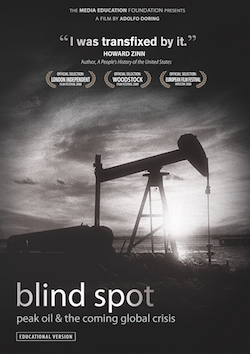
Blind Spot is uncompromising about the realities we face as we leave the era of cheap, abundant oil behind. A formidable cast of geoscientists, physicists, environmental analysts, inventors and other experts details the essence of our plight. Our modern world, which requires ever-increasing quantities of easily obtainable oil, faces a future of ever-dwindling supply. Because oil is finite and the rate of new oil discoveries has been dropping since the early 1960s, logic and mathematics dictate that its production will eventually reach an all-time high, followed by permanent decline. The numbers indicate that the point of peak production, a phenomenon called “peak oil,” is imminent. And, sadly, alternative energy sources, for all the hype they’ve generated, are powerless to save us. They are nowhere near as energy-dense as oil, and we’ve already waited too long to invest meaningfully in them.
This assessment has held up well. Most people wouldn’t know it, though, for all the obfuscation on this subject in the media. A lot of people today insist that world oil output has continued to climb steadily, a decade-plus after peak oil experts warned us it would begin to head downward. But such claims are based on a, let’s say, “creative” definition of oil. The peak oil predictions of the late 1990s to early 2000s had to do with crude oil as traditionally defined, whereas the figures most people hear about these days are more appropriately termed total liquid fuels. These include things like biofuels and tight oil from shale, which are not traditional crude. We now know that production of the latter peaked around 2005 to 2006, right on schedule (and, incidentally, even before Blind Spot’s release). Eventually, total liquids will follow suit.
Besides the specter of oil’s scarcity, Blind Spot looks at a range of deleterious effects the substance has had while plentiful. These include overpopulation, climate change, war in the Middle East, the economic decline of America’s middle class, health effects from automobile emissions and mass species extinctions.
Overpopulation is perhaps the most frightening of all the topics listed above. Richard Heinberg, a major peak oil author and senior fellow at the Post Carbon Institute, describes how, beginning around the early 1800s, oil enabled industrial agriculture. This in turn permitted the world’s population to increase sevenfold (seven-and-a-half-fold as of 2018). Blind Spot shows a line graph of world population growth from 1 A.D. to 2007, which reveals that as of 1850 there were fewer than one billion humans alive—a data point labeled “Earth’s Approximate Carrying Capacity.” Thus, Heinberg argues that absent oil, the planet isn’t capable of supporting more than about a billion people. Our task at this point, he says, is to reduce population as humanely as possible before nature does the job for us.
The miracle of petrochemical-based industrial farming is but one factor enabling today’s bloated human population; it’s also our luck that Earth’s current climate favors widespread human settlement and agriculture. Yet that propitious climate is among the things we’re destroying through our oil usage. Gases emitted by burning fossil fuel are altering the climate in ways that are fast eliminating human habitat. For this reason, if for no other, it’s fortunate that we’re depleting our oil resources. However, climate change researcher James Hansen suggests that the damage might already be done, due to positive (i.e., self-reinforcing) feedback effects. Hansen warns of “the danger that these positive feedbacks will cause a situation that begins to run under its own power.” In the 10 years that have passed since Blind Spot’s release, evidence in favor of this scenario has steadily mounted, with data repeatedly showing rates of change far beyond what climate scientists once said was likely.
Just as the science on climate change continues to grow more and more alarming, so research into the human health effects of automobile exhaust increasingly shows it to be deadlier than previously thought. Terry Tamminen, former head of the California Environmental Protection Agency (EPA) under Governor Arnold Schwarzenegger, reports that levels of exhaust pollutants once thought to be benign are, in fact, quite harmful. He also exposes some of the measures that oil and automobile companies have taken to bury this fact.
Apart from the harms that directly attend oil usage, there’s another host of troubling issues associated with fuels that have been touted as oil’s replacements. Blind Spot highlights two such fuels, ethanol and biodiesel. Cornell University ecologist David Pimentel, who chaired a U.S. Department of Energy (DOE) panel on ethanol from 1979 to 1983, decries the ethics of diverting food crops to fuel production. The number of malnourished people on Earth today is the largest in history, he observes, and increased biofuels production means less food to go to these already starving people. Biofuels’ other horrors include soil degradation, water depletion, deforestation and ocean dead zones caused by fertilizer runoff.
In addition to their ecological and human health effects, ethanol and biodiesel lack the one thing that is oil’s greatest virtue: its energy density. Our present society needs fuels with high energy returned on energy invested (EROEI) ratios. The DOE research that Pimentel advised found ethanol to have a lower-than-1:1 EROEI, meaning that it takes more energy to produce than it yields in return. As such, ethanol isn’t an energy source but an energy sink. Pimentel adds that subsequent studies into ethanol and other biofuels have reinforced this finding. So, once the present glut of fracked tight oil from the American West begins to vanish, efforts to mitigate its decline by ramping up biofuel production are bound to be just as ill-fated as the attempt to reverse conventional oil’s downward spiral with biofuels 10 years ago was.
Blind Spot covers far more ground than has been described so far in this review. Beyond the hard science underpinning our energy picture and the ecological corner into which we’ve backed ourselves through our fuel choices, the film goes into the link between oil supply and economic growth, the psychological and sociological facets of our predicament, the tactics advertisers use to entice us to consume and how we, as a society, need new stories to make sense of our changing world. These discussions enter some pretty deep philosophical territory, but the thread that ties them all together—an awareness that infinite growth on a finite world is impossible—is remarkably simple.
Where Blind Spot falls down is in not exploring in earnest the matter of how to deal with our mess. The documentary spends some brief, isolated moments outlining the types of changes that are necessary, but these are mere asides. The problem isn’t that the individuals interviewed lack detailed proposals for addressing the challenges we face. On the contrary, they have plenty of thoughts on what we should do, as evidenced by the many books they’ve collectively written. It is the film that’s at fault for not allowing its experts to really delve into the subject.
My desire is not for the film to offer “solutions,” for it seems to me that its fatalism about the future is substantiated. But many issues that can’t be solved can nonetheless be responded to effectively, and this, I judge, is the case with peak oil. If only Blind Spot had closed with a section examining some of the promising suggestions that have been put forward by the many fine thinkers among its cast. As it is, the film ends on a stark warning about a coming mass die-off of the human population, voiced over the image of a poisoned, dead bird lying on its back. That sort of ending inspires not constructive action but melancholy.
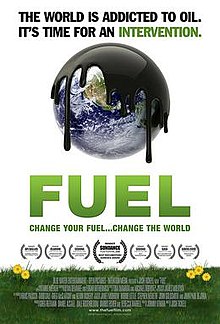
A deeply personal film, Fuel is every bit as much a portrait of Tickell’s activist career up through early 2008 as it is a wake-up call to humanity. Tickell is an alternative fuels advocate who rose to fame during the late ’90s for embarking on a two-year nationwide tour to raise awareness about the merits of biodiesel. He traveled in a flamboyantly colored, diesel-powered van known as the “Veggie Van,” running it on used frying oil from restaurants he passed along the way. Fuel begins with an amusing scene in which he pulls his rig, in all its bright-colored glory (its paint job a mural of sunflowers set against a radiant blue sky) into a drive-through and asks for a medium soft drink—as well as all of the restaurant’s used cooking oil. We chuckle heartily as the flustered server struggles to understand Tickell’s request.
Tickell was born in Australia and moved to Baton Rouge, Louisiana, as a boy. Following the move, he was dismayed at no longer being able to play amid nature as he had back home. His new stomping ground was too toxic for such recreation. Tickell was a bright kid, and during a school science project for which he collected and analyzed local water samples, he gained his first clues into how the state government had long been controlled by oil interests, and as a result had been underreporting levels of toxic waste in the environment. Tickell went on to earn a college degree in sustainable living, which afforded him the opportunity to intern on some organic farms in Europe. It was on one of these farms that he first encountered biodiesel and decided to spread the word about it in America.
One distinct difference between Fuel and Blind Spot is that Fuel interviews not only scientists, entrepreneurs, scholars, politicians and the like, but also Hollywood celebrities. Among the stars it features—all of whom have supported causes related to getting off oil—are Julia Roberts, Woody Harrelson, Willie Nelson, Neil Young and Sheryl Crow. Their presence, together with Tickell’s beguiling, vulnerable and altogether touching narrative, lends Fuel a good deal more entertainment value and drama than Blind Spot. The soundtrack reinforces this tone, with songs by Crow, Nelson, John Mellencamp and other popular musicians conveying an inspirational, at times humorous, feel, as opposed to the solemn instrumental track of Blind Spot.
In many ways, Fuel and Blind Spot are well aligned ideologically. Tickell shows no signs of being what peak oil folks would call an oil cornucopian, or one who believes that we can magically make more of the stuff appear simply by wanting it badly enough. (He has other cornucopian leanings, but we’ll get to those later.) He grants the basic tenets of peak oil and includes clips from interviews he conducted with heavyweights on the subject like Colin Campbell and the late Matthew Simmons. Also like Blind Spot, Fuel makes a point of emphasizing how ubiquitous petroleum is in our lives, the connection between oil and war, oil’s adverse ecological and human health impacts and the existential threat that climate change poses. Both films are also critical of Americans’ profligate consumption, the advertising industry that encourages our wastefulness and the use of food crops to create fuel (they’re agreed that ethanol is a nonstarter).
Moreover, Fuel is sober enough to recognize that there’s no silver bullet when it comes to replacing oil. Tickell says we need “a barrel of solutions,” and to illustrate, he shows us a diagram in the shape of a barrel, with seven horizontal sections. These are labeled, from top to bottom, “ENERGY EFFICIENCY,” “PUBLIC TRANSPORTATION,” “PLUG-IN HYBRIDS/EV’s,” “SOLAR,” “WIND,” “BIOMASS” and “SUSTAINABLE BIOFUELS.” As he drills down on each category, we watch him meet with entrepreneurs, lawmakers and investors across America, as well as travel to Germany and Sweden to gain insight into what those nations have done to reduce their oil dependence. He talks with experts in wood-based bioenergy, wind power, tidal energy, diesel automotive innovations, biodegradable plastic alternatives, vertical farming, retrofitting for energy conservation and the use of wastewater as an algal biofuel feedstock. In short, rather than a single magic bullet, he fires a volley of projectiles, the better to hit an exceedingly daunting target.
Unfortunately, however, some of the solutions that Tickell examines reflect a delusion on his part. He appears to take it for granted that our species somehow has ultimate control over its destiny, no matter that it’s the biosphere we’re destroying that put us here and continues to support us. “We can sustain every living human being,” Tickell glibly assures us, “as well as the human beings that will come. The choice is ours.” He also uses the phrase “almost insurmountable” to describe the challenges we face. How can he draw such a fine distinction? Couldn’t an equally valid case be made that our crises are just shy of surmountable? The filmmaker provides zero evidence in support of claims such as those quoted above; he merely asserts them.
Worse yet, he ignores a wealth of evidence that goes against these optimistic statements. He never brings up the Club of Rome’s landmark 1972 report titled The Limits to Growth (to say nothing of its subsequent updates). Since this study remains one of the most prescient ever conducted on the implications of continued growth in the global population and economy through the end of this century, its omission from Tickell’s assessment is glaring. Tickell also avoids mentioning the DOE’s 2005 Hirsch Report, which stressed the need to begin our shift away from oil at least 20 years in advance of its peak, lest the transition fail miserably. Tickell’s faith that humanity can somehow magically avert certain disaster is no doubt reassuring to many viewers, but it has nothing to do with reality.
Numerous other vital topics go neglected in Tickell’s selective analysis. For instance, he states that biodiesel’s EROEI is 3:1 (a figure that contradicts the DOE findings mentioned earlier, but let’s grant for argument’s sake that it’s correct). The next logical question, which Tickell doesn’t ask, is whether a 3:1 EROEI is actually sufficient to power industrial society. The belief among many who have studied the energetics of complex human systems is that it isn’t—not by half. And just as with EROEI, Tickell fails to pose questions about a raft of other necessary topics relevant to our energy situation, including the vast number of finite resources besides oil that are nearing peak production, the paradox inherent in striving toward ever-greater efficiency (peakists will know this as the Jevons paradox), the failings of free trade and nature’s status as the ultimate arbiter of what takes place in human economic affairs.
Even so, you don’t have to share Tickell’s blind trust in human ingenuity to applaud him for at least proposing solutions. Peak oil author John Michael Greer has sensibly argued that what we need right now is a fruitful state of dissensus. Greer reasons that because so much is still unknown as to which approaches will work and which won’t, we need to research as many avenues as possible to weed out the promising ones from the duds. I don’t know whether Tickell is aware of Greer’s ideas, but his openness to a range of potential responses, as demonstrated in Fuel, makes him an exemplar of dissensus.
69 Comments on "Blind Spot and Fuel: a Review of Two Peak Oil Documentaries from 2008"
Davy on Sat, 25th Aug 2018 9:54 am
“You make it sounds as if the rest of the country is immune for what happens in Washington.”
No, different type of civil war. It could end violently but usually the effects are a melting of both sides into a new state. It is unclear who will get the better of the other. Neither side will likely win BTW because the US is paralyzed from real change from diversely competing special interest groups much greater than race or political ideology.
“Morale, don’t think for a minute that this conflict can be confined to Washington if the Deep State and its media manage to topple a legitimately elected president Trump. The campaign is relentless and I have seen nothing like this during my life:”
Moral of the story of the above story is extremist self-serving views tend to remain fanciful if not amusing. Trump will not be toppled because of the rigors required of impeachment. The fact that the opposing side is so far off into corruption and guilt also makes forceful implementation of soft coup unlikely anymore.
“If Trump goes, regardless how, it will be the start signal for an uprising, rather in months or weeks than in years. Expect the insurgents to receive support from Russia and China, perhaps even from populist-run European countries, like Hungary, Poland, Italy or Austria.”
Nonsense, this is not Europe and not the 20th century. Much more at work. The whole world is connected today in new and powerful ways. Information is dispensed immediately so as to make surprise and stealth difficult. Propaganda and red flags are now completely suspect and often counterproductive. Revolutions are stymied by the realities of the economy and a brittle climax ecosystem of our late term civilization
Cloggie on Sat, 25th Aug 2018 10:03 am
The white have a higher IQ because the white liberals have an above average IQ..If you look at just white conservatives their IQ’s are no greater than minorities you fucking idiot..
If these libtards are so smart, then why are they importing low-IQ third worlders in great numbers, thereby lowering the average IQ of America, creating ethnic tensions, which threatens to blow up the union.
Oh wait, I know, they are using these immigrants as a weapon against whitey, make him electoral impotent…
https://documents1940.wordpress.com/2017/09/27/paul-krugman-white-americans-are-losing-their-country/
…and to cancel his (meanwhile) former majority…
https://documents1940.wordpress.com/2018/05/21/european-america-is-over/
…so they can push through their commie color-blind rainbow society, while making whitey pay for it all.
And how do you think “low-IQ” deplorable whitey is going to respond?
Oh wait, why don’t you listen to him in person:
https://www.youtube.com/watch?v=LBOTk00eMT4
Meet the real deplorables, the losers of the US multicult system. Interesting is the monologue between [3:47] and [12:39]… “I want to see this country split up in hundreds of pieces”. From a European perspective that would be a little too much to handle, but yes it is true, we love America so much that we want to see at least four of them.
We in Europe pick up these signals of course and understand we can begin to plan for the end of the American Era.
Davy on Sat, 25th Aug 2018 10:12 am
More hype from desperation from those who are not positioned well enough to dethrone the dollar and are on the receiving end of an economic and political Americana in decline. We are in a brittle late term civilization with a self-organizing global interconnected economy unable or willing to change. Changes will be made around the edges. Most niches are filled but niches can be subject to the slow process of attrition that comes from creative and destructive effects of change from growth and decline. Bilateral and regional arrangements are likely the next force to drain globalism of vigor but this is a parasitic process. As regions drain the global host they will themselves lose economic vigor. The US and its economic adversaries will only cause decline on themselves by this conflict. These are zero sum gains in the long run. The dollar is here to stay as a significant reserve currency component until the global system ends as we know it. How much the dollar declines likely rest with how far the US will go to cause the decline? The reality of this decline is primarily the weaponization of the dollar which is just a result of economic and political failure of the US. It will likely be the case that this dollar issue will be a moot point once decline has run its dangerous course to economic collapse IOW there will be no replacement by then because there will be no global economy. In the meantime the dollar will remain essential to world trade as China, Russia, and EM adversaries of the US battle to de-dollarize their economies. Some of these economies are so small as to make their efforts meaningless in the bigger picture.
Davy on Sat, 25th Aug 2018 10:16 am
sorry posted to wrong thread. This belongs on: Thank God This Is Happening” Russia Says Time Has Come To Ditch The Dollar
MASTERMIND on Sat, 25th Aug 2018 10:54 am
CLogg
Legal immigration is at 25 year low..and is half of what it was 25 years ago..We are only adding less than a quarter percent a year to our population
Source: Bloomberg
https://imgur.com/a/M4bnRHy
And illegal immigration peaked back in 2000 and has declined 80 percent since..Last year it was at 45 year low..
Source: Border Patrol
https://www.scribd.com/document/375672329/CBP-Border-Security-Report-Fiscal-Year-2017
More Mexicans are leaving the US than coming here–and it’s not because of deportation
http://www.latimes.com/projects/la-me-a-dream-displaced-life-back-home/
You have been duped by fake news scaremongering..Just pure racism and paranoia ..And once again proving the white conservative has a low IQ..
Antius on Sat, 25th Aug 2018 1:13 pm
“CLogg thinks populism can save his economy..Putting the lowest IQ white people in charge will save everything”
We’ve been through this before. More intelligent people tend to spend more time in academic education, where they are indoctrinated with far left bullshit.
The nationalist is often a lot cleverer than the average citizen, for it takes an enquiring mind to reject popular mythology when peer pressure is against you.
MASTERMIND on Sat, 25th Aug 2018 3:13 pm
Antius
Nationalism is the measles of mankind..
-Einstein
They are a lot cleverer? You mean more clever?
You are dumb as dirt..
MASTERMIND on Sat, 25th Aug 2018 3:19 pm
Antius
Dirk Nowitzki showing off his athleticism on the soccer field
https://gfycat.com/EmptyBlindBetafish
White people can’t play sports..too small of dick..
LMFAO
Cloggie on Sat, 25th Aug 2018 3:23 pm
“Nationalism is the measles of mankind..
-Einstein
They are a lot cleverer? You mean more clever?
You are dumb as dirt..”
Got any other references than your fellow chosenite tribesmen-with-a-globalist-agenda, millimind?
For a century your kind has terrorized the planet with the horrors of bolshevism, WW2, holohoax, multicult, 9/11, Iraq, Syria, Ukraine.
What are we supposed to do with you? Doing nothing is no option.
Cloggie on Sat, 25th Aug 2018 3:31 pm
“White people can’t play sports..too small of dick..
LMFAO”
White people, the only show in town in sports, apart from sprint or soccer, basketball:
https://tinyurl.com/y8sjycdq
The most amazing thing is the total lame apathy with which white Americans here respond to your continued insults against them: namely not at all. You can do with them what you want. Scary.
Boat on Sat, 25th Aug 2018 3:45 pm
Clog
If it were raining tits mm would get hit by a dick. He is a reincarnated BC evonomic doomer who predicted a total crash 1 1/2 years ago. Much like the shortonoil etp crowd who predicted total collaspe in less than 3 months. Time will chase these prognosticators away.
MASTERMIND on Sat, 25th Aug 2018 4:42 pm
Boat
I never predicted any crash 1 1/2 years ago..And I wasn’t even on this blog back then..Nice straw man though..
Limits to growth had 12 models. One of those models, the “standard run” or, alternatively, the “business as usual” model was the one that 30 years of historical data tracked/followed. And according to that model the global economy will collapse by 2030.
Scientific American: Apocalypse Soon: Has Civilization Passed the Environmental Point of No Return?
https://www.scientificamerican.com/article/apocalypse-soon-has-civilization-passed-the-environmental-point-of-no-return/
Peer Reviewed Study: Limits to Growth was Right. Research Shows We’re Nearing Global Collapse (Turner, 2014)
https://www.scribd.com/document/379418787/Is-Global-Collapse-Imminent-An-Updated-Comparison-of-The-Limits-to-Growth-with-Historical-Data-Turner-2014
Looking Back on the Limits of Growth – Smithsonian
https://www.smithsonianmag.com/science-nature/looking-back-on-the-limits-of-growth-125269840/
.https://imgur.com/a/ZUUkN4c
MASTERMIND on Sat, 25th Aug 2018 4:47 pm
Clogg
You can’t compare all of Europe against single countries like China and United States..
the 90 meters is the ultimate event and no white people who could even quality..They can’t run or jump, too flat footed..
LMFAO!
Cloggie on Sat, 25th Aug 2018 5:02 pm
You can’t compare all of Europe against single countries like China and United States..
Why not? I just did. The EU has a parliament, president, a currency, central bank, high court, space program, ground breaking energy policy, Europol, Airbus/EADS, ESA, etc., etc. 80% of the legislation in Europe comes from the EU. The only difference is that the budget is only 1.5% EU GDP, which will increase in the coming years.
The Olympic medal table is only a small sign of things to come. China may become the next #1 country, but Europe, including Russia replacing Britain, is going to return to become the next #1 as a united civilization, like we have always been and always will be. And there is not f* you can do about it.
DerHundistLos on Sat, 25th Aug 2018 8:53 pm
MASTERMIND:
“If you look at the white conservative IQ its no greater than minorities..And if you consider the fact minorities are more athletic, can sing, dance, and are funnier than white conservatives..I would argue that minorities are Superior to white conservatives..
That is why you are being replaced..Girls don’t like dumb peckerwoods with no artistic.”
Quite true and presented in a smart and humorous format worthy of Bill Maher.
DerHundistLos on Sun, 26th Aug 2018 3:33 am
Boat:
When a person tells fibs, their credibility is sunk (unless you’re a habitual liar like Trump).
Cloggie on Sun, 26th Aug 2018 4:25 am
MASTERMIND:
“If you look at the white conservative IQ its no greater than minorities..And if you consider the fact minorities are more athletic, can sing, dance, and are funnier than white conservatives..I would argue that minorities are Superior to white conservatives..
That is why you are being replaced..Girls don’t like dumb peckerwoods with no artistic.”
Quite true and presented in a smart and humorous format worthy of Bill Maher.
For TheLoseHound the demise of his own kind is a good joke.
/rolleyes
For him US politics can be reduced to the Dems-Reps dichotomy, with the Dems the good guys and the Reps the bad guys. And since (((Maher))) supports the Dems, he is a good guy. And since most whites vote Reps and Trump, they must be the bad guys.
For types like TheLoseHound, onlooker, Sissy and many others (not Davy) this view is standard. They are completely blind for the reality of the deep state and the dominant Jewish role in US politics, the real power broker in the US, temporarily put on hold since November 2016 by outsider Trump, who hijacked the system, to the horror of the deep state. McCain for instance was a Rep, but completely loyal to deep state interests. In the big scheme of things, his membership of the Republican party was irrelevant. He was a member of George Carlin’s Big Club=Deep State, like so many Democrats and other Republicans alike.
DerHund is more concerned about the fate of North-American wild-life, than that of his children, if any.
James Andrew on Mon, 26th Jan 2026 6:28 am
This review really made me think about how dependent we are on fossil fuels and the challenges ahead as energy sources evolve. It’s a reminder that even everyday services, from local travel to things like Amersham taxis, could be impacted by shifts in fuel availability and sustainability thinking. Understanding these broader trends helps all of us appreciate the importance of planning for a future with cleaner, more resilient transport options.
Elizabbeth Cole on Mon, 26th Jan 2026 6:33 am
Great review of how Blind Spot and Fuel highlight our deep reliance on oil and the challenges of moving beyond it, which really makes you think about sustainable transport solutions. It’s a reminder that even local services like Cranleigh taxi providers must stay adaptable as energy needs and fuel choices evolve for a greener future.