Shell Sketches Future With Drastically Fewer Fossil Fuels
$this->bbcode_second_pass_quote('', '[')img]https://firenewsfeed.com/image/480x270/aHR0cHM6Ly9pbWFnZXMuYXhpb3MuY29tL3pYZ1BmcXJFYzFERFFPX1ZxVGRURy1MNU94cz0vMHgwOjI0MDB4MTM1MC8xOTIweDEwODAvMjAxOC8wMy8yNi8xNTIyMDk0ODQxNzk3LnBuZw==[/img]
Coal, oil and natural gas would plummet within the next couple of decades in a new report Royal Dutch Shell released Monday, envisioning a future where world leaders cut greenhouse gas emissions as laid out in the 2015 Paris climate deal.
Why it matters:
$this->bbcode_second_pass_quote('', '[')b]This is a company sketching a potential future where its primary products precipitously drop in use. That’s like [i]McDonald’s imagining a future without beef hamburgers.[/i] Meanwhile, Shell is one of the most aggressive global hydrocarbon producers addressing climate change by investing in other energy technologies.


PeakOil is You
Shell Sketches Future With Drastically Fewer Fossil Fuels
Shell Sketches Future With Drastically Fewer Fossil Fuels
 by vox_mundi » Tue 27 Mar 2018, 12:44:21
Highlights of this hypothetical future:
$this->bbcode_second_pass_quote('', '[')i]- Governments adopt carbon taxes just under $50 per ton by 2030 that reach $200 by 2070.
Global coal demand has already peaked, oil demand peaks around 2025 and natural gas peaks around 2035.
- Solar becomes the dominant energy source around 2055.
- The shift to renewable energy is “affordable, being well within historical spending on the new energy system as a share of global GDP.”
Flashback:
$this->bbcode_second_pass_quote('', '[')i]- Shell CEO Ben Van Beurden told Axios earlier this month that oil demand could peak within seven years if the world took drastic action to cut carbon emissions — which is a big "if." That deal is not legally binding, and its force is in question given that President Trump has vowed to withdraw America from it.
$this->bbcode_second_pass_quote('', '[')b]... “It depends on what you want to believe. If you believe that Paris is going to be a success, that somehow the nations of this planet are going to get our act together, are going to be effective in devising and enforcing policies that will decarbonize the energy system, my expectation is then that oil demand will peak in 2025, 2026. That’s the Goldilocks scenario. It all needs to come together.”
— van Beurden
- van Beurden said he remains disappointed that Trump is pulling America out of the Paris deal, but said a shift to lower-carbon energy is “inevitable.”
- van Beurden’s comments on peak oil demand appear to be the most aggressive by any oil and gas executive on a topic that is central to the industry’s future profitability — and climate change.
- Shell announced late last year it would aim to cut the "net carbon footprint of its energy products by around half by 2050.”
U.S. Energy Market Found To Be More Unstable Over Past Decade
$this->bbcode_second_pass_quote('', 'A') trio of researchers with Carnegie Mellon University has found that the U.S. energy market has become more unstable over the past decade, and because of that, expert predictions have become more error prone. In their paper published in the journal Nature Energy, Evan Sherwin, Max Henrion and Inês Azevedo describe their study of the volatility of the U.S. energy sector, what they found, and suggest that some of the instability may be due to structural changes in the U.S. and world energy systems.
... The trio came to this conclusion after conducting a study of the energy system in the U.S. More specifically, they looked at energy statistics from 1952 to 2015, such as production numbers and prices. As part of their study, they looked at volatility for each year, which was calculated by factoring in the amount of change and how large it was. They also compared predictions made by energy experts with actual outcomes to see how well they fared over the same time period.
The researchers report that the most recent decade was the most volatile. They also found that the most recent decade proved to be the most challenging for experts to predict, as well, as they were wrong more often than in previous decades.
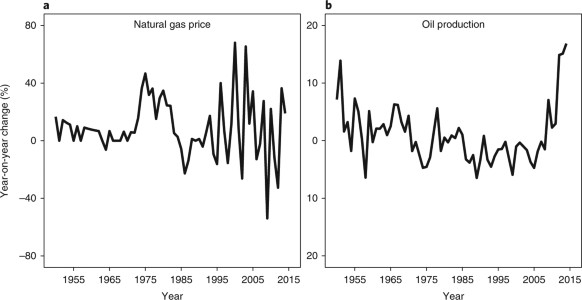
Year-on-year changes for two energy quantities.
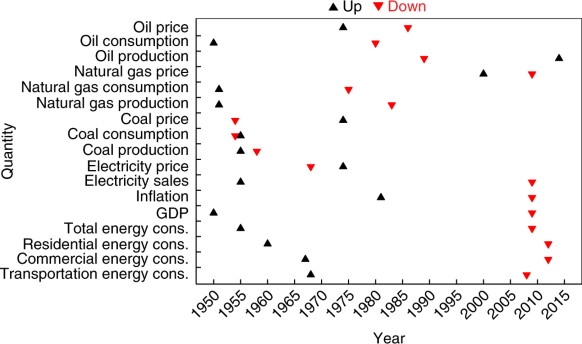
Extreme changes for 17 energy quantities, from 1949 to 2014.
Estimation of the year-on-year volatility and the unpredictability of the United States energy system, Nature Energy 2018
Last edited by vox_mundi on Tue 27 Mar 2018, 13:11:22, edited 1 time in total.
“There are three classes of people: those who see. Those who see when they are shown. Those who do not see.” ― Leonardo da Vinci
Insensible before the wave so soon released by callous fate. Affected most, they understand the least, and understanding, when it comes, invariably arrives too late.
Insensible before the wave so soon released by callous fate. Affected most, they understand the least, and understanding, when it comes, invariably arrives too late.