



>May 26, 2001
> It Gets 78 Miles a Gallon, but U.S. Snubs Diesel
>
>
> By EDMUND L. ANDREWS with KEITH BRADSHER
>
>
>
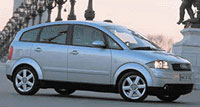
> RANKFURT, May 26 - To judge by the mileage it can get, the Audi A2
> sounds like just the kind of exotic hybrid-fuel car that President
> Bush would want to promote with his new energy plan.
>
> The sporty new four-door compact has a top speed of 100 miles an
> hour. It can travel 78 miles on a single gallon of fuel and emits
> fewer "greenhouse" gases than almost any other vehicle on the
> market. Yet the A2 has at its core a technology that generates
> scorn in the United States: the diesel engine.
>
> The A2 is part of a powerful movement in Western Europe, where
> gasoline prices are often three times what they are in the United
> States. Diesel engines burn as much as 30 percent less fuel than
> gasoline engines of comparable size, and they emit far less carbon
> dioxide and other greenhouse gases, which have been implicated in
> global warming. After being disparaged for years because they were
> noisy, smelly, smoke-belching and sluggish, a new generation of
> much cleaner, more nimble diesel-powered cars is suddenly the
> height of fashion in Europe.
>
> Diesel engines powered 32.3 percent, or nearly one-third, of all
> new cars sold in Europe last year, compared with 21.7 percent in
> 1997. Analysts predict the share will rise to at least 40 percent
> by 2005.
>
> The contrast with the United States could not be more stark. Fewer
> than 1 percent of new American cars have diesel engines. And the
> gap is likely to widen, because American antipollution regulations
> severely restrict the sale of diesel engines, and American
> environmental groups are adamantly opposed to relaxing them.
> European environmentalists, while pressing for tougher standards,
> are far more accepting of the new diesel technology.
>
> A report commissioned by Congress and being prepared by a panel of
> the National Academy of Sciences bluntly suggests that the United
> States may be missing a big chance.
>
> According to a person familiar with the draft report, which is due
> in July and is being prepared with considerable secrecy, the panel
> will suggest that "the surest, fastest way to improve the fuel
> efficiency of the American fleet would be to allow diesels to be a
> greater part of the landscape." President Bush has said that he is
> waiting for the report before deciding what, if any, changes to
> make in American fuel-efficiency standards for automobiles.
>
> But the panel is not expected to call for a change in the
> environmental rules. The person close to the panel said a shift
> toward diesel would require "gigantic" investment and "would
> probably be a foreign- dominated technology."
>
> Harry Pearce, a vice chairman of General Motors until Friday, when
> he becomes chairman of its Hughes Electronics unit, said the
> company had no intention of investing in more diesel engines for
> the American market unless the air pollution rules change. "We're
> denying ourselves the largest incremental step we could take" to
> reduce American emissions of global-warming gases, he said.
>
> In Germany, home of Mercedes and Porsche and unlimited speeds on
> the autobahn, the average new car has improved its fuel efficiency
> steadily since 1990 and now gets about 32 miles a gallon. The
> average diesel car gets about 40 miles a gallon. By contrast, the
> average efficiency of new vehicles in the United States has
> deteriorated steadily over the period as ever more sport utility
> vehicles have been sold, and was just 24.5 miles a gallon last
> year.
>
> By all accounts, diesel technology has made a series of major
> advances in the last 10 years. The days are long gone when diesel
> engines spewed black smoke. The newest engines are almost as quiet
> and smooth as their gasoline rivals, and the telltale metallic
> knocking sounds have almost disappeared in some cars.
>
> Performance has also improved. The newest generation of
> pump-injected and "common rail" diesels offer better torque and
> acceleration than comparable-size gasoline- powered cars.
>
> "The performance is fantastic," said Paul Schröder, a German
> physical therapist who is trading his old Audi gasoline car for a
> diesel- powered A2. "My main goal was to save on fuel expenses. But
> I love to drive, and I wanted a car that would be fun. This car has
> great acceleration, and it is very agile. It really is a lot of
> fun."
>
> Mr. Schröder calculates that he will cut his monthly fuel bill by
> about half, partly because diesel fuel is cheaper and partly
> because of the new car's extraordinary mileage.
>
> Engines emit carbon dioxide and other gases implicated in global
> warming in direct proportion to the amount of diesel or gasoline
> they burn, so vehicles with more efficient diesel engines emit less
> of these gases. And today's diesel engines produce far fewer tiny
> soot particles than just seven years ago.
>
> As a result, European environmentalists and government officials
> have been much more comfortable with diesels than their American
> counterparts. "A liter of diesel takes one farther and produces
> fewer greenhouse gases," said Albrecht Schmidt, a top expert on
> energy issues for Germany's Green Party. "The big problem with
> diesel is the small particulates, but we think that problem can be
> solved with new particulate filters."
>
> American environmentalists remain highly critical. "Diesel is the
> quick and dirty way to increase fuel economy," said Daniel Becker,
> the director of energy and global warming policy at the Sierra
> Club. "As long as we have other technologies that are clean, I
> don't see the point in producing carcinogenic soot."
>
> Differences in attitudes among environmentalists are reflected in
> the stringency of air pollution rules, with European regulators
> giving fairly lenient treatment to diesels while American
> regulators have virtually banned them.
>
> Stringent air pollution rules for diesel engines were issued with
> virtually no warning by the California Air Resources Board in late
> 1998, and will take effect in the 2004 model year. The decision was
> made by the board itself, a group of political appointees, many of
> whom were about to leave office because their patron, Gov. Pete
> Wilson, a Republican, was retiring. The board's technical staff had
> recommended more lenient standards, but at its final meeting, with
> no staff analysis, the board adopted stricter rules with little
> discussion.
>
> The rules were chosen without consideration for the ramifications
> for global warming; California regulators say that is an
> international issue outside their purview.
>
> The Environmental Protection Agency traditionally copies
> California's air pollution rules and did so for the diesel rule in
> late 1999. The agency's decision, which also takes effect in the
> 2004 model year, came despite heavy federal subsidies by the Energy
> Department and the Transportation Department for the production of
> prototype vehicles with hybrid engines that could run on either
> diesel fuel or electricity.
>
> General Motors, Ford and DaimlerChyrsler each completed diesel-
> electric hybrid cars in early 2000 that could get 80 miles to the
> gallon, but have largely abandoned these projects because of the
> new air pollution rules. They are now struggling to catch up with
> Toyota and Honda in the production of hybrid vehicles that use
> electric power to improve the overall fuel efficiency of vehicles
> with gasoline engines.
>
> At the same time, compared with Europe, the United States has much
> dirtier diesel fuel - used by heavy trucks and in a slightly
> different form, as home heating oil - with far higher levels of
> sulphur. The American oil industry, much more influential than
> Europe's oil industry because the United States produces a lot of
> oil, has lobbied successfully to prevent rules requiring cleaner
> fuel to take effect until June 2006.
>
> In France, more than half of all new cars sold are powered by
> diesel engines. "Diesels are trendy," said Thierry Dombreval,
> senior vice president for marketing at Renault. "The customers for
> diesels are younger and more affluent, and those are the people who
> are trendsetters."
>
> BMW and Mercedes are selling diesels in nearly half of their most
> expensive cars. The waiting period for the diesel version of the
> Mercedes sport utility vehicle is 12 months, which is three months
> more than for the gasoline version.
>
> Diesel currently sells at an average of $1.45 a gallon in the
> United States, compared with $1.70 for gasoline, but diesel prices
> sometimes rise above gasoline prices in winter when refineries
> produce heating oil instead of diesel. In most European countries,
> diesel is at least 20 percent cheaper than gasoline because of tax
> treatment.
>
> A leading reason for Europe's boom in diesel-powered cars is their
> tax treatment. Most European countries impose much higher "ecology"
> taxes on gasoline than diesel fuel, mainly because governments want
> to avoid damaging commercial truckers.
>
> In the United States, the image of diesel cars has never recovered
> from the damage done in the early 1980's when automakers,
> responding to sharp rises in oil prices, raced to introduce such
> models on a large scale without working out the technical glitches
> first. "We put some vehicles out there in the marketplace that,
> independent of the emissions and fuel economy, just didn't work
> very well," Mr. Pearce of G.M. said.
>
> In Europe, both Ford and G.M., which have been producing cars
> there for decades, lost significant market share because they
> failed to recognize the coming popularity of diesels years ago.
> Today, both companies are racing to catch up.
>
> "I believe it is just a matter of time before the United States
> comes around to diesel," said David W. Thursfield, chief executive
> of Ford of Europe. "The technology has moved ahead so much. Fifty
> miles to the gallon is normal, and you don't even know you are
> driving a diesel."
>
>
>
http://www.nytimes.com/2001/05/27/busin ... 1&ei=1&en=
0908976c6854e587


