Donate Bitcoin

Donate Paypal


PeakOil is You

PeakOil is You

U.S. is now the world’s biggest oil and gas producer

General discussions of the systemic, societal and civilisational effects of depletion.

Re: U.S. is now the world’s biggest oil and gas producer

Unread postby kublikhan » Tue 08 Oct 2013, 13:28:02

Rockman - The wiki capacity data still looks off. It looks like it is pulling data from multiple different sources. You have to be careful when doing this as you might be comparing apples and oranges. If you go straight to the EIA data, it doesn't show anywhere close to a 20% increase in capacity. In the decade between 2000-2010, capacity increased less than 1%. Data for 2011 is still preliminary, but if you add the increase for that year capacity increased just over 1%.
Annual Energy Review

Full data for 2012 and 2013 that has been compiled into the historic data is not available yet. But it appears the trend of retiring coal capacity has sharply increased from previous years, setting new records of capacity retirement and far outpacing coal capacity additions.

$this->bbcode_second_pass_quote('', 'P')lant owners and operators report to EIA that they expect to retire almost 27 gigawatts (GW) of capacity between 2012 and 2016. The 27 GW of retiring capacity amounts to 8.5% of total 2011 coal-fired capacity. The coal-fired capacity expected to be retired over the next five years is more than four times greater than retirements performed during the preceding five-year period (6.5 GW). Moreover, based on EIA data, the approximate 9 GW of coal-fired capacity retirements expected to occur in 2012 will likely be the largest one-year amount in the nation's history. The record is, however, expected to be short-lived as almost 10 GW of coal-fired capacity are expected to retire in 2015.
27 gigawatts of coal-fired capacity to retire over next five years

$this->bbcode_second_pass_quote('', 'D')uring the first half of 2012, 165 new electric power generators were added in 33 states, for a total of 8,098 megawatts (MW) of new capacity. Only one coal-fired generator was brought online in the first half of 2012, an 800-MW unit at the Prairie State Energy Campus in Illinois.

A total of 3,092 MW was retired, from 58 generators in 17 states. Over half of this was coal, and another 30% was petroleum-fired generators.
Natural gas, renewables dominate electric capacity additions in first half of 2012

You have to take projections with a grain of salt, but EIA expects coal capacity retirements to outnumber additions from now until at least 2040:
$this->bbcode_second_pass_quote('', 'A')pproximately 15 percent of the coal-fired capacity active in 2011 is expected to be retired by 2040 in the Reference case, while only 4 percent of new generating capacity added is coal-fired.
ANNUAL ENERGY OUTLOOK 2013

About the reason for coal's decline, I agree money was the driving factor in the decline. However we also have new clean air laws. Perhaps the two went hand in hand(ie, it was probably easier to pass new clean air laws with natural gas so cheap and coal declining anyway.) When NG prices inevitably rise, I think these new laws are still going to act as a disincentive for building new coal plants. Even ramping up electricity production at existing coal plants might be problematic under the new rules.

$this->bbcode_second_pass_quote('', 'T')he Environmental Protection Agency is due to unveil next week the first batch of regulations under President Barack Obama's new climate action plan - a carbon emissions-rate standard for new fossil fuel power plants. The EPA is due to issue an emissions-rate standard for new fossil fuel power plants by September 20. Proposed standards on existing plants will follow in 2014.

If standards are as strict as the industry expects, it could be the death knell for new coal plant construction. The recent bankruptcy of Longview, a highly efficient West Virginia coal plant, is an example of the pressures already facing the industry. "Longview is having a hard time surviving financially even though it is the most efficient plant around. Under these new regulations, a plant like this couldn't even be built"

The new rules, like those initially proposed in 2012, are also likely to include a requirement for new coal plants to use a form of carbon capture and storage (CCS), a technology that captures carbon emissions and stores the carbon underground that is years away from being available on a commercial scale.

Only one commercial-scale project is under way in Mississippi, but despite some financial and technical support from the Department of Energy, it has faced major cost overruns.
U.S. coal industry braces for EPA emissions crackdown

If new coal plants are going to need CCS to comply with the new clean air law, I don't think many new coal plants are going to get built even with expensive NG. Maybe when NG prices spike, this will give the coal industry the ammunition they need to amend the clean air law closer to what they want. As the law currently stands however, it doesn't look very economical to build new coal plants.
The oil barrel is half-full.
User avatar
kublikhan
Master Prognosticator
 
Posts: 5064
Joined: Tue 06 Nov 2007, 04:00:00
Location: Illinois

Re: U.S. is now the world’s biggest oil and gas producer

Unread postby ROCKMAN » Tue 08 Oct 2013, 14:52:57

k - I'm sure your instincts are correct. Difficult to find concise and complete data. And Wiki isn't known for great accuracy but it's easy to find. I appreciate all your digging. I agree that our regs will stifle coal-burning expansion here. But regs can be quickly changed when the public goes into a panic. I'm sure I won't be around but when NG prices get high enough and the economy begins to struggle for any and oil energy resources I have no doubt society will accept the downsides of coal consumption as a means of maintaining itself.
User avatar
ROCKMAN
Expert
Expert
 
Posts: 11397
Joined: Tue 27 May 2008, 03:00:00
Location: TEXAS

Re: U.S. is now the world’s biggest oil and gas producer

Unread postby kublikhan » Tue 08 Oct 2013, 15:26:10

$this->bbcode_second_pass_quote('ROCKMAN', 'I')'ve asked repeated of the cornucopians how this is good news for the vast majority of US citizens and they are nonresponsive.
+1
This is not good for US citizens, it sucks. Even when certain regions of the US got "cheap" WTI (vis a vis Brent), we consumers did not see the benefits the refiners got it :(

$this->bbcode_second_pass_quote('', 'F')or nearly two years, refineries in the Midwest have been buying crude oil at steep discounts thanks to a glut of U.S. and Canadian oil. But drivers in the Midwest haven’t seen a corresponding decrease in gasoline prices. In fact, they sometimes pay more at the pump than people in other parts of the country, even as windfall profits flow to BP, Koch Industries Inc. and other large Midwestern refiners.

“It’s good to be a refiner,” said Tom Kloza, chief oil analyst at the Oil Price Information Service. The disparity of fortunes between Midwest refiners and consumers isn’t a surprise to industry analysts. In today’s complex fuel market, retail gasoline prices are no longer just a reflection of the cost of oil.

Nowhere has this shift been more obvious than in the Midwest, where ramped up tar sands oil production and construction of new and expanded pipelines helped create an oil glut that first surfaced in 2011.

Although Midwest pump prices have periodically dipped a bit, refiners that bought the cheaper crude kept most of the gains for themselves.

“The Midwest has just had a lot of bad luck,” said Phil Flynn, a Chicago-based energy trader at the Price Futures Group. “We also had power outages during a storm that slowed production. We had that pipeline in Minnesota, because of the floods, knocked out of commission.” Because of those glitches, gasoline inventories in the Midwest fell close to 25-year lows.

The region’s refiners aren’t complaining, though. Even though Canada’s heavy crude has gotten a lot more expensive in 2013—it’s now trading at $82.34 per barrel compared to $96.50 per barrel for U.S. benchmark oil—refiners that buy it still pocket a double-digit discount that doesn’t get passed along in lower gasoline prices. The strongest profit margins have been in the Midwest, but refiners elsewhere also benefited from snags in gasoline supplies that sent pump prices soaring well above production costs.

“Right now, if you’re a refiner, whether you’re on the Gulf Coast, the East Coast or whatever, you’re saying to your fellow refiners, ‘Pinch me, I want to make sure this is not a dream,’” Kloza said.
Cheaper Canadian oil not reflected in Midwest pump prices
The oil barrel is half-full.
User avatar
kublikhan
Master Prognosticator
 
Posts: 5064
Joined: Tue 06 Nov 2007, 04:00:00
Location: Illinois
Top

Re: U.S. is now the world’s biggest oil and gas producer

Unread postby kublikhan » Tue 08 Oct 2013, 15:48:06

$this->bbcode_second_pass_quote('', 'S')paringly titled “Oil and the Debt,” the focus of the report is on making the case against the “drill, baby, drill” approach to federal energy policy. The critical factor is that the report covers oil dependency, period, not just dependency on imported oil.

"…the negative impacts of high and volatile oil prices for households, businesses, and public agencies would remain largely unaddressed by an energy strategy focused strictly on increasing domestic oil production." If that sounds familiar, it’s the same economic rationale underlying President Obama’s energy initiatives: the petroleum market is global.

To cap it off, the report refers supportively to another analysis that positions “a transfer of wealth to oil exporters” as one of three key ways in which dependency on the global petroleum market imposes costs on the US economy, along with a “deadweight” loss of GDP from higher prices and losses resulting from disruptive price spikes.
New AEI Report Blames Oil Dependency For Dragging Down US Economy
The oil barrel is half-full.
User avatar
kublikhan
Master Prognosticator
 
Posts: 5064
Joined: Tue 06 Nov 2007, 04:00:00
Location: Illinois
Top

Re: U.S. is now the world’s biggest oil and gas producer

Unread postby ROCKMAN » Tue 08 Oct 2013, 16:25:43

k - And not just dependency on oil foreign oil exporters but domestic producers also. Granted there's some benefit to portions of our economy from domestic production but at the end of the day there's still $300 billion year transferred from all other segments of the economy to just one...the oil patch. Good for us...not so much for the other 90%+ of the nation.

I hope our moderators don't mind the redundancy but I'll repeat what I posted earlier under Peak Oil News. I figured I would let folks decide what they wanted to be proud of:

There are all kinds of metrics a country might brag about. If one cooks the numbers right maybe the US exceeds Russia and the Saudis in total “oil” production. Of course Russia can brag that they receive about $230 BILLION from other economies they sell oil to and the KSA is selling about $340 BILLION of oil to other economies. And current the US economy is sending about $260 BILLION per year to foreign economies for its oil imports.

So as far as having bragging rights who would you rather be:

A) The country with the highest “oil” production and sending $260 BILLION per year to other countries for oil
B) The country with the second highest oil production receiving $340 BILLION per year by selling oil to other countries
C) The country with the third highest oil production receiving $230 BILLION per year by selling oil to other countries

And here’s a bonus option:

D) The country spending $620 BILLION per year (3X what it was spending just 10 years ago) for all the oil it’s consuming.

Some folks really do have to struggle to come up with something to brag about when it comes to the US oil situation, eh?
User avatar
ROCKMAN
Expert
Expert
 
Posts: 11397
Joined: Tue 27 May 2008, 03:00:00
Location: TEXAS

Re: U.S. is now the world’s biggest oil and gas producer

Unread postby kublikhan » Tue 08 Oct 2013, 17:43:56

Yeah that's the point the “Oil and the Debt,” report was trying to drive home: It's our entire domestic consumption that is the problem, it doesn't matter if it's foreign or domestically produced.

Here's another article discussing the same idea from the world's perspective:

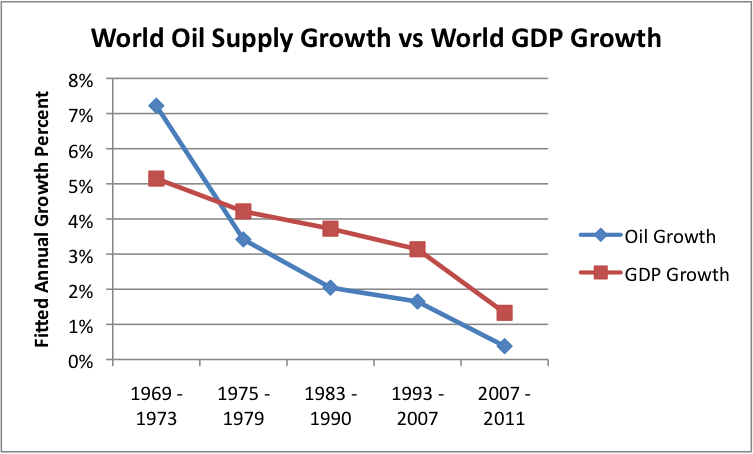
$this->bbcode_second_pass_quote('', 'I')t should not be surprising to find that there is a close tie between GDP growth and oil supply growth. While it is possible to substitute away from oil in some situations, or to find more efficient ways of using the oil, we have literally trillions of dollars of machinery in the world that uses oil right now. Because of this, the rate of substitution away from oil is necessarily very slow.
...
A person wouldn’t expect the two types of growth rates (oil supply and real GDP growth) to be exactly the same. The GDP growth rate would likely be higher than the oil growth rate because the oil growth rate is theoretically depressed for several reasons: continued switching from oil to cheaper fuel (often electricity); improvements in energy efficiency; and a gradual change to more of a service economy. (Services use less energy per unit of GDP than the manufacturing of goods.) If we compare the two fitted growth rates (world oil consumption and world real GDP), this is what the comparison looks like:

Graph: World Oil Supply Growth vs GDP Growth

We can also look at what theoretically would happen if world oil supply starts declining (but here we are on shakier ground, because of many follow-on effects). If oil supply declines by 1.0% per year, the regression line in Figure 12 would suggest that world real GDP can be expected still be expected to increase, but by only 1.2% per year. If world oil supply declines by 2.0% per year, the model would suggest world GDP can be expected to increase by only 0.4% per year. If world oil supply declines by 4.0% per year, the model would suggest that world real GDP can be expected to decline by 1.0% per year.

These are very tentative amounts. Clearly, if world oil supply or world real GDP starts decreasing, there will be many follow on effects, including political changes, and these may have effects of their own. Also, if it is clear that we again have a serious oil problem, there will be a mad dash to eliminate unnecessary use, and this may have a favorable impact on real world GDP. But it is clear from these calculated amounts that we are entering a very challenging period.
Evidence that oil limits are leading to limits to GDP growth
The oil barrel is half-full.
User avatar
kublikhan
Master Prognosticator
 
Posts: 5064
Joined: Tue 06 Nov 2007, 04:00:00
Location: Illinois
Top

Re: U.S. is now the world’s biggest oil and gas producer

Unread postby sparky » Tue 08 Oct 2013, 23:23:53

.
@ Kubilai , I found your estimate on the depletion side a bit optimistic
a one for one relationship between crude growth and GDP growth seems closer to the truth
GDP include some credit activity , one can discount about 1% of economic growth as pure financial churning
also the population increase must be discounted as not really "growth" except as a burden
User avatar
sparky
Intermediate Crude
Intermediate Crude
 
Posts: 3587
Joined: Mon 09 Apr 2007, 03:00:00
Location: Sydney , OZ

Re: U.S. is now the world’s biggest oil and gas producer

Unread postby Anvil » Wed 09 Oct 2013, 06:43:09

Just another thing to add to the many sins of the militant USA.
Anvil
Peat
Peat
 
Posts: 141
Joined: Thu 16 Jun 2011, 18:01:16

Re: U.S. is now the world’s biggest oil and gas producer

Unread postby kublikhan » Wed 09 Oct 2013, 11:21:53

$this->bbcode_second_pass_quote('sparky', '@') Kubilai , I found your estimate on the depletion side a bit optimistic
a one for one relationship between crude growth and GDP growth seems closer to the truth
GDP include some credit activity , one can discount about 1% of economic growth as pure financial churning
also the population increase must be discounted as not really "growth" except as a burden
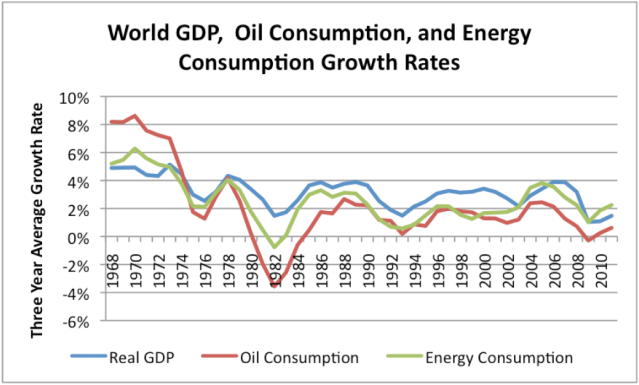
Those are Gail's estimates, and she did caution they rest on rather shaky foundations. However I would not be expecting a 1-1 correlation in oil consumption and GDP growth rates. Oil consumption has always been more volatile than GDP. Check out what happen during the oil crises of the 1970s/early 80s. In 1968, world oil consumption was growing around 8%, world GDP, 5%. By 1976, oil growth had fallen to under 2%, GDP 2.5%. By 1982, world oil consumption growth had fallen to around -4%, world GDP growth was positive 2%. Oil went from +8% growth to -4% growth, a difference of 12%. GDP went from 5% to 2%, a different of 3%.
World GDP, Oil Consumption, and energy consumption growth rates

Keep in mind that the US economy has a much lower oil intensity today than it did in the 1970s.
$this->bbcode_second_pass_quote('', 'I')'m going to operate from 1970 to 2003, as that's the period covered by all the series I need. Over those 33 years, real GDP increased by a factor of 2.74. In the same period, US oil consumption has gone from 5.36 billion barrels to 7.31 billion barrels (according to the EIA). That's an increase by a factor of 1.36. So oil intensity has decreased with a multiplier of 1.36/2.74 = 0.50. So we have a 50% reduction.

Now the breakdown of our 50% reduction in oil intensity is as follows.
* 20% is due to increased transportation efficiency - 2003 transportation oil usage is only 0.63 of what we would have expected just GDP scaling from 1970. That is mainly due to the 0.7 multiplier applied to gallons/mile in highway vehicles since 1970 (as discussed last night), but a little is due to improved aviation efficiency also.
* 13% is due to reduced use in residential and commercial buildings, almost all of it heating. These sectors got 0.09 and 0.19 multipliers respectively (ie they got mostly eliminated as the graph makes clear). This represents a mixture of improved building efficiency (insulation and draft-proofing) and fuel switching away from oil (primarily to natural gas).
* 5% is due to reduced use in electricity generation - a 0.20 multiplier (again, not much left). This is fuel switching to uranium, coal, and natural gas.
* 13% is due to reduced oil intensity of industry (a 0.49 multiplier). This presumably represents a mixture of
- Improved efficiency in industrial processes.
- Fuel switching by industry
- Dematerialization of the industrial sector (industry producing smaller, higher-tech, higher value products).
- Improved insulation and draft-proofing of industrial facilities to reduce heating needs
- Offshoring the nasty dirty oil-intensive parts of industry.

Moreover, since oil use, as I noted, is only two-thirds as important an input into world GDP as it was three decades ago, the effect of the current surge in oil prices, though noticeable, is likely to prove significantly less consequential to economic growth and inflation than the surge in the 1970s.
Why Oil Intensity Changed in the US Economy

Also keep in mind that world GDP growth Not = US/Europe GDP growth. Europe's GDP growth rate has been fluttering around 0% for some time now while the world GDP growth rate is over 2%. The world hit 4% GDP growth in 2010 while the US was half that.
world GDP growth
The oil barrel is half-full.
User avatar
kublikhan
Master Prognosticator
 
Posts: 5064
Joined: Tue 06 Nov 2007, 04:00:00
Location: Illinois
Top

Re: U.S. is now the world’s biggest oil and gas producer

Unread postby ROCKMAN » Wed 09 Oct 2013, 13:53:41

Pstarr – “The study ignores the cause of America's improving oil-trade deficit”. I was going to ask over what time span but then I see you mention a quadrupling in oil prices so I assume you mean over the last 10 to 12 years. If by the improved oil-trade deficit you mean how much purchasing imported oil adds to our trade imbalance here are the numbers: oil-trade deficit about a dozen years ago = $110 billion/year. Oil-trade deficit today = $260 billion/year. We are importing less oil by volume but are spending a great deal more money for oil imports than when we were importing more oil. We would be spending more for imported oil if we were importing as much but only if oil prices had increased significantly and we didn’t increase domestic production. But we did increase domestic production because oil prices did zoom up. If oil prices hadn’t zoomed up we would be importing more oil. So far a rather well behaved feedback loop.

Likewise we’re producing more domestic oil but at a cost about 3X as much as when we were producing less domestically. But I think you already know these stats.
User avatar
ROCKMAN
Expert
Expert
 
Posts: 11397
Joined: Tue 27 May 2008, 03:00:00
Location: TEXAS

Re: U.S. is now the world’s biggest oil and gas producer

Unread postby Graeme » Wed 09 Oct 2013, 15:24:58

North American oil will grow even if price shrinks, analyst says

$this->bbcode_second_pass_quote('', 'N')orth American oil production is showing no signs of slowing down and will likely continue growing unless prices fall to around $60 a barrel, more than $40 below today’s price, an analyst said at a Houston conference Tuesday.

Tony Scott, manager of oil and gas analysis for Bentek Energy, said the $100-plus price means high returns for oil companies. With companies cutting their costs and improving their production methods, their work probably will remain lucrative at far lower prices, he said.

U.S. benchmark light, sweet crude ended up 46 cents at $103.49 a barrel Tuesday on the New York Mercantile Exchange.

“We’ll see a slowdown at $80, but it’s not going to be a dramatic slowdown,” Scott said at the Platts Commodity Week conference held at the Hilton Americas in downtown Houston.


fuelfix
Human history becomes more and more a race between education and catastrophe. H. G. Wells.
Fatih Birol's motto: leave oil before it leaves us.
User avatar
Graeme
Fusion
Fusion
 
Posts: 13258
Joined: Fri 04 Mar 2005, 04:00:00
Location: New Zealand
Top

Re: U.S. is now the world’s biggest oil and gas producer

Unread postby ROCKMAN » Wed 09 Oct 2013, 16:57:03

pstarr - I'm continually amazed over the lack of vocal outcry over oil/fuel prices in the US. I easily recall the days when much smaller increases led to a lot of public chatter about hanging us geologist up by our balls. Maybe it’s because so much else is going nuts in the world and in D.C. As you point if the US is paying 3X as much for oil as it was not that long ago then the average consumer is paying 3X as much. Lots of press about Canadian oil sands, pipeline permits, oil spills in the GOM frac’ng destroying water supplies, etc. And when was the last time we heard a big public outcry over oil prices? But almost daily headlines about the US becoming the biggest oil producer on the planet. When was the last time you saw a story about those mysterious “speculators” that are responsible for high oil prices?

I just babble on mostly to tease the cornucopians amongst us. I don’t think Joe6Pack would hear me if I were shouting it in his ear. Perhaps it’s just a case of the Mother of All Denials.
User avatar
ROCKMAN
Expert
Expert
 
Posts: 11397
Joined: Tue 27 May 2008, 03:00:00
Location: TEXAS

Re: U.S. is now the world’s biggest oil and gas producer

Unread postby John_A » Wed 09 Oct 2013, 17:30:37

$this->bbcode_second_pass_quote('ROCKMAN', '
')To be honest sometimes I wonder why I should have to point out the obvious.


Interesting Rock. But that is the ONE thing I never wonder about. Horse...water....etc etc.
45ACP: For when you want to send the very best.
John_A
Heavy Crude
Heavy Crude
 
Posts: 1193
Joined: Sat 25 Jun 2011, 21:16:36
Top

Re: U.S. is now the world’s biggest oil and gas producer

Unread postby kublikhan » Wed 09 Oct 2013, 17:52:12

$this->bbcode_second_pass_quote('ROCKMAN ', 'I') just babble on mostly to tease the cornucopians amongst us. I don’t think Joe6Pack would hear me if I were shouting it in his ear. Perhaps it’s just a case of the Mother of All Denials.
I think it's more like after the initial shock of 2008 wore off, these gas prices are not that scary anymore as we have had time to adjust.

$this->bbcode_second_pass_quote('', 'W')e must be getting used to Middle East-related spikes in the price of oil. Worries about the Syrian civil war sent crude oil prices above $110 a barrel last week. Mostly absent this time, however, is the usual fretting about how higher oil prices are going to sink the economy.

Consumers may have become somewhat shock-resistant. After the gyrations of the past few years, an additional nickel or dime per gallon is no longer the budget-breaker it once was. “It’s that old fool me once, fool me twice thing,” says Sameer Samana, an international strategist at Wells Fargo Advisors in St. Louis. “You can only be surprised by that volatility and the price spikes so many times.”

U.S. motorists, for their part, have gotten used to gasoline prices in the range of $3.50 a gallon, sometimes a bit higher and sometimes a bit lower.
Consumers are getting used to oil-price spikes
The oil barrel is half-full.
User avatar
kublikhan
Master Prognosticator
 
Posts: 5064
Joined: Tue 06 Nov 2007, 04:00:00
Location: Illinois
Top

Re: U.S. is now the world’s biggest oil and gas producer

Unread postby ROCKMAN » Thu 10 Oct 2013, 08:53:06

pstarr - OK ... we know your limits. Rotting toes...OK. Rotting nuts...not OK. LOL. I appreciate your words though. I've gotten use to cruising around on my "polio crutches" (as my hands like to call them) even when I'm on a well site. And I automatically reach high with my left arm because of rotator cup problems even though I'm right handed. And it's true: I can't remember the last time hearing anyone complain about gasoline prices. And know all the news stories are about how much cheaper fuel has gotten lately.
User avatar
ROCKMAN
Expert
Expert
 
Posts: 11397
Joined: Tue 27 May 2008, 03:00:00
Location: TEXAS

PreviousNext

Return to Peak Oil Discussion

Who is online

Users browsing this forum: No registered users and 1 guest

cron