


PeakOil is You
TWO AMERICAS
Re: TWO AMERICAS
 by Ibon » Fri 05 May 2017, 08:38:26
$this->bbcode_second_pass_quote('evilgenius', 'B')ut it's also about how people just do not want to become involved. People don't want to confront their own attitudes. They don't really want to correct injustices.
Until the matrix which creates this social isolation and apathy is undermined there will be no change to this. You cannot have any meaningful civic engagement beforehand.
Individuals get embedded and set in their ways as they age, the saying you cannot teach an old dog new tricks. I think civilizations suffer this same process, when they age the system looses its elasticity, its ability to re invent itself, to address injustices.
You are asking individuals here to become involved but this represents a daunting task when individuals are only a reflection of the values of the culture they come from. It goes further though, we discussed how most folks are just followers. Even those few who are pro-active and initiators, even they cannot really "get involved" as you say because of the inertia that has embedded itself in our aging civilization.
Most folks who are initiators or pro-active end up seeking personal gain and become leaches on the society as a whole. The whole orientation is about gaming the system. Just look at our politics, our financial institutions, corporate policies, it's all geared toward extracting personal gain.
Nothing flows inward toward making the whole sound and resilient. It's all about individuals extracting the maximum out of the system.
We are reflections of the system. The entire human eco system on the planet is parasitic and is about extraction of resources that flow one way. The externalities of environmental damages are not considered in the economic system. Should we be surprised that individuals follow this same orientation????
As the system does so do the individuals.
This is why even those individuals who have the personal integrity are fighting upstream against an enormous current of dysfunction. This causes folks with personal integrity to retreat as well to more individual pursuits, not out of selfishness but because the system has reached a level of dysfunction where the only area left where one can effect change is ones immediate surroundings. This explains one of the reasons why I find myself on top of a mountain in an isolated wilderness. Once you jump a level higher to the macro structure like politics, the economy, the government, you are already in totally dysfunctional territory.
This is a rather bleak assessment but it is not hopeless since the pathway is clear. We are heading toward self destruction and the cracks that are opening will expand to chasms and it is within these cracks that one can affect change. There is a growing population of the disenfranchised. They have nothing to lose, the system has already spit them out. Are they a growing resource base from where change will come? Not in the early days because the parasitic orientation of those in power will do anything and everything to preserve their personal privilege. Today they have turned this into a political movement. It is overt and not covert.
Eventually when the cracks grow to chasms there will be a critical mass of the disenfranchised and the power structure will start to collapse. Civil war, class struggle, this will ripple deep through our civilization. It will be a time of incredible upheaval. Brave and courageous folks attempting change will be mowed down by the power structure but these folks will become martyrs. Eventually the parasites will be locked in their bunkers and the masses of disenfranchised will find them and hang them and burn them and dance around the fire. The brotherhood will be strong.
I have a crystal ball and it is not foggy. It is crystal clear.

Patiently awaiting the pathogens. Our resiliency resembles an invasive weed. We are the Kudzu Ape
blog: http://blog.mounttotumas.com/
website: http://www.mounttotumas.com
blog: http://blog.mounttotumas.com/
website: http://www.mounttotumas.com
-

Ibon - Expert

- Posts: 9572
- Joined: Fri 03 Dec 2004, 04:00:00
- Location: Volcan, Panama
Re: TWO AMERICAS
by onlooker » Fri 05 May 2017, 09:49:41
To all of what Ibon, just said I say the Hell is what we will leave behind but WE are going to have to cross through the wide expanse of it and its worse parts to finally leave it behind
"We are mortal beings doomed to die
-

onlooker - Fission

- Posts: 10957
- Joined: Sun 10 Nov 2013, 13:49:04
- Location: NY, USA
Re: TWO AMERICAS
by KaiserJeep » Fri 05 May 2017, 11:04:36
Ibon, you are IMHO going too far down one particular rathole. YES humanity is damaging to the ecology. But overshoot in any animal species has often had terribly significant impact to the environment that species lives in.
The real question is where does Humanity peak? Many assume that we are one the very edge of a crash:
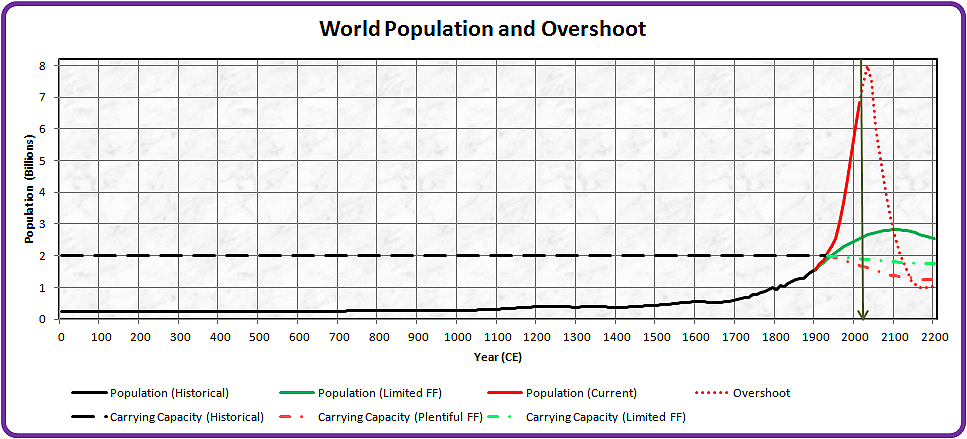
...while the UN is a little more sanguine:
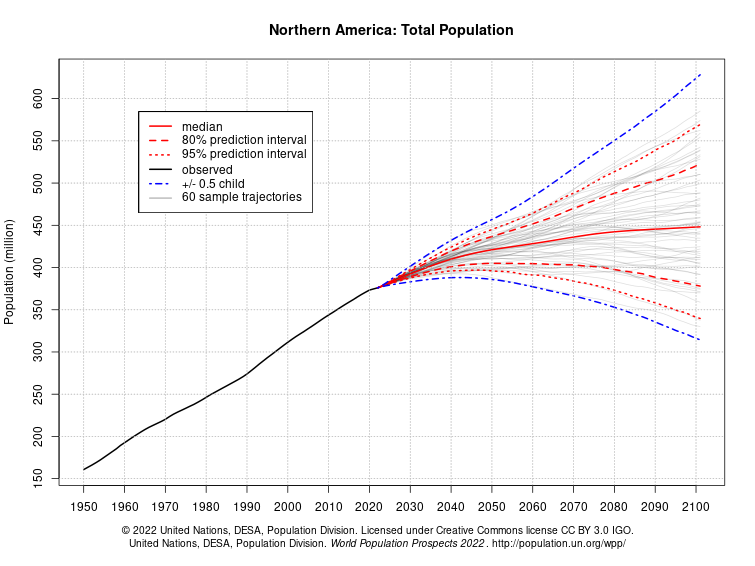
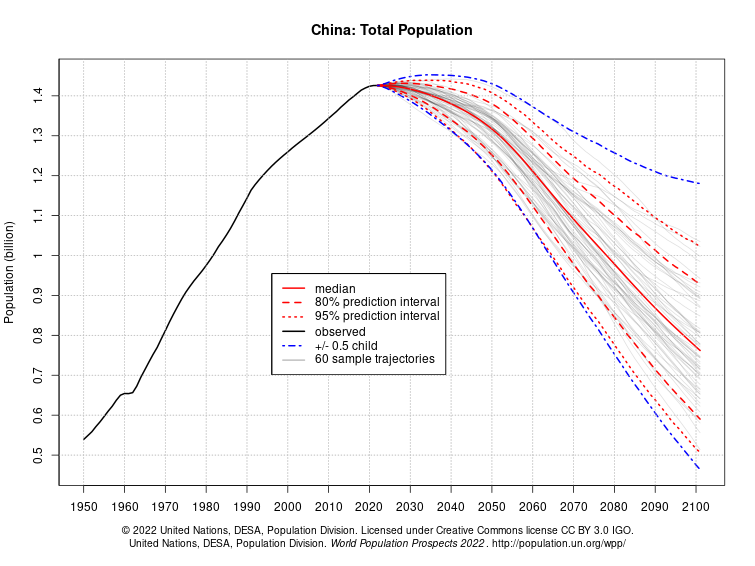
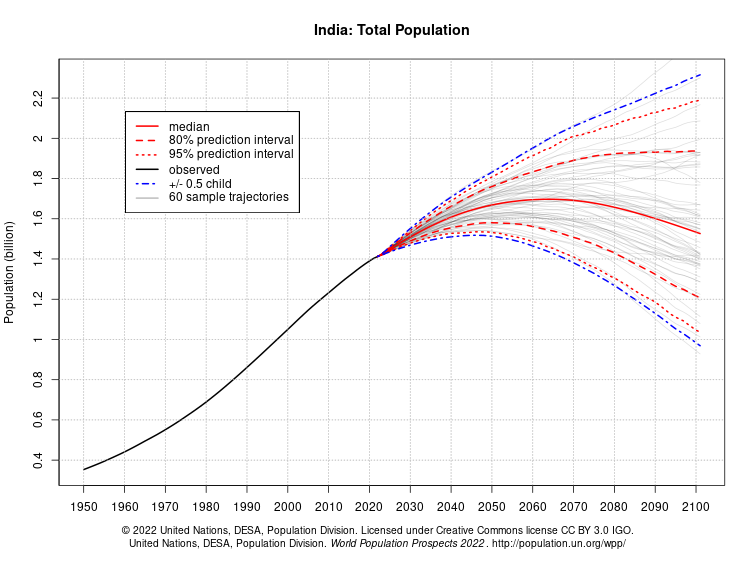
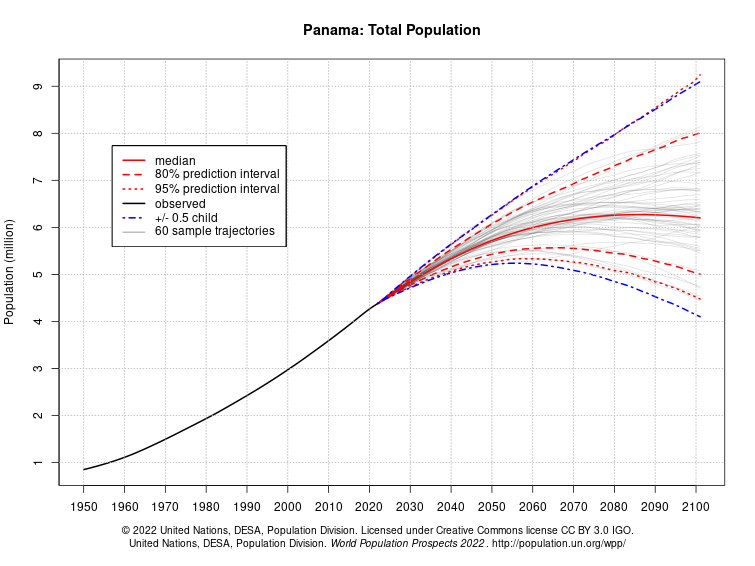
...with the joker in the deck being whether China goes out with a whimper or a big nuclear warfare bang.....
Figures are from Paul Chefurka:
http://www.paulchefurka.ca/CC_Overshoot.html
and the UN:
https://esa.un.org/unpd/wpp/Graphs/Probabilistic/POP/TOT/
The real question is where does Humanity peak? Many assume that we are one the very edge of a crash:
...while the UN is a little more sanguine:
...with the joker in the deck being whether China goes out with a whimper or a big nuclear warfare bang.....
Figures are from Paul Chefurka:
http://www.paulchefurka.ca/CC_Overshoot.html
and the UN:
https://esa.un.org/unpd/wpp/Graphs/Probabilistic/POP/TOT/
KaiserJeep 2.0, Neural Subnode 0010 0000 0001 0110 - 1001 0011 0011, Tertiary Adjunct to Unimatrix 0000 0000 0001
Resistance is Futile, YOU will be Assimilated.
Warning: Messages timestamped before April 1, 2016, 06:00 PST were posted by the unmodified human KaiserJeep 1.0
Resistance is Futile, YOU will be Assimilated.
Warning: Messages timestamped before April 1, 2016, 06:00 PST were posted by the unmodified human KaiserJeep 1.0
- KaiserJeep
- Light Sweet Crude

- Posts: 6094
- Joined: Tue 06 Aug 2013, 17:16:32
- Location: Wisconsin's Dreamland
Re: TWO AMERICAS
by Ibon » Fri 05 May 2017, 18:34:07
$this->bbcode_second_pass_quote('KaiserJeep', ' ')YES humanity is damaging to the ecology. But overshoot in any animal species has often had terribly significant impact to the environment that species lives in.
Yes this is true. The carrying capacity drops below the base line that existed before overshoot due to environmental degradation. This will be true for humans as it has been for other species. More so because we are causing local degradation to all major resource sinks plus systemic changes due to biodiversity loss and climate change.
The silver lining here is that the 21st century social upheaval will be increasingly steered by mother nature and not just from within the man made social and political conflicts. Mother nature is added to the mix in the form of the external consequences of human overshoot. This external steering can dissolve cultural divides and polarity as the impacts do not target one or another ideology. Capitalism will be forced to morph into something else not because of an apposing ideology but simply because external constraints will force the long ignored externalities of environmental degradation to be encompassed in any investment or decision of where resources should go. Not from some ideology preached by some socialist professor but from the shifting values of citizens whereby environmental stability will be added as a cultural value to consumption.
Please take a minute to consider this. Earlier 20th century capitalism hailed consumption as liberty from the toil of most folks agrarian past. Everyone looked at capitalism and consumption as providing security and stability. This was actually the case when you consider the improved quality of life, standard of living and wealth.
Move forward into 21st century environmental feedbacks of human overshoot. A gyrating biosphere of rising sea levels, crop failures and social and political conflicts, maybe pandemics, mass migration of hundreds of millions will result in the emergence of another set of values in the citizenry. Stability and security will increase but unlike the 20th century, it wont be consumption that is associated with stability but rather an increased regulation of consumption.
Citizens wont see this as government oppression and over regulation. They will welcome any attempts at regulating an external environment that went from 20th century benign to 21st century mercurial and destabilizing.
In todays value anyone like Cog for example would consider regulation of consumption as an imposition of his liberty. This is the hallmark of 20th century consumption values. To assume that this cultural position will stay resilient into the later half of the 21st century when the external will throw some major curve balls is highly unlikely. Society will go on war footing and instead of fighting regulation will embrace it.
This adaptability requires, needs , depends on and is only possible as a response to growing instabilities. That is why since a couple of years now I have begun to see more and more clearly that the issues we choose to fight against like climate change and increasing poverty and all the other myriad of consequences are actually not the problems but rather the solutions. It is hard to flip 180 degrees to see that the portal through which our culture may one day learn to self regulate is the very consequences of having not done so. Peak Oil, climate change, pandemics, crop failures, mass migration, fresh water constraints. There is a basket of external consequences to choose from.
There is a Cornucopia of Consequences to choose from..... all of them representing the catalyst, the solution to human overshoot and also the portal through which our civilization re invents itself.
Or not.
Patiently awaiting the pathogens. Our resiliency resembles an invasive weed. We are the Kudzu Ape
blog: http://blog.mounttotumas.com/
website: http://www.mounttotumas.com
blog: http://blog.mounttotumas.com/
website: http://www.mounttotumas.com
-
Ibon - Expert
- Posts: 9572
- Joined: Fri 03 Dec 2004, 04:00:00
- Location: Volcan, Panama
Re: TWO AMERICAS
by KaiserJeep » Fri 05 May 2017, 18:57:15
Or not.
Man is also the animal that strives to understand the ecosystem and biodiversity. The ecological damages we are talking about have been occuring for hundreds of years. Efforts at mitigation are also hundreds of years old. Now we have the twin weapons of Science and Digital Computing to understand and manage adverse effects.
Have you looked at any cornfields in the MidWest lately? There are no weeds in whole counties. They have been eradicated by decades of herbicides and GMO grains they cannot compete with. The dirt is no longer living soil, it is a lifeless matrix upon which they spray chemicals and which the rain falls upon. Yet the rotation of corn and the soybeans and the Winter wheat cover is still being perfected, along with the minimization of petroleum fuels invested, and yields of grain and soy and animal feed grasses have been increasing steadily over those decades.
Most of us assume that the "fragile" ecology will eventually crash from such exploitation. I do not. Too many scientists, too many agricultural engineers, too much gene-splicing is going on. As long as we can "manage" these virtually sterile croplands, using chemical analyses and irrigation and increasingly specialized GMO species, more food will be produced.
Based on present trends, I see no reason that the world population might not go as high as 20-30 billion. Certainly the UN is making long term plans to feed that many.
What if, in spite of the hubris man displays, he subjugates and controls and successfully exploits a much simplified global ecology?
Maybe the World won't end, and we will stop reproducing beyond replacement rates, naturally.
Man is also the animal that strives to understand the ecosystem and biodiversity. The ecological damages we are talking about have been occuring for hundreds of years. Efforts at mitigation are also hundreds of years old. Now we have the twin weapons of Science and Digital Computing to understand and manage adverse effects.
Have you looked at any cornfields in the MidWest lately? There are no weeds in whole counties. They have been eradicated by decades of herbicides and GMO grains they cannot compete with. The dirt is no longer living soil, it is a lifeless matrix upon which they spray chemicals and which the rain falls upon. Yet the rotation of corn and the soybeans and the Winter wheat cover is still being perfected, along with the minimization of petroleum fuels invested, and yields of grain and soy and animal feed grasses have been increasing steadily over those decades.
Most of us assume that the "fragile" ecology will eventually crash from such exploitation. I do not. Too many scientists, too many agricultural engineers, too much gene-splicing is going on. As long as we can "manage" these virtually sterile croplands, using chemical analyses and irrigation and increasingly specialized GMO species, more food will be produced.
Based on present trends, I see no reason that the world population might not go as high as 20-30 billion. Certainly the UN is making long term plans to feed that many.
What if, in spite of the hubris man displays, he subjugates and controls and successfully exploits a much simplified global ecology?
Maybe the World won't end, and we will stop reproducing beyond replacement rates, naturally.
KaiserJeep 2.0, Neural Subnode 0010 0000 0001 0110 - 1001 0011 0011, Tertiary Adjunct to Unimatrix 0000 0000 0001
Resistance is Futile, YOU will be Assimilated.
Warning: Messages timestamped before April 1, 2016, 06:00 PST were posted by the unmodified human KaiserJeep 1.0
Resistance is Futile, YOU will be Assimilated.
Warning: Messages timestamped before April 1, 2016, 06:00 PST were posted by the unmodified human KaiserJeep 1.0
- KaiserJeep
- Light Sweet Crude
- Posts: 6094
- Joined: Tue 06 Aug 2013, 17:16:32
- Location: Wisconsin's Dreamland
Re: TWO AMERICAS
by Ibon » Fri 05 May 2017, 21:50:58
$this->bbcode_second_pass_quote('KaiserJeep', 'O')r not.
Man is also the animal that strives to understand the ecosystem and biodiversity. The ecological damages we are talking about have been occuring for hundreds of years. Efforts at mitigation are also hundreds of years old. Now we have the twin weapons of Science and Digital Computing to understand and manage adverse effects.
Have you looked at any cornfields in the MidWest lately? There are no weeds in whole counties. They have been eradicated by decades of herbicides and GMO grains they cannot compete with. The dirt is no longer living soil, it is a lifeless matrix upon which they spray chemicals and which the rain falls upon. Yet the rotation of corn and the soybeans and the Winter wheat cover is still being perfected, along with the minimization of petroleum fuels invested, and yields of grain and soy and animal feed grasses have been increasing steadily over those decades.
Most of us assume that the "fragile" ecology will eventually crash from such exploitation. I do not. Too many scientists, too many agricultural engineers, too much gene-splicing is going on. As long as we can "manage" these virtually sterile croplands, using chemical analyses and irrigation and increasingly specialized GMO species, more food will be produced.
Based on present trends, I see no reason that the world population might not go as high as 20-30 billion. Certainly the UN is making long term plans to feed that many.
What if, in spite of the hubris man displays, he subjugates and controls and successfully exploits a much simplified global ecology?
Maybe the World won't end, and we will stop reproducing beyond replacement rates, naturally.
Man is also the animal that strives to understand the ecosystem and biodiversity. The ecological damages we are talking about have been occuring for hundreds of years. Efforts at mitigation are also hundreds of years old. Now we have the twin weapons of Science and Digital Computing to understand and manage adverse effects.
Have you looked at any cornfields in the MidWest lately? There are no weeds in whole counties. They have been eradicated by decades of herbicides and GMO grains they cannot compete with. The dirt is no longer living soil, it is a lifeless matrix upon which they spray chemicals and which the rain falls upon. Yet the rotation of corn and the soybeans and the Winter wheat cover is still being perfected, along with the minimization of petroleum fuels invested, and yields of grain and soy and animal feed grasses have been increasing steadily over those decades.
Most of us assume that the "fragile" ecology will eventually crash from such exploitation. I do not. Too many scientists, too many agricultural engineers, too much gene-splicing is going on. As long as we can "manage" these virtually sterile croplands, using chemical analyses and irrigation and increasingly specialized GMO species, more food will be produced.
Based on present trends, I see no reason that the world population might not go as high as 20-30 billion. Certainly the UN is making long term plans to feed that many.
What if, in spite of the hubris man displays, he subjugates and controls and successfully exploits a much simplified global ecology?
Maybe the World won't end, and we will stop reproducing beyond replacement rates, naturally.
This was one of your better posts KJ. And it is a totally probable counter argument to my last post. Years ago I was milking a theme here at PO.com that it was our resiliency that is the problem and not the fragility of our precarious situation.
I think everyone should understand that the scenario KJ outlines here may very well happen. As my tag line states,.....Our resiliency resembles an invasive weed. We are the Kudzu Ape
Patiently awaiting the pathogens. Our resiliency resembles an invasive weed. We are the Kudzu Ape
blog: http://blog.mounttotumas.com/
website: http://www.mounttotumas.com
blog: http://blog.mounttotumas.com/
website: http://www.mounttotumas.com
-
Ibon - Expert
- Posts: 9572
- Joined: Fri 03 Dec 2004, 04:00:00
- Location: Volcan, Panama
Re: TWO AMERICAS
by onlooker » Fri 05 May 2017, 22:44:44
Kaiser and Ibon, I ask you to consider this:
http://dieoff.org/page134.htm Joseph Tainter
Yet complexity can also be detrimental to sustainability.
Since our approach to resolving our problems has been to develop the most complex society and economy of human history, it is important to understand how previous societies fared when they pursued analogous strategies.
The development of complexity is thus an economic process: complexity levies costs and yields benefits. It is an investment, and it gives a variable return. Complexity can be both beneficial and detrimental. Its destructive potential is evident in historical cases where increased expenditures on socioeconomic complexity reached diminishing returns, and ultimately, in some instances, negative returns (Tainter 1988, 1994b). This outcome emerges from the normal economic process: simple, inexpensive solutions are adopted before more complex, expensive ones. Thus, as human populations have increased, hunting and gathering has given way to increasingly intensive agriculture, and to industrialized food production that consumes more energy than it produces (Clark and Haswell 1966; Cohen 1977; Hall et al. 1992). Minerals and energy production move consistently from easily accessible, inexpensively exploited reserves to ones that are costlier to find, extract, process, and distribute. Socioeconomic organization has evolved from egalitarian reciprocity, short-term leadership, and generalized roles to complex hierarchies with increasing specialization.
Ultimately a growing society reaches a point where continued investment in complexity yields higher returns, but at a declining marginal rate.
Two things make a society liable to collapse at this point. First new emergencies impinge on a people who are investing in a strategy that yields less and less marginal return. As such a society becomes economically weakened it has fewer reserves with which to counter major adversities. A crisis that the society might have survived in its earlier days now becomes insurmountable.
Second, diminishing returns make complexity less attractive and breed disaffection. As taxes and other costs rise and there are fewer benefits at the local level, more and more people are attracted by the idea of being independent. The society "decomposes" as people pursue their immediate needs rather than the long-term goals of the leadership. [3]
The more likely option is a future of greater investments in problem solving, increasing overall complexity, and greater use of energy. This option is driven by the material comforts it provides, by vested interests, by lack of alternatives, and by our conviction that it is good
Does not complexity and technology engender more of the same? Yes
So, are they're limits to our technological prowess? Yes
Can we really reboot Industrial Civilization if it collapses? No
Are we not bound to the law of diminishing returns in our complexity and technology? Yes
This process is describing almost to a tee our recent evolution. Ibon you expect Collapse and to some degree welcome it. Kaiser you seem to present a dichotomy of losers and a few winners on this planet. We are a species now that is exponentially impacting our surroundings in very negative ways. And we in overshoot of the planetary environment http://peakoil.com/enviroment/we-would- ... ustainable. So, I see little now that can mitigate a worldwide crash and collapse. Whatever remains afterwards will NOT resemble anything we have now.
http://dieoff.org/page134.htm Joseph Tainter
Yet complexity can also be detrimental to sustainability.
Since our approach to resolving our problems has been to develop the most complex society and economy of human history, it is important to understand how previous societies fared when they pursued analogous strategies.
The development of complexity is thus an economic process: complexity levies costs and yields benefits. It is an investment, and it gives a variable return. Complexity can be both beneficial and detrimental. Its destructive potential is evident in historical cases where increased expenditures on socioeconomic complexity reached diminishing returns, and ultimately, in some instances, negative returns (Tainter 1988, 1994b). This outcome emerges from the normal economic process: simple, inexpensive solutions are adopted before more complex, expensive ones. Thus, as human populations have increased, hunting and gathering has given way to increasingly intensive agriculture, and to industrialized food production that consumes more energy than it produces (Clark and Haswell 1966; Cohen 1977; Hall et al. 1992). Minerals and energy production move consistently from easily accessible, inexpensively exploited reserves to ones that are costlier to find, extract, process, and distribute. Socioeconomic organization has evolved from egalitarian reciprocity, short-term leadership, and generalized roles to complex hierarchies with increasing specialization.
Ultimately a growing society reaches a point where continued investment in complexity yields higher returns, but at a declining marginal rate.
Two things make a society liable to collapse at this point. First new emergencies impinge on a people who are investing in a strategy that yields less and less marginal return. As such a society becomes economically weakened it has fewer reserves with which to counter major adversities. A crisis that the society might have survived in its earlier days now becomes insurmountable.
Second, diminishing returns make complexity less attractive and breed disaffection. As taxes and other costs rise and there are fewer benefits at the local level, more and more people are attracted by the idea of being independent. The society "decomposes" as people pursue their immediate needs rather than the long-term goals of the leadership. [3]
The more likely option is a future of greater investments in problem solving, increasing overall complexity, and greater use of energy. This option is driven by the material comforts it provides, by vested interests, by lack of alternatives, and by our conviction that it is good
Does not complexity and technology engender more of the same? Yes
So, are they're limits to our technological prowess? Yes
Can we really reboot Industrial Civilization if it collapses? No
Are we not bound to the law of diminishing returns in our complexity and technology? Yes
This process is describing almost to a tee our recent evolution. Ibon you expect Collapse and to some degree welcome it. Kaiser you seem to present a dichotomy of losers and a few winners on this planet. We are a species now that is exponentially impacting our surroundings in very negative ways. And we in overshoot of the planetary environment http://peakoil.com/enviroment/we-would- ... ustainable. So, I see little now that can mitigate a worldwide crash and collapse. Whatever remains afterwards will NOT resemble anything we have now.
"We are mortal beings doomed to die
-
onlooker - Fission
- Posts: 10957
- Joined: Sun 10 Nov 2013, 13:49:04
- Location: NY, USA
Re: TWO AMERICAS
by Ibon » Sat 06 May 2017, 07:17:26
$this->bbcode_second_pass_quote('onlooker', '
')
Ultimately a growing society reaches a point where continued investment in complexity yields higher returns, but at a declining marginal rate.
')
Ultimately a growing society reaches a point where continued investment in complexity yields higher returns, but at a declining marginal rate.
The Collapse of Complex Societies by Joseph Tainter is a must read for the dynamics at play here. I read the book twice, once shortly after its publication and then years later again through the lens of peak oil particularly when Montequest frequently made reference to this book in his many posts.
Tainter's arguments are persuasive, the parallels unfolding in real time reinforce many of his main tenants as does the history of past civilizations. Intuitively the cyclical nature of growing complexity, collapse and renewal mirrors natural processes as well.
Human resiliency is unprecedented though. We have managed to pull the rabbit out of the hat several times since Malthus early predictions of collapse 200 years ago and we are once again on the cusp of perhaps revolutionary technological advances and so I would not put all my die-off eggs in Tainter's basket yet.
I don't believe we will pull the rabbit out of the hat once again. The ecologist in me intuitively gravitates toward Tainter's position and towards my earlier posts here on this thread.
Smarter minds than yours or mine however have repeatedly underestimated the resiliency of Kudzu Ape. To discount this resiliency would be foolish. KJ's post might be correct.
Just saying.
Patiently awaiting the pathogens. Our resiliency resembles an invasive weed. We are the Kudzu Ape
blog: http://blog.mounttotumas.com/
website: http://www.mounttotumas.com
blog: http://blog.mounttotumas.com/
website: http://www.mounttotumas.com
-
Ibon - Expert
- Posts: 9572
- Joined: Fri 03 Dec 2004, 04:00:00
- Location: Volcan, Panama