$this->bbcode_second_pass_quote('RedStateGreen', '
')We just can't understand it fully because we only know causality and a linear progression of time.



PeakOil is You
Theism, Agnosticism, Atheism, Deism, etc...
Re: Theism, Agnosticism, Atheism, Deism, etc...
 by Ludi » Sat 27 Dec 2008, 22:29:11
There are also theories that Thingness or the existence of space-time continua, of which ours is just one of many, have always existed, so there was no need for an immortal Creator. Blobs of space-time continua may exist in an infinite, timeless, and/or immortal "Out There" that we can't be aware of with the usual senses and instruments.
String Theory deals with this a bit.
Who knows, the active principle of OutThereness may be God.
- Ludi
Re: Theism, Agnosticism, Atheism, Deism, etc...
by yippleflipple » Sun 28 Dec 2008, 00:57:15
sorry 3aidlillahi, Im kind of a noob if you havent noticed, so still looking for what I like and dont like
Last edited by yippleflipple on Sat 10 Jan 2009, 10:12:58, edited 1 time in total.
-

yippleflipple - Peat

- Posts: 71
- Joined: Sat 13 Sep 2008, 03:00:00
Re: Theism, Agnosticism, Atheism, Deism, etc...
by Auntie_Cipation » Sun 28 Dec 2008, 01:35:58
Atheist, Taoist, Animist, Deep Ecologist
"... among the ways available in which a man can die, it is a rare and signal distinction to be killed by a leopard."
-- Raymond Dasmann
-- Raymond Dasmann
-

Auntie_Cipation - Lignite
- Posts: 210
- Joined: Thu 18 Aug 2005, 03:00:00
Re: Theism, Agnosticism, Atheism, Deism, etc...
by mercurygirl » Sun 28 Dec 2008, 02:21:53
$this->bbcode_second_pass_quote('Ludi', '')$this->bbcode_second_pass_quote('RedStateGreen', '
')We just can't understand it fully because we only know causality and a linear progression of time.
')We just can't understand it fully because we only know causality and a linear progression of time.
There are also theories that Thingness or the existence of space-time continua, of which ours is just one of many, have always existed, so there was no need for an immortal Creator. Blobs of space-time continua may exist in an infinite, timeless, and/or immortal "Out There" that we can't be aware of with the usual senses and instruments.
String Theory deals with this a bit.
Who knows, the active principle of OutThereness may be God.

- mercurygirl
- Heavy Crude

- Posts: 1091
- Joined: Sun 29 Jan 2006, 04:00:00
Re: Theism, Agnosticism, Atheism, Deism, etc...
by vision-master » Sun 28 Dec 2008, 10:00:17
$this->bbcode_second_pass_quote('Quinny', 'I')t's more likely to support the existence of other life out there than god.
I think the possibility of life out there is slim but there is a chance.
The existence of God seems ridiculous. I was always told at Sunday School that 'God is Good' - I thought they were being literal, and I suppose still accept it that way ie. a symbol of all that is good in the world.
Problem is that many religions/religious people use God/religion as an excuse for intolernce and hatred neither of which could be described as good.
Non-Atheists explain this?
If God created the world. Who created God?
I think the possibility of life out there is slim but there is a chance.
The existence of God seems ridiculous. I was always told at Sunday School that 'God is Good' - I thought they were being literal, and I suppose still accept it that way ie. a symbol of all that is good in the world.
Problem is that many religions/religious people use God/religion as an excuse for intolernce and hatred neither of which could be described as good.
Non-Atheists explain this?
If God created the world. Who created God?
As is above, so is below. Do not separate our consciousness as something unique. The Sun, the Moon, the entire Cosmos has a consciousness. As has been said, "we are one". Timeless. Egyptian Hieroglyphs talk about their civilization going back 36,000 years, the time of the Gods, the Golden age. Ancient Pharaohs believed they could transform into a Sun in the after life. The concept isn’t as far fetched as one would think. Its entirely possible mankind went through devolution until about the time of Christ and since then we have slowly been evolving back to a Golden age. Human consciousness has been sleeping, just as the Cosmos does. Everything has its cycles.

In Egyptian culture, science was not separated into different disciplines. All science focused towards the afterlife. Today, science is soulless. That is why we live in a crazy World and there is so much unhappiness.
Sumerians talk about a time of the Gods too. The truth is slowly coming out.
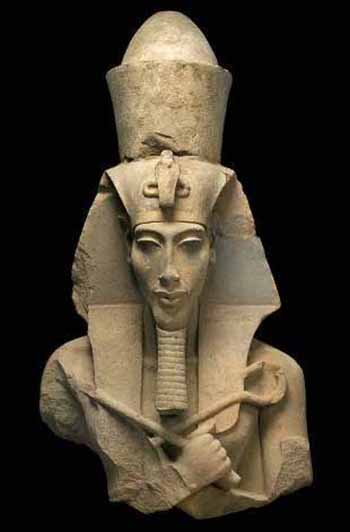
Notice the head of a snake comming out of the Pharaohs forehead. This is the third eye that is connected to the pineal gland.
$this->bbcode_second_pass_quote('', '
')
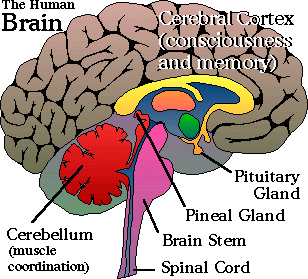
While the physiological function of the pineal gland has been unknown until recent times, mystical traditions and esoteric schools have long known this area in the middle of the brain to be the connecting link between the physical and spiritual worlds. Considered the most powerful and highest source of ethereal energy available to humans, the pineal gland has always been important in initiating supernatural powers. Development of psychic talents has been closely associated with this organ of higher vision.
- vision-master