


PeakOil is You
The Price of Oil's Replacement
Re: The Price of Oil's Replacement
 by vtsnowedin » Wed 06 Aug 2008, 14:20:03
A shot glass full is as far from 100 gallons as taking off from Long Island is from landing in Paris.
-

vtsnowedin - Fusion

- Posts: 14897
- Joined: Fri 11 Jul 2008, 03:00:00
Re: The Price of Oil's Replacement
by ROCKMAN » Wed 06 Aug 2008, 17:01:06
Mr. Bill,
The $4 trillion still seems light but way beyond my expertise. But who would supply the $400 billion/yr while we'll still be paying ever increasing energy prices? Even if DD kicks in high gear that would also kill many capital sources. Oddly enough, the only likely capital source I can imagine would be OPEC.
Am I way out of line with these thoughts?
The $4 trillion still seems light but way beyond my expertise. But who would supply the $400 billion/yr while we'll still be paying ever increasing energy prices? Even if DD kicks in high gear that would also kill many capital sources. Oddly enough, the only likely capital source I can imagine would be OPEC.
Am I way out of line with these thoughts?
-
ROCKMAN - Expert

- Posts: 11397
- Joined: Tue 27 May 2008, 03:00:00
- Location: TEXAS
Re: The Price of Oil's Replacement
by Starvid » Thu 07 Aug 2008, 00:11:38
$this->bbcode_second_pass_quote('ROCKMAN', 'M')r. Bill,
The $4 trillion still seems light but way beyond my expertise. But who would supply the $400 billion/yr while we'll still be paying ever increasing energy prices? Even if DD kicks in high gear that would also kill many capital sources. Oddly enough, the only likely capital source I can imagine would be OPEC.
Am I way out of line with these thoughts?
The $4 trillion still seems light but way beyond my expertise. But who would supply the $400 billion/yr while we'll still be paying ever increasing energy prices? Even if DD kicks in high gear that would also kill many capital sources. Oddly enough, the only likely capital source I can imagine would be OPEC.
Am I way out of line with these thoughts?
I'd say you are. You are excused though because as an American you have been culturally conditioned not to even consider the most obvious choice: direct State investment. Taxes and government backed bonds can drum up incredible amounts of capital.
Peak oil is not an energy crisis. It is a liquid fuel crisis.
-

Starvid - Intermediate Crude

- Posts: 3021
- Joined: Sun 20 Feb 2005, 04:00:00
- Location: Uppsala, Sweden
Re: The Price of Oil's Replacement
by MrBill » Thu 07 Aug 2008, 05:11:56
$this->bbcode_second_pass_quote('ROCKMAN', 'M')r. Bill,
The $4 trillion still seems light but way beyond my expertise. But who would supply the $400 billion/yr while we'll still be paying ever increasing energy prices? Even if DD kicks in high gear that would also kill many capital sources. Oddly enough, the only likely capital source I can imagine would be OPEC.
Am I way out of line with these thoughts?
The $4 trillion still seems light but way beyond my expertise. But who would supply the $400 billion/yr while we'll still be paying ever increasing energy prices? Even if DD kicks in high gear that would also kill many capital sources. Oddly enough, the only likely capital source I can imagine would be OPEC.
Am I way out of line with these thoughts?
RM, I calculated that at $130/barrel (when I last did my calculation) that at 86 mbd that crude oil accounts for about $4 trillion per year in our current energy mix. Of course, you would have to add to that the cost of refining. The $6 trillion was quoted elsewhere. I will try to find the link again. I think it is on Trader's Corner, but a quick search did not turn it up. In the last month in any case.
Of course, that excludes all other sources of energy like coal, natural gas and alternatives. But I thought the purpose of the calculation was just to find a substitute for the amount of oil that the US currently imports. Or about 20-percent of the $4 trillion or $800 billion per year. $800 billion a year is quite a carrot. The energy security is just icing on the cake.
Maybe there is no killer application that solves peak oil depletion. But meanwhile all the nay-sayers are missing an energy revolution going on all around them. If bio-fuel from algae is part of that revolution then I think worrying about peak wastewater is a little nit-picky?
Bio-diesel costs more to produce than it is worth? Then how come EU governments need to tax it to bring it into line with conventional diesel? What about tax distortions? The problem is not that consumers are addicted to fossil fuels, but governments need the tax revenue that comes from petroluem sales to pay for other subsidies and social programmes.
EU biodiesel firms blame politicians as demand falls
I can buy bio-diesel at almost any service station in Germany, but some still insist it is not scalable. Farmers can buy bio-diesel ready tractors direct from Case NewHolland (CNH) or John Deere for example.
[align=center]
 [/align]
[align=center]This New Holland T7060 model tractor is approved to run on a B100 blend.[/align]
Meanwhile we are constantly making R&D gains and commercializing these technologies such as cellulosic ethanol, offshore wind farms, micro-nuclear plants, wave technology, solar desalination, etc. None of these are The Answer. We also need to rationalize our energy consumption and abandon those economic activities that no longer make sense in a new era of higher energy prices and/or energy shortages. None of them may match the EROEI of petroleum. So what? Once petroluem is gone from our current energy mix then it is like comparing beef burgers to unicorn steaks. You eat what's in front of you.
The availability of capital is not an issue. There may be physical limits, but there is no shortage of capital. Even now alternative energy is attracting so much capital and private equity that it is the fastest growing sector. The USA might not have the $400 billion per year needed to find a solution, but in a $66 trillion global economy that is chump change.
People tend to forget that capital is generated by commercializing new technologies. Find a new way to vertically drill a mile under the sea and you can make money using that technology. It takes capital to make a profit, but profits are the return on your investment. Microsoft, Intel, Google, etc. all started up as an idea in someone's head. But their successful commercial implementation created a lot of wealth.
The wealth we are consuming due to high energy prices is not lost. It is accruing to OPEC and non-OPEC energy producers. They in turn re-invest that capital into other projects. If you can commercialize bio-fuels from algae then attracting the capital to fund that will be just like striking oil in Masjid-i-Suleiman, Persia, in 1908 all over again.
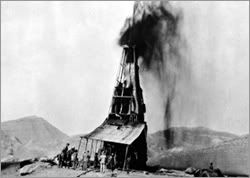
I know I will get corno-roasted for being so optimistic. I really am not very optimistic. But for other reasons like inertia and the short attention spans of voters and policy makers alike. On that front I am very pessimistic. Thank goodness I believe in the power of the market. Some very smart entrepreneurs and some very astute financiers are investing in alternative energy because they smell a profit in it. Apathetic consumers and brain dead politicians will benefit by default when they successfully commercialize these alternative energies and make a handsome profit for their efforts.
There's an energy revolution going on. The last thing we need now is cheap oil to puncture the bubble. A lot of good inventions and applications came out of the dotcom bubble, but that does not mean everyone made money. But if we cannot come up with one killer application then perhaps we can come up with 1000 smaller solutions.
The organized state is a wonderful invention whereby everyone can live at someone else's expense.
-

MrBill - Expert
- Posts: 5630
- Joined: Thu 15 Sep 2005, 03:00:00
- Location: Eurasia
Re: The Price of Oil's Replacement
by vtsnowedin » Thu 07 Aug 2008, 06:35:28
$this->bbcode_second_pass_quote('MrBill', '[') If bio-fuel from algae is part of that revolution then I think worrying about peak wastewater is a little nit-picky?
.
.
For want of a nail the shoe was lost.
For want of a shoe the horse was lost.
For want of a horse the battle was lost.
For want of a nail the war was lost.
Peak wastewater might be a bit picky but it is a reality check on the wild unsubstantiated claims made be people trying to lure in investor dollars with a slick video. Of course we will be five or ten years down the road before we run short of waste fertilizer sources such as city sewage and we can cross that bridge when we come to it but should we not consider the entire process and its requirements to know how much faith to place in its future.
I found this interesting and instructive.
. “Even the new oils may come with a high price on the learning curve. Jatropha is not the easy conversion it was thought to be and we are hearing stories from places such as Mozambique and Peru that the oil itself needs careful monitoring, let alone harvesting and crushing. It may be cheap, but there may be a reason for that. Algae oil is slowly appearing in experimental reactors and ponds, but the jury is still out on the ideal mono-cell, the way to harvest the oil and how to create a sustainable economic model for the colorful scum.”
Peter Brown-Bio diesel mag.August 08 issue pg.85
Last edited by vtsnowedin on Thu 07 Aug 2008, 10:23:59, edited 1 time in total.
-
vtsnowedin - Fusion
- Posts: 14897
- Joined: Fri 11 Jul 2008, 03:00:00
Re: The Price of Oil's Replacement
by ROCKMAN » Thu 07 Aug 2008, 07:28:56
Mr. Bill,
I thought you might be a little more pessimistic about capital availability given past comments regarding the current debt situation. I was also assume you saw direct gov't funding of much of the initial effort as a way to accelerate the process. But you have a good view of the macro so I'll roll the dice with you.
I thought you might be a little more pessimistic about capital availability given past comments regarding the current debt situation. I was also assume you saw direct gov't funding of much of the initial effort as a way to accelerate the process. But you have a good view of the macro so I'll roll the dice with you.
-
ROCKMAN - Expert
- Posts: 11397
- Joined: Tue 27 May 2008, 03:00:00
- Location: TEXAS
Re: The Price of Oil's Replacement
by MrBill » Thu 07 Aug 2008, 08:06:22
The key word is proven technology not wild unsubstantiated claims that will attract capital.
My problem with the nay-sayers is not that they do not have valid points, but they are rather negative. Their opening position is that based on today's technology that nothing is scalable enough to replace petroleum in our current energy mix. And despite commerical projects coming on-line they simply will not move with the times. Or recognize break throughs when and where they happen.
If we have a financial problem we need to find a financial solution. If we have an environmental problem we need to find an environmental solution. If we have an energy problem we need to find an energy solution. Linear thinking does not help. There is no one solution to replacing petroleum in our current energy mix. But there are a 1000 mitigating strategies large and small that can reduce the impact of a world without oil in 20, 30 or 50-years time.
The problem with servicing the past debt situation is quite simple. That money has already been spent. It was spent on the wrong priorities. It was spent with no regard as to how to repay it. Now that public debt can only be repaid by a combination of inflation; currency devaluation; lower, slower, no growth; higher taxes; lower living standards; and debt default. Obviously this affects the USA not most of the rest of the world that are net savers. The US may have the intellectual capital necessary to find some solutions to our energy problems, but the entity called The United States of America is a debtor nation, and therefore lacks the financial resources at this time to solve these energy issues on a large scale.
Therefore the burden falls on the rest of the world that has capital to invest in these problems. They can choose to fund American initiatives or they can choose to fund their own energy projects. But those energy projects are being built. They are being financed.
Like the peak of a roof there is a tipping point where wide spread adoption takes place. The first steam engine, the first bicycle, the first plane and the first automobile did not start a revolution overnight. The gains made by alternative fuels thus far have also been modest. First of all they have to compete against petroluem that is still relatively cheap and abundant given its superior EROEI. And secondly these technologies are still pretty much in their infancy. They may need thirty to fifty years before they reach critical mass and wide spread adoption.
If you tell me the world will collapse in the next thirty to fifty years before those technologies are commercial on a wide scale then fine. I certainly cannot prove you wrong. Then really my only advice to you is good luck. Enjoy your life and stop worrying about problems that apparently can never be solved. I personally would sooner spend my time looking for a solution than worrying about peak feces or peak wastewater. In the long-run we're all worm food in any case! ; - ))
UPDATE: From Fish Farm to Fuel
Mechanizing a Green Movement
My problem with the nay-sayers is not that they do not have valid points, but they are rather negative. Their opening position is that based on today's technology that nothing is scalable enough to replace petroleum in our current energy mix. And despite commerical projects coming on-line they simply will not move with the times. Or recognize break throughs when and where they happen.
If we have a financial problem we need to find a financial solution. If we have an environmental problem we need to find an environmental solution. If we have an energy problem we need to find an energy solution. Linear thinking does not help. There is no one solution to replacing petroleum in our current energy mix. But there are a 1000 mitigating strategies large and small that can reduce the impact of a world without oil in 20, 30 or 50-years time.
The problem with servicing the past debt situation is quite simple. That money has already been spent. It was spent on the wrong priorities. It was spent with no regard as to how to repay it. Now that public debt can only be repaid by a combination of inflation; currency devaluation; lower, slower, no growth; higher taxes; lower living standards; and debt default. Obviously this affects the USA not most of the rest of the world that are net savers. The US may have the intellectual capital necessary to find some solutions to our energy problems, but the entity called The United States of America is a debtor nation, and therefore lacks the financial resources at this time to solve these energy issues on a large scale.
Therefore the burden falls on the rest of the world that has capital to invest in these problems. They can choose to fund American initiatives or they can choose to fund their own energy projects. But those energy projects are being built. They are being financed.
Like the peak of a roof there is a tipping point where wide spread adoption takes place. The first steam engine, the first bicycle, the first plane and the first automobile did not start a revolution overnight. The gains made by alternative fuels thus far have also been modest. First of all they have to compete against petroluem that is still relatively cheap and abundant given its superior EROEI. And secondly these technologies are still pretty much in their infancy. They may need thirty to fifty years before they reach critical mass and wide spread adoption.
If you tell me the world will collapse in the next thirty to fifty years before those technologies are commercial on a wide scale then fine. I certainly cannot prove you wrong. Then really my only advice to you is good luck. Enjoy your life and stop worrying about problems that apparently can never be solved. I personally would sooner spend my time looking for a solution than worrying about peak feces or peak wastewater. In the long-run we're all worm food in any case! ; - ))
UPDATE: From Fish Farm to Fuel
Mechanizing a Green Movement
The organized state is a wonderful invention whereby everyone can live at someone else's expense.
-
MrBill - Expert
- Posts: 5630
- Joined: Thu 15 Sep 2005, 03:00:00
- Location: Eurasia
Re: The Price of Oil's Replacement
by ROCKMAN » Thu 07 Aug 2008, 10:45:57
Mr. Bill,
Perhaps my expectations are too much controlled by US ego. Even though I see the truth in your words it's difficult not seeing the US take the lead in such an effort. But, given the inequity in fuel consumption, I wonder if the rest of the world will be as motivated/aggressive as the US would be if we had the capital and common sense.
And I do appreciate your comments about herd mentality. Almost 20 years ago when I first started studying horizontal drilling technology I was like the proverbial kid in the candy shop with a $20 bill. So many applications...I just needed a capital source. I can't remember how many meetings I was politely thanked for my presentation and told "we call you". And, of course, the phone never rang. After all, "if it were really a good idea we would already be doing it" could be easily read between the lines. It will be interesting (scary) to see how long it takes the US to adjust its attitude toward alternatives.
Perhaps my expectations are too much controlled by US ego. Even though I see the truth in your words it's difficult not seeing the US take the lead in such an effort. But, given the inequity in fuel consumption, I wonder if the rest of the world will be as motivated/aggressive as the US would be if we had the capital and common sense.
And I do appreciate your comments about herd mentality. Almost 20 years ago when I first started studying horizontal drilling technology I was like the proverbial kid in the candy shop with a $20 bill. So many applications...I just needed a capital source. I can't remember how many meetings I was politely thanked for my presentation and told "we call you". And, of course, the phone never rang. After all, "if it were really a good idea we would already be doing it" could be easily read between the lines. It will be interesting (scary) to see how long it takes the US to adjust its attitude toward alternatives.
-
ROCKMAN - Expert
- Posts: 11397
- Joined: Tue 27 May 2008, 03:00:00
- Location: TEXAS
Re: The Price of Oil's Replacement
by MrBill » Thu 07 Aug 2008, 11:04:12
RM, the funding could come from private sources within the US, but if it is government funding then ultimately it is being under-written by Asian and OPEC central banks.
Alternatively, private equity funds can hoover up funding from anywhere on the globe and invest it into US lead projects. Infrastructure funds as well as alternative energy are where many of the big players want to be. There is scope to expand that if energy prices stay high making alternatives that much more attractive. Some of it is, of course, based on proprietary technology naturally, but there is also a great deal of public-private networking and sharing of ideas going on as well.
I found this article interesting:
$this->bbcode_second_pass_quote('', 'U').K. Prime Minister Gordon Brown was deluded when he announced in March that ``we will never return to the old boom and bust,'' said Willem Buiter, a professor at the London School of Economics and a former Bank of England policy maker.
Writing in the Financial Times, Buiter said capitalist market economies are inherently cyclical, the private credit system is by its nature prone to alternating fits of irrational euphoria and black depression, and busts play an essential role, cleaning up the mess.
Financial stability was undermined by thoughtless liberalization, especially in the U.S. and the U.K., with ``soft-touch'' regulation leading to a proliferation of opaque securities held by ``shadow-banking'' institutions that were anything but transparent, he said.
In the U.S.' ``balkanised'' supervision regime, no one was in charge and few were even aware of the disastrous developments that were in train, Buiter said.
The result in both countries was bloated banking systems, house-price bubbles and households living beyond their means, and it will take two or three years to work off these excesses, he said.
The correction, which will involve higher unemployment and more defaults, repossessions and bankruptcies, will leave highly advanced countries with reasonable prospects, as long as material expectations moderate, and developing countries that are net commodity exporters will have the potential for prosperity, Buiter said.
For poorer countries that are commodity importers, worsening terms of trade and an acute environmental challenge will make life ``very difficult,'' he concluded.
Alternatively, private equity funds can hoover up funding from anywhere on the globe and invest it into US lead projects. Infrastructure funds as well as alternative energy are where many of the big players want to be. There is scope to expand that if energy prices stay high making alternatives that much more attractive. Some of it is, of course, based on proprietary technology naturally, but there is also a great deal of public-private networking and sharing of ideas going on as well.
I found this article interesting:
$this->bbcode_second_pass_quote('', 'U').K. Prime Minister Gordon Brown was deluded when he announced in March that ``we will never return to the old boom and bust,'' said Willem Buiter, a professor at the London School of Economics and a former Bank of England policy maker.
Writing in the Financial Times, Buiter said capitalist market economies are inherently cyclical, the private credit system is by its nature prone to alternating fits of irrational euphoria and black depression, and busts play an essential role, cleaning up the mess.
Financial stability was undermined by thoughtless liberalization, especially in the U.S. and the U.K., with ``soft-touch'' regulation leading to a proliferation of opaque securities held by ``shadow-banking'' institutions that were anything but transparent, he said.
In the U.S.' ``balkanised'' supervision regime, no one was in charge and few were even aware of the disastrous developments that were in train, Buiter said.
The result in both countries was bloated banking systems, house-price bubbles and households living beyond their means, and it will take two or three years to work off these excesses, he said.
The correction, which will involve higher unemployment and more defaults, repossessions and bankruptcies, will leave highly advanced countries with reasonable prospects, as long as material expectations moderate, and developing countries that are net commodity exporters will have the potential for prosperity, Buiter said.
For poorer countries that are commodity importers, worsening terms of trade and an acute environmental challenge will make life ``very difficult,'' he concluded.
source: Aug. 6 (Bloomberg)
High fuel, food and fertilizer prices could be such a boon for developing countries. Think hydroelectric power in the Congo for example. Or bio-mass production in Asia and central America. But these countries are not really focussed on the economic issues other than the social costs of high fuel, food and fertilizer prices, so they miss the forest for the trees.
The organized state is a wonderful invention whereby everyone can live at someone else's expense.
-
MrBill - Expert
- Posts: 5630
- Joined: Thu 15 Sep 2005, 03:00:00
- Location: Eurasia
![[smilie=5geezer.gif]](https://udev.peakoil.com/forums/images/smilies/5geezer.gif "5geezer")



 I would think that the EREOI for oil will be taking a turn for the worse soon also. Consider that the shallow easy to reach and pump fields were the first found so in most cases will be the first depleted. When all our oil come from fifty miles off shore or the center of a war zone (if you add in the cost of your army) your net energy out will be much less than we are used to. Same for coal, move a mountain before you start and have to put it back when you are done then add in the cost of stack scrubbers and CO2 sequestraing and its a long way from $200 per ton.
