BBC: Lights from Freeplay Foundation
I know the idea is to help the poor, but do you think these things will become a 'must have' for PO back-up supplies? I don't have any electricity generation in my place and the costs of a good pv system is a little above my budget at this time.
An alternative would be to have a small solar charger for batteries, and use these in LED torches etc.
Anybody got suggestions/thoughts on these alternatives?



PeakOil is You
THE Lighting Thread (merged)
Wind up lights
 by IslandCrow » Thu 01 Nov 2007, 12:40:47
We should teach our children the 4-Rs: Reduce, Reuse, Recycle and Rejoice.
-

IslandCrow - Heavy Crude

- Posts: 1272
- Joined: Mon 12 Sep 2005, 03:00:00
- Location: Finland
Re: Wind up lights
by Cornelian » Thu 01 Nov 2007, 15:25:13
I have in my emergency kit all the windups - windup radio, windup lights, windup mobile phone charger. They're all pretty poor. LOL They are really for emergency use only.
It would be interesting if they can use the same idea to get something decent happening. Convert one of those wonderful old treadle sewing machines, perhaps, for house lighting.
It would be interesting if they can use the same idea to get something decent happening. Convert one of those wonderful old treadle sewing machines, perhaps, for house lighting.
-

Cornelian - Peat

- Posts: 120
- Joined: Mon 20 Nov 2006, 04:00:00
- Location: Tasmania
Re: Wind up lights
by Cobra_Strike » Thu 01 Nov 2007, 16:29:18
I have a great hand held wind up light, LED's are a great way to go.
We stand here, as the light of other days surrounds us.
"Hail the Dead"
"Hail the Dead"
- Cobra_Strike
- Tar Sands

- Posts: 500
- Joined: Fri 06 Jan 2006, 04:00:00
- Location: Pacific Northwest
Re: Wind up lights
by oowolf » Thu 01 Nov 2007, 17:50:47
On sale now at Harbor Freight for $5.
Actually, you get about 5-10 minutes really bright light, then 20 or 30 minutes of weaker light.
What do you want for $5?
http://www.harborfreight.com/cpi/ctaf/d ... mber=95266
Actually, you get about 5-10 minutes really bright light, then 20 or 30 minutes of weaker light.
What do you want for $5?
http://www.harborfreight.com/cpi/ctaf/d ... mber=95266
-

oowolf - Expert

- Posts: 1337
- Joined: Tue 09 Nov 2004, 04:00:00
- Location: Big Rock Candy Mountain
Re: Wind up lights
by WisJim » Thu 01 Nov 2007, 22:25:04
I picked up a small handcranked flashlight with 3 LEDs that works well. You can choose 1 or 3 LEDs lit, and it holds a charge for weeks--it is kept in a car glove box, and works with a good bright light even after being ignored for weeks, and charges up well with a few cranks if it diims. Cost about $5 or less.
Also, the Freeplay folks make some crank/battery/PV radios that work well, and at least one comes with a detachable LED light that runs from the radio. Adequate for emergency task lighting, and you have a radio, too.
http://www.ccrane.com/radios/wind-up-em ... radio.aspx
We have 2 other Freeplay radios, one about 9 or 10 years old, crank style, with a plug in PV panel, and the other we just got this past year, and it cranks, has built in PVs, and works well. It is our garden or outdoor radio.
Also, the Freeplay folks make some crank/battery/PV radios that work well, and at least one comes with a detachable LED light that runs from the radio. Adequate for emergency task lighting, and you have a radio, too.
http://www.ccrane.com/radios/wind-up-em ... radio.aspx
We have 2 other Freeplay radios, one about 9 or 10 years old, crank style, with a plug in PV panel, and the other we just got this past year, and it cranks, has built in PVs, and works well. It is our garden or outdoor radio.
-

WisJim - Expert
- Posts: 1286
- Joined: Mon 03 Jan 2005, 04:00:00
- Location: western Wisconsin
Re: Wind up lights
by IslandCrow » Fri 02 Nov 2007, 04:49:40
Thanks for all the responses...now I know what to buy myself for Christmas! 
We should teach our children the 4-Rs: Reduce, Reuse, Recycle and Rejoice.
-
IslandCrow - Heavy Crude
- Posts: 1272
- Joined: Mon 12 Sep 2005, 03:00:00
- Location: Finland
Re: Wind up lights
by Narz » Fri 02 Nov 2007, 05:32:15
I highly recommend this one, it's pricey but it's the best. 24-hours of light on a full charge. The price has gone way done. I paid about $60 for it.
It's also rechargeable in an outlet (if you're too lazy to wind). I use it to read at night when the lady's asleep. Supposedly will last 100,000 hours.
It's also rechargeable in an outlet (if you're too lazy to wind). I use it to read at night when the lady's asleep. Supposedly will last 100,000 hours.
“Seek simplicity but distrust it”
-

Narz - Intermediate Crude

- Posts: 2360
- Joined: Sat 25 Nov 2006, 04:00:00
- Location: the belly of the beast (New Jersey)
Can Energy-saving devices bought from China really save NRG?
by SolarDave » Sun 09 Dec 2007, 05:08:01
I have looked for an answer to this riddle for a while with no success.
Can a container of Compact Fluorescent (CFL) bulbs bought by Americans that were manufactured in China ever save the energy it took to ship them over here?
For example: Suppose one gallon of diesel was used at the point of entry just to offload, stack, sort, and load the container onto the long-haul truck to take it to the final destination.
On gallon of diesel is equivalent to 40.6 KWh (ref: Energy Conversion Factors) so the bulbs are "in the hole" that amount before they are even turned on. And of course, there is more:
Some energy was used to move the bulbs from China to the USA. Some was used to manage them (as above) at the port in China.
Do any of you wise forum users know of a study that compares the energy saved vs. energy cost for Chinese (or any other distant source, I'm not just picking on China) energy-saving devices? How much electricity does a CFL bought in America, but manufactured in China, have to save before it "breaks even?" What about other energy saving devices? Do they save net energy when they are transported huge distances before they are put to use?
Setback thermostats?
LED bulbs (the new ones that replace standard household lighting)?
Low Rolling Resistance Tires?
Non-US Manufactured "Energy Saving" appliances?
Does transporting these things from manufacture to end-user negate any energy savings they claim to produce? Will a domestic equivalent save a little more than an import, or a lot more?
Curious minds want to know.
SolarDave
Can a container of Compact Fluorescent (CFL) bulbs bought by Americans that were manufactured in China ever save the energy it took to ship them over here?
For example: Suppose one gallon of diesel was used at the point of entry just to offload, stack, sort, and load the container onto the long-haul truck to take it to the final destination.
On gallon of diesel is equivalent to 40.6 KWh (ref: Energy Conversion Factors) so the bulbs are "in the hole" that amount before they are even turned on. And of course, there is more:
Some energy was used to move the bulbs from China to the USA. Some was used to manage them (as above) at the port in China.
Do any of you wise forum users know of a study that compares the energy saved vs. energy cost for Chinese (or any other distant source, I'm not just picking on China) energy-saving devices? How much electricity does a CFL bought in America, but manufactured in China, have to save before it "breaks even?" What about other energy saving devices? Do they save net energy when they are transported huge distances before they are put to use?
Setback thermostats?
LED bulbs (the new ones that replace standard household lighting)?
Low Rolling Resistance Tires?
Non-US Manufactured "Energy Saving" appliances?
Does transporting these things from manufacture to end-user negate any energy savings they claim to produce? Will a domestic equivalent save a little more than an import, or a lot more?
Curious minds want to know.
SolarDave
100% of the electricity needed for this post was generated by ME.
http://www.los-gatos.ca.us/davidbu/pedgen/green_virtual_gym.html
Posted from a Pedal Powered Computer
http://www.los-gatos.ca.us/davidbu/pedgen/green_virtual_gym.html
Posted from a Pedal Powered Computer
-

SolarDave - Coal
- Posts: 400
- Joined: Thu 19 May 2005, 03:00:00
Re: Can Energy-saving devices bought from China really save
by heroineworshipper » Sun 09 Dec 2007, 06:15:01
The shipping cost is negligable and as long as it's made in China, the environmental damage to melt the glass, refine the metal, mine the raw materials, is their problem.
-
heroineworshipper - Tar Sands
- Posts: 890
- Joined: Fri 14 Jul 2006, 03:00:00
- Location: Calif*
Re: Can Energy-saving devices bought from China really save
by Paradox » Sun 09 Dec 2007, 08:35:01
SolarDave ... the answer is yes ....
some 'back of the envelope' calculations .... forgive the use of metrics ..... I am from Australia ....
based on how much fuel per kilogram it takes to move your car one kilometer, it would require 0.14 litres of fuel to move a 167 gram flourescent light bulb 12,000 kilometers from China to the USA (fuel cost = about US$0.10)
A flourescent bulb lasts 6x longer than an incandescent bulb, therefore the energy to locally transport 6 USA manufactured incandescent bulbs during the lifetime of one flourescent is probably similar.
The flourescent bulb is 80% more energy efficient in converting electrical energy into light, therefore a 20watt flourescent is equivalent to a 100watt incandescent.
Swapping incandescent bulbs for flourescent of the same brightness reduces electricity consumption to 20% of current consumption .... if the whole country (or planet) converts, it will make a big difference .....
.... Paradox
some 'back of the envelope' calculations .... forgive the use of metrics ..... I am from Australia ....
based on how much fuel per kilogram it takes to move your car one kilometer, it would require 0.14 litres of fuel to move a 167 gram flourescent light bulb 12,000 kilometers from China to the USA (fuel cost = about US$0.10)
A flourescent bulb lasts 6x longer than an incandescent bulb, therefore the energy to locally transport 6 USA manufactured incandescent bulbs during the lifetime of one flourescent is probably similar.
The flourescent bulb is 80% more energy efficient in converting electrical energy into light, therefore a 20watt flourescent is equivalent to a 100watt incandescent.
Swapping incandescent bulbs for flourescent of the same brightness reduces electricity consumption to 20% of current consumption .... if the whole country (or planet) converts, it will make a big difference .....
.... Paradox
-
Paradox - Wood
- Posts: 3
- Joined: Thu 28 Apr 2005, 03:00:00
New Light Source Lasts 15 Years Without a Recharge
by Carlhole » Sat 15 Dec 2007, 06:50:39
New Light Source Lasts 15 Years Without a Recharge
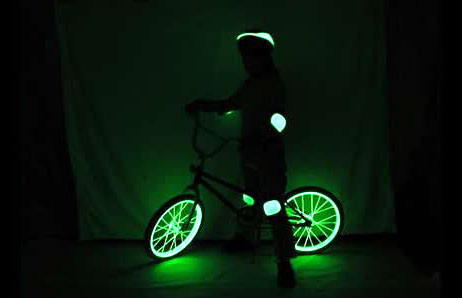
$this->bbcode_second_pass_quote('Litroenergy', 'H')ow about a glowing light source that lasts for 15 years instead of the typical 15 minutes of a glowstick? GlowPaint’s newest product does just that and is also non-toxic and inexpensive and doesn’t require a recharge via solar or electrical sources for its entire lifespan. According to the company, “This has potential to save billions in energy costs world-wide. Litroenergy™ surpasses all known available lighting options for cost/durability/reliability and safety.” Their products are expected to be used to replace other forms of safety, emergency and novelty lighting duties normally performed by glow sticks, LEDs and other light sources.
Litroenergy was also submitted to the Nasa Create the Future Design Contest to compete based on its originality and potentially major impact on sustainable energy technology. More information can be found via GlowPaint’s online patent application though much of their research remains proprietary.
$this->bbcode_second_pass_quote('Litroenergy', 'H')ow about a glowing light source that lasts for 15 years instead of the typical 15 minutes of a glowstick? GlowPaint’s newest product does just that and is also non-toxic and inexpensive and doesn’t require a recharge via solar or electrical sources for its entire lifespan. According to the company, “This has potential to save billions in energy costs world-wide. Litroenergy™ surpasses all known available lighting options for cost/durability/reliability and safety.” Their products are expected to be used to replace other forms of safety, emergency and novelty lighting duties normally performed by glow sticks, LEDs and other light sources.
Litroenergy was also submitted to the Nasa Create the Future Design Contest to compete based on its originality and potentially major impact on sustainable energy technology. More information can be found via GlowPaint’s online patent application though much of their research remains proprietary.
[align=center]
 [/align]
- Carlhole
Re: New Light Source Lasts 15 Years Without a Recharge
by steam_cannon » Sat 15 Dec 2007, 13:38:40
Tritium glow paint... Yeah, I've heard about this before.
Pros
* Lasts 12 years until half as bright.
* Safe beta-radiation not powerful enough to leave the paint or penetrate skin.
* Sealed nano-containers, probably safer then large glass tubes.
Cons
Expensive, tritium normally isn't cheap. $300 for an exit sign light. $8 to $40 for a key chain light. In the US they are difficult to get because they are considered a frivolous use of a "duel use" technology by the government. (Never the less, I'm giving one as a Christmas gift to a chemist I know...)
But does this mean it's expensive?
They claim that it will cost a mere 35 Cents to light up an 8 ½ x 11 piece of plastic.
"The fill rate of Litroenergy micro particles in plastic injection molding material or paint is about 20%. The cost to light up 8 ½ x 11 piece of plastic 1/8” thick is about .35 cents."
http://www.createthefuturecontest.com/p ... ntryID=567
http://peswiki.com/index.php/Directory: ... ergy#Costs
"advantage of the invention is that the radioactive gas completely surrounds the phosphor particles, thus causing light emission from one hundred percent of the surface of the particles."
http://www.freepatentsonline.com/20070200074.html
So it's possible that this product uses tritium much more efficiently then the usual tritium glow tube and that's how they might be keeping costs down.
Pros
* Lasts 12 years until half as bright.
* Safe beta-radiation not powerful enough to leave the paint or penetrate skin.
* Sealed nano-containers, probably safer then large glass tubes.
Cons
Expensive, tritium normally isn't cheap. $300 for an exit sign light. $8 to $40 for a key chain light. In the US they are difficult to get because they are considered a frivolous use of a "duel use" technology by the government. (Never the less, I'm giving one as a Christmas gift to a chemist I know...)
But does this mean it's expensive?
They claim that it will cost a mere 35 Cents to light up an 8 ½ x 11 piece of plastic.
"The fill rate of Litroenergy micro particles in plastic injection molding material or paint is about 20%. The cost to light up 8 ½ x 11 piece of plastic 1/8” thick is about .35 cents."
http://www.createthefuturecontest.com/p ... ntryID=567
http://peswiki.com/index.php/Directory: ... ergy#Costs
"advantage of the invention is that the radioactive gas completely surrounds the phosphor particles, thus causing light emission from one hundred percent of the surface of the particles."
http://www.freepatentsonline.com/20070200074.html
So it's possible that this product uses tritium much more efficiently then the usual tritium glow tube and that's how they might be keeping costs down.
Last edited by steam_cannon on Sun 16 Dec 2007, 02:07:19, edited 2 times in total.
-

steam_cannon - Expert
- Posts: 2859
- Joined: Thu 28 Dec 2006, 04:00:00
- Location: MA
Re: New Light Source Lasts 15 Years Without a Recharge
by Slowpoke » Sat 15 Dec 2007, 16:51:46
Isn't tritium the stuff they make them newfangled weapon sights out of?
-
Slowpoke - Peat
- Posts: 70
- Joined: Mon 24 Oct 2005, 03:00:00
Re: New Light Source Lasts 15 Years Without a Recharge
by Tanada » Sat 15 Dec 2007, 18:51:06
$this->bbcode_second_pass_quote('Slowpoke', 'I')sn't tritium the stuff they make them newfangled weapon sights out of?
Ahem, how is something invented 40 years or more ago considered 'newfangled'????
Newfangled sites are those fiber optic doohickies (ROFLMAO)
;)>:)$this->bbcode_second_pass_quote('Alfred Tennyson', 'W')e are not now that strength which in old days
Moved earth and heaven, that which we are, we are;
One equal temper of heroic hearts,
Made weak by time and fate, but strong in will
To strive, to seek, to find, and not to yield.
Moved earth and heaven, that which we are, we are;
One equal temper of heroic hearts,
Made weak by time and fate, but strong in will
To strive, to seek, to find, and not to yield.
- Tanada
- Site Admin

- Posts: 17094
- Joined: Thu 28 Apr 2005, 03:00:00
- Location: South West shore Lake Erie, OH, USA
Re: New Light Source Lasts 15 Years Without a Recharge
by Loki » Sat 15 Dec 2007, 19:16:10
$this->bbcode_second_pass_quote('Slowpoke', 'I')sn't tritium the stuff they make them newfangled weapon sights out of?
I don't know how newfangled they are, but I have tritium sights on my AR and they work splendidly. The Glock will be getting them next, once I get around to it.
-

Loki - Expert
- Posts: 3509
- Joined: Sat 08 Apr 2006, 03:00:00
- Location: Oregon