
PeakOil is You
The Coming Oil Flood
Re: The Coming Oil Flood
 by agramante » Wed 25 Feb 2015, 21:10:51
It seems to me that the Saudi definition of "spare capacity" has changed over the years. In the 80's, they dramatically slowed their extraction rate, partly to bolster prices, and partly to preserve their fields. Even despite the increasingly high water cut they were able to open the taps back up again and increase production in fairly short order--on a scale of days to weeks. Now, their definition of "spare capacity" involves bringing new wells on line within a few years. In other words, it's not spare at all. I think OPEC's current claims of spare capacity are fictitious. We have almost no way to confirm or deny their claims, but there is that remarks in the Wikileaks cache from a few years ago of the Saudi oil minister saying they were producing flat-out--something entirely at odds with the official line.
- agramante
- Peat

- Posts: 131
- Joined: Fri 31 May 2013, 23:06:39
Re: The Coming Oil Flood
by Pops » Wed 25 Feb 2015, 21:31:16
Actually I believe they converted a lot of fields to MRC wells.
And they have been producing around 10mmbopd since 2005 (except for the dip around 09) and only made that for perhaps a year in 79
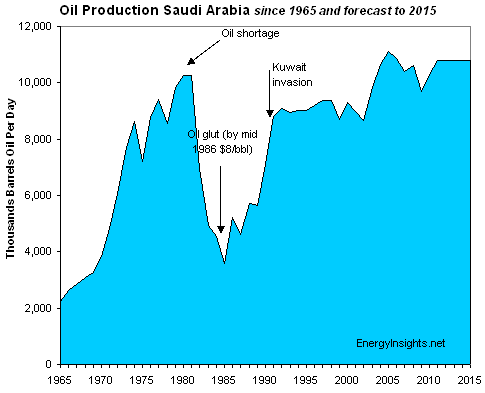
But I'm interested in reading your source for believing they have no spare capacity. rocdoc says he thinks they did everything they had planned to make 12.5
And they have been producing around 10mmbopd since 2005 (except for the dip around 09) and only made that for perhaps a year in 79
But I'm interested in reading your source for believing they have no spare capacity. rocdoc says he thinks they did everything they had planned to make 12.5
The legitimate object of government, is to do for a community of people, whatever they need to have done, but can not do, at all, or can not, so well do, for themselves -- in their separate, and individual capacities.
-- Abraham Lincoln, Fragment on Government (July 1, 1854)
-- Abraham Lincoln, Fragment on Government (July 1, 1854)
-

Pops - Elite

- Posts: 19746
- Joined: Sat 03 Apr 2004, 04:00:00
- Location: QuikSac for a 6-Pac
Re: The Coming Oil Flood
by rockdoc123 » Wed 25 Feb 2015, 22:17:54
$this->bbcode_second_pass_quote('', 'N')ow, their definition of "spare capacity" involves bringing new wells on line within a few years. In other words, it's not spare at all.
No they use the same definition as the EIA which is the ability to have it turned on in 30 days at minimal expense.
All of the billions were spent on the megaprojects from 2006 - 2010 and after they were completed was when Saudi Arabia announced they had reached their goal of a 12.5 MMB/d spare capacity.
I don't think there is any reason to doubt their spare capacity as a volume. They spent the money and there is independent confirmation of that from various Western firms who were contracted. I think the question that needs to be asked is what is the percentage of different product sitting in spare capacity. The megaprojects brought on a lot of light oil and super light oil (Shaybah) and also some heavier crudes (Safaniyah) and some with higher % sulphur. Various refineries like certain types of crude. As a consequence when Libya production first fell off the table due to the post Gaddafi unrest KSA stepped in but because they did not have enough of the correct blend of crude (Libyan crude is relatively sweet and quite light a combination that is tuned perfectly for their European customers). They were able to orchestrate swaps so they could come up with the right volume of light crude (swapping some of their heavier or more sour blends for lighter sweeter blends) but that might not always be possible. KSA has specific markets for it's different crudes...they aren't all fungible which to my mind might create a problem in the future without investment in upgraders etc.
-

rockdoc123 - Expert
- Posts: 7685
- Joined: Mon 16 May 2005, 03:00:00
Re: The Coming Oil Flood
by Keith_McClary » Wed 25 Feb 2015, 22:38:45
$this->bbcode_second_pass_quote('rockdoc123', 'A')ll of the billions were spent on the megaprojects from 2006 - 2010 and after they were completed was when Saudi Arabia announced they had reached their goal of a 12.5 MMB/d spare capacity.
I don't think there is any reason to doubt their spare capacity as a volume.
Their old fields might have declined a bit.I don't think there is any reason to doubt their spare capacity as a volume.
Facebook knows you're a dog.
-

Keith_McClary - Light Sweet Crude

- Posts: 7344
- Joined: Wed 21 Jul 2004, 03:00:00
- Location: Suburban tar sands
Re: The Coming Oil Flood
by sparky » Thu 26 Feb 2015, 01:47:19
.
Probably they did , but their production so far is holding , so one must look at this thing as a fact
they produce anything between 9 to 10 millions barrel per day and at a pinch could throw a couple millions more on the market .
a major concern is their internal consumption ,which is rising , relentlessly
Don't forget production is misleading , exports is the crux of the matter !
Probably they did , but their production so far is holding , so one must look at this thing as a fact
they produce anything between 9 to 10 millions barrel per day and at a pinch could throw a couple millions more on the market .
a major concern is their internal consumption ,which is rising , relentlessly
Don't forget production is misleading , exports is the crux of the matter !
-

sparky - Intermediate Crude

- Posts: 3587
- Joined: Mon 09 Apr 2007, 03:00:00
- Location: Sydney , OZ
Re: The Coming Oil Flood
by Pops » Thu 26 Feb 2015, 10:28:09
$this->bbcode_second_pass_quote('pstarr', 'I')t just seems to me (and my good friend Mr. Occam) that unless the answer it quite transparent, the methods reproduceable, and the theory testable (falsification and all that) then this over-capacity thing is much over-rated. I have to go with a world recession

$this->bbcode_second_pass_quote('', '[')BofA Guy] cited fresh American Petroleum Institute (API) data which showed U.S. crude inventories climbed by a larger-than-expected 8.9 million barrels in the week ended Feb. 20, for a total of around 437 million barrels squirreled away. Around 50 million to 100 million barrels of crude oil may be gathering dust in floating storage by the end of the second quarter, compared with around 110 million barrels in April 2009, during the global financial crisis, he estimated.
As much as 80 percent of the commercially available storage in the U.S. may already be utilized, Premasish Das, downstream analyst at IHS Energy Insight, told CNBC last week.
...
Others are also concerned about how quickly space could run out. “Within around two months, [onshore storage will] be completely exhausted,” Ivan Szapakowski, a commodity strategist at Citigroup, told CNBC last week. “The only remaining storage globally will then be floating storage, tankers.”
Citigroup is forecasting oil prices to fall toward $20 a barrel before recovering.
Oil is already getting stashed offshore. Tanker prices and lease rates have doubled over the past 18 months, Gaurav Sodhi, a resources analyst at Intelligent Investor, told CNBC last week.
“Clearly, someone is going out there and leasing a lot of offshore storage and those lease rates are much higher. That suggests to me that there’s a massive supply of oil sitting on the ocean,” Sodhi said, noting each tanker can hold around 1 million to 2 million barrels each. “That sort of storage is going to take a while to unwind.”
The legitimate object of government, is to do for a community of people, whatever they need to have done, but can not do, at all, or can not, so well do, for themselves -- in their separate, and individual capacities.
-- Abraham Lincoln, Fragment on Government (July 1, 1854)
-- Abraham Lincoln, Fragment on Government (July 1, 1854)
-
Pops - Elite
- Posts: 19746
- Joined: Sat 03 Apr 2004, 04:00:00
- Location: QuikSac for a 6-Pac