Donate Bitcoin

Donate Paypal


PeakOil is You

PeakOil is You

GPT4 Artificial Intelligence Online

What's on your mind?
General interest discussions, not necessarily related to depletion.

Re: IBM Has Achieved Cat Scale Brain Simulation

Unread postby Carlhole » Fri 20 Nov 2009, 22:04:07

$this->bbcode_second_pass_quote('2cher', 'C')arhole, you can argue science with Luddite's, it is like trying to follow an arguement between an atheist, and a theist... pointless


Well, one man's pointlessness is another man's fun. What can I say?
Carlhole
 

Re: IBM Has Achieved Cat Scale Brain Simulation

Unread postby Carlhole » Fri 20 Nov 2009, 22:30:03

Carlhole
 

Re: IBM Has Achieved Cat Scale Brain Simulation

Unread postby Carlhole » Mon 23 Nov 2009, 23:21:25

Blue Brain's Dr. Henry Markham says "Simulated Cat Brain Project a ‘Scam’"

$this->bbcode_second_pass_quote('', '[')i]“What IBM reported is a scam — no where near a cat-scale brain simulation,” he writes in an open letter to Bernard Myerson, IBM’s Chief Technology Officer. “I am absolutely shocked at this announcement. Not because it is any kind of technical feat, but because of the mass deception of the public.”

Markham isn’t exactly a disinterested observer, as IEEE Spectrum’s Sally Adee notes. He’s got his own ersatz mind project, called Blue Brain, that’s also affiliated with IBM. So perhaps it’s not surprising that Markham claims Modha has simply put together a “PR stunt here to ride on Blue Brain.”

Still, such public criticism is unusual — especially when you consider that it’s also an indirect indictment of Darpa, one of the leading funders of artificial intelligence research.

$this->bbcode_second_pass_quote('Henry Marham, Blue Brain', '[')i]All these kinds of simulations are trivial and have been around for decades — simply called artificial neural network (ANN) simulations. We even stooped to doing these kinds of simulations as benchmark tests four years ago with 10’s of millions of such points…. If we (or anyone else) wanted to we could easily do this for a billion “points,” but we would certainly not call it a cat-scale simulation. It is really no big deal to simulate a billion points interacting if you have a big enough computer. The only step here is that they have at their disposal a big computer. For a grown-up “researcher” to get excited because one can simulate billions of points interacting is ludicrous.

…This is light years away from a cat brain, not even close to an ant’s brain in complexity. It is highly unethical of Mohda to mislead the public in making people believe they have actually simulated a cat’s brain…. That IBM and DARPA would support such deceptive announcements is even more shocking.


I think the proper response here is: mee-yow! I can’t wait for round three of this cat-brain cat fight.


I really was surprised at the news that Blue Brain had a competitor which had reportedly surpassed Blue Brains' already extensive accomplishments. No previous news had so much as hinted that there was more than one such project going on in the world (see my first post in this thread).

I was wondering when Markham would speak up on the subject. Given the suddenness of the LLNL announcement, Markham is probably correct that some wool has been pulled here.
Carlhole
 

Re: IBM Has Achieved Cat Scale Brain Simulation

Unread postby Arthur75 » Tue 24 Nov 2009, 03:50:41

$this->bbcode_second_pass_quote('', '
')$this->bbcode_second_pass_quote('Henry Marham, Blue Brain', '[')i]All these kinds of simulations are trivial and have been around for decades — simply called artificial neural network (ANN) simulations. We even stooped to doing these kinds of simulations as benchmark tests four years ago with 10’s of millions of such points…. If we (or anyone else) wanted to we could easily do this for a billion “points,” but we would certainly not call it a cat-scale simulation. It is really no big deal to simulate a billion points interacting if you have a big enough computer. The only step here is that they have at their disposal a big computer. For a grown-up “researcher” to get excited because one can simulate billions of points interacting is ludicrous.

…This is light years away from a cat brain, not even close to an ant’s brain in complexity. It is highly unethical of Mohda to mislead the public in making people believe they have actually simulated a cat’s brain…. That IBM and DARPA would support such deceptive announcements is even more shocking.


I think the proper response here is: mee-yow! I can’t wait for round three of this cat-brain cat fight.


Hey interesting ! We are still waiting to learn what is fundamentally different with Mr Marham's project though :)
User avatar
Arthur75
Tar Sands
Tar Sands
 
Posts: 529
Joined: Sun 29 Mar 2009, 05:10:51
Location: Paris, France
Top

Re: IBM Has Achieved Cat Scale Brain Simulation

Unread postby Carlhole » Tue 24 Nov 2009, 11:50:26

$this->bbcode_second_pass_quote('Arthur75', '')$this->bbcode_second_pass_quote('', '
')$this->bbcode_second_pass_quote('Henry Marham, Blue Brain', '[')i]All these kinds of simulations are trivial and have been around for decades — simply called artificial neural network (ANN) simulations. We even stooped to doing these kinds of simulations as benchmark tests four years ago with 10’s of millions of such points…. If we (or anyone else) wanted to we could easily do this for a billion “points,” but we would certainly not call it a cat-scale simulation. It is really no big deal to simulate a billion points interacting if you have a big enough computer. The only step here is that they have at their disposal a big computer. For a grown-up “researcher” to get excited because one can simulate billions of points interacting is ludicrous.

…This is light years away from a cat brain, not even close to an ant’s brain in complexity. It is highly unethical of Mohda to mislead the public in making people believe they have actually simulated a cat’s brain…. That IBM and DARPA would support such deceptive announcements is even more shocking.


I think the proper response here is: mee-yow! I can’t wait for round three of this cat-brain cat fight.


Hey interesting ! We are still waiting to learn what is fundamentally different with Mr Marham's project though :)


Markham spent 15 years dissecting and painstakingly reproducing the rat cortical column - as well as incorporating all that is known about the relevant neuroscience - before attempting to re-create it using NEURON software (or other). He's claiming that the IBM researchers have not done any of this; that they are simply demonstrating artificial neural networks on a large, fast machine.
Carlhole
 
Top

Re: IBM Has Achieved Cat Scale Brain Simulation

Unread postby Arthur75 » Tue 24 Nov 2009, 16:14:27

$this->bbcode_second_pass_quote('Carlhole', ' ')that they are simply demonstrating artificial neural networks on a large, fast machine.


Ah ok, but he is also saying :

$this->bbcode_second_pass_quote('', 'A')ll these kinds of simulations are trivial and have been around for decades — simply called artificial neural network (ANN) simulations. We even stooped to doing these kinds of simulations as benchmark tests four years ago with 10’s of millions of such points….


So what gives ? 8)
User avatar
Arthur75
Tar Sands
Tar Sands
 
Posts: 529
Joined: Sun 29 Mar 2009, 05:10:51
Location: Paris, France
Top

What's Different

Unread postby Isochroma » Tue 24 Nov 2009, 17:18:07

Reading the report here: IEEE: Cat Fight Brews Over Cat Brain

http://spectrum.ieee.org/blog/semicondu ... pectrum%29

Selected excerpt:

Dear Bernie,

You told me you would string this guy up by the toes the last time Mohda made his stupid statement about simulating the mouse's brain.

I thought that having gone through Blue Brain so carefully, journalists would be able to recognize that what IBM reported is a scam - no where near a cat-scale brain simulation, but somehow they are totally deceived by these incredible statements.

I am absolutely shocked at this announcement. Not because it is any kind of technical feat, but because of the mass deception of the public.

1. These are point neurons (missing 99.999% of the brain; no branches; no detailed ion channels; the simplest possible equation you can imagine to simulate a neuron, totally trivial synapses; and using the STDP learning rule I discovered in this way is also is a joke).

2. All these kinds of simulations are trivial and have been around for decades - simply called artificial neural network (ANN) simulations. We even stooped to doing these kinds of simulations as bench mark tests 4 years ago with 10's of millions of such points before we bought the Blue Gene/L. If we (or anyone else) wanted to we could easily do this for a billion "points", but we would certainly not call it a cat-scale simulation. It is really no big deal to simulate a billion points interacting if you have a big enough computer. The only step here is that they have at their disposal a big computer. For a grown up "researcher" to get excited because one can simulate billions of points interacting is ludicrous.

3. It is not even an innovation in simulation technology. You don't need any special "C2 simulator", this is just a hoax and a PR stunt. Most neural network simulators for parallel machines can can do this today. Nest, pNeuron, SPIKE, CSIM, etc, etc. all of them can do this! We could do the same simulation immediately, this very second by just loading up some network of points on such a machine, but it would just be a complete waste of time - and again, I would consider it shameful and unethical to call it a cat simulation.

4. This is light years away from a cat brain, not even close to an ants brain in complexity. It is highly unethical of Mohda to mislead the public in making people believe they have actually simulated a cat's brain. Absolutely shocking.

5. There is no qualified neuroscientist on the planet that would agree that this is even close to a cat's brain. I see he did not stop making such stupid statements after they claimed they simulated a mouse's brain.

6. You should also ask Mohda where he got the notion of "reverse engineering" from, when he does not even know what it means - look the the models - this has nothing to do with reverse engineering. And mouse, rat, cat, primate, human - ask him where he took that from? Simply a PR stunt here to ride on Blue Brain.

That IBM and DARPA would support such deceptive announcements is even more shocking.

That the Bell prize would be awarded for such nonsense is beyond belief. I never realized that such trivial and unethical behavior would actually be rewarded. I would have expected an ethics committee to string this guy up by the toes.

I suppose it is up to me to let the "cat out of the bag" about this outright deception of the public.

Competition is great, but this is a disgrace and extremely harmful to the field. Obviously Mohda would like to claim he simulated the Human brain next - I really hope someone does some scientific and ethical checking up on this guy.

All the best,

Henry


Not that I really needed to be vindicated, but his points are my points fleshed out in suitable detail.
User avatar
Isochroma
Peat
Peat
 
Posts: 50
Joined: Sun 22 Jul 2007, 03:00:00

Real Guys

Unread postby Isochroma » Tue 24 Nov 2009, 17:37:04

Now for the real guys, doing the real hard work of real simulation at the atomic scale: The CURE - Modelling Biological Systems

http://www.cure.group.cam.ac.uk/Network ... jects.html

Selected excerpts:

"The Theory of Condensed Matter group (TCM) work on atomistic models of biochemical systems, photoreaction systems, proteing inhibitor complexes and protein-metal ion complexes, (cytochrome P450, cyclin dependant kinases cdk) as well as theoretical studies on the folding of proteins. One major approach in this group is the development of first principle models, (ab initio, quantum mechanical) modelling individual atoms in complex molecules. See the Atomistic Biological Physics Discussion Group website "

"The software developed in TCM such as CASTEP, SIESTA and AMBER. are able to simulate the behaviour of up to several hundred atoms, but the calculations become exponentially more complex with increasing number of variables."

"Mike Payne and others in the TCM group are completing a linear scaling method of atomic simulation (ie gets computationally more complex in linear scale with atomic complexity) ONETEP. This development will make possible the modelling of much larger, more complex systems and so has considerable relevance to research on protein structure. Other simulation programs are able to model more complex systems, but in less detail. The group's longer term aim is to produce a software package that combines both the quantum mechanical and molecular model scales together. For example in modelling a protein system it would simulate the proteins on a molecular scale except in the active site region where more detailed, atomic scale calculations would be made."

Currently the world's most advanced atomic simulator seems to be ONETEP (http://www2.tcm.phy.cam.ac.uk/onetep/)

"ONETEP (Order-N Electronic Total Energy Package) is a linear-scaling code for quantum-mechanical calculations based on density-functional theory."
User avatar
Isochroma
Peat
Peat
 
Posts: 50
Joined: Sun 22 Jul 2007, 03:00:00

Re: What's Different

Unread postby Carlhole » Tue 24 Nov 2009, 17:53:46

$this->bbcode_second_pass_quote('Isochroma', '
')Not that I really needed to be vindicated, but his points are my points fleshed out in suitable detail.


Oh so now you are supporting Dr. Henry Markham of the Blue Brain Project?

We're in total agreement on that one, dude. I'be been a fan of BB for a long time now. It's major sci-fi but its real and serious. This only makes the BB story more interesting. This thread will go probably go on from here with more news.
Carlhole
 
Top

The Doors

Unread postby Isochroma » Tue 24 Nov 2009, 18:18:47

Sometimes a lie can be the most interesting doorway into the realm of the true.

May it intake flocks of the innocent like the black hole that it is.
User avatar
Isochroma
Peat
Peat
 
Posts: 50
Joined: Sun 22 Jul 2007, 03:00:00

Re: The Doors

Unread postby Carlhole » Tue 24 Nov 2009, 18:36:32

$this->bbcode_second_pass_quote('Isochroma', 'S')ometimes a lie can be the most interesting doorway into the realm of the true. May it intake flocks of the innocent like the black hole that it is.


That's just sounds like a mystical bunch of BS to me.

I look at the Blue Brain Project as the most serious attempt so far to understand the workings of the human brain; it can only improve from here. Everything is in existence now to do this modeling - except maybe the gigantaf---inormous amount of memory and processing power needed to do something that supercomputing scientists think maybe possible. When you get into the whole approach, everything appears reasonable and practical - even if it is expensive and possibly fails to do what is expected.

...But someone's got to at least try. And Dr. Markham is the foremost researcher-engineer doing this in the world, I believe.

It has other applications besides computer research or as a sci-fi subject: you could possibly design new drugs that ideally affect neuron behavior... You could learn more about things like bi-polar or schizophrenia...

Also, lots of animal research going on in neuroscience. Dr. Markhman pointed out to everybody that "at some point you have to prepared to quit doing animal research". And he's right, whether or not you think consciousness might somehow immediately emerge from building this thing - it probably won't at first... But animal research is just too limited for what they need to explore. Which is. "How does brain microstructure yield vastly cheap and powerful information processing"? If Markham is able to make some discoveries, maybe they'll yield more capable chips - or go on to some different kind of computing entirely. You could look at this story and decide that it was more about the progress of supercomputing and ongoing computer design than it is about digitally reproducing a real but virtual human neocortex - one that would do all kinds of tricks for us. The kids in the 50's woulda dug it, man.

So supercomputers are the main tool to for discovering how the brain works on a small, basic level. It's a mystery. These kind of advanced macnines are needed everywhere and there is a lot of international competition going on in the field. The US is still ahead. But the Chinese just build t their first machine. These things are needed to do a whole lot of other stuff besides studying the brain. There's a huge market out there for better faster, smarter machines. There's also a lot of interest in building climate-modeling supercomputers or fusion simulators.
Last edited by Carlhole on Tue 24 Nov 2009, 18:51:36, edited 1 time in total.
Carlhole
 
Top

Markram Comments!

Unread postby Isochroma » Tue 24 Nov 2009, 18:43:21

I was reading thru the IEEE article and damn! Mr. Markram commented on it!

Here's his words, word-for-word (unsimulated):

"IBM's claim is a HOAX. This is a mega public relations stunt - a clear case of scientific deception of the public. These simulations do not even come close to the complexity of an ant, let alone that of a cat. IBM allows Mohda to mislead the public into believing that they have simulated a brain with the complexity of a cat - sheer nonsense. Here are the scientific reasons why it is a hoax: How complex is their model? They claim to have simulated over a billion neurons interacting. Their so called "neurons" are the tiniest of points you can imagine, a microscopic dot. Over 98% of the volume of a neuron is branches (like a tree). They just cut off all the branches and roots and took a point in the middle of the trunk to represent a entire neuron. In real life, each segment of the branches of a neuron contains dozens of ion channels that powerfully controls the information processing in a neuron. They have none of that. Neurons contain 10's of thousands of proteins that form a network with 10's of millions of interactions. These interactions are incredibly complex and will require solving millions of differential equations. They have none of that. Neurons contain around 20'000 genes that produce products called mRNA, which builds the proteins. The way neurons build proteins and transport them to all the corners of the neuron where they are needed is an even more complex process which also controls what a neuron is, its memories and how it will process information. They have none of that. They use an alpha function (up fast down slow) to simulate a synaptic event. This is a completely inaccurate representation of a synapse. There are at least 6 types of synapses that are highly non-linear in their transmission (i.e. that transform inputs and not only transmit inputs). In fact you would need a 10's of thousands of differential equations to simulate one synapse. Synapses are also extremely complex molecular machines that would themselves require thousands of differential equations to simulate just one. They simulated none of this. There are complex differential equations that must be solved to simulate the ionic flow in the branches, to simulate the ion channels biophysics, the protein-protein interactions, as well as the complete biochemical and genetic machinery as well as the synaptic transmission between neurons. 100's of thousands of more differential equations. They have none of this. These "points" they simulated and the synapses that they use for communication are literally millions of times simpler than a real cat brain. So they have not even simulated a cat's brain at one millionth of its complexity. Is it nonetheless the biggest simulation ever run? No. These people simulated 1.6 billion points interacting. They used a formulation to model the summing up and threshold spiking of the "points" called the Izhikevik Formulation. Prof Eugene Izhikevik himself already in 2005 has run a simulation with 100 billion such points interacting just for the fun of it: (over 60 larger simulations have been run) : http://www.izhikevich.org/human_brain_s ... n%20Models). The simulations ran on a cluster of desktop PCs every graduate student could have built. This is no technical achievement. That model exhibited oscillations, but that always happens so even simulating 100 Billion such points interacting is light years away from a brain. Is the simulator they built a big step? Not even close. There are numerous proprietary and peer-reviewed neurosimulators (e.g., NCS, pNEURON, SPLIT, NEST) out there that can handle very large parallel models that are essentially only bound by the available memory. The bigger the machine you have available, the more neurons you can simulate. All these simulators apply optimizations for the particular platform in order to make optimal use of the available hardware. Without any comparison to existing simulators, their publication is a non-peer reviewed claim. Did they learn anything about the brain? They got very excited because they saw oscillations. Oscillations are an obligatory artifact that one always gets when many points interact. These findings that they claim on the neuroscience side may excite engineers, but not neuroscientists. Why did they get the Gordon Bell Prize? They submitted a non-peer reviewed paper to the Gordon Bell Committee and were awarded the prize almost instantly after they made their press release. They seem to have been very successful in influencing the committee with their claim, which technically is not peer-reviewed by the respective community and is neuroscientifically outrageous. But is there any innovation here? The only innovation here is that IBM has built a large supercomputer - which is irrelevant to the press release. Why did IBM let Mohda make such a deceptive claim to the public? The only possible reason I can think of is that this a publicity stunt promote their supercompter. The supercomputer industry is suffering from the financial crisis and they probably are desperate to boost their sales. It is so disappointing to see this truly great company allow the deception of the public on such a grand scale. But have you not said you can simulate the Human brain in 10 years? I am a biologist and neuroscientist that has studied the brain for 30 years. I know how complex it is. I believe that with the right resources and the right strategy it is possible. We have so far only simulated a small part of the brain at the cellular level of a rodent and I have always been clear about that. Would other neuroscientists agree with you? There is no neuroscientist on earth that would agree that they came even close to simulating the cat's brain - or any brain. But did Mohda not collaborate with neuroscientists? I would be very surprised if any neuroscientists that he may have had in his DARPA consortium realized he was going to make such an outrages claim. I can imaging that it is remotely possible that the San Fransisco neuroscientists knew he was going to make such a stupid claim. But did you not collaborate with IBM? I was collaborating with IBM on the Blue Brain Project at the very beginning because they had the best available technology to faithfully allow us to integrate the diversity and complexity found in brain tissue into a model. This for me is a major endeavor to advance our insights into the brain and drug development. Two years ago, when the same Dharmendra Mhoda claimed the ¿mouse-scale simulations¿, I cut all neuroscience collaboration with IBM because this is an unethical claim and it deceives the public. Aren't you afraid they will sue you for saying that they have deceived the public? We'll there is right and wrong and what they have done is not only wrong, but outrageous. They deceived you and millions of other people. Henry Markram Blue Brain Project."

For the record, here's my take on why such outrageous claims are made: to impress the brass at IBM and, most importantly, at the Funders, ie. the US Military, whose $16.1 million grant must be justified, and appeals for more dough must be backed by something impressively scientific and seemingly relevant. The picture to be painted to those who decide on matters of money must be just real enough to fool but easy enough to achieve with available or near-available equipment. The resolved product of conflict between the need for money and the pretense of relevant science is sometimes trumpeted in lay media, where sharpshooters like myself and MarkRAM can shoot it down like fish in a barrel or red balloons in a darkling sky.
User avatar
Isochroma
Peat
Peat
 
Posts: 50
Joined: Sun 22 Jul 2007, 03:00:00

Re: Markram Comments!

Unread postby Carlhole » Tue 24 Nov 2009, 19:04:14

$this->bbcode_second_pass_quote('Isochroma', 'I') was reading thru the IEEE article and damn! Mr. Markram commented on it!

Here's his words, word-for-word (unsimulated):

[i]"IBM's claim is a HOAX. This is a mega public relations stunt - a clear case of scientific deception of the public. These simulations do not even come close to the complexity of an ant, let alone that of a cat...


Well, you know... Markham's my man... So I don't disagree with him. Question is: Why would LLNL and IBM pull off such a hoax? Maybe its a thrown gauntlet or challenge or something. Maybe it will be an invitation to cooperate with Markham... I don't know. Why can't there be Supercomputing-Brain Research soap operas on in the afternoon? Beats me.

BTW, have you read over the Blue Brain FAQ page?
Carlhole
 
Top

Re: IBM Has Achieved Cat Scale Brain Simulation

Unread postby Isochroma » Tue 24 Nov 2009, 19:11:50

I updated my post - read my comment at its bottom: it's the money, the ca$h, moolah, etc. Taxpayer chips for silicon chips and slippery dreams lubricated by a fantasy coded in software.

So long as a duck quacks it can attract mates or even dumb hunters - at least for a while. Feed, then move on.

There's something so emotional, so sadly sentimental about the whole case. It's like a rain of tears on an unknown corpse. The conclusion goes somewhere else. It flows from rivulets into streams and onward to locations unknown, beyond the narrow illumination of explication.
User avatar
Isochroma
Peat
Peat
 
Posts: 50
Joined: Sun 22 Jul 2007, 03:00:00

Re: IBM Has Achieved Cat Scale Brain Simulation

Unread postby Carlhole » Tue 24 Nov 2009, 19:28:44

BTW, if you really wanted to argue the Blue Brain people, you'd have to read the technical criticisms of other supercomputer scientists. There's a vocal group that don't believe Markham's approach will work. But they'd probably give you a very involved answer. And it hasn't been made public. Maybe it's out therte on the Net somewhere. At any rate. I'm not one of these guys. So I have to wait for news to break about whatever debates are going on in that field. But advanced, detailed computational brain modeling sure doesn't seem like Jules Verne stuff anymore. It's current.

One of the primary goals of Blue Brain is to simply create a highly accurate repository of what is already known about the neurons, cortical columns and other designed-in virtual brain performance. Knowledge can only increase from here as theory builds on theory, neuroscience ideas are won or lost, or lead to something new.

It's a no-brainer that the supercomputing race will lead to something important, probably fundamentally new - and probably accompany any future human evolution in the world. Intelligence is probably the most valuable thing in the Universe (when you really consider the Zen koan of the word "valuable"). So... it's inevitable that big efforts will go into brain modeling and creating levels of machine conceptualization of enormous data flows.
Carlhole
 

Mountains and Molehills

Unread postby Isochroma » Tue 24 Nov 2009, 20:01:25

"One of the primary goals of Blue Brain is to simply create a highly accurate repository of what is already known about the neurons, cortical columns and other designed-in virtual brain performance."

You're starting to embarrass yourself. I suggest you re-read MarkRAM's statement and his following comments.

There isn't even an attempt to "create a highly accurate repository of what is already known about the neurons, cortical columns".

Instead, there is an attempt to "create a highly accurate-looking portrayal of a simulation that is hoped to - in the short term - suck down more taxpayer dollars - and in the long term - might give the USMIL something better than what they've currently got to run Predators, etc.

What is being done is an attempt to justify the receipt of existing taxpayer dollars and get more by blatantly lying about what is being done. Statements that are outright false, and statements that are downright misleading.

You should understand that the basis for a biosystem is its atomic foundation, and that anything that doesn't start from that foundation is a gross parody, perhaps not even deserving the title of imitation, never mind simulation.

Real simulations of real phenomena are stuck at the scale of folding a single protein molecule, or simulating some hundreds of simpler atoms or molecules.

In comparison, the simpler task of 3D visual simulation is much more advanced. Today's fake3D rendering pipeline (read: sewer pipe) called Direct3D and other acronyms, along with its accompanying power-thirsty rasterizers, is what passes for reality in almost all 3D software applications, like games for example.

In the case of 3D visual rendering, the chasm is between the fake3D of rasterization versus the real3D of raytracing, which actually simulates the photons - either forward or backward - which interact with each other and the scene and finally deposit their cute quanta into the virtual camera, or the virtual light sources - depending on the RT's temporal directionality.

It's a poor comparison between visual 3D methods and brain simulation, but in some respects it highlights the essential difference between an imitation and an attempt at reality; in the case of visual 3D, the two techniques produce much more similar results than anything currently claimed or possible with brains.

It might be guessed that my favor in visual 3D lies in the true simulation approach. It's not that I hate the childish lie that is rasterization, but I have a distaste for imitations no matter how polished. We have an art as human beings of making what we like to see, rather than looking at the hard nastiness underneath.

The very qualities and quantities that make this reality so interesting, so full of infinite possibility - including the unique potential of awareness - are those that are most difficult if not entirely impossible to simulate on current digital hardware. Some are already known to be impossible to simulate - like the origination of random data, which has to be imported from an external source outside the simulation.

True, the gap between our innate and also our exate capacity and the ambitions of the greedy is an unbridgeable chasm at present; however, I don't excuse those who pretend to have climbed mountains while only digging themselves into deep holes.
User avatar
Isochroma
Peat
Peat
 
Posts: 50
Joined: Sun 22 Jul 2007, 03:00:00

Re: Mountains and Molehills

Unread postby Carlhole » Tue 24 Nov 2009, 21:06:25

$this->bbcode_second_pass_quote('Isochroma', '')$this->bbcode_second_pass_quote('Carlhole', 'O')ne of the primary goals of Blue Brain is to simply create a highly accurate repository of what is already known about the neurons, cortical columns and other designed-in virtual brain performance."


You're starting to embarrass yourself. I suggest you re-read MarkRAM's statement and his following comments.

There isn't even an attempt to "create a highly accurate repository of what is already known about the neurons, cortical columns".


Jesus, dude! From the first entry on the FAQ page of Blue Brain's website:

$this->bbcode_second_pass_quote('', '[')b]What are the developments in supercomputing that have made this project possible?
What really makes it now possible is the convergence of multiple factors.
$this->bbcode_list('1')
  • The data
    The neocortical microstructure has been studied for over 100 years starting from the seminal work of the Spanish neuranatomist, Ramon Y Cajal. An immense amount of information was collected, but it was still not possible to piece all the fragments together and build the complete puzzle. The reason for this is that pure anatomy was not enough. It required combined anatomy and electrical recordings of the neurons and the synaptic pathways that make up the microcircuit. Ten years ago, starting at the Max-Planck and continuing at the Weizmann Institute for Science, I began using the new approach of infrared-DIC microscopy to do multi-neuron patch-clamp recordings. This allowed my lab to essentially map out, in a highly quantitative manner, the main elements and synaptic pathways making up the neocortical column (NCC). We are now at crucial moment in the history of neuroscience, where we can begin to bring together 100 years of research into a single model of the NCC. I already discussed with IBM in 1999 (5 years ago) in preparation for this day.
  • Blue Gene/L supercomputer
    While powerful supercomputing powers have been around for some time, it's use has largely been dedicated to other projects. This is the first time that such supercomputing power is dedicated with a priority in Brain Research. The Blue Gene/L architecture is now so efficient, compact, easy to run, and scalable to fit the needs of virtually any project, that it is now the right moment for using the supercomputers to simulate the brain.
  • The software for large scale neural simulations
    There are no optimized software programs that can carry out very large scale (10's of thousands) simulations of morphologically complex neurons (there are many for simple/point neurons). The software that is being finalized for such simulations consists of a hybrid between two powerful software approaches: one for large scale neural network simulations called Neocortical Simulator (NCS) developed by Phil Goodmann at Reno University and the other is a well established program called NEURON developed by Michael Hines at Yale. We are in the last stages of finalizing this software. NCS has been benchmarked on Blue Gene/L and it is the ideal large scale simulator for Blue Gene.
  • Database, Visualization, Analysis and Simulation Expertise
    The level of expertise in these areas, also at IBM, is now also at a very high level and accessible.
  • Probably more than half the neuroscience community will be very skeptical about this project, but if one listens to the skeptics, nothing will get done. It is the perfect time in history to start this. It will not be easy, but so many researchers are willing to help that I believe that we will have an accurate replica of the Neocortical Column within 2-3 years. We will know it is accurate when it behaves eletrically as the real one in as many ways as we can test experimentally.

  • Sounds like you're just ignorant of everything and don't bother to read what the whole project is really all about.
    Carlhole
     
    Top

    Re: IBM Has Achieved Cat Scale Brain Simulation

    Unread postby Isochroma » Tue 24 Nov 2009, 21:12:23

    I'll be reposting until it gets into your thick neocortical columns:

    "Dear Bernie,

    You told me you would string this guy up by the toes the last time Mohda made his stupid statement about simulating the mouse's brain.

    I thought that having gone through Blue Brain so carefully, journalists would be able to recognize that what IBM reported is a scam - no where near a cat-scale brain simulation, but somehow they are totally deceived by these incredible statements.

    I am absolutely shocked at this announcement. Not because it is any kind of technical feat, but because of the mass deception of the public.

    1. These are point neurons (missing 99.999% of the brain; no branches; no detailed ion channels; the simplest possible equation you can imagine to simulate a neuron, totally trivial synapses; and using the STDP learning rule I discovered in this way is also is a joke).

    2. All these kinds of simulations are trivial and have been around for decades - simply called artificial neural network (ANN) simulations. We even stooped to doing these kinds of simulations as bench mark tests 4 years ago with 10's of millions of such points before we bought the Blue Gene/L. If we (or anyone else) wanted to we could easily do this for a billion "points", but we would certainly not call it a cat-scale simulation. It is really no big deal to simulate a billion points interacting if you have a big enough computer. The only step here is that they have at their disposal a big computer. For a grown up "researcher" to get excited because one can simulate billions of points interacting is ludicrous.

    3. It is not even an innovation in simulation technology. You don't need any special "C2 simulator", this is just a hoax and a PR stunt. Most neural network simulators for parallel machines can can do this today. Nest, pNeuron, SPIKE, CSIM, etc, etc. all of them can do this! We could do the same simulation immediately, this very second by just loading up some network of points on such a machine, but it would just be a complete waste of time - and again, I would consider it shameful and unethical to call it a cat simulation.

    4. This is light years away from a cat brain, not even close to an ants brain in complexity. It is highly unethical of Mohda to mislead the public in making people believe they have actually simulated a cat's brain. Absolutely shocking.

    5. There is no qualified neuroscientist on the planet that would agree that this is even close to a cat's brain. I see he did not stop making such stupid statements after they claimed they simulated a mouse's brain.

    6. You should also ask Mohda where he got the notion of "reverse engineering" from, when he does not even know what it means - look the the models - this has nothing to do with reverse engineering. And mouse, rat, cat, primate, human - ask him where he took that from? Simply a PR stunt here to ride on Blue Brain.

    That IBM and DARPA would support such deceptive announcements is even more shocking.

    That the Bell prize would be awarded for such nonsense is beyond belief. I never realized that such trivial and unethical behavior would actually be rewarded. I would have expected an ethics committee to string this guy up by the toes.

    I suppose it is up to me to let the "cat out of the bag" about this outright deception of the public.

    Competition is great, but this is a disgrace and extremely harmful to the field. Obviously Mohda would like to claim he simulated the Human brain next - I really hope someone does some scientific and ethical checking up on this guy.

    All the best,

    Henry"

    As he states, it is an abstract simulator, and does not model or even attempt to simulate the actual molecules or molecular processes that make up a brain. It uses POINT NEURONS. Reread his statements.

    I told you over and over and over again, but aparently your brain is lacking the plasticity to absorb the detail: there is no computer today that can even simulate a single cell of any kind, and it takes networks of them to fold single protein molecules.

    There was never even an attempt to simulate an actual brain or its biochemical processes.

    Learn. Understand. Or get out of this thread. Your comments are worse than useless because all you do is regurgitate media statements without understanding the basis of simulation, intelligence, or chemistry.

    Therefore you've got no basis to even realize that what we're talking about isn't even a simulation of a brain but a simple brainwash.
    User avatar
    Isochroma
    Peat
    Peat
     
    Posts: 50
    Joined: Sun 22 Jul 2007, 03:00:00

    Re: IBM Has Achieved Cat Scale Brain Simulation

    Unread postby Carlhole » Tue 24 Nov 2009, 21:24:09

    $this->bbcode_second_pass_quote('Isochroma', 'I')'ll be reposting until it gets into your thick neocortical columns:

    $this->bbcode_second_pass_quote('Dr. Henry Markham', 'D')ear Bernie,

    You told me you would string this guy up by the toes the last time Mohda made his stupid statement about simulating the mouse's brain.

    I thought that having gone through Blue Brain so carefully, journalists would be able to recognize that what IBM reported is a scam - no where near a cat-scale brain simulation, but somehow they are totally deceived by these incredible statements.

    I am absolutely shocked at this announcement. Not because it is any kind of technical feat, but because of the mass deception of the public.

    1. These are point neurons (missing 99.999% of the brain; no branches; no detailed ion channels; the simplest possible equation you can imagine to simulate a neuron, totally trivial synapses; and using the STDP learning rule I discovered in this way is also is a joke).

    2. All these kinds of simulations are trivial and have been around for decades - simply called artificial neural network (ANN) simulations. We even stooped to doing these kinds of simulations as bench mark tests 4 years ago with 10's of millions of such points before we bought the Blue Gene/L. If we (or anyone else) wanted to we could easily do this for a billion "points", but we would certainly not call it a cat-scale simulation. It is really no big deal to simulate a billion points interacting if you have a big enough computer. The only step here is that they have at their disposal a big computer. For a grown up "researcher" to get excited because one can simulate billions of points interacting is ludicrous...

    ...

    All the best,

    Henry".


    Christ! Yet another Einstein.

    Above, you are quoting MY HERO, Dr. Henry Markham of the Blue Brain Project, whom I have been following for the past year and half. Search my other threads about Blue Brain here on PO.com; there are 4 - 5 of them.

    After my first post on THIS thread, I had to drop a bunch of IQ points to explain that this was NOT some comic book sci-fi fiction - this was real supercomputed neuroscience going on right now which looks quite intriguing - and I was speaking from having read about the details of the Blue Brain Project. Dr. Markham recently remarked that a full, virtual, supercomputed human brain would be possible within ten years.

    I agree with Dr. Markham as you quoted him above. The IBM/Lawrence Livermore paper came as a bolt out-of-the-blue for anyone following this stuff. Read my first post in this thread! Sounds like you are trying to win an argument by agreeing with me!! At least we both agree that Dr. Markham of Blue Brain is the foremost authority in supercomputed neuroscience whose word should be taken seriously.

    Did the IBM Almaden Researcher pull a publicity stunt by claiming to have done the same tedious neuroscience research as Blue Brain? Looks like it.

    Are they so impressed with Blue Brain that they would risk looking foolish in the computational neuroscience community by comparing themselves with it? How are they going to respond to Dr. Markham's irate charges? Do they want to set themselves up in competition or join forces with Blue Brain? Beats me.

    I'm just reporting developments as they appear in this ongoing story. And when IBM Almaden replies to Dr. Markham, I'll report that here too.
    Carlhole
     
    Top

    Re: IBM Has Achieved Cat Scale Brain Simulation

    Unread postby Carlhole » Wed 25 Nov 2009, 04:51:08

    Rival Scientist Calls IBM Cat Brain Simulation a Scam

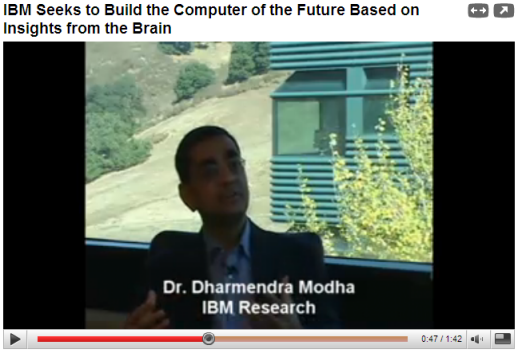
    $this->bbcode_second_pass_quote('', '[')b]Claims by an IBM researcher that he and other scientists were able to simulate a cat's brain using a new algorithm running on an IBM supercomputer are being disputed. Henry Markram, heading up another project called Blue Brain, calls the claims by IBM scientist Dharmendra Modha a scam and a hoax and argues that what Modha's group accomplished only proved that it had access to a massive supercomputer.

    In a letter to IBM CTO Bernard Meyerson, Henry Markram, the lead on the Ecole Polytechnique Federale de Lausanne's Blue Brain project, said the presentation at Supercomputing by Dharmendra Modha, manager of cognitive computing at IBM Research-Almaden, was a mass deception played upon the public, adding that the research did not support Modha's findings.


    $this->bbcode_second_pass_quote('', 'M')odha's project includes not only IBM scientists, but also researchers from Stanford, the University of Wisconsin, Cornell, Columbia University Medical Center and the University of California-Merced.

    The scientists' work is part of a DARPA (Defense Advanced Research Projects Agency) initiative called SYNAPSE (Systems of Neuromorphic Adaptive Plastic Scalable Electronics). For the first phase of the project, the researchers built a cortical simulator that was run on IBM's Dawn Blue Gene/P supercomputer at Lawrence Livermore National Laboratory. The algorithm, called BlueMatter, when combined with the cortical simulator, lets scientists experiment with mathematical hypotheses about how brain structure affects function, according to the researchers.
    Markram's Blue Brain project also aims to build a synthetic brain through reverse-engineering a mammal's brain and also uses an IBM Blue Gene/L computer. Markram is director of the EPFL's Brain Mind Institute, which founded the project.


    It sounds like these are two different approaches to supercomputed neuroscience: Markham's Blue Brain Project is the more credible project which purports to exactly reproduce in exacting detail, with a supercomputer, everything that is known about neuroscience as a path towards using computers to make basic discoveries about the brain.

    Modha's posits that a more mathematical, algorithmic representation of neuron behavior would also be suited to supercomputing applications. However, Modha got a prize for this at the conference in Portland while the Blue Brain Project seems to have trouble getting mentioned anywhere.

    At the recent Singularity Summit 2009, one of the major themes discussed was "Whole Brain Emulation". But the Blue Brain Project was barely mentioned in the press about it! I heard Kurzweil mumble "blue brain" under his breath a single time. That was it! (What is this? Jealousy, or something?). I know an intersting scientific subject when I see one. So does everybody else.

    Even if the goal were strictly about building a working repository of information and model of the human brain, the Blue Brain Project is easily the more interesting of the approaches taken since BBP has so many general uses. Personally, I think IBM Almaden's, Dr. Modha, probably has weaseled some of Blue Brain's thunder.

    But since a mathematical representation, (if it's possible) would be so much faster than pain-stakingly duplicating REAL, vast, neuron structuresin the brain, Modha's approach probably can be continually explored, refined and improved. If Dr. Markham were to discover some basic principle at work, Modha would be right there to mathematically adapt it.

    It just makes the Computational Neuroscience story more interesting to follow.
    Carlhole
     
    Top

    PreviousNext

    Return to Open Topic Discussion

    Who is online

    Users browsing this forum: No registered users and 0 guests

    cron