$this->bbcode_second_pass_quote('Isochroma', 'I')n a press release to the general population - or even a scientistic audience - such a title is plain false on its face, without qualification. Simple as that.
Another sad example of both the blatant corporatistic lies trumpeted in the business-owned press and designed to mislead for commerical profit - characteristic of our current age - and the more subtle but damaging mischaracterization - nay - confusion - of abstraction with reality, which is not so much unique to an age as to particular 'civilizations'.



PeakOil is You
GPT4 Artificial Intelligence Online
Re: IBM Has Achieved Cat Scale Brain Simulation
 by Carlhole » Thu 19 Nov 2009, 16:50:01
What a load nonsense.
Look, (1) Much is known about neuroscience already. But this knowledge has never been compiled into an accurate macro brain model whereby neuroscientists can make new discoveries and continually add to existing knowledge. Computer models of neurons and collections of neurons are fully proven to be highly accurate and reliable. It is a natch that greater and more sophisticated models which incorporate more neuroscientific detail will evolve further.
(2) . Intense worldwide competition is evolving the art and science of supercomputing very rapidly. It won't be terribly long before an exaflop machine is built. That's a million trillion calculations a second. It is also a tremendous challenge to model large collections of simulated cortical columns via supercomputer, leading to an eventual simulation of a full neocortex or brain. The race has already begun. It's a real, ongoing effort.
There are other intense challenges for supercomputing labs - such as modeling fusion reactions or climate. I'm just reporting on this particular application because it is so seemingly sci-fi, yet the work is very real and progressing with great speed.
- Carlhole
Re: IBM Has Achieved Cat Scale Brain Simulation
by Isochroma » Thu 19 Nov 2009, 17:04:16
carlhole,
You are yourself lost in abstractions. You claim my statement is nonsense, yet you yourself haven't the sense to actually make a claim as to why it is nonsense.
Instead you go off on some intellectual jackoff about progress, etc.
The title of the paper is a lie, a blatant and self-serving one too. To remind you, seeing as your memory is so short, the title was:
"IBM Has Achieved Cat Scale Brain Simulation Which are 15 times the scale of Previous Rat Brain Simulations."
Let's take this statement apart, starting at the beginning.
"Cat Scale Brain Simulation". Lie. A cat-scale brain simulation would, as its title says, be a simulation that achieves the geometric scale of a cat, in the brain area obviously.
And it would actually simulate a fucking cat brain, wouldn't it?
But IBM is not simulating a cat brain, it is running a software called NEURON which is an imitation of a vanishingly small subset of observable characteristics that are said to resemble neuron function.
An imitation of an abstraction of a limited observation.
Any good lie has elements of truth, but is nevertheless fundamentally deficient in itself.
The defining characteristic that differentiates a lie from the truth is that a lie is not just deficient in truthfulness, but that it opposes the truth, obscures the truth, misleads from the truth, imprisons and deposes of the truth.
Another characteristic of a lie is that like a weakling crop it is often propped up by supporting statements which occur near its vicinity, which obscure and legitimize the lie:
"15 times the scale of Previous Rat Brain Simulations"
The second part of the announcement is obviously true, but it says nothing qualitative about the qualitative or quantitative truth of the first statement.
Instead it occupies paper space, linguistic space, and ultimately the mental space of the sheeple who unquestioningly read it. It trumps one or more characteristics in common with the lie which indirectly support the lie without being contestable in themselves.
You are yourself lost in abstractions. You claim my statement is nonsense, yet you yourself haven't the sense to actually make a claim as to why it is nonsense.
Instead you go off on some intellectual jackoff about progress, etc.
The title of the paper is a lie, a blatant and self-serving one too. To remind you, seeing as your memory is so short, the title was:
"IBM Has Achieved Cat Scale Brain Simulation Which are 15 times the scale of Previous Rat Brain Simulations."
Let's take this statement apart, starting at the beginning.
"Cat Scale Brain Simulation". Lie. A cat-scale brain simulation would, as its title says, be a simulation that achieves the geometric scale of a cat, in the brain area obviously.
And it would actually simulate a fucking cat brain, wouldn't it?
But IBM is not simulating a cat brain, it is running a software called NEURON which is an imitation of a vanishingly small subset of observable characteristics that are said to resemble neuron function.
An imitation of an abstraction of a limited observation.
Any good lie has elements of truth, but is nevertheless fundamentally deficient in itself.
The defining characteristic that differentiates a lie from the truth is that a lie is not just deficient in truthfulness, but that it opposes the truth, obscures the truth, misleads from the truth, imprisons and deposes of the truth.
Another characteristic of a lie is that like a weakling crop it is often propped up by supporting statements which occur near its vicinity, which obscure and legitimize the lie:
"15 times the scale of Previous Rat Brain Simulations"
The second part of the announcement is obviously true, but it says nothing qualitative about the qualitative or quantitative truth of the first statement.
Instead it occupies paper space, linguistic space, and ultimately the mental space of the sheeple who unquestioningly read it. It trumps one or more characteristics in common with the lie which indirectly support the lie without being contestable in themselves.
-

Isochroma - Peat

- Posts: 50
- Joined: Sun 22 Jul 2007, 03:00:00
Re: IBM Has Achieved Cat Scale Brain Simulation
by flapjax » Thu 19 Nov 2009, 17:34:35
$this->bbcode_second_pass_quote('Isochroma', '
')... but it says nothing qualitative about the qualitative or quantitative truth of the first statement.
')... but it says nothing qualitative about the qualitative or quantitative truth of the first statement.
Did I just read that?
-

flapjax - Lignite
- Posts: 241
- Joined: Wed 15 Oct 2008, 03:00:00
Re: IBM Has Achieved Cat Scale Brain Simulation
by Isochroma » Thu 19 Nov 2009, 18:02:45
Yes, you did.
But maybe my point was too obscure. By that statement I meant that while the second claim (15 times...) is likely true, it is used in a way which purports to support or otherwise prop up the first claim, which is false.
Language is a subtle tool, and statements aren't just thrown together by those making them at random, but in an ordered way so as to support the creation of a certain picture in the reader's mind. That process has a name too - it's called propaganda. From the blatant to the subtle, brainwashing has its forms and follows certain functions.
But maybe my point was too obscure. By that statement I meant that while the second claim (15 times...) is likely true, it is used in a way which purports to support or otherwise prop up the first claim, which is false.
Language is a subtle tool, and statements aren't just thrown together by those making them at random, but in an ordered way so as to support the creation of a certain picture in the reader's mind. That process has a name too - it's called propaganda. From the blatant to the subtle, brainwashing has its forms and follows certain functions.
-
Isochroma - Peat
- Posts: 50
- Joined: Sun 22 Jul 2007, 03:00:00
Re: IBM Has Achieved Cat Scale Brain Simulation
by Carlhole » Thu 19 Nov 2009, 18:53:32
$this->bbcode_second_pass_quote('Isochroma', 'c')arlhole,
The title of the paper is a lie, a blatant and self-serving one too.
The title of the paper is a lie, a blatant and self-serving one too.
Like I said earlier, if you want to make an ass out of yourself by sending objectionable emails to the scientists involved, by all means go right ahead. I'm just reporting on this interesting application of advanced supercomputing in neuroscience that research organizations like Lawrence Livermore, companies like IBM, and Universities like Stanford are involved in. The Blue Brain Project is financed by the Swiss Government.
All of these organizations are infinitely more credible than you, some unknown jackass on a public discussion board who weirdly rants about a current news event.
- Carlhole
Re: IBM Has Achieved Cat Scale Brain Simulation
by Isochroma » Thu 19 Nov 2009, 19:22:59
Let me take amoment to correct your statement: "The Blue Brain project is funded by the SWISS PEOPLE". Tax money stolen from their pockets and handed to the mega-corporation IBM.
Your resort to personal insults - 'some unknown jackass on a public discussion board' - belies your lack of ability to counter my statements, and says a lot about your own credibility.
For the record, I am opposed to taxpayer dollars being handed to big rich corporations like IBM for this kind of 'research' which is just a thinly veiled giveaway of taxpayer dollars to a giant multinational corporation.
Let's move on to a statement by IBM itself - not the title some ambitious blogger created to pump up the story:
"...that exceeds the scale of a cat cortex"
http://www-03.ibm.com/press/us/en/press ... ss#release
Another lie. Nothing they have done even meets the scale of a cat cortex, never mind exceeds it. They cannot even simulate a single cell, never mind an entire cortex. But such facts are lost in an ocean of techno-drivel propounded by IBM's loquacious PR writer - a certain Sara Delekta Galligan - who waxes poetic about how "This scientific tool, akin to a linear accelerator or an electron microscope, is a critical instrument used to test hypotheses of brain structure, dynamics and function."
Of course, the software in question and the computer it runs on are nothing at all like a linear accelerator or a microscope, in neither their design nor function or even goals.
Furthermore, IBM's tentacles are feeding from the US military-industrial complex too: "After the successful completion of Phase 0, IBM and its university partners were recently awarded $16.1M in additional funding from the Defense Advanced Research Projects Agency (DARPA) for Phase 1 of DARPA’s Systems of Neuromorphic Adaptive Plastic Scalable Electronics (SyNAPSE) initiative."
The US military wants something that produces similar outputs to real brains without all the messy work of actually simulating the real atoms that make up a real brain.
The reason they want it is so they can run their Predators and whatever other control systems without people or with less people, and faster too: "it’s imperative that we create a more intelligent computing system that can help us make sense the vast amount of information that's increasingly available to us, much the way our brains can quickly interpret and act on complex tasks"
Such help will also find a loving home in the corporate world, where superfast stock trading algorithms will benefit, along with all the other things big corporations do or want to do superfast: firing employees, shifting trillions of dollars around the world between currencies and stocks, etc. A match made in heaven, if I may say so myself.
So the goal is to take the general public's money - from taxpayers in several countries - and use it to enrich IBM so that IBM can find a way to replace those useless stock-traders and warplane-drivers and numerous others with machines. In even simpler terms: force the general public to pay for their own obsolescence and the brains that will power their future oppressor-machines. If some brain-damaged person is someday helped by such an advance - unlikely as the possibility is since it isn't trumpeted in the press release - it will be a secondary effect.
Your resort to personal insults - 'some unknown jackass on a public discussion board' - belies your lack of ability to counter my statements, and says a lot about your own credibility.
For the record, I am opposed to taxpayer dollars being handed to big rich corporations like IBM for this kind of 'research' which is just a thinly veiled giveaway of taxpayer dollars to a giant multinational corporation.
Let's move on to a statement by IBM itself - not the title some ambitious blogger created to pump up the story:
"...that exceeds the scale of a cat cortex"
http://www-03.ibm.com/press/us/en/press ... ss#release
Another lie. Nothing they have done even meets the scale of a cat cortex, never mind exceeds it. They cannot even simulate a single cell, never mind an entire cortex. But such facts are lost in an ocean of techno-drivel propounded by IBM's loquacious PR writer - a certain Sara Delekta Galligan - who waxes poetic about how "This scientific tool, akin to a linear accelerator or an electron microscope, is a critical instrument used to test hypotheses of brain structure, dynamics and function."
Of course, the software in question and the computer it runs on are nothing at all like a linear accelerator or a microscope, in neither their design nor function or even goals.
Furthermore, IBM's tentacles are feeding from the US military-industrial complex too: "After the successful completion of Phase 0, IBM and its university partners were recently awarded $16.1M in additional funding from the Defense Advanced Research Projects Agency (DARPA) for Phase 1 of DARPA’s Systems of Neuromorphic Adaptive Plastic Scalable Electronics (SyNAPSE) initiative."
The US military wants something that produces similar outputs to real brains without all the messy work of actually simulating the real atoms that make up a real brain.
The reason they want it is so they can run their Predators and whatever other control systems without people or with less people, and faster too: "it’s imperative that we create a more intelligent computing system that can help us make sense the vast amount of information that's increasingly available to us, much the way our brains can quickly interpret and act on complex tasks"
Such help will also find a loving home in the corporate world, where superfast stock trading algorithms will benefit, along with all the other things big corporations do or want to do superfast: firing employees, shifting trillions of dollars around the world between currencies and stocks, etc. A match made in heaven, if I may say so myself.
So the goal is to take the general public's money - from taxpayers in several countries - and use it to enrich IBM so that IBM can find a way to replace those useless stock-traders and warplane-drivers and numerous others with machines. In even simpler terms: force the general public to pay for their own obsolescence and the brains that will power their future oppressor-machines. If some brain-damaged person is someday helped by such an advance - unlikely as the possibility is since it isn't trumpeted in the press release - it will be a secondary effect.
-
Isochroma - Peat
- Posts: 50
- Joined: Sun 22 Jul 2007, 03:00:00
Catty
by Isochroma » Thu 19 Nov 2009, 20:02:07
Now it's time to flesh out the details a bit more.
It's already obvious that the case we speak of is a leech of taxpayer dollars, and that it is also another pound of pork out of the government trough.
Beyond these things, why is the US military so interested in simulating a cat brain?
For starters, it's easy. Cat brains are well-studied. Cats are easy to breed too. Their brains are small enough to be mimic-able, but large enough to be useful.
When I say useful, I mean it in a certain sense. A very particular sense, indeed.
Cats are one of the world's most efficient, most lethal predators. Their perception and classification of targets is fast, accurate - and therefore supremely desireable.
They are intelligent enough to be trained, or have instincts hardwired into their brains. And they are cruel, in a way which nicely mimics the cruelty of the very institution which is funding a mimic of their brains.
Now for the next part of the puzzle.
The USMIL is very busy developing Predators and Reapers and who knows what else. Coming online now and in the near future are observing vehicles and killer-observers with very high-resolution cameras that capture frames very fast.
Wired: Special Forces’ Gigapixel Flying Spy Sees All
http://www.wired.com/dangerroom/2009/02 ... xel-flyin/
"You may think your new ten-megapixel camera is pretty hot –- but not when you compare it to the 1.8 Gigapixel beast built for the Pentagon. The camera is designed as a payload for the A-160T Hummingbird robot helicopter now being quietly delivered to Special Forces. It will give them an unprecedented ability to track everything on the ground in real time. The camera is scheduled for flight testing at the start of next year."

Problem is, all the data is too much too fast to transmit, and having multiple people try to figure it out in realtime just won't do:
"The camera is pretty impressive, but it’s the processing and the software behind it that will make this such a capable system. It would take a human a very long time to scan the whole area under surveillance if they were looking for something – but this is exactly the type of task which the swarming software we looked at last week excels at. Luckily enough, that just happens to be a Darpa program too."
The 'swarming software' is a first attempt to get the data-river dealt with, but it isn't the kind of intelligence they really want. It doesn't have the selfsense, the vicious killer smarts of a cat. And it won't have a chance at making smart decisions when the dataflow quaduples yet again: the USMIL wants "a 2.3 gigapixel camera for aerial surveillance":
US Army wants 2.3 gigapixel camera for aerial surveillance
http://www.engadget.com/2009/08/20/us-a ... veillance/
The data is too voluminous and too fast to be transmitted in its entirety, so they need an onboard AI with sufficient intelligence to not only send selected streams out, but to eventually make decisions and predate. A cat is the ultimate predator, just smart enough and plenty fast enough to kill the chosen targets.
Cats are both supreme watchers and also vicious killers. They are the current ideal to approach for watcher-hunter-killer AI, and the IBM neuron program is the approach path.
It's already obvious that the case we speak of is a leech of taxpayer dollars, and that it is also another pound of pork out of the government trough.
Beyond these things, why is the US military so interested in simulating a cat brain?
For starters, it's easy. Cat brains are well-studied. Cats are easy to breed too. Their brains are small enough to be mimic-able, but large enough to be useful.
When I say useful, I mean it in a certain sense. A very particular sense, indeed.
Cats are one of the world's most efficient, most lethal predators. Their perception and classification of targets is fast, accurate - and therefore supremely desireable.
They are intelligent enough to be trained, or have instincts hardwired into their brains. And they are cruel, in a way which nicely mimics the cruelty of the very institution which is funding a mimic of their brains.
Now for the next part of the puzzle.
The USMIL is very busy developing Predators and Reapers and who knows what else. Coming online now and in the near future are observing vehicles and killer-observers with very high-resolution cameras that capture frames very fast.
Wired: Special Forces’ Gigapixel Flying Spy Sees All
http://www.wired.com/dangerroom/2009/02 ... xel-flyin/
"You may think your new ten-megapixel camera is pretty hot –- but not when you compare it to the 1.8 Gigapixel beast built for the Pentagon. The camera is designed as a payload for the A-160T Hummingbird robot helicopter now being quietly delivered to Special Forces. It will give them an unprecedented ability to track everything on the ground in real time. The camera is scheduled for flight testing at the start of next year."
Problem is, all the data is too much too fast to transmit, and having multiple people try to figure it out in realtime just won't do:
"The camera is pretty impressive, but it’s the processing and the software behind it that will make this such a capable system. It would take a human a very long time to scan the whole area under surveillance if they were looking for something – but this is exactly the type of task which the swarming software we looked at last week excels at. Luckily enough, that just happens to be a Darpa program too."
The 'swarming software' is a first attempt to get the data-river dealt with, but it isn't the kind of intelligence they really want. It doesn't have the selfsense, the vicious killer smarts of a cat. And it won't have a chance at making smart decisions when the dataflow quaduples yet again: the USMIL wants "a 2.3 gigapixel camera for aerial surveillance":
US Army wants 2.3 gigapixel camera for aerial surveillance
http://www.engadget.com/2009/08/20/us-a ... veillance/
The data is too voluminous and too fast to be transmitted in its entirety, so they need an onboard AI with sufficient intelligence to not only send selected streams out, but to eventually make decisions and predate. A cat is the ultimate predator, just smart enough and plenty fast enough to kill the chosen targets.
Cats are both supreme watchers and also vicious killers. They are the current ideal to approach for watcher-hunter-killer AI, and the IBM neuron program is the approach path.
Last edited by Isochroma on Thu 19 Nov 2009, 20:17:37, edited 4 times in total.
-
Isochroma - Peat
- Posts: 50
- Joined: Sun 22 Jul 2007, 03:00:00
Condensed
by Isochroma » Thu 19 Nov 2009, 20:24:56

Far, far more than just pattern recognition. They want the full spectrum: observe, hunt and kill. So they looked at what was most known in bioresearch - and likeliest to be simulable with current or near-future hardware - and settled on a logical choice: the cat - nature's ultimate hunter-killer.
"A skilled predator, the cat is known to hunt over 1,000 species for food."
http://en.wikipedia.org/wiki/Cat
Translation: its neural systems can be formed to recognize a large number of distinct target-types.
Cats use two hunting strategies, either stalking prey actively, or waiting in ambush until an animal comes close enough to be captured
http://en.wikipedia.org/wiki/Cat#Hunting_and_feeding
Translation: catlike AI will be capable of surveillance, stalking, hunting and killing.
For those who like their data compressed,
US taxpayers are funding IBM so IBM can make a software/hardware that simulates what they consider the important functions of a cat brain, so that they can develop artificial inteligences which embody the characteristics that make a cat the excellent watcher-hunter-predator it is in real life.
These AIs can then be loaded into UAVs and other military vehicles for use surveilling, hunting and killing people, buildings and other targets.
They will be fast enough to gobble down the terabits of data from gigapixel cameras in realtime, smart enough to recognize and discriminate targets from non-targets, smart enough to take higher-level orders as 'instincts' or 'urges', yet simple enough to be simulable on available hardware.
The secondary benefit to this is that as more intelligence functions are offloaded from people to simulated brains, the higher-ups will have new excuses when innocents are slaughtered or mistaken facilities are destroyed: "the AI malfunctioned".
Later on, after the USMIL's finished milking it for the initial ROIs, the taxpayer-funded research might yield catlike intelligences which predate stocks and bonds and pounce on currency trades, etc. It may seem strange but once the basis is in place, such an intelligence can be transformed to serve a variety of interests for those who control things in both the military and wealth arenas.
Lastly, one more aspect of cats bears particular relevance: the cat eye. The cat's eye and visual processing system is one of the most studied and quite adapted to its natural uses. That is one of the main attractors for those looking to implement a digital 'killer app' from a cat brain simulator in UAV or other highly visual applications.
Last edited by Isochroma on Thu 19 Nov 2009, 21:01:20, edited 8 times in total.
-
Isochroma - Peat
- Posts: 50
- Joined: Sun 22 Jul 2007, 03:00:00
Re: IBM Has Achieved Cat Scale Brain Simulation
by bratticus » Thu 19 Nov 2009, 20:39:13
-

bratticus - Permanently Banned
- Posts: 2368
- Joined: Thu 12 Jun 2008, 03:00:00
- Location: Bratislava
Re: IBM Has Achieved Cat Scale Brain Simulation
by copious.abundance » Thu 19 Nov 2009, 22:39:00
Will this explain why my cat is so fascinated by water dripping from my kitchen faucet?
Stuff for doomers to contemplate:
http://peakoil.com/forums/post1190117.html#p1190117
http://peakoil.com/forums/post1193930.html#p1193930
http://peakoil.com/forums/post1206767.html#p1206767
http://peakoil.com/forums/post1190117.html#p1190117
http://peakoil.com/forums/post1193930.html#p1193930
http://peakoil.com/forums/post1206767.html#p1206767
-

copious.abundance - Fission

- Posts: 9589
- Joined: Wed 26 Mar 2008, 03:00:00
- Location: Cornucopia
Re: Catty
by Carlhole » Thu 19 Nov 2009, 23:37:00
$this->bbcode_second_pass_quote('Isochroma', '.')..The data is too voluminous and too fast to be transmitted in its entirety, so they need an onboard AI with sufficient intelligence to not only send selected streams out, but to eventually make decisions and predate. A cat is the ultimate predator, just smart enough and plenty fast enough to kill the chosen targets.
Cats are both supreme watchers and also vicious killers. They are the current ideal to approach for watcher-hunter-killer AI, and the IBM neuron program is the approach path.
Cats are both supreme watchers and also vicious killers. They are the current ideal to approach for watcher-hunter-killer AI, and the IBM neuron program is the approach path.
You've obviously read a lot of comic books.
But in your painfully embarrassing way, you seem to be now arguing that these supercomputing scientists are actually on a path to success in meeting their computational neuroscience objectives. So I suppose I have won the argument that this is all very interesting and valid science news.
Here's another article for all you brainiacs still reading: IBM Reveals the Biggest Artificial Brain of All Time
$this->bbcode_second_pass_quote('Popular Mechanics', 'I')BM has revealed the biggest artificial brain of all time, a simulation run by a 147,456-processor supercomputer that requires millions of watts of electricity and over 150,000 gigabytes of memory. The brain simulation is a feat for neuroscience and computer processing—but it's still one-eighty-third the speed of a human brain and is only as large as a cat's. Will we ever get to truly capable artificial intelligence?
$this->bbcode_second_pass_quote('', '&')quot;This is a Hubble Telescope of the mind, a linear accelerator of the brain," says Dharmendra Modha, the Almaden computer scientist who will announce the feat at the Supercomputing 2009 conference in Portland, Ore. In other words, in the realm of computer science, the team's undertaking is grand.
The cortex, the wrinkly outer layer of the brain, performs most of the higher functions that make humans human, from recognizing faces and speech to choreographing the dozens of muscle contractions involved in a perfect tennis serve. It does this using a universal neural circuit called a microcolumn, repeated over and over millions of times. Modha hopes the simulation, assembled using neuroscience data from rats, cats, monkeys and humans, will help scientists better understand how the brain works—and, in particular, how the cortical microcolumn manages to perform such a wide range of tasks.
But deciphering the microcolumn can also help build better computers, Mars rovers and robots that are truly intelligent. By reverse engineering this cortical structure, Modha says, researchers could give machines the ability to interpret biological senses such as sight, hearing and touch. And artificial machine brains could process, intelligently, senses that don't currently exist in the natural world, such as radar and laser range-finding.
The term "cat scale" is just a magnitude indicator:
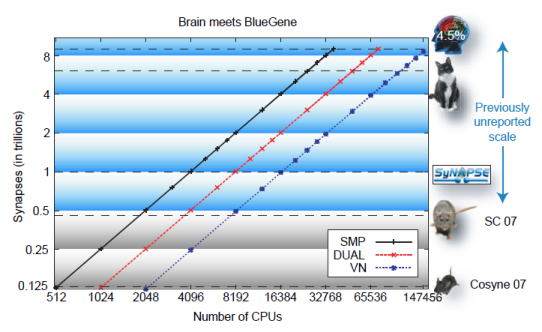
$this->bbcode_second_pass_quote('', 'T')he plots show that in each mode, as the number of MPI Processes is increased (x-axis), a proportionately larger size of the model, quantifieded with number of synapses, can be successfully simulated (y-axis)...
The horizontal lines are provided for reference and indicate the number of synapses in the cortex of various mammals of interest (see table in the introduction). On a half-rack system with 512 nodes, we were able to simulate at a scale of the mouse cortex, comparable to our prior work [13]; on 2 racks with 2; 048 nodes, we were able to simulate at a scale of the rat cortex, comparable to our previous report [2]. Representing previously unattained scales, on 4 racks with 4; 096 nodes, we are able to simulate at a scale of the ultimate objective of the SyNAPSE program; with a little over 24; 756 nodes and 24 racks, we simulated a 6:1 trillion synapses at the scale of the cat cortex. Finally, the largest model size consists of 900 million neurons and 9 trillion synapses, in 1; 179; 648 groups of 763 neurons each. This corresponds to a scale of 4.5% of the human cortex.

