

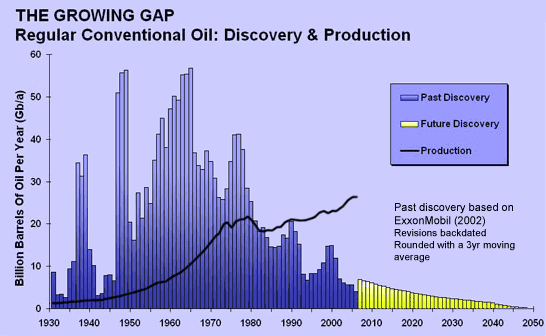
was referenced in a different argument.
It was referenced in part because I often make the sarcastic statement that peakers start off with a commonly accepted "oil in the ground" number, and then start discarding anything and everything they don't like, aren't familiar with, hasn't been discovered yet even if there are seeps nearby, or isn't sitting right under existing infrastructure, or might be in some arbitrary water depth. And then, to cap it all off, they proclaim that running out isn't the issue, but lets chop the final number in half and proclaim THAT moment in time to the pinnacle trigger for <fill in your favorite green-Rambo scenario>.
Now, this 50% number appears quite arbitrary, and I would reference the following work by Hook, Secretary of ASPO as a possible reason why. When he studied some large fields he discovered that actually some 35% of URR had been produced at the onset of decline, not the mythical 50% often bandied about during speculation by the likes of us amateurs. His results encompass nearly the entire range of possibilities available, from 7% to 90%, so its value might be limited under ALL circumstances.
The histogram upon which I make this statement comes from Fig 11, Page 12, of his Natural Resources Research Paper.
http://www.tsl.uu.se/uhdsg/publications/GOF_NRR.pdf
So the experts apparently think that the range of when decline sets in certainly isn't specific to 50%, but thats another matter.
So we have a censored discovery graph because the single largest accumulation of oil discovered by man in 1935 is generally ignored because it isn't counted in anyone's reserves category, an unnecessary distinction which Hubbert certainly didn't make when he built in billions of barrels of future conversions from resources to reserves in his original, 1956 work.
Figure 21, Oil "undiscovered reserves" otherwise known as resources, which fits right in with explanations of the conversion of resources to reserves by Tyler here.
http://www.energybulletin.net/node/13630
http://peakoil.com/peak-oil-discussion/ ... 30-30.html
So, conservative estimates of the discovery in 1935 should be about 250 Billion barrels, but they aren't there. Presto...a censored graph. But thats not the INTERESTING censorship. You see, that oil falls into the resources/reserves distinction which Tyler makes, therefore it is ignored by anyone trying to cut cut cut the amount of oil available to humanity under ALL circumstances.
But here's even the more TRICKY censorship.
You see, Ghawar is on that discovery chart as well...only....its not. You see, Ghawar as estimated by even the TOD analytical specialists runs about 90-105 billion barrels URR.
http://www.theoildrum.com/node/2494
And its not on that graph either.
Which begs the question, while it is understood that peakers are genetically predisposed to underestimate all volumes, all the time, ( in order to achieve their Rapture as soon as possible ) why are they cutting back on known estimates of Ghawar on that discovery graph as well? Ghawar's discovery wells are listed as flowing by 1938
http://www.theoildrum.com/node/5432
and yet here we don't even have the amount it has PRODUCED showing up on the discovery graph?
Methinks....a wee bit of peaker tomfoolery is afoot? First you exclude the game changer, which Hubbert certainly didn't do, and then you actually start trying to hide the single largest field even discovered? Naughty naughty, backdating the TOD estimates means that there should be a nice, 100 BILLION spike somewhere near 1938...anyone else see it, because I sure don't.
Now, if peakers are going to use censored information, is it any surprise that they can be led to bogus conclusions?
And while we are at it, where are Oilfinders totals on that yellow projected discovery line? He's rounded up a decent 20-30 billion barrels for at least 2 years in a row....methinks....at the least some discovery chart like this needs updated with both the most current information, and the REAL historical information? For starters? Perhaps there is already such a graph which hasn't been censored? I must admit, googling around for these things runs into more peaker type censored info than most anything else.





 ) and TOD is obviously laboring away firming up its real size ( about 100 Billion ) and then it gets ignored? While I realize its convenient to disguise the true size of discoveries through time to make certain that embarrassing questions aren't asked, how valid of a scientific approach is that? Wonderful way to create a recruiting tool, "Look at discoveries! Aren't they terrible! We're all Doomed!" but holy cow, how can anyone expect to be taken seriously on resource depletion issues when you do this kind of stuff?