Here's why another generation of derivatives are on the way. Forget all your airy-fairy libertarian notions of small shopkeeper with gun at door freedom. You must consume! Consume I tell you!
http://www.telegraph.co.uk/finance/econ ... hrift.html



PeakOil is You
The paradox of thrift
The paradox of thrift
 by americandream » Sun 20 Sep 2009, 19:56:36
- americandream
- Permanently Banned
- Posts: 8650
- Joined: Mon 18 Oct 2004, 03:00:00
Re: The paradox of thrift
by mattduke » Sun 20 Sep 2009, 19:58:53
Classic Keynsian fallacy. This from the same guy that advised digging and refilling holes in the ground as "solution" to depression.
http://peakoil.com/economics-finance/ke ... x%20thrift
http://peakoil.com/economics-finance/ke ... x%20thrift
-

mattduke - Intermediate Crude

- Posts: 3591
- Joined: Fri 28 Oct 2005, 03:00:00
Re: The paradox of thrift
by americandream » Sun 20 Sep 2009, 20:17:51
Raise your hand those amongst us who would willingly sacrifice your way of life to the brute force of pure economy. That noble creature does not exist and it is in the nature of capital to seek the path of least resistance to survival.
I am a marxist but theres no damned way I would willingly succumb to the impoverishment of my affluent capitalist means of livelihood. I'm rational but not a saint. The next generation of derivatives is on the drawing board.
$this->bbcode_second_pass_quote('mattduke', 'C')lassic Keynsian fallacy. This from the same guy that advised digging and refilling holes in the ground as "solution" to depression.
http://peakoil.com/economics-finance/ke ... x%20thrift
I am a marxist but theres no damned way I would willingly succumb to the impoverishment of my affluent capitalist means of livelihood. I'm rational but not a saint. The next generation of derivatives is on the drawing board.
$this->bbcode_second_pass_quote('mattduke', 'C')lassic Keynsian fallacy. This from the same guy that advised digging and refilling holes in the ground as "solution" to depression.
http://peakoil.com/economics-finance/ke ... x%20thrift
- americandream
- Permanently Banned
- Posts: 8650
- Joined: Mon 18 Oct 2004, 03:00:00
Re: The paradox of thrift
by efarmer » Sun 20 Sep 2009, 20:21:48
The real danger is that the cash strapped consumer, low on funds will have to ditch the television and Internet links completely, and without anyone able to dig into his head and tell him what he needs to buy to be stylish and complete as a human being, he will simply look to his neighbors to see what they are doing, who of course will be looking back at him because they too have lost their link with the consumer programming mavens. This will lock us out of consuming our way out of the results of consumption that we are presently in.
I am afraid they will all just buy more Spam and sacks of potatoes. The cure of course, will be to send in "seed consumers" outfitted by manufacturers, retailers, and advertisers, with fancy clothes, cars, and goodies to start the fermentation of consumer frenzy back up again.
Being a "seed" consumer could be the next big thing...
This will be very fragile, if the rumor that the "seed" consumer is a politician
or a repo man gets going, we are back to square one.
I am afraid they will all just buy more Spam and sacks of potatoes. The cure of course, will be to send in "seed consumers" outfitted by manufacturers, retailers, and advertisers, with fancy clothes, cars, and goodies to start the fermentation of consumer frenzy back up again.
Being a "seed" consumer could be the next big thing...
This will be very fragile, if the rumor that the "seed" consumer is a politician
or a repo man gets going, we are back to square one.
-

efarmer - Intermediate Crude
- Posts: 2003
- Joined: Fri 17 Mar 2006, 04:00:00
Re: The paradox of thrift
by mattduke » Sun 20 Sep 2009, 20:25:03
This cartoon may help AmericanDream. The author is a political prisoner in the US.
http://www.takelifeback.com/hegawid
http://www.takelifeback.com/hegawid
-
mattduke - Intermediate Crude
- Posts: 3591
- Joined: Fri 28 Oct 2005, 03:00:00
Re: The paradox of thrift
by Tyler_JC » Sun 20 Sep 2009, 20:42:42
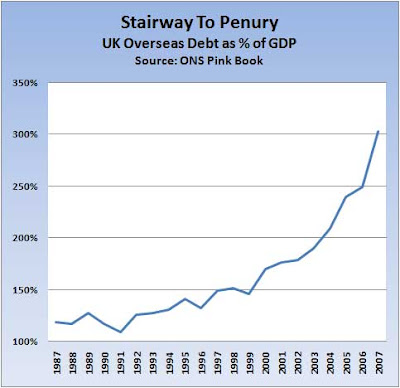

Consumption-led growth be damned. Britain is in no position to increase its debt load right now. Sensible public policy would be moderate tax hikes on the rich and spending cuts across the board.
Keynesian economics is based on the idea that the long term doesn't matter because "in the long run we're all dead".
Speaking as someone in his 20s, I'd say the long term matters quite a bit. Extreme leveraging at the government level is just as bad, if not worse, than extreme leveraging at the corporate/individual level. Governments are in for a serious shock once they realize that 1940s debt levels are not going to be followed by 1950s/1960s economic growth levels.
Once the debt payments exceed economic growth over a long period of time, the indebted countries will be caught in a hopeless debt trap. They will never be able to truly pay off these obligations and the only solution will be a devaluation of their currency followed by years of austerity.
"www.peakoil.com is the Myspace of the Apocalypse."
- Tyler_JC
- Expert

- Posts: 5438
- Joined: Sat 25 Sep 2004, 03:00:00
- Location: Boston, MA
Re: The paradox of thrift
by americandream » Sun 20 Sep 2009, 21:53:26
All this academic steady state capitalism is fine in the class room but you ask an investor (small or otherwise) to steady state his appetite for increasing annual returns and you wont get work as a professional in the financial services. In fact, you will quickly be consigned to a failed state of employment.
You'ld be surprised at the number of financial professionals who all agree that only compulsion (due to an impending calamity, resource exhaustion or something beyond humankinds control) will impel us to adopt a steady state system. And it wont be a proft driven one. The two do not mix. Try asking a child not to grow. Impossible dreams of those who invariably sit in academic cloisters and have never really confronted business people other than to beg for grants and subsidies.
$this->bbcode_second_pass_quote('mattduke', 'T')his cartoon may help AmericanDream. The author is a political prisoner in the US.
http://www.takelifeback.com/hegawid
You'ld be surprised at the number of financial professionals who all agree that only compulsion (due to an impending calamity, resource exhaustion or something beyond humankinds control) will impel us to adopt a steady state system. And it wont be a proft driven one. The two do not mix. Try asking a child not to grow. Impossible dreams of those who invariably sit in academic cloisters and have never really confronted business people other than to beg for grants and subsidies.
$this->bbcode_second_pass_quote('mattduke', 'T')his cartoon may help AmericanDream. The author is a political prisoner in the US.
http://www.takelifeback.com/hegawid
- americandream
- Permanently Banned
- Posts: 8650
- Joined: Mon 18 Oct 2004, 03:00:00
Re: The paradox of thrift
by americandream » Sun 20 Sep 2009, 21:57:27
Thats all well and good but its the private sectors tail thats wagging this government sector dog. The lobbying mechanism is fiendishly fcukked in the western world.
$this->bbcode_second_pass_quote('Tyler_JC', 'C')onsumption-led growth be damned. Britain is in no position to increase its debt load right now. Sensible public policy would be moderate tax hikes on the rich and spending cuts across the board. --snip-- Once the debt payments exceed economic growth over a long period of time, the indebted countries will be caught in a hopeless debt trap. They will never be able to truly pay off these obligations and the only solution will be a devaluation of their currency followed by years of austerity.
$this->bbcode_second_pass_quote('Tyler_JC', 'C')onsumption-led growth be damned. Britain is in no position to increase its debt load right now. Sensible public policy would be moderate tax hikes on the rich and spending cuts across the board. --snip-- Once the debt payments exceed economic growth over a long period of time, the indebted countries will be caught in a hopeless debt trap. They will never be able to truly pay off these obligations and the only solution will be a devaluation of their currency followed by years of austerity.
- americandream
- Permanently Banned
- Posts: 8650
- Joined: Mon 18 Oct 2004, 03:00:00
Re: The paradox of thrift
by nobodypanic » Sun 20 Sep 2009, 22:19:43
$this->bbcode_second_pass_quote('americandream', 'A')ll this academic steady state capitalism is fine in the class room but you ask an investor (small or otherwise) to steady state his appetite for increasing annual returns and you wont get work as a professional in the financial services. In fact, you will quickly be consigned to a failed state of employment.
You'ld be surprised at the number of financial professionals who all agree that only compulsion (due to an impending calamity, resource exhaustion or something beyond humankinds control) will impel us to adopt a steady state system. And it wont be a proft driven one. The two do not mix. Try asking a child not to grow. Impossible dreams of those who invariably sit in academic cloisters and have never really confronted business people other than to beg for grants and subsidies.
You'ld be surprised at the number of financial professionals who all agree that only compulsion (due to an impending calamity, resource exhaustion or something beyond humankinds control) will impel us to adopt a steady state system. And it wont be a proft driven one. The two do not mix. Try asking a child not to grow. Impossible dreams of those who invariably sit in academic cloisters and have never really confronted business people other than to beg for grants and subsidies.
agreed.
even the petty bourgeoisie's first priority is to grow his business, to make more money, to get bigger. the very structure of capitalism makes it necessary that he do so in order to survive and thrive in the institutionalized cut throat competition that takes place w/in the market arena. thus, sans growth, capitalism ceases to be and must instead become something else.
-

nobodypanic - Heavy Crude

- Posts: 1103
- Joined: Mon 02 Jun 2008, 03:00:00


