Donate Bitcoin

Donate Paypal


PeakOil is You

PeakOil is You

THE Michael C. Lynch Thread Pt. 2

What's on your mind?
General interest discussions, not necessarily related to depletion.

Re: Michael Lynch: New discoveries keep pace with depletion

Postby JohnDenver » Tue 25 Aug 2009, 18:58:43

No one has addressed the OP's question. Lynch's point is that reserves have remained constant over time due to a combination of discovery and reserve growth, with reserve growth including increasing recovery factors.

$this->bbcode_second_pass_quote('Lynch', 'W')hen a new field is found, it is given a size estimate that indicates how much is thought to be recoverable at that point in time. But as years pass, the estimate is almost always revised upward, either because more pockets of oil are found in the field or because new technology makes it possible to extract oil that was previously unreachable. Yet because petroleum geologists don’t report that additional recoverable oil as “newly discovered,” the peak oil advocates tend to ignore it. In truth, the combination of new discoveries and revisions to size estimates of older fields has been keeping pace with production for many years.



$this->bbcode_second_pass_quote('', 'A')ctually, the consensus among geologists is that there are some 10 trillion barrels out there. A century ago, only 10 percent of it was considered recoverable, but improvements in technology should allow us to recover some 35 percent — another 2.5 trillion barrels — in an economically viable way.


Here's some figures for the world (for the BP Stat. Rev.):

World oil reserves in 1980: 667 billion barrels
World oil reserves in 2004: 1211 billion barrels
Word oil production 1980-2004: 608 billion barrels

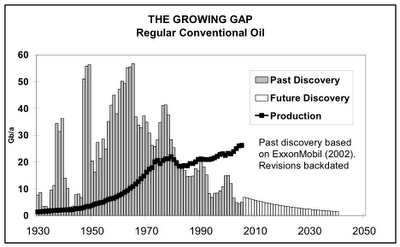
This is Colin Campbell's "Growing Gap" graph of discovery (Feb. 2006 version), which I have transcribed into a spreadsheet:
Image

From the spreadsheet, we find,

World oil discovery 1980-2004: 339 billion barrels

So... The world started out with 667 b barrels in 1980, added 339 b barrels through discovery, and pumped out 608 b barrels. That gives us: 667 + 339 - 608 = 398 billion barrels.

Clearly, something has gone seriously haywire because the actual reserves in 2004 are 1211 b barrels, i.e. 813 b barrels more than we should have if discovery is the only way to increase reserves.

Why do we have 813 b barrels more reserves in 2004 than in 1980 if we're producing more than we discover?

Spurious additions to OPEC reserves won't explain it. OPEC reserves only increased by 486 b barrels from 1980 to 2004, so that still leaves us with 327 b barrels unaccounted for. That's 27 Prudhoe Bays which somehow got added to world reserves between 1980-2004, without being discovered. And that occurred in non-OPEC, a region which accounts for only about 15% of world reserves. So the crucial question is: how big is reserve growth/increased recovery in OPEC?

In the longer term, the issue is how far the recovery rate can be increased, and that's an interesting question. For example, it may be feasible to cook even more oil out of large fields with nuclear power or solar.
JohnDenver
Intermediate Crude
Intermediate Crude
 
Posts: 2145
Joined: Sun 29 Aug 2004, 03:00:00

Re: Michael Lynch: New discoveries keep pace with depletion

Postby TheDude » Tue 25 Aug 2009, 19:38:48

This was discussed at TOD 3 years ago: The Oil Drum | Reserves Growth and Production Flows.

$this->bbcode_second_pass_quote('', 'D')r. Leo P. Drollas, Deputy Director and Chief Economist for the Centre for Global Energy Studies has issued a response to Heading Out's Depletion estimates and the CGES. I feel that Drollas' comments deserve a response.

The argument concerns what is termed "reserves growth" which Drollas defines as

$this->bbcode_second_pass_quote('', 'G')rowing knowledge tends to result in more oil reserves through oilfield extensions and revisions of reserves -- what is commonly known in the industry as `reserves growth' -- as well as through discoveries of new oilfields....

If there are no gross additions to reserves the depletion rate is equal to the world's rate of oil production as a percentage of global proven reserves (2.38% in 2005). However, gross additions have not been zero; indeed, since 1954 they have exceeded the world's production of oil.


Basically the riposte is the old canard about increasing world P1 by a third and only gaining about 5 years before peak sets in.

US production and P1:

Image

To me this makes the whole reserves growth issue seem like nothing but a red herring, as Dave Cohen says in the TOD article. You'd as well focus on what comes out of curve fitting, and the most accurate production forecasts at this stage are coming from peak oilers: Jean Laherrère and Duncan/Youngquist.

Laherrère's Reserve Growth: Technological Progress has this to say as well:

$this->bbcode_second_pass_quote('', 'R')emaining reserves can be expected to remain constant if annual reserves growth for oil is 1 percent, equating to additions of 16 billion barrels per year. If, however, reserve growth is half smaller at 0.5 percent annually (8 billion barrels per year)--then the "oil deficit" will translate into a reduction in "remaining reserves", by approximately 10 billion barrels per year.

This "oil deficit" cannot be sustained indefinitely. If production continues to exceed discoveries, global oil production is certain to begin falling, reflecting the increasing scarcity of global oil reserves. This development can be expected to affect global oil supplies sooner rather than later. As shown in Figures 3-6, a study of the major U.S. oil fields and the world's giant oil fields suggests an aggregate annual field "growth rate" of only 0.5 percent. This estimate will continue to decline as the world's largest oil fields enter into the advanced stages of maturity.
Cogito, ergo non satis bibivi
And let me tell you something: I dig your work.
User avatar
TheDude
Expert
Expert
 
Posts: 4896
Joined: Thu 06 Apr 2006, 03:00:00
Location: 3 miles NW of Champoeg, Republic of Cascadia
Top

Re: Michael Lynch: New discoveries keep pace with depletion

Postby TheDude » Tue 25 Aug 2009, 19:41:49

Thanks, pstarr. May I call you p? :roll:

The posters at TOD liked that one, too. It's a bit creepy. I see why people say everything was better in the 60s...

Image
Cogito, ergo non satis bibivi
And let me tell you something: I dig your work.
User avatar
TheDude
Expert
Expert
 
Posts: 4896
Joined: Thu 06 Apr 2006, 03:00:00
Location: 3 miles NW of Champoeg, Republic of Cascadia

Re: Michael Lynch: New discoveries keep pace with depletion

Postby JohnDenver » Tue 25 Aug 2009, 20:28:57

$this->bbcode_second_pass_quote('TheDude', 'L')ynch and other petroleum cornucopians strike a very odd pose to make their claims; it's sort of the ne plus ultra of the Efficient Markets Hypothesis. For instance, Iran. Hundreds of billions of proven reserves? OK. So that's why they're importing product and switching their vehicle fleet over to NG, and their infrastructure is rusting; read Lisa Margonelli's book Oil on the Brain, where she visits an Iranian offshore platform that's not only covered in tarnish, but still riddled with holes from shelling during the war with Iraq.


All the points you raise can be explained by the fact that Iran has been under a trade embargo for more than 20 years. You're presenting no evidence at all that Iran lacks oil. All signs indicate that they are swimming in it, but lack technology and financing.

$this->bbcode_second_pass_quote('', 'A')ug. 25, 2009
Iran may struggle to put its latest oil field discovery into production because of a lack of technology and tougher commercial sanctions, analysts said Tuesday.
Link

Anyway, time will tell if the current peak is the last or not. Iraq will be a key factor, and its future can't be predicted. I'll check back with you in 5 years. :)

$this->bbcode_second_pass_quote('', 'I')raq aims to increase its oil production by up to four times with the development of 10 new fields to be auctioned later this year, Iraqi Oil Minister Hussein al-Shahristani said Tuesday.
Link
JohnDenver
Intermediate Crude
Intermediate Crude
 
Posts: 2145
Joined: Sun 29 Aug 2004, 03:00:00
Top

Re: Michael Lynch: New discoveries keep pace with depletion

Postby TheDude » Tue 25 Aug 2009, 21:12:32

$this->bbcode_second_pass_quote('JohnDenver', 'A')ll the points you raise can be explained by the fact that Iran has been under a trade embargo for more than 20 years. You're presenting no evidence at all that Iran lacks oil. All signs indicate that they are swimming in it, but lack technology and financing.


And the US and North Sea didn't/don't? Iran isn't exactly locked in maximum security holdup, either: FACTBOX: Iran's major oil customers, energy partners | Special Coverage | Reuters

$this->bbcode_second_pass_quote('', '-')- INVESTMENT -- China's National Petroleum Corporation (CNPC) signed a $4.7 billion contract with a Chinese state firm in June to develop a phase of South Pars, replacing France's Total.

-- CNPC signed a memorandum of understanding for development of the South Azadegan field earlier this year. Under that deal, it would pay 90 percent of the costs of a $2.5 billion project.

-- CNPC is in talks with Iran for $3.6 billion deal to buy LNG from Phase 14 of South Pars project. CNPC is also in talks to explore and develop energy reserves in Iran's Caspian.

-- CNPC signed a deal with the NIOC in January to develop the north Azadegan oilfield. The deal is worth $2 billion in its first phase. Under the first phase lasting 48 months, the capacity would reach 75,000 barrels per day (bpd). The tenure of the project is 12 years.

-- China's Sinopec Group finalized a $2 billion pact to develop Iran's huge Yadavaran field in December 2007.

-- The China National Offshore Oil Corp (CNOOC) is in talks to finalize a $16 billion dealt to develop the North Pars gas field and build a liquefied natural gas (LNG) plant.


I'm not one of these fanatics who thinks it's geology to the exclusion of all else, either. Lack of investment could bring on a permanent world peak as well.

$this->bbcode_second_pass_quote('', 'A')nyway, time will tell if the current peak is the last or not. Iraq will be a key factor, and its future can't be predicted. I'll check back with you in 5 years. :)

$this->bbcode_second_pass_quote('', 'I')raq aims to increase its oil production by up to four times with the development of 10 new fields to be auctioned later this year, Iraqi Oil Minister Hussein al-Shahristani said Tuesday.
Link


A useful news source: Iraq Oil Forum. From an interview with former SOC director Jabbar Al-Luaibi::

$this->bbcode_second_pass_quote('', 'Q'): What’s the state of the 1400+ wells you have across the southern fields?

A: About 33% of those wells are completely out of service. In the upstream industry, there are four elements that go together and the absence of one will affect all of the others. These are: drilling, workovers, reservoir management, and surface installations. All four are in a poor state in our case in southern Iraq, and even when one is working, the others are crippling. We have no proper reservoir simulation to know exactly where our reservoirs and wells stand or how much they can produce. For years, I’ve demanding why we cannot have seismic equipment to do proper measurement in the producing reservoirs and see their conditions and how their fluid saturations are changing, which will then help us decide where to drill and what work over is needed. This is a basic requirement in order to draw up a program to sustain production and then increase it. Without reservoir management, it’s like driving your car without any indicators on the dashboard. And we are not asking for the modern technologies that our neighbors are applying in their oil fields, but just the very basic needs. I have asked many companies who were working under the MOUs for help and we got some monitoring devices for reservoir logging, which has kept us going so far and without it we would have been in an even worse shape.

Iraqi contractions in production have been more severe than subsequent advances as well, which have never reached former peaks. What gains they're making are being offset by declines in Mexico, if you want to look at things from a simplistic 1:1 correspondence.
Cogito, ergo non satis bibivi
And let me tell you something: I dig your work.
User avatar
TheDude
Expert
Expert
 
Posts: 4896
Joined: Thu 06 Apr 2006, 03:00:00
Location: 3 miles NW of Champoeg, Republic of Cascadia
Top

Re: Michael Lynch: New discoveries keep pace with depletion

Postby JohnDenver » Wed 26 Aug 2009, 00:40:34

Like I said, time will tell.

It is interesting that the peak oilers don't dispute the large reserves claimed by Lynch. They only dispute whether they can be brought on quickly.

Which is sort of the best of both worlds -- Lots of oil out there, but only available in time-release form.

And of course even a near-term peak is hardly a catastrophe. As you know, Kjell Aleklett, President of ASPO international, is forecasting that liquids production in 2030, 21 years from now, will be 90% of what it is today. Similarly, Laherrere, who you single out above for accuracy, says: "30 years from now, production of easy oil will be 35% less than to day but production of all liquids (including from coal and biomass) only 5% less than to day." That would be 95% of today's liquids production, in the year 2039. Those levels of production will be available in a world where electric transport is far more sophisticated and disseminated than it is now. And there will also be large amounts of transitional energy and vehicle fuel available in the form of NG, whose production and reserves are surging in the US due to new technology.

I'm sure you'll disagree, but to me, it looks like a very manageable problem.
JohnDenver
Intermediate Crude
Intermediate Crude
 
Posts: 2145
Joined: Sun 29 Aug 2004, 03:00:00

Re: Michael Lynch: New discoveries keep pace with depletion

Postby Carlhole » Wed 26 Aug 2009, 00:49:23

$this->bbcode_second_pass_quote('JohnDenver', 'I')'m sure you'll disagree, but to me, it looks like a very manageable problem.


It DOES look manageable.

The price ought to remain high enough to spur innovation in alternatives/conservation while allowing the majors to count reliably upon rewards for exploration and development.
Carlhole
 
Top

Re: Michael Lynch: New discoveries keep pace with depletion

Postby TonyPrep » Wed 26 Aug 2009, 01:51:05

$this->bbcode_second_pass_quote('JohnDenver', 'I')t is interesting that the peak oilers don't dispute the large reserves claimed by Lynch. They only dispute whether they can be brought on quickly.
I'm sure many peakists would not believe a recoverable estimate of 3.5 trillion barrels to go. But, even if Lynch was correct, how does that 3.5 trillion barrels translate to a peak beyond the lifetimes of anyone living today?

It's also not just a question of when certain fields can be produced but also the rate at which they can be produced, as well as the energy that goes into producing them. For example, the Canadian oil sands may have larger resources than Gawar but will never be produced at the rate Gawar has been, and is, nor at the net energy that Gawar was produced. If those extra 2.5 trillion barrels can only be produced at, say, 20 mbpd, there will still be a short term peak but the tail will be a very long one. It still amounts to a serious problem in the not too distant future.

When we see many major producing regions in decline, it gives the lie to Lynch's position but he has his head in the oil sands and so is unlikely to ever acknowledge that.
User avatar
TonyPrep
Intermediate Crude
Intermediate Crude
 
Posts: 2842
Joined: Sun 25 Sep 2005, 03:00:00
Location: Waiuku, New Zealand
Top

Re: Michael Lynch: New discoveries keep pace with depletion

Postby Plantagenet » Wed 26 Aug 2009, 02:23:17

$this->bbcode_second_pass_quote('JohnDenver', '.')...to me, it looks like a very manageable problem.


Even the minor shortfall of petroleum supply in 2008 produced oil prices of $148/barrel and helped trigger the global economic collapse.

The world's economy is built on cheap energy. As energy becomes more expensive the economy apparently responds by going into recession.
User avatar
Plantagenet
Expert
Expert
 
Posts: 26765
Joined: Mon 09 Apr 2007, 03:00:00
Location: Alaska (its much bigger than Texas).
Top

Re: Michael Lynch: New discoveries keep pace with depletion

Postby BigTex » Wed 26 Aug 2009, 07:18:48

What is the objective measure that would prove or disprove Lynch's thesis?

Would it be making a new future higher peak in production?

Or is his thesis compatible with continued production declines?

I'm just trying to figure out what would shut him up.

If embedded in his worldview is the idea that no matter what is happening today, there will be future increases in production beyond prior peaks, that's not helpful. You could sit around waiting for decades for his thesis to be definitively refuted.

In Lynch's view, what would the world production curve look like over the next 50 years? Increasing? Flat? Decreasing?
:)
User avatar
BigTex
Intermediate Crude
Intermediate Crude
 
Posts: 3858
Joined: Thu 03 Aug 2006, 03:00:00
Location: Graceland

Re: Michael Lynch: New discoveries keep pace with depletion

Postby JohnDenver » Wed 26 Aug 2009, 08:53:46

$this->bbcode_second_pass_quote('BigTex', 'I')n Lynch's view, what would the world production curve look like over the next 50 years? Increasing? Flat? Decreasing?


Lynch's view of peak oil, from the peakoil.com thread (July 2005):
$this->bbcode_second_pass_quote('', 'A') peak could occur due to depressed demand (technological innovation or taxes, etc.) but I don't anticipate it any time soon. I think there will be no peak due to geological reasons until at least 2030 and probably 2050, which assumes some "unconventional oil" such as gas to liquids and tar sands, and maybe shale oil.

Resources are not present in step function, ie., a sharp transition from cheap to expensive. Instead, you will see a combination of unconventional oils, more efficient uses (hybrid electrics, etc.) and probably greater electrification. I think a combination of solar and fission will be the next big contributors. But there will be lots of gas (including gas-to-liquids) and oil will hardly disappear.

Link
JohnDenver
Intermediate Crude
Intermediate Crude
 
Posts: 2145
Joined: Sun 29 Aug 2004, 03:00:00
Top

Re: Michael Lynch: New discoveries keep pace with depletion

Postby TheDude » Wed 26 Aug 2009, 14:27:15

$this->bbcode_second_pass_quote('JohnDenver', 'A')nd of course even a near-term peak is hardly a catastrophe. As you know, Kjell Aleklett, President of ASPO international, is forecasting that liquids production in 2030, 21 years from now, will be 90% of what it is today.


I pointed out to you (or someone, anyway) that that was a misquote from an Australian paper. Do you have a bona fide link?

$this->bbcode_second_pass_quote('', 'S')imilarly, Laherrere, who you single out above for accuracy, says: "30 years from now, production of easy oil will be 35% less than to day but production of all liquids (including from coal and biomass) only 5% less than to day." That would be 95% of today's liquids production, in the year 2039.


And this is supposed to be heartening? 40 mb/d from CTL would fry us like eggs on a skillet.

Image

Oh but we'll CCS our way to Utopia. I thought you derided Hirsch for embracing these massive supply side solutions too, when we can conservify our way out of peak oil.
Cogito, ergo non satis bibivi
And let me tell you something: I dig your work.
User avatar
TheDude
Expert
Expert
 
Posts: 4896
Joined: Thu 06 Apr 2006, 03:00:00
Location: 3 miles NW of Champoeg, Republic of Cascadia
Top

Re: Michael Lynch: New discoveries keep pace with depletion

Postby JohnDenver » Wed 26 Aug 2009, 18:42:56

$this->bbcode_second_pass_quote('TheDude', '')$this->bbcode_second_pass_quote('JohnDenver', 'A')nd of course even a near-term peak is hardly a catastrophe. As you know, Kjell Aleklett, President of ASPO international, is forecasting that liquids production in 2030, 21 years from now, will be 90% of what it is today.


I pointed out to you (or someone, anyway) that that was a misquote from an Australian paper.


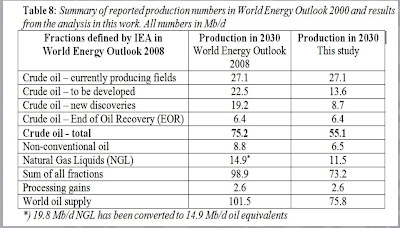
You were wrong. The quote was accurate. Here's Aleklett's Table (from the pdf of his presentation, located here):

Image

As you can see at the bottom of the right hand column, Aleklett's figure for world oil supply in 2030 is 75.8 mbd, or about 90% of the recent production level of about 85 mbd.

$this->bbcode_second_pass_quote('TheDude', '')$this->bbcode_second_pass_quote('JohnDenver', 'S')imilarly, Laherrere, who you single out above for accuracy, says: "30 years from now, production of easy oil will be 35% less than to day but production of all liquids (including from coal and biomass) only 5% less than to day." That would be 95% of today's liquids production, in the year 2039.


And this is supposed to be heartening? 40 mb/d from CTL would fry us like eggs on a skillet.


I don't believe anyone mentioned 40 mb/d from CTL except you. Laherre(pdf) certainly didn't. He mentioned CTL as one component -- with biomass, heavy oil, NGL etc. -- of non-conventional production. I doubt that CTL will play much of a role at all as a substitute; NG seems more likely in the near term due to the abundance of shale gas.

Anyway, you mentioned Laherrere for his predictive success, so I'm pointing out his prediction for 2040 to you. It would probably better if you looked at his work as it is, rather than with your distortions applied to it.

$this->bbcode_second_pass_quote('TheDude', 'O')h but we'll CCS our way to Utopia.

I don't recall mentioning anything about CCS or Utopia. I believe my exact wording was "manageable problem" not utopia.

$this->bbcode_second_pass_quote('TheDude', 'I') thought you derided Hirsch for embracing these massive supply side solutions too, when we can conservify our way out of peak oil.

I'm not opposed to any fuel source on principle. I derided Hirsch due his claim that massive supply side solutions were the only way to address peak oil, and thus we needed 20 years to implement a solution.

Note, however, that you are arguing with yourself. I didn't propose any large-scale CTL program, and neither did Laherrere. You're the only one talking about 40 mb/d of CTL.
JohnDenver
Intermediate Crude
Intermediate Crude
 
Posts: 2145
Joined: Sun 29 Aug 2004, 03:00:00
Top

Re: Michael Lynch: New discoveries keep pace with depletion

Postby JohnDenver » Wed 26 Aug 2009, 18:56:45

$this->bbcode_second_pass_quote('TheDude', '')$this->bbcode_second_pass_quote('BigTex', 'W')hat is the objective measure that would prove or disprove Lynch's thesis?

Would it be making a new future higher peak in production?


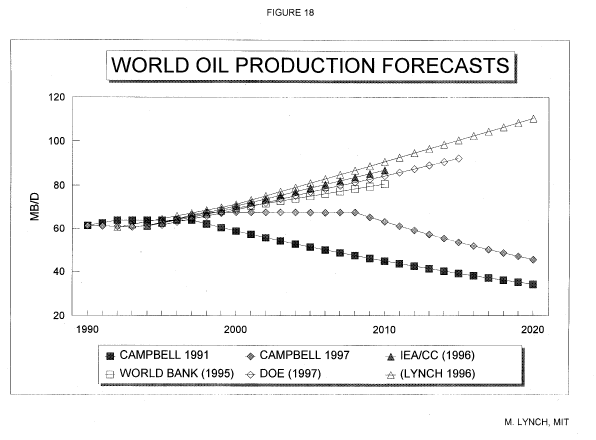
Post of mine on TOD: Permalink. After castigating Campbell for his bad calls in the 90s, Mike can eat some humble pie now, since his own 1996 call for 2008 C+C was at least 88 mb/d, about 15 mb/d above what actually transpired, whereas Colin's from the same era was the closest on Lynch's graph; and other peak oilers' calls have turned out to be closer to what has transpired in the Noughts.


The chart:
Image

I don't see "C+C" anywhere on that chart. The chart says "Oil" not C+C. Oil production *was* roughly 88 mb/d in 2008, as you can see from the IEA stats:

Image
JohnDenver
Intermediate Crude
Intermediate Crude
 
Posts: 2145
Joined: Sun 29 Aug 2004, 03:00:00
Top

Re: Michael Lynch: New discoveries keep pace with depletion

Postby TheDude » Wed 26 Aug 2009, 19:58:49

$this->bbcode_second_pass_quote('JohnDenver', 'I') don't see "C+C" anywhere on that chart. The chart says "Oil" not C+C. Oil production *was* roughly 88 mb/d in 2008, as you can see from the IEA stats:

Image


To quote the Clash, you are wrong 'em Boyo. C+C was 66965.55 kb/d average for '98 according to EIA, Liquids 75654.07 kb/d. Paper was published March 1998. My modified graph shows that Lynch was clearing talking C+C, not all liquids.
Cogito, ergo non satis bibivi
And let me tell you something: I dig your work.
User avatar
TheDude
Expert
Expert
 
Posts: 4896
Joined: Thu 06 Apr 2006, 03:00:00
Location: 3 miles NW of Champoeg, Republic of Cascadia
Top

Re: Michael Lynch: New discoveries keep pace with depletion

Postby Lore » Wed 26 Aug 2009, 20:03:58

Daniel Yergin was just on Kudlow tonight giving a big thumbs up to Michael Lynch's article. Larry Kudlow is once again assured that we will have centuries of oil to bathe in... drill... drill... drill!
The things that will destroy America are prosperity-at-any-price, peace-at-any-price, safety-first instead of duty-first, the love of soft living, and the get-rich-quick theory of life.
... Theodore Roosevelt
User avatar
Lore
Fission
Fission
 
Posts: 9021
Joined: Fri 26 Aug 2005, 03:00:00
Location: Fear Of A Blank Planet

Re: Michael Lynch: New discoveries keep pace with depletion

Postby TheDude » Wed 26 Aug 2009, 20:45:04

$this->bbcode_second_pass_quote('JohnDenver', 'S')imilarly, Laherrere, who you single out above for accuracy, says: "30 years from now, production of easy oil will be 35% less than to day but production of all liquids (including from coal and biomass) only 5% less than to day." That would be 95% of today's liquids production, in the year 2039.


That's the only appearance in that pdf of "coal" or "ctl;" Aleklett doesn't bring it up at all either, so I'm curious what Jean was getting at with bringing it up in the first place. It isn't in Kjell's forecast either, unless part of "non-conventional," which is doubtful.

$this->bbcode_second_pass_quote('', 'I') don't believe anyone mentioned 40 mb/d from CTL except you. Laherre(pdf) certainly didn't. He mentioned CTL as one component -- with biomass, heavy oil, NGL etc. -- of non-conventional production. I doubt that CTL will play much of a role at all as a substitute; NG seems more likely in the near term due to the abundance of shale gas.


See above. Is there a paper of his where he lays out his forecast for CTL? All I can suss out is that he's contemptuous of including it under liquids, that he sees (2006) peak coal in 2050 and peak FFs in 2030. Also peak liquids in 2015, "if there is no demand constraint, which is unlikely with soon coming economic crisis forecasted by P.Volcker." Yeah, right. Doomer. :o

$this->bbcode_second_pass_quote('', 'A')nyway, you mentioned Laherrere for his predictive success, so I'm pointing out his prediction for 2040 to you. It would probably better if you looked at his work as it is, rather than with your distortions applied to it.


Past maybe 15 years I hand the reins over to wide boundary analysts - or science fiction writers, which is to say it's too far to tell much. This is especially the case now, with global warming and environmental degradation on the march.
Cogito, ergo non satis bibivi
And let me tell you something: I dig your work.
User avatar
TheDude
Expert
Expert
 
Posts: 4896
Joined: Thu 06 Apr 2006, 03:00:00
Location: 3 miles NW of Champoeg, Republic of Cascadia

Top

Re: Michael Lynch: New discoveries keep pace with depletion

Postby BigTex » Wed 26 Aug 2009, 22:33:50

$this->bbcode_second_pass_quote('JohnDenver', '
')The chart:
Image


I'll bet Lynch uses that chart as a cornie chick panty dropper.
:)
User avatar
BigTex
Intermediate Crude
Intermediate Crude
 
Posts: 3858
Joined: Thu 03 Aug 2006, 03:00:00
Location: Graceland
Top

Re: Michael Lynch: New discoveries keep pace with depletion

Postby TonyPrep » Thu 27 Aug 2009, 01:29:47

$this->bbcode_second_pass_quote('JohnDenver', 'O')il production *was* roughly 88 mb/d in 2008, as you can see from the IEA stats:
The IEA has 2008 production currently estimated at 86.53 mbpd. The EIA estimates it at 85.38 mbpd. I suppose you could call either of those "roughly" 88 mbpd, if you wanted to believe that Lynch was right (assuming he was talking about the same class of liquids).
User avatar
TonyPrep
Intermediate Crude
Intermediate Crude
 
Posts: 2842
Joined: Sun 25 Sep 2005, 03:00:00
Location: Waiuku, New Zealand
Top

PreviousNext

Return to Open Topic Discussion

Who is online

Users browsing this forum: No registered users and 1 guest

cron