$this->bbcode_second_pass_quote('shortonoil', ' ')
WHERE THE NUMBERS COME FROM:
it has been shown that GDP is directly proportional to the amount of energy input into an economy.



PeakOil is You
This is really serious the poo has hit the fan
Re: This is really serious the poo has hit the fan
 by nobodypanic » Fri 27 Feb 2009, 18:41:35
thanks. that's pretty much what i thought was going on.
-

nobodypanic - Heavy Crude

- Posts: 1103
- Joined: Mon 02 Jun 2008, 03:00:00
Re: This is really serious the poo has hit the fan
by retiredguy » Fri 27 Feb 2009, 19:23:19
So says Tainter.
-

retiredguy - Tar Sands

- Posts: 633
- Joined: Tue 11 Jan 2005, 04:00:00
- Location: southern Wisconsin
Re: This is really serious the poo has hit the fan
by shortonoil » Sat 28 Feb 2009, 13:21:27
nobodypanic said:
$this->bbcode_second_pass_quote('', 't')hanks. that's pretty much what i thought was going on.
$this->bbcode_second_pass_quote('', 't')hanks. that's pretty much what i thought was going on.
Energy input increases, material science advancement and the ability to adopt new social traditions are key elements for the building of a civilization. None give us the luxury of avoiding them!
There is the common misconception that conservation of oil can now compensate for much of our energy input. Although it is true that there may be some benefit to be derived from conservation efforts, the return on those efforts are likely to be far less than one would first expect. The energy cost of the efforts themselves, and the maintenance of those results will undoubtedly limit their benefit. The point of diminishing returns for conservation is never very far away, plus in this case it would most likely be self defeating. Applying resources, which could be utilized elsewhere, to conserve oil still leaves one with the original problem - oil.
Compensating for fossil fuels’ declining energy contribution will require technological advancement. Developing those skills/techniques and then applying them throughout the entire social/economic environment will take many decades. Since we have at most a decade and a half to implement solutions, our solutions will have to be s simple and as straight forward as possible. Development of resources, like geothermal, although it produces more expensive power per kWh than coal or nuclear, has the advantage of simplicity and rapid deployment.
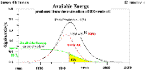
Over the next 16 years, in order to maintain its viability, the modern world will have to replace the annual production of 156,000 trillion BTU of energy supply! There is no question that this will be a daunting task. Most likely, impossible. If we are to limit the impact damage from this event (such as the burning of just a few cities after our monetary systems collapse) it will be necessary for us to learn many new social traditions. We will have to learn to tolerate greatly reduced standards of living. We will have to learn to relinquish our cherished and ridiculous symbols of social position, and gain the desire to work in concert toward the reconstruction and rebuilding of civilization.
The alternative? Chaos!
Available Energy
-
shortonoil - False ETP Prophet

- Posts: 7132
- Joined: Thu 02 Dec 2004, 04:00:00
- Location: VA USA
Re: This is really serious the poo has hit the fan
by Cyrus » Sat 28 Feb 2009, 15:19:21
Great to see you posting again Shortonoil!
-
Cyrus - Tar Sands
- Posts: 647
- Joined: Tue 25 Jan 2005, 04:00:00
Re: This is really serious the poo has hit the fan
by bencole » Sat 28 Feb 2009, 16:26:24
$this->bbcode_second_pass_quote('shortonoil', '
')
Energy input increases, material science advancement and the ability to adopt new social traditions are key elements for the building of a civilization. None give us the luxury of avoiding them!
')
Energy input increases, material science advancement and the ability to adopt new social traditions are key elements for the building of a civilization. None give us the luxury of avoiding them!
It doen't look likely that the energy input to the developed world
is going to increase anytime soon. The situation we are dealing with now is energy input decreases for the future, and how to mitigate the effects to society.
$this->bbcode_second_pass_quote('', 'T')here is the common misconception that conservation of oil can now compensate for much of our energy input.
Although it is true that there may be some benefit to be derived from conservation efforts, the return on those efforts are likely to be far less than one would first expect. The energy cost of the efforts themselves, and the maintenance of those results will undoubtedly limit their benefit. The point of diminishing returns for conservation is never very far away, plus in this case it would most likely be self defeating. Applying resources, which could be utilized elsewhere, to conserve oil still leaves one with the original problem - oil.
I disagree, a substantial amount of our energy use is needless waste by
almost any definition. People like to drive large vehicles because
the want more power, people use disposible products because they save time and are convienent. We keep city skylines brightly lit at night for the aesthetic value. We overuse air travel for its convience factor. We use energy in great amounts
merely for the purpose of entertaining our senses, for our modern day fun and amusement. Have you been to Las Vegas?
The return on energy conservation is extremely high not just in terms of the energy supply metric. The environment benefits enourmously from reductions in energy usage is enormous, regardless of whether the source is fossil fuels or otherwise, it's not a diminishing return at all. The scientific community considers
conservation a key point in solving our energy dilema. The effect of peak oil is caused by the overuse of the resource.
$this->bbcode_second_pass_quote('', 'C')ompensating for fossil fuels’ declining energy contribution will require technological advancement. Developing those skills/techniques and then applying them throughout the entire social/economic environment will take many decades.
Since we have at most a decade and a half to implement solutions, our solutions will have to be s simple and as straight forward as possible.
Time to get cracking, no time like the present. If the USA can spend decades planning and pursuing wars to secure supplies of energy, I'm convinced that applying skills/techniques to solving energy problems in the socioeconomc sphere is a realistic undertaking.
$this->bbcode_second_pass_quote('', 'D')evelopment of resources, like geothermal, although it produces more expensive power per kWh than coal or nuclear, has the advantage of simplicity and rapid deployment.
Geothermal is tailored to geographic areas where it is most viable, like iceland. Specific areas are best matched to an ideal
form of renewable energy based on geography. The southwest
for instance would benefit from solar energy to a greater extent
than more northern latitudes.
$this->bbcode_second_pass_quote('', 'O')ver the next 16 years, in order to maintain its viability, the modern world will have to replace the annual production of 156,000 trillion BTU of energy supply!
There is no question that this will be a daunting task. Most likely, impossible.
Not impossible I don't think. The demand for this amount of energy
could be reduced through conservation efforts. It might take a painful sacrifice in some peoples view, things like the elimination of air travel for pleasure or trucking fresh fruit from south america in the winter, but it can be done.
$this->bbcode_second_pass_quote('', 'I')f we are to limit the impact damage from this event (such as the burning of just a few cities after our monetary systems collapse) it will be necessary for us to learn many new social traditions.





 but we need to change this entire entropic open-energy-cycle system to get off the petroleum hayride.