


PeakOil is You
Re: There was a large treasury sell off today.
Re: There was a large treasury sell off today. What bailout?
 by shortonoil » Sun 15 Feb 2009, 22:32:56
$this->bbcode_second_pass_quote('Reverse Engineer', 'T')hat might be when the model has 95% of the available energy gone from oil, but it by no means represents when the end of the contraction would be in terms of population, that will go on for quite a while longer, unless you postulate an immediate die off within 16.3 years?
The Available Energy model is a rigid mathematical representation of the world’s petroleum supply, from an energy perspective. Some where around here is a list of it limitations. It does not include the effects of NG or coal depletion, nor does it anticipate any Black Swan events.
It is intended to be used as a frame work to estimate the cause and effect of energy degragation from petroleum supplies, and produce a usable time table. Since the relationship between available energy and economic activity is well documented, it gives us a view of the society’s future economic state.
From a historical perspective the decline in world population will probably be dramatic and swift. We know that economic activity affects population growth and density, especially in temperate regions. How fast that depopulation occurs, is however, outside the model’s ability to predict. What we do know is that the energy from petroleum is essential to the support of the world’s population. From this point going forward that energy will be declining rapidly (geometrically), and for all practicable purposes that energy will no longer be available in 16.3 years.
From an analysts point of view, the model is infinitely superior to the “dried bones” and “chicken blood” approach used by contemporary economists, which can not be used to establish verifiable boundary conditions. The thermodynamic approach can. If I were to bet my life on it (which I am) I would prefer a model founded on thermodynamic principles rather than the witch craft presently practiced by neo-classical economics!
-
shortonoil - False ETP Prophet

- Posts: 7132
- Joined: Thu 02 Dec 2004, 04:00:00
- Location: VA USA
Re: There was a large treasury sell off today. What bailout?
by ReverseEngineer » Sun 15 Feb 2009, 22:47:53
Correct me if I am wrong, but the model presupposes a constant or increasing level of fossil fuel depletion through the course of the 16.3 years. However, given the contraction in the Chinese economy and 3 straight months of electrical power consumption dropping by 7-12%, it would seem to me that this would spread out the amount of time until 95% depletion.
Beyond that, I don't think its necessaruy to reach 95% or wait 16.3 years before the contraction begins, clearly it already HAS begun. I don't think it will be done in 16.3 years either. What can I use the model to predict then? Will we be at our lowest point in 16.3 years and ready for a recovery?
Beyond that, I don't think its necessaruy to reach 95% or wait 16.3 years before the contraction begins, clearly it already HAS begun. I don't think it will be done in 16.3 years either. What can I use the model to predict then? Will we be at our lowest point in 16.3 years and ready for a recovery?
-

ReverseEngineer - Intermediate Crude

- Posts: 3352
- Joined: Wed 16 Jul 2008, 03:00:00
Re: There was a large treasury sell off today. What bailout?
by shortonoil » Sun 15 Feb 2009, 23:55:31
What the model predicts is that each year the “percentage” of energy lost for the general economy will be greater than the “percentage” lost in the previous year. That is were the geometric factor comes into play. This will have a decisive effect on peoples’ perception of how economic conditions are faring. I would expect individuals will get much more defensive about their economic situation each year.
The present large drop in economic activity, probably 10% world wide, is to be expected. We should see similar declines for the next 4 to 5 years, except for a slight leveling off later this year as energy companies cut their E&D efforts and that energy becomes temporarily available to the general economy. This happened in the US after the frantic drilling increases of the mid ‘70s and cut backs in the ‘80s. The ERoEI at the well head increased from about 14:1 to 22:1 during that period.
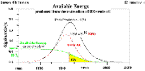
Where we will see the decline is in world oil production. If you look at the Total Available Energy curve and production curve, you will see that TAE (Total Available Energy) past peak production declines BEFORE production declines(that results from a 100 years of declining ERoEI). Since TAE can be correlated directly to economic activity, the economy will slow before oil production declines on the way down. That is why most people will not associate the coming depression with PO. They will be looking at the wrong metric. They will be looking at barrels of oil and confusing it with the energy that is available from it for the general economy.
That is why the economic stimulus plan will not work. The energy is not available to power more of an economy than what we already have. That will be the situation for the next 16.3 years. Constant economic decline in the face of what ever anyone does.
Will this bottom in 16.3 years? That will only happen if the problem becomes understood. Looking at the general conceptual capabilities of even this site, I would say not likely. Improvement will only occur when our past link into an oil dependent (for energy) culture falls completely apart. I estimate that will take 40 years at the minimum. A good indication of when the situation may be starting to improve could be when all the major oil companies have gone broke. But no matter how you look at it, kicking the oil habit is going to be a bitch.
The trick for the next couple of decades is going to be the realization that you can make money when losing money in a deflationary economy. Leverage is an anachronism. Not betting on FED toilet paper, which isn’t long for this world, and steer clear of the lunies that are starting to crawl out of the wood work.
The present large drop in economic activity, probably 10% world wide, is to be expected. We should see similar declines for the next 4 to 5 years, except for a slight leveling off later this year as energy companies cut their E&D efforts and that energy becomes temporarily available to the general economy. This happened in the US after the frantic drilling increases of the mid ‘70s and cut backs in the ‘80s. The ERoEI at the well head increased from about 14:1 to 22:1 during that period.
Where we will see the decline is in world oil production. If you look at the Total Available Energy curve and production curve, you will see that TAE (Total Available Energy) past peak production declines BEFORE production declines(that results from a 100 years of declining ERoEI). Since TAE can be correlated directly to economic activity, the economy will slow before oil production declines on the way down. That is why most people will not associate the coming depression with PO. They will be looking at the wrong metric. They will be looking at barrels of oil and confusing it with the energy that is available from it for the general economy.
That is why the economic stimulus plan will not work. The energy is not available to power more of an economy than what we already have. That will be the situation for the next 16.3 years. Constant economic decline in the face of what ever anyone does.
Will this bottom in 16.3 years? That will only happen if the problem becomes understood. Looking at the general conceptual capabilities of even this site, I would say not likely. Improvement will only occur when our past link into an oil dependent (for energy) culture falls completely apart. I estimate that will take 40 years at the minimum. A good indication of when the situation may be starting to improve could be when all the major oil companies have gone broke. But no matter how you look at it, kicking the oil habit is going to be a bitch.
The trick for the next couple of decades is going to be the realization that you can make money when losing money in a deflationary economy. Leverage is an anachronism. Not betting on FED toilet paper, which isn’t long for this world, and steer clear of the lunies that are starting to crawl out of the wood work.
-
shortonoil - False ETP Prophet
- Posts: 7132
- Joined: Thu 02 Dec 2004, 04:00:00
- Location: VA USA
Re: There was a large treasury sell off today. What bailout??
by shady28 » Mon 16 Feb 2009, 10:03:45
$this->bbcode_second_pass_quote('cbxer55', '
')Really, is this any surprise to any of us? We have all been fond of saying that these "bailouts" are pre-taxing our children and grand-children before they ever even get a job. Our daughter just had her first baby, and I do not envy him his future. Its going to get rough.
')Really, is this any surprise to any of us? We have all been fond of saying that these "bailouts" are pre-taxing our children and grand-children before they ever even get a job. Our daughter just had her first baby, and I do not envy him his future. Its going to get rough.
I've been saying this for a while, but while our children will see the results of gross financial mismanagement as they mature they will not be paying the dues for it as much as people believe.
Baby boomers, gen x et al are not getting off the hook. The re-adjustment has already started and those responsible will be paying a heavy price. Medicare? SS? 401K? Forget it. This is no longer something that has to be taken care of 20 years down the road. The chickens have come home to roost and the time is now. By the time today's 5 year old is 18, it will be done and over with and they will be working from a new baseline that will likely include an entirely different financial and political landscape than what we have now.
Welcome to the Kondratieff Winter
-

shady28 - Coal
- Posts: 412
- Joined: Wed 06 Jul 2005, 03:00:00
Re: There was a large treasury sell off today. What bailout?
by shortonoil » Mon 16 Feb 2009, 15:54:24
A few more comments RE. Yes, it already has begun; the model shows that it began in 1999. The year the world hit peak Total Available Energy. What you can use the model for is to predict that the world is now rapidly approaching the end of the fossil fuel age. As oil goes its way, the other fossil fuels will do the same and for the same reason. Their ERoEI is declining and will continue to decline until they will become nothing more than mineral deposits, having no value as energy sources.
The model can predict that the Stimulus Package can not work. We may see an increase in monetary flows for a short period, but we will not see an increase in real economic development. The energy is not there to produce it.
Coupled with basic monetary theory, the model can predict that our present system must soon fail. With energy supply declining, real economic growth can not take place. Since credit origination is declining from contracting growth, the system can not create enough money to service the debt that already exists. Each default reduces the serviceable monetary base by a factor of 20:1, the banks’ reserve requirements. The FED can compensate short term by printing naked currency, but that expands their balance sheet. Bernie said at a congressional hearing the other day that the FED could jungle $8 trillion in short term, for a while. The model does not tell us what day the bottom will fall out, but it tells us that there can not be many days left until it does. We can be sure that the contraction rate is now better than 6%, and growing.
The model can tell us that the guy on Bloomberg, predicting that his firm is going to make gobs of money buying distressed commercial real estate, is a fool and will soon clean out his investors. It tells us that our children are not going to inherit the burden of our mistakes. Our children are going to inherit a huge amount of unsupportable and deserted infrastructure.
The model tells us what is; based on physical theory, the best we have. It is not an optimistic, Goldie Locks prediction to help stuff the pockets of some charlatan, or ease the fears of a Soccer mom. It is not based on wishful thinking, anticipation or hopes for a better tomorrow. It is not telling us that everything is going to be OK. It was not created to tell us what we want to hear-
It is not surprising that few are accepting it!
The model can predict that the Stimulus Package can not work. We may see an increase in monetary flows for a short period, but we will not see an increase in real economic development. The energy is not there to produce it.
Coupled with basic monetary theory, the model can predict that our present system must soon fail. With energy supply declining, real economic growth can not take place. Since credit origination is declining from contracting growth, the system can not create enough money to service the debt that already exists. Each default reduces the serviceable monetary base by a factor of 20:1, the banks’ reserve requirements. The FED can compensate short term by printing naked currency, but that expands their balance sheet. Bernie said at a congressional hearing the other day that the FED could jungle $8 trillion in short term, for a while. The model does not tell us what day the bottom will fall out, but it tells us that there can not be many days left until it does. We can be sure that the contraction rate is now better than 6%, and growing.
The model can tell us that the guy on Bloomberg, predicting that his firm is going to make gobs of money buying distressed commercial real estate, is a fool and will soon clean out his investors. It tells us that our children are not going to inherit the burden of our mistakes. Our children are going to inherit a huge amount of unsupportable and deserted infrastructure.
The model tells us what is; based on physical theory, the best we have. It is not an optimistic, Goldie Locks prediction to help stuff the pockets of some charlatan, or ease the fears of a Soccer mom. It is not based on wishful thinking, anticipation or hopes for a better tomorrow. It is not telling us that everything is going to be OK. It was not created to tell us what we want to hear-
It is not surprising that few are accepting it!
-
shortonoil - False ETP Prophet
- Posts: 7132
- Joined: Thu 02 Dec 2004, 04:00:00
- Location: VA USA
Re: There was a large treasury sell off today. What bailout??
by pedalling_faster » Mon 16 Feb 2009, 16:33:52
$this->bbcode_second_pass_quote('uNkNowN ElEmEnt', 'T')here is only so many times they can do this though right? This paper is the last bubble, only speculators are buying cause they are hoping joe average is stupid enough to buyin following the pack and then when the leave and it tanks, guess who is left holding the bag. The Shyte has hit the fan, just no one is admitting it yet. They've pulled the plug, they're just waiting for the body to give up its last gasp.
yeah. didn't have to be this way.
how much of the money the government is borrowing is to pay the interest on the debt ?
http://www.LASIK-Flap.com/ ~ Health Warning about LASIK Eye Surgery
-
pedalling_faster - Permanently Banned
- Posts: 1399
- Joined: Sat 10 Dec 2005, 04:00:00
Re: There was a large treasury sell off today. What bailout?
by sameu » Mon 16 Feb 2009, 16:45:11
not to rain on your parade, RE, but this modelling has been done in the past by system dynamicists, and a lot more detailed and profound
their model: World3
the outcome: different scenario's
what we are witnessing today: scenario 1: resource collapse
their model: World3
the outcome: different scenario's
what we are witnessing today: scenario 1: resource collapse
-

sameu - Tar Sands

- Posts: 579
- Joined: Thu 18 Aug 2005, 03:00:00
- Location: Belgium, Europe
Re: There was a large treasury sell off today. What bailout?
by ReverseEngineer » Mon 16 Feb 2009, 19:37:30
$this->bbcode_second_pass_quote('shortonoil', 'T')he model can predict that the Stimulus Package can not work.
IOW, its not telling me anything I didn't already know, but its nice to have a numerical justification

-
ReverseEngineer - Intermediate Crude
- Posts: 3352
- Joined: Wed 16 Jul 2008, 03:00:00