
PeakOil is You
THE Jim Rogers Thread (merged)
Re: Jim Rogers calls most big U.S. banks "bankrupt"
 by idiom » Mon 15 Dec 2008, 02:15:52
Ayn Rand would be pissed.
The world ends without a tragedy,Time is melting into history
The sky is falling, Voices crying out in desperation
Hear them calling, Everybody, save yourself
The sky is falling, Voices crying out in desperation
Hear them calling, Everybody, save yourself
-

idiom - Tar Sands

- Posts: 672
- Joined: Mon 23 Aug 2004, 03:00:00
- Location: New Zealand
Re: Jim Rogers calls most big U.S. banks "bankrupt"
by nobodypanic » Mon 15 Dec 2008, 11:31:42
$this->bbcode_second_pass_quote('', 'A')lan Shrugged: Greenspan, Ayn Rand and Their God That Failed
In a historic moment, former Fed chair Alan Greenspan acknowledged he had been wrong for years to assume that government regulation was bad for markets. Whoops—there goes decades of Ayn Rand down the drain.
by David Corn
In a congressional hearing room on Thursday, former Fed Chairman Alan Greenspan, one of the most influential civil servants of the past century, saw his stock plummet—and his entire career lose its moorings. More important, the ideological battle over economic theory and the role of government in markets—a fight that has played out in the current presidential campaign—took a historic turn.
With members of the House oversight and government reform committee blasting Greenspan for his past decisions that helped pave the way for the current financial crisis, he acknowledged that his libertarian view of markets and the financial world had not worked out so well. "You know," he told the legislators, "that's precisely the reason I was shocked, because I have been going for 40 years or more with very considerable evidence that it was working exceptionally well." While Greenspan did defend his various decisions, he admitted that his faith in the ability of free and loosely-regulated markets to produce the best outcomes had been shaken: "I made a mistake in presuming that the self-interests of organizations, specifically banks and others, were such as that they were best capable of protecting their own shareholders and their equity in the firms."
In other words, whoops—there goes decades of Ayn Rand down the drain.
In a historic moment, former Fed chair Alan Greenspan acknowledged he had been wrong for years to assume that government regulation was bad for markets. Whoops—there goes decades of Ayn Rand down the drain.
by David Corn
In a congressional hearing room on Thursday, former Fed Chairman Alan Greenspan, one of the most influential civil servants of the past century, saw his stock plummet—and his entire career lose its moorings. More important, the ideological battle over economic theory and the role of government in markets—a fight that has played out in the current presidential campaign—took a historic turn.
With members of the House oversight and government reform committee blasting Greenspan for his past decisions that helped pave the way for the current financial crisis, he acknowledged that his libertarian view of markets and the financial world had not worked out so well. "You know," he told the legislators, "that's precisely the reason I was shocked, because I have been going for 40 years or more with very considerable evidence that it was working exceptionally well." While Greenspan did defend his various decisions, he admitted that his faith in the ability of free and loosely-regulated markets to produce the best outcomes had been shaken: "I made a mistake in presuming that the self-interests of organizations, specifically banks and others, were such as that they were best capable of protecting their own shareholders and their equity in the firms."
In other words, whoops—there goes decades of Ayn Rand down the drain.
http://www.commondreams.org/view/2008/10/25-6

-

nobodypanic - Heavy Crude

- Posts: 1103
- Joined: Mon 02 Jun 2008, 03:00:00
Re: Jim Rogers calls most big U.S. banks "bankrupt"
by Daphne64 » Mon 15 Dec 2008, 21:22:54
With that in mind I bought some JPMorgan puts. I figure that stock hasn't been pounded yet like most of the other big stocks, and they do have that massive silver short position on COMEX...
We'll see how it turns out!
We'll see how it turns out!
- Daphne64
- Peat

- Posts: 151
- Joined: Tue 27 May 2008, 03:00:00
- Location: middle of the USA
Re: Jim Rogers calls most big U.S. banks "bankrupt"
by Daphne64 » Mon 15 Dec 2008, 21:23:25
With that in mind I bought some JPMorgan puts. I figure that stock hasn't been pounded yet like most of the other big stocks, and they do have that massive silver short position on COMEX...
We'll see how it turns out!
We'll see how it turns out!
- Daphne64
- Peat
- Posts: 151
- Joined: Tue 27 May 2008, 03:00:00
- Location: middle of the USA
Jim Rogers: Sell Sterling. It's finished.
by mattduke » Wed 21 Jan 2009, 11:27:09
-

mattduke - Intermediate Crude

- Posts: 3591
- Joined: Fri 28 Oct 2005, 03:00:00
Re: Jim Rogers: Sell Sterling. It's finished.
by jdmartin » Fri 23 Jan 2009, 11:24:18
I've always wanted to visit England...now might be a good time to go~
After fueling up their cars, Twyman says they bowed their heads and asked God for cheaper gas.There was no immediate answer, but he says other motorists joined in and the service station owner didn't run them off.
-

jdmartin - Heavy Crude
- Posts: 1272
- Joined: Thu 19 May 2005, 03:00:00
- Location: Merry Ol' USA
Jim Rogers: Saudi Arabia lying, can't increase production
by Sixstrings » Mon 28 Feb 2011, 23:30:07
$this->bbcode_second_pass_quote('', 'J')im Rogers joins Zero Hedge in being highly skeptical about just how credible Saudi's call for a 1MM + boost in its oil supply is: "Saudi Arabia has been lying about the reserves for decades. Saudi Arabia the last two times said they are going to increase production and they couldn't increase production. Don't fall for that. The reason oil is going up is the world is running out of known reserves of oil."
http://www.zerohedge.com/article/jim-rogers-saudi-arabia-lying-about-being-able-increase-its-oil-production
http://www.zerohedge.com/article/jim-rogers-saudi-arabia-lying-about-being-able-increase-its-oil-production
So what's the truth here.. is this another empty promise, or can Saudi Arabia actually increase production (other than just tapping into stored reserves).
Last edited by Ferretlover on Wed 10 Aug 2011, 16:46:20, edited 1 time in total.
Reason: Merged thread.
Reason: Merged thread.
-

Sixstrings - Fusion

- Posts: 15160
- Joined: Tue 08 Jul 2008, 03:00:00
Re: Jim Rogers: Saudi Arabia lying, can't increase productio
by evilgenius » Mon 28 Feb 2011, 23:38:44
Yeah, there's probably going to be a war.
-

evilgenius - Intermediate Crude
- Posts: 3730
- Joined: Tue 06 Dec 2005, 04:00:00
- Location: Stopped at the Border.
Re: Jim Rogers: Saudi Arabia lying, can't increase productio
by anador » Mon 28 Feb 2011, 23:49:42
isn't there already a war?
not to mention the ME is like a kicked anthill right now
not to mention the ME is like a kicked anthill right now
@#$% highways
-

anador - Coal
- Posts: 455
- Joined: Thu 26 Feb 2009, 17:31:18
Re: Jim Rogers: Saudi Arabia lying, can't increase productio
by Cid_Yama » Mon 28 Feb 2011, 23:59:30
Let me tell you an interesting history of OPEC. In 1986, they established a quota system that based each countries cap in production on the the amount of oil remaining in their reserves.
This created an incentive to report more reserves remaining and a disincentive to report any decline in reserves.
Most every one of the OPEC countries doubled their estimate of reserves and have not been claiming any decline in reserves remaining even though they have been pumping for years. As evidenced by this funky looking chart.
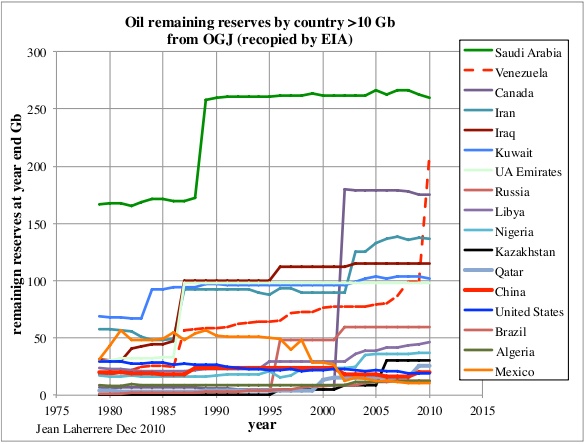
Only So Much Oil
This created an incentive to report more reserves remaining and a disincentive to report any decline in reserves.
Most every one of the OPEC countries doubled their estimate of reserves and have not been claiming any decline in reserves remaining even though they have been pumping for years. As evidenced by this funky looking chart.
Only So Much Oil
Last edited by Cid_Yama on Tue 01 Mar 2011, 00:03:28, edited 1 time in total.
"For my part, whatever anguish of spirit it may cost, I am willing to know the whole truth; to know the worst and provide for it." - Patrick Henry
The level of injustice and wrong you endure is directly determined by how much you quietly submit to. Even to the point of extinction.
The level of injustice and wrong you endure is directly determined by how much you quietly submit to. Even to the point of extinction.
-

Cid_Yama - Light Sweet Crude

- Posts: 7169
- Joined: Sun 27 May 2007, 03:00:00
- Location: The Post Peak Oil Historian
Re: Jim Rogers: Saudi Arabia lying, can't increase productio
by Cid_Yama » Tue 01 Mar 2011, 00:25:56
Everyone has know that they have been lying about their reserves since 1986, but everyone has been willing to go along with the lie, because they want that oil.
Simple as that. Cantarell has now crashed, and the other supergiants are right behind them. And they will continue to report incredible remaining reserves until they crash.
Because of the advanced recovery going on at all of the supergiants, none of them will slow decline, they will all crash like Cantarell.
Simple as that. Cantarell has now crashed, and the other supergiants are right behind them. And they will continue to report incredible remaining reserves until they crash.
Because of the advanced recovery going on at all of the supergiants, none of them will slow decline, they will all crash like Cantarell.
"For my part, whatever anguish of spirit it may cost, I am willing to know the whole truth; to know the worst and provide for it." - Patrick Henry
The level of injustice and wrong you endure is directly determined by how much you quietly submit to. Even to the point of extinction.
The level of injustice and wrong you endure is directly determined by how much you quietly submit to. Even to the point of extinction.
-
Cid_Yama - Light Sweet Crude
- Posts: 7169
- Joined: Sun 27 May 2007, 03:00:00
- Location: The Post Peak Oil Historian
Re: Jim Rogers: Saudi Arabia lying, can't increase productio
by Cid_Yama » Tue 01 Mar 2011, 00:40:42
Canada's jump on the chart after 2000 is the oil sands. Which shows we are even cheating in our reporting, by including unconventional oil.
We don't want to admit it. So we lie even to ourselves.
This is evidenced by the repeated reports of Oil Shale reserves on this website, which isn't even oil but Kerogen. It can be turned into a synthetic oil at great expense and low EROEI, but it isn't oil.
We don't want to admit it. So we lie even to ourselves.
This is evidenced by the repeated reports of Oil Shale reserves on this website, which isn't even oil but Kerogen. It can be turned into a synthetic oil at great expense and low EROEI, but it isn't oil.
"For my part, whatever anguish of spirit it may cost, I am willing to know the whole truth; to know the worst and provide for it." - Patrick Henry
The level of injustice and wrong you endure is directly determined by how much you quietly submit to. Even to the point of extinction.
The level of injustice and wrong you endure is directly determined by how much you quietly submit to. Even to the point of extinction.
-
Cid_Yama - Light Sweet Crude
- Posts: 7169
- Joined: Sun 27 May 2007, 03:00:00
- Location: The Post Peak Oil Historian
Re: Jim Rogers: Saudi Arabia lying, can't increase productio
by Daniel_Plainview » Tue 01 Mar 2011, 00:45:30
$this->bbcode_second_pass_quote('Sixstrings', '')$this->bbcode_second_pass_quote('', 'J')im Rogers joins Zero Hedge in being highly skeptical about just how credible Saudi's call for a 1MM + boost in its oil supply is
Is this 1MM+ increase light/sweet crude or heavy/sour crude? I have no doubt that KSA could boost its heavy sour production by 1MM ...
-

Daniel_Plainview - Prognosticator

- Posts: 4220
- Joined: Tue 06 May 2008, 03:00:00
- Location: 7035 Hollis ... Near the Observatory ... Just down the way, tucked back in the small woods