PeakOil is You
Club of Rome
Club of Rome
 by MJ » Thu 31 Mar 2005, 09:04:20
Does anyone have a link to a full transcript of "Limits to growth" by the Club of Rome?
-

MJ - Peat

- Posts: 77
- Joined: Thu 17 Feb 2005, 04:00:00
- Location: Belgium
by clv101 » Thu 31 Mar 2005, 09:23:29
It's a book, published 1972. A full transcript would be a breach of copyright.
Amazon.com
Amazon.co.uk
Amazon.com
Amazon.co.uk
"Everything is proceeding as I have foreseen." The Emperor (Return of the Jedi)
The Oil Drum: Europe
The Oil Drum: Europe
-

clv101 - Heavy Crude

- Posts: 1050
- Joined: Wed 02 Jun 2004, 03:00:00
- Location: Bristol, UK

Club of Rome got it wrong
by roccman » Tue 29 May 2007, 20:49:28
Hmmmmmmmm...kinda makes you wonder where some people go to school...or maybe that in fact was Ian's issue.
http://www.huffingtonpost.com/ian-welsh ... 49539.html
"Needless to say, we haven't run out of the resources that Limits to Growth expected us to run out of, though with the rise of Peak Oil and such, the triumphalism of the late nineties, where practically every commodity's price was at generational lows, is not quite so sharp. Nonetheless, it's certainly the case that the Club of Rome got it wrong - at least in terms of timetable, and perhaps overall. It's worth, in this time of the resurgence of environmentalism, and the basic argument that there are limits to growth "the rest of the world can't have a Western style of life", to walk back and examine why the Club of Rome got it wrong"
BIG SNIP
"We could try and find, in other words, efficiencies and substitutions The original "Limits to Growth" was wrong because it didn't take substitutions, efficiencies and technological growth into consideration - if we want the current limits to be mitigated we have to work those three things -- efficiencies, substitutions and technological advance, as hard as we can."
You can post a comment on Ian's blog if you feel so compelled.
http://www.huffingtonpost.com/ian-welsh ... 49539.html
"Needless to say, we haven't run out of the resources that Limits to Growth expected us to run out of, though with the rise of Peak Oil and such, the triumphalism of the late nineties, where practically every commodity's price was at generational lows, is not quite so sharp. Nonetheless, it's certainly the case that the Club of Rome got it wrong - at least in terms of timetable, and perhaps overall. It's worth, in this time of the resurgence of environmentalism, and the basic argument that there are limits to growth "the rest of the world can't have a Western style of life", to walk back and examine why the Club of Rome got it wrong"
BIG SNIP
"We could try and find, in other words, efficiencies and substitutions The original "Limits to Growth" was wrong because it didn't take substitutions, efficiencies and technological growth into consideration - if we want the current limits to be mitigated we have to work those three things -- efficiencies, substitutions and technological advance, as hard as we can."
You can post a comment on Ian's blog if you feel so compelled.
-

roccman - Light Sweet Crude

- Posts: 4065
- Joined: Fri 27 Apr 2007, 03:00:00
- Location: The Great Sonoran Desert
Re: Club of Rome got it wrong
by Plantagenet » Tue 29 May 2007, 20:55:13
If you want to know how and why the Club of Rome got it wrong, start with the critiques of Julian Simon.
Never underestimate the ability of Joe Biden to f#@% things up---Barack Obama
-----------------------------------------------------------
Keep running between the raindrops.
-----------------------------------------------------------
Keep running between the raindrops.
-

Plantagenet - Expert

- Posts: 26765
- Joined: Mon 09 Apr 2007, 03:00:00
- Location: Alaska (its much bigger than Texas).
Re: Club of Rome got it wrong
by CrudeAwakening » Tue 29 May 2007, 21:19:49
Ah, yes, Julian Simon, responsible for such timeless quotes as:
$this->bbcode_second_pass_quote('Julian Simon', 'O')ur supplies of natural resources are not finite in any economic sense. Nor does past experience give reason to expect natural resources to become more scarce. Rather, if history is any guide, natural resources will progressively become less costly, hence less scarce, and will constitute a smaller proportion of our expenses in future years.
$this->bbcode_second_pass_quote('Julian Simon', 'O')ur supplies of natural resources are not finite in any economic sense. Nor does past experience give reason to expect natural resources to become more scarce. Rather, if history is any guide, natural resources will progressively become less costly, hence less scarce, and will constitute a smaller proportion of our expenses in future years.
It's just a shame he died before he could witness his ludicrous remarks put to rest.
-

CrudeAwakening - Tar Sands

- Posts: 834
- Joined: Tue 28 Jun 2005, 03:00:00
Re: Club of Rome got it wrong
by Plantagenet » Thu 31 May 2007, 13:14:21
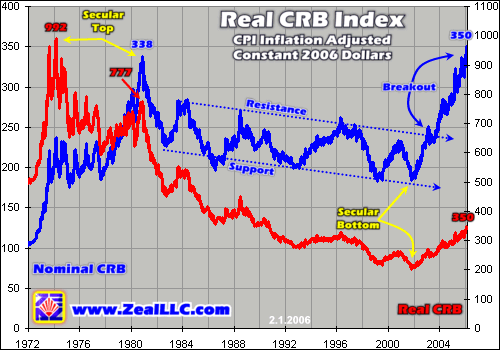
The Club of Rome was ludicrously wrong in their predictions of an imminent collapse of civilization in the 70-80s due to a global shortage of raw materials.
Simon explained where they went wrong. Simon engaged in a famous bet with Paul Ehrlich over the cost of a basket of such commodities projected into the future, and was proven right over the time frame of the bet.
Oil is by far the most important global raw material and commodity, and its price followed Simon's model quite well up to 2005-6, when we reached Peak Oil. The current high prices of oil reflect supply shortages caused by Peak Oil. Simon predicted that when commodity shortages occur, the commodity is replaced by something else. He would therefore predict that as oil prices go even higher, oil will be replaced by other alternative energy sources, which will ultimately produce even lower priced energy then oil.
Simon explained where they went wrong. Simon engaged in a famous bet with Paul Ehrlich over the cost of a basket of such commodities projected into the future, and was proven right over the time frame of the bet.
Oil is by far the most important global raw material and commodity, and its price followed Simon's model quite well up to 2005-6, when we reached Peak Oil. The current high prices of oil reflect supply shortages caused by Peak Oil. Simon predicted that when commodity shortages occur, the commodity is replaced by something else. He would therefore predict that as oil prices go even higher, oil will be replaced by other alternative energy sources, which will ultimately produce even lower priced energy then oil.
Never underestimate the ability of Joe Biden to f#@% things up---Barack Obama
-----------------------------------------------------------
Keep running between the raindrops.
-----------------------------------------------------------
Keep running between the raindrops.
-
Plantagenet - Expert
- Posts: 26765
- Joined: Mon 09 Apr 2007, 03:00:00
- Location: Alaska (its much bigger than Texas).
Re: Club of Rome got it wrong
by MonteQuest » Thu 31 May 2007, 23:47:59
Give me a break. One of the most persistent myths is that The Limits to Growth was a gloom and doom book that predicted that we would run out of resources in a few years.
They did not.
They actually concluded:
$this->bbcode_second_pass_quote('', 'I')t is possible to alter these growth trends and to establish a condition of ecological and economic stability that is sustainable far into the future. The state of global equilibrium could be designed so that basic material needs of each person on earth are satisfied and each person has an equal opportunity to realize his or her individual human potential.
They did not.
They actually concluded:
$this->bbcode_second_pass_quote('', 'I')t is possible to alter these growth trends and to establish a condition of ecological and economic stability that is sustainable far into the future. The state of global equilibrium could be designed so that basic material needs of each person on earth are satisfied and each person has an equal opportunity to realize his or her individual human potential.
A Saudi saying, "My father rode a camel. I drive a car. My son flies a jet-plane. His son will ride a camel."
-

MonteQuest - Expert
- Posts: 16593
- Joined: Mon 06 Sep 2004, 03:00:00
- Location: Westboro, MO
Re: Club of Rome got it wrong
by MonteQuest » Thu 31 May 2007, 23:57:00
$this->bbcode_second_pass_quote('Plantagenet', 'T')he Club of Rome was ludicrously wrong in their predictions of an imminent collapse of civilization in the 70-80s due to a global shortage of raw materials.
Have you read the book? Their conclusions seemed to indicate that the world would run out of many resources by the year 2000. Sadly, many misread the book, which only claimed the resources known then would run out by now. This was based upon computer simulations projecting growth with known resources.
A Saudi saying, "My father rode a camel. I drive a car. My son flies a jet-plane. His son will ride a camel."
-
MonteQuest - Expert
- Posts: 16593
- Joined: Mon 06 Sep 2004, 03:00:00
- Location: Westboro, MO
Re: Club of Rome got it wrong
by threadbear » Fri 01 Jun 2007, 00:23:27
$this->bbcode_second_pass_quote('Plantagenet', 'I')f you want to know how and why the Club of Rome got it wrong, start with the critiques of Julian Simon.
I would say the Club of Rome has clearly been vindicated by recent events. Anyone who would argue with Malthus, at this point, should have their heads examined.
-

threadbear - Expert
- Posts: 7577
- Joined: Sat 22 Jan 2005, 04:00:00