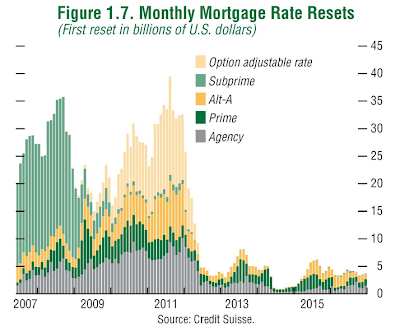
by TWilliam » Sun 28 Sep 2008, 23:15:16
$this->bbcode_second_pass_quote('Micki', 't')he sub-primes just tipped the trailer, they were of course not responsible for this mess by themselves.
Also, the effect of the resets takes x number of months to filter through because they defaults don't happen straight away and even if they do I am sure the process for the bank to foreclose takes some months.
Yep. Like I said, what we're seeing now is just the start of what was triggered early in 2007. Wait until the impact of this last 9 months hits the financial markets next summer...
$this->bbcode_second_pass_quote('', 'I')f unemployment figures take off you will also see a lot more foreclosures among the other mortgage categories.
If? What's this 'if'? It's already happening. What was it HP announced recently? 25,000? That's not exactly a 'minor restructuring'. I'm also noticing a growing number of vacant, recently occupied retail spaces in my area...
$this->bbcode_second_pass_quote('', 'N')ot sure exactly what the "option adjustable rate" means, but at first glance it suggests to me that if the fed wants to keep the wheels on, rates need to be low going into 2011.
Option ARMs:$this->bbcode_second_pass_quote('', 'A')n "option ARM" is typically a 30-year A[djustable]R[ate]M[ortgage] that initially offers the borrower four monthly payment options: a specified minimum payment, an interest-only payment, a 15-year fully amortizing payment, and a 30-year fully amortizing payment.
These types of loans are also called "pick-a-payment" or "pay-option" ARMs.
When a borrower makes a Pay-Option ARM payment that is less than the accruing interest, so-called "negative amortization" will occur, which means that the unpaid portion of the accruing interest is added to the outstanding principal balance. For example, if the borrower makes a minimum payment of $1,000 and the ARM has accrued monthly interest in arrears of $1,500, $500 will be added to the borrower's loan balance. Moreover, the next month's interest-only payment will be calculated using the new, higher principal balance.
Option ARMs are popular because they are usually offered with a very low teaser rate (often as low as 1%) which translates into very low minimum payments for the first year of the ARM. During boom times, lenders often underwrite borrowers based on mortgage payments that are below the fully amortizing payment level. This enables borrowers to qualify for a much larger loan (i.e., take on more debt) than would otherwise be possible. When evaluating an Option ARM, prudent borrowers will not focus on the teaser rate or initial payment level, but will consider the characteristics of the index, the size of the "mortgage margin" that is added to the index value, and the other terms of the ARM. Specifically, they need to consider the possibilities that (1) long-term interest rates go up; (2) their home may not appreciate or may even lose value or even (3) that both risks may materialize.
Option ARMs are best suited to sophisticated borrowers with growing incomes, particularly if their incomes fluctuate seasonally and they need the payment flexibility that such an ARM may provide. Sophisticated borrowers will carefully manage the level of negative amortization that they allow to accrue.
In this way, a borrower can control the main risk of an Option ARM, which is "payment shock", when the negative amortization and other features of this product can trigger substantial payment increases in short periods of time.[5]
For example, the minimum payment on an Option ARM can jump dramatically if its unpaid principal balance hits the maximum limit on negative amortization (typically 110% to 125% of the original loan amount). If that happens, the next minimum monthly payment will be at a level that would fully amortize the ARM over its remaining term. In addition,
Option ARMs typically have automatic "recast" dates (often every fifth year) when the payment is adjusted to get the ARM back on pace to amortize the ARM in full over its remaining term.For example, a $200,000 ARM with a 110% "neg am" cap will typically adjust to a fully amortizing payment, based on the current fully-indexed interest rate and the remaining term of the loan, if negative amortization causes the loan balance to exceed $220,000. For a 125% recast, this will happen if the loan balance reaches $250,000.
Any loan that is allowed to generate negative amortization means that the borrower is reducing his equity in his home, which increases the chance that he won't be able to sell it for enough to repay the loan. Declining property values would exacerbate this risk.
I highlighted above two key elements relevant to why the O-ARM resets will likely be a problem, especially for borrowers who went for the 'interest only' initial option. The reset bumps the payment to get it back in line with what will be needed to fully amortize the loan over its remaining lifetime. The indices to which ARM rates are typically tied, frequently the LIBOR or the 1-year CMT, were at an 11-year low in 2003, which is when a large number of these loans began to appear. They have generally been trending upward since then, which means that many of these loans have likely entered negative amortization, which will mean the loan principle will be even larger when the reset occurs, thus making the payment jump that much more. Couple that with the declining market making it difficult, if not impossible, to sell for enough to cover the outstanding balance, and you can see the problem...